Circular motion (A-level only)
Welcome to circular motion! Until now, you have mostly studied objects moving in straight lines. However, the universe is full of things moving in circles: planets orbiting stars, cars going around roundabouts, and electrons in particle accelerators.
Here is what you will learn in this topic:
- How to measure angles in radians and calculate angular speed.
- Why an object moving in a circle at a constant speed is actually accelerating.
- How to calculate centripetal acceleration and centripetal force.
Measuring angles: The Radian
Before we can track objects spinning in circles, we need a better way to measure angles than degrees. In A-Level Physics, we use radians.
Radian
A radian (rad\text{rad}rad) is the angle subtended at the centre of a circle by an arc whose length is equal to the radius of the circle.
Because the total circumference of a circle is 2πr2\pi r2πr, there are exactly 2π2\pi2π radians in a full circle (360∘360^\circ360∘).
To convert degrees to radians, multiply by 2π360\frac{2\pi}{360}3602π (which simplifies to π180\frac{\pi}{180}180π). For example, 90∘90^\circ90∘ is π2 rad\frac{\pi}{2} \text{ rad}2π rad, and 180∘180^\circ180∘ is π rad\pi \text{ rad}π rad.
Calculator mode
When dealing with circular motion (and later, simple harmonic motion), you will often need to calculate sines and cosines of angles given in radians. Make sure your calculator is in radian mode!
Angular Speed
When an object moves in a straight line, we talk about its linear speed vvv (distance divided by time). When an object spins in a circle, it is often more useful to talk about how much angle it covers per second.
Angular Speed
Angular speed (symbol ω\omegaω, the lowercase Greek letter omega) is the rate of change of angle. It is measured in radians per second (rad s−1\text{rad s}^{-1}rad s−1).
If an object completes one full circle, it sweeps through an angle of 2π2\pi2π radians. If it takes a time TTT (the time period) to do this, its angular speed is:
ω=2πT\omega = \frac{2\pi}{T}ω=T2πSince frequency fff (the number of complete revolutions per second) is given by f=1Tf = \frac{1}{T}f=T1, we can also write:
ω=2πf\omega = 2\pi fω=2πfLinking angular speed and linear speed
Imagine two horses on a merry-go-round, one near the centre and one near the outside edge. They both complete one revolution in the same amount of time, so they have the same angular speed, ω\omegaω. However, the horse on the outside travels a much larger distance in that same time, so it has a higher linear speed, vvv.
The linear speed vvv of an object moving in a circle of radius rrr at angular speed ω\omegaω is given by:
v=rωv = r \omegav=rωCalculating speed on a London Eye capsule
A passenger on the London Eye sits in a capsule at a distance of 60 m60 \text{ m}60 m from the central axis. The wheel completes one full rotation every 30 minutes30 \text{ minutes}30 minutes. Calculate the passenger's linear speed in m s−1\text{m s}^{-1}m s−1.
- First, convert the time period TTT into standard SI units (seconds). T=30×60=1800 sT = 30 \times 60 = 1800 \text{ s}T=30×60=1800 s
- Calculate the angular speed ω\omegaω using the time period. ω=2πT=2π1800≈0.00349 rad s−1\omega = \frac{2\pi}{T} = \frac{2\pi}{1800} \approx 0.00349 \text{ rad s}^{-1}ω=T2π=18002π≈0.00349 rad s−1
- Calculate the linear speed vvv using the radius r=60 mr = 60 \text{ m}r=60 m. v=rω=60×0.00349≈0.21 m s−1v = r\omega = 60 \times 0.00349 \approx 0.21 \text{ m s}^{-1}v=rω=60×0.00349≈0.21 m s−1
The Centripetal Acceleration Paradox
Here is one of the most important concepts in A-Level Physics: An object moving in a circle at a constant speed is accelerating.
How is this possible? Remember that velocity is a vector—it has both magnitude (speed) and direction. Even if the speed is constant, the direction of the object is constantly changing as it moves around the circle. Because velocity is changing, the object must be accelerating.
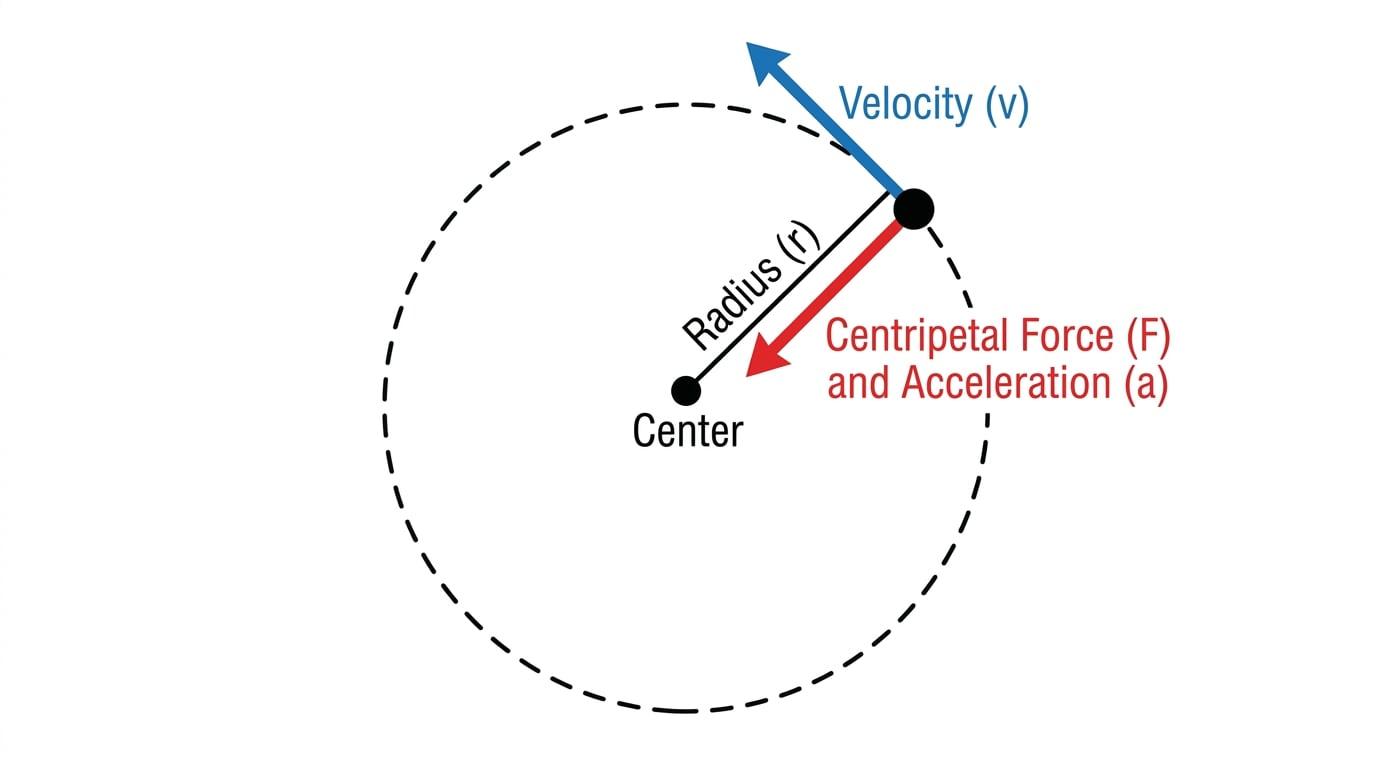
As shown in the diagram, the velocity vector vvv is always tangent to the circular path. The acceleration required to constantly turn the object points directly towards the centre of the circle. We call this centripetal acceleration.
Centripetal Acceleration
Centripetal acceleration is the acceleration of an object moving in a circular path, directed towards the centre of the circle.
The AQA specification does not require you to derive the formulas for centripetal acceleration, but you must know how to use them. The centripetal acceleration aaa can be calculated using either linear speed vvv or angular speed ω\omegaω:
a=v2r=ω2ra = \frac{v^2}{r} = \omega^2 ra=rv2=ω2rCentripetal Force
According to Newton's Second Law (F=maF = maF=ma), if an object is accelerating, there must be a resultant force acting on it in the same direction as the acceleration.
Therefore, for an object to move in a circle, there must be a resultant force acting towards the centre of the circle. We call this the centripetal force.
Substituting our acceleration formulas into F=maF = maF=ma, we get:
F=mv2r=mω2rF = \frac{mv^2}{r} = m \omega^2 rF=rmv2=mω2rCentripetal force is not a new force!
"Centripetal force" is just a label for the resultant force that points towards the centre. It is always provided by an existing physical force (or a combination of forces).
- For a planet orbiting the Sun, gravity provides the centripetal force.
- For a ball whirled on a string, tension provides the centripetal force.
- For a car cornering on a roundabout, friction between the tyres and the road provides the centripetal force.
Centrifugal force
You might have heard of "centrifugal force"—the feeling of being thrown outwards when you spin on a roundabout. In physics, this is a "fictitious" force. You are not actually being pushed outwards; your body's inertia just wants to keep moving in a straight line, while the roundabout pulls you inwards! Always refer to centripetal (centre-seeking) force in your exams.
Let's look at an example estimating forces, which tests your practical maths skills (estimating accelerations and forces).
Estimating forces on a cornering car
A typical family car of mass 1200 kg1200 \text{ kg}1200 kg goes around a flat, circular bend of radius 40 m40 \text{ m}40 m at a constant speed of 15 m s−115 \text{ m s}^{-1}15 m s−1. Calculate the centripetal force required to keep the car in circular motion, and state what provides this force.
- Identify the knowns: m=1200 kgm = 1200 \text{ kg}m=1200 kg, r=40 mr = 40 \text{ m}r=40 m, v=15 m s−1v = 15 \text{ m s}^{-1}v=15 m s−1.
- Select the correct formula for centripetal force using linear speed. F=mv2rF = \frac{mv^2}{r}F=rmv2
- Substitute the values and calculate the force. F=1200×15240F=1200×22540F=6750 N\begin{aligned} F &= \frac{1200 \times 15^2}{40} \\ F &= \frac{1200 \times 225}{40} \\ F &= 6750 \text{ N} \end{aligned}FFF=401200×152=401200×225=6750 N
- State the source of the force: The centripetal force is provided by the friction between the car's tyres and the road surface.
When equations break down
If the car in the example above drove faster, it would require a larger centripetal force (since F∝v2F \propto v^2F∝v2). If the required force exceeds the maximum possible friction the tyres can provide, the car will "break" circular motion and skid outwards in a straight line tangent to the curve.
In the exam
- Check your units: Always ensure mass is in kg\text{kg}kg, distance is in m\text{m}m, and time is in s\text{s}s. Examiners love giving the radius in cm\text{cm}cm or time period in minutes to catch you out.
- Identify the force: If a question asks "what is the tension in the string?", you need to recognise that the tension is the centripetal force, and calculate mv2r\frac{mv^2}{r}rmv2.
- Choose the right formula: You have two options for force: F=mv2rF = \frac{mv^2}{r}F=rmv2 and F=mω2rF = m\omega^2 rF=mω2r. Look at the data given in the question to decide which is quicker to use so you don't waste time converting vvv to ω\omegaω unnecessarily.
- Direction matters: If asked for the direction of the resultant force or acceleration, always state clearly: "Towards the centre of the circle."
Check yourself
- Can you explain why an object moving at a constant speed in a circle is accelerating?
- Do you know the difference between linear speed (vvv) and angular speed (ω\omegaω)?
- If you double the linear speed of an object in a circle (keeping the radius constant), what happens to the centripetal force required?
- Can you name the physical force providing the centripetal force for an electron orbiting a nucleus?