Explaining the fringes (in general terms)
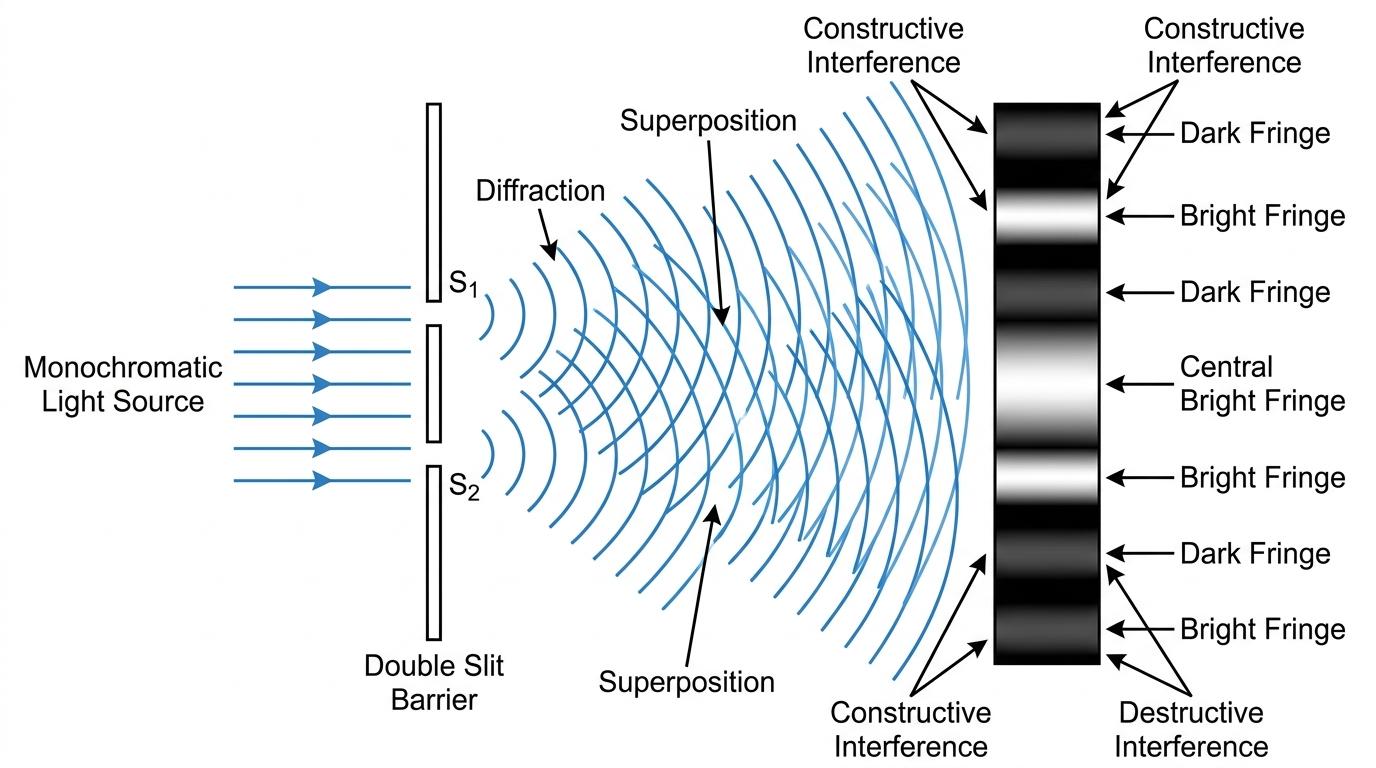
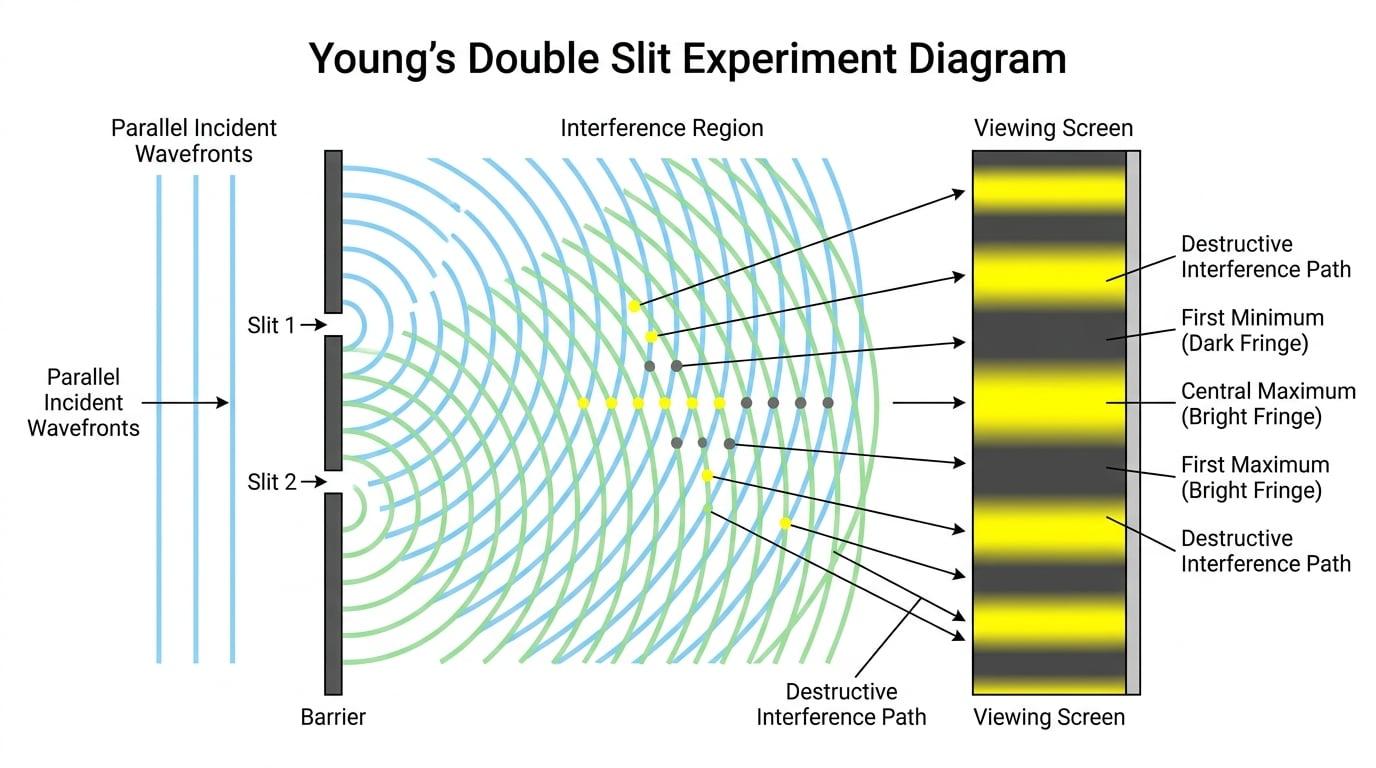
To understand the significance of the experiment, you need to be able to explain how the pattern on the screen is formed using wave theory. Remember, for this specific historical topic, AQA expects a descriptive explanation, not a mathematical calculation.
Here is the step-by-step wave explanation for the fringes:
- Diffraction: As the light passes through the two narrow slits, it diffracts (spreads out).
- Superposition: Because the diffracted waves from the two slits overlap in the space beyond the slits, the principle of superposition applies. The two waves add together.
- Constructive interference: At certain points on the screen, the waves from both slits arrive in phase (a crest meets a crest). The waves interfere constructively, creating a bright fringe. This occurs when the path difference is a whole number of wavelengths (nλn\lambdanλ).
- Destructive interference: At other points, the waves arrive in antiphase (a crest meets a trough). The waves interfere destructively, cancelling each other out to create a dark fringe. This occurs when the path difference is an odd number of half-wavelengths ((n+0.5)λ(n + 0.5)\lambda(n+0.5)λ).
The Core Argument
Young's experiment produced an alternating pattern of bright and dark fringes. The crucial point is the dark fringes. Two sources of light had combined to produce darkness. This is perfectly explained by waves cancelling out (destructive interference), but it is completely impossible to explain using Newton's particles. You cannot add two particles together and get zero particles!
Forgetting the first step
When asked to explain the formation of fringes in an exam, many students jump straight to "interference". Don't forget that the light must first diffract at the slits in order to spread out and overlap! No diffraction = no overlapping = no interference.
The Paradigm Shift
Young's experiment was the ultimate "smoking gun" for wave theory. It provided clear, observable evidence of diffraction and interference—phenomena that are exclusively wave-like.
Even so, the acceptance wasn't completely overnight. It took later mathematical proofs by Augustin-Jean Fresnel and experiments by François Arago to finally lay Newton's corpuscular theory to rest. However, Young's double slit experiment remains the defining moment that shifted the scientific consensus from particles to waves.
(Note: Later in your A-Level, you will learn about the Photoelectric Effect, which proved that light actually behaves as both a particle and a wave. But in the context of the 19th century, wave theory had decisively won this round!)
AQA-Style Descriptive Question
Explain why the scientific community initially rejected Huygens' wave theory of light, and how Young's double slit experiment eventually provided evidence to overturn this rejection. (5 marks)
Step-by-step approach:
- Identify the reasons for initial rejection: State that Newton's corpuscular theory was favored due to Newton's immense reputation and authority in the scientific community.
- Provide the physical reason for rejection: Mention that light was not observed to diffract around everyday objects (it forms sharp shadows) because its wavelength is too short.
- Explain what Young's experiment showed: State that passing light through two narrow slits caused the light to diffract and overlap.
- Explain the interference pattern: Describe how the overlapping waves superposed to create a pattern of alternating bright and dark fringes on a screen.
- State the definitive conclusion: Conclude that dark fringes are caused by destructive interference, which can only be explained if light is a wave (particles cannot cancel each other out).
In the exam
When answering historical context questions on wave-particle duality:
- Always name the specific phenomena that Young's experiment demonstrated: diffraction and interference (specifically, superposition).
- If asked why Newton's theory was preferred, always mention both his personal scientific reputation AND the fact that light travels in straight lines (sharp shadows) with no obvious everyday diffraction.
- Remember that no calculations are required for this specific section of the spec. If a question asks you to "explain the fringes in general terms", use words like path difference, phase, constructive, and destructive, rather than solving w=λDsw = \frac{\lambda D}{s}w=sλD.
Check yourself
- Can you name the two competing historical theories of light and their main proponents?
- Why did Newton's theory initially win out over Huygens' theory?
- What two physical processes must happen to the light in Young's experiment to create the fringe pattern?
- Why does the presence of dark fringes completely disprove the corpuscular theory?