Newton's corpuscular theory of light (A-level only)
What you'll learn
- The basic principles of Newton's corpuscular (particle) theory of light.
- How Huygens' rival wave theory compared to Newton's.
- The key reasons why the scientific community preferred Newton's theory for over 100 years.
The 17th Century Debate: What is light?
Today, we are comfortable with the idea of wave-particle duality—the concept that light can behave as both a wave and a particle depending on the experiment. However, in the late 17th century, physicists demanded a single, definitive answer: is light made of solid particles flying through space, or is it a wave rippling through a medium?
Two brilliant scientists proposed competing theories. Sir Isaac Newton argued that light was a stream of particles. Christiaan Huygens argued it was a wave. To understand the history of physics, we need to look at both theories and understand why Newton initially won the argument.
Newton's Corpuscular Theory
Newton published his views on light in his book Opticks (1704). He proposed that light consists of streams of tiny, invisible particles.
Corpuscle
A "corpuscle" (literally meaning "little body") was Newton's term for a tiny, perfectly elastic particle of light. Newton suggested that luminous objects (like the Sun or a candle) shoot out streams of these corpuscles in straight lines.
Newton used his corpuscles to successfully explain the two main optical phenomena known at the time: reflection and refraction.
Explaining Reflection
Newton argued that corpuscles undergo perfectly elastic collisions with surfaces. Just like a rubber ball bouncing off a wall, a corpuscle bounces off a mirror so that the angle of incidence equals the angle of reflection. Since the corpuscles are perfectly elastic, no kinetic energy is lost.
Explaining Refraction
When light passes from air into a denser medium like glass, it bends towards the normal. Newton explained this using forces. He suggested that the denser medium exerts a localized attractive force on the corpuscles as they approach the boundary.
This attractive force acts perpendicular to the boundary. It increases the corpuscle's perpendicular velocity component (vyv_{\text{y}}vy) while leaving its parallel velocity component (vxv_{\text{x}}vx) unchanged. Because the vertical speed increases, the resultant speed of the corpuscle increases, and its path changes direction, bending towards the normal.
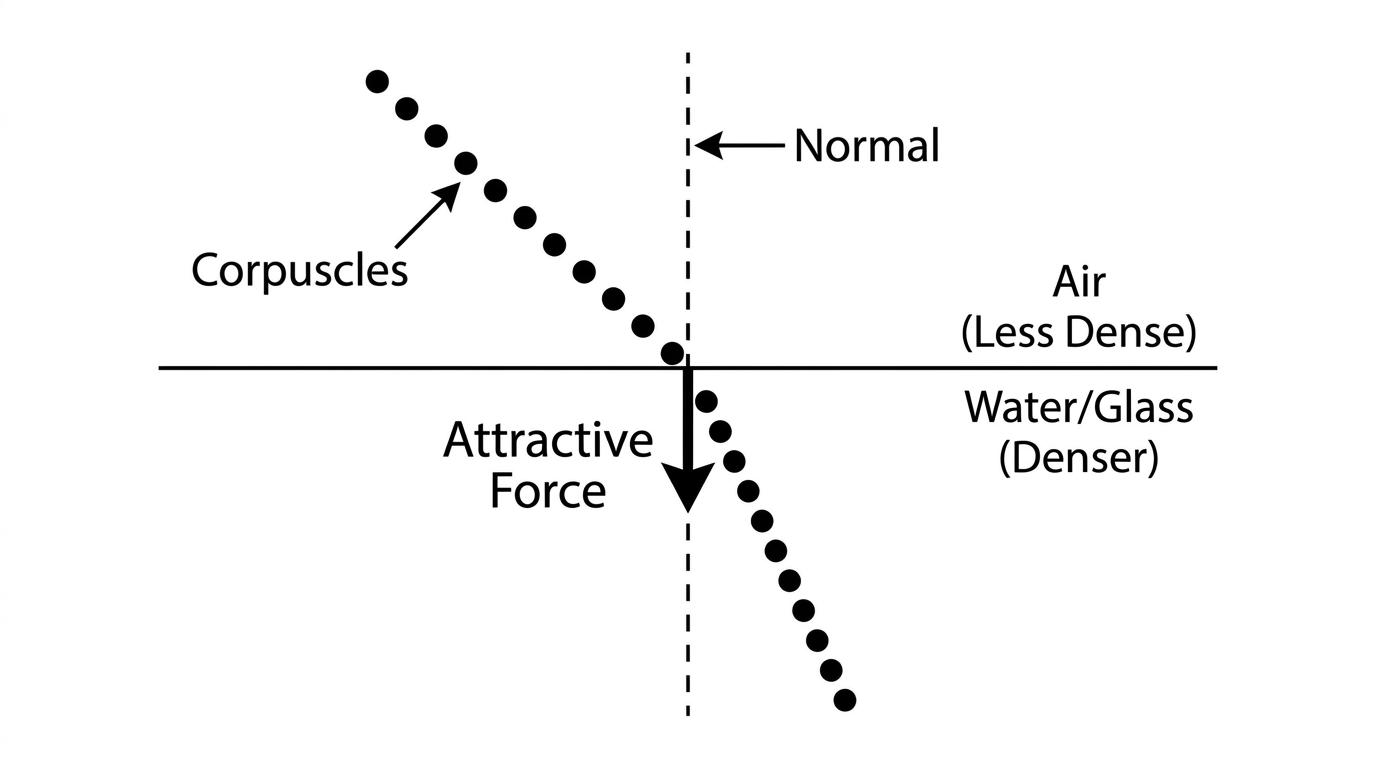
Newton's bold prediction
Because the attractive force accelerates the particles into the denser medium, Newton's theory firmly predicted that light must travel faster in denser media (e.g. faster in water than in air).
Huygens' Wave Theory
Around the same time, Christiaan Huygens proposed a completely different model. He believed light was a longitudinal wave.
To explain how waves propagate, he came up with what we now call Huygens' Principle. He proposed that every point on an advancing wavefront acts as a source of tiny, secondary spherical "wavelets". The new wavefront is simply the tangent to all these secondary wavelets.
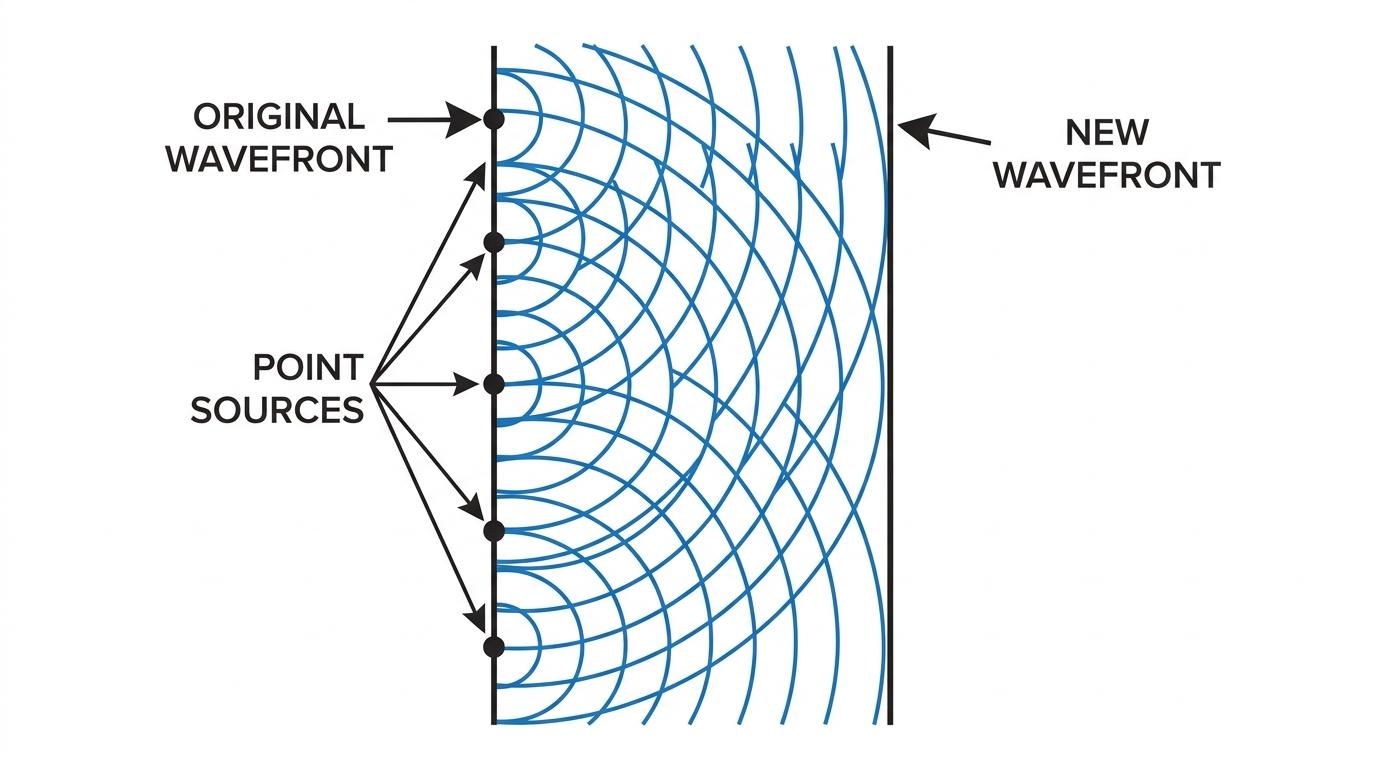
Huygens could also explain reflection and refraction using his wavefronts. However, his explanation for refraction was the exact opposite of Newton's. To make a wavefront bend towards the normal as it enters glass, the part of the wavefront hitting the glass first must slow down. Therefore, Huygens predicted that light must travel slower in denser media.
The Problem of the Aether
In the 17th century, the only waves physicists knew about were mechanical waves (like sound or water waves), which absolutely require a physical medium to travel through. If light was a wave arriving from the Sun, space couldn't be empty.
Huygens proposed that all of space was filled with an invisible, massless, highly elastic medium called the luminiferous aether.
Why Newton's Theory Was Preferred
For over a hundred years, the scientific consensus strongly favoured Newton's corpuscular theory. Huygens' theory was largely rejected. The AQA specification requires you to know exactly why Newton's theory was preferred.
There are four main reasons you can use in an exam:
- Light travels in straight lines (sharp shadows): Everyday experience shows that light casts sharp shadows. Waves (like sound or water ripples) are known to bend around obstacles—a phenomenon called diffraction. Because light was not visibly observed to diffract around everyday objects, physicists felt it behaved much more like a stream of straight-moving particles than a wave.
- Newton's immense reputation: Newton had successfully explained the laws of motion and universal gravitation. He was a giant of science. Huygens, while respected, simply did not have Newton's unmatched authority. Many scientists accepted the corpuscular theory purely on Newton's reputation.
- The implausibility of the aether: Huygens' wave theory required the entire universe to be filled with the "luminiferous aether". For light to travel so quickly, this aether had to be incredibly stiff, yet perfectly transparent and exert zero drag on the planets orbiting the Sun. This seemed physically absurd to many scientists.
- Lack of experimental evidence: To settle the debate over refraction, scientists needed to measure the speed of light in water to see if it sped up (Newton) or slowed down (Huygens). In the 17th and 18th centuries, the technology to measure the speed of light over short distances simply did not exist.
Mentioning the photoelectric effect
When asked why Newton's theory was preferred in the 17th century, students sometimes mistakenly talk about the photoelectric effect. Do not do this. The photoelectric effect was discovered in the late 19th century and explained by Einstein in 190519051905. It has absolutely nothing to do with the historical debate between Newton and Huygens. Stick to sharp shadows, reputation, and the aether.
Worked Example: Comparing the theories
Question: In the late 17th century, Newton and Huygens proposed competing theories for the nature of light. State two general differences between their theories, and explain two reasons why Newton's theory was widely accepted over Huygens' theory. (4 marks)
Answer:
- Difference 1: Newton proposed light consists of discrete particles (corpuscles), whereas Huygens proposed light is a (longitudinal) wave.
- Difference 2: Newton predicted light travels faster in denser media, whereas Huygens predicted light travels slower in denser media.
- Reason for acceptance 1: Newton had a much stronger scientific reputation, so his ideas carried more authority.
- Reason for acceptance 2: Light casts sharp shadows and does not appear to diffract significantly, which is characteristic of particles travelling in straight lines rather than waves bending around obstacles.
The Eventual Downfall
If Newton was wrong, how was his theory eventually overthrown? It took over a century for experimental techniques to catch up:
- In 180118011801, Thomas Young performed his famous double-slit experiment, demonstrating beyond doubt that light undergoes diffraction and interference. These are exclusively wave properties that corpuscles cannot explain.
- In 185018501850, Léon Foucault successfully measured the speed of light in water and found it was slower than in air. This directly contradicted Newton's boldest prediction and proved Huygens right.
Newton's corpuscular theory was finally abandoned, and the wave theory of light became the new accepted scientific truth (until the 20th century threw another spanner in the works with quantum mechanics!).
In the exam
When answering questions on this topic, keep these points in mind:
- Always use the word corpuscles when describing Newton's particles.
- If asked to explain Newton's model of refraction, specifically mention that an attractive force from the denser medium increases the normal component of the particle's velocity.
- Contrast the speed predictions explicitly: Newton = faster in glass, Huygens = slower in glass.
- When listing reasons for Newton's dominance, "Newton's strong reputation" is a perfectly valid and frequently rewarded mark-scheme point.
Check yourself
- Can you define what a corpuscle is in the context of Newton's theory?
- How did Newton explain the bending of light towards the normal during refraction?
- Why did the fact that light casts sharp shadows lead scientists to reject Huygens' wave theory?
- What was the "aether", and why did scientists find it difficult to believe in?