What you'll learn
- Why the First Law of Thermodynamics alone is not enough to explain how engines work.
- The definition of the Second Law of Thermodynamics in terms of heat engines.
- How to calculate the actual efficiency and the maximum theoretical efficiency of an engine.
- Why practical engines fall short of maximum efficiency, and how Combined Heat and Power (CHP) schemes make better use of energy.
Why the First Law isn't enough
The First Law of Thermodynamics is simply the conservation of energy: energy cannot be created or destroyed, only transferred or transformed.
If we applied only the First Law to a machine, it would theoretically be completely fine to build an engine that takes in 1000 joules of heat and turns it into exactly 1000 joules of useful work. Energy is conserved, so the First Law is happy.
However, over centuries of engineering, nobody has ever been able to build an engine that turns 100% of its heat input into work. There is always some "waste" heat left over. This real-world limitation tells us that another fundamental rule is at play: the Second Law of Thermodynamics.
The Second Law and Heat Engines
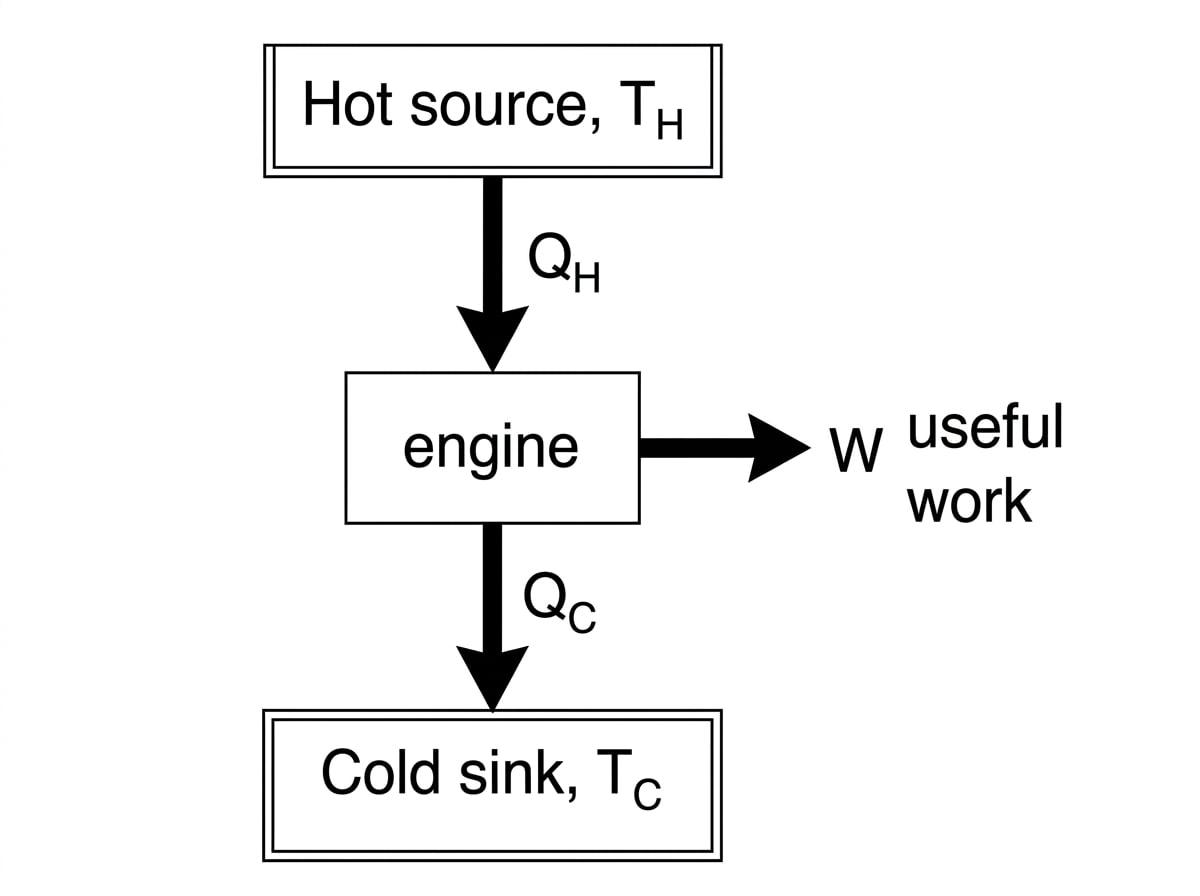
To understand the Second Law, we first need to define the components of a theoretical engine.
Heat Engine Terminology
- Heat engine: A system or device that continuously converts thermal energy into useful mechanical work.
- Source: A high-temperature thermal reservoir that supplies heat to the engine. Its temperature is THT_HTH.
- Sink: A low-temperature thermal reservoir that absorbs waste heat from the engine. Its temperature is TCT_CTC.
The Second Law of Thermodynamics dictates that heat will naturally flow from hot to cold, never the reverse without external work. Because of this, an engine can only extract work from the flow of heat between two regions of different temperatures.
The Second Law (Heat Engine Statement)
It is impossible for a heat engine to operate using only the First Law. A heat engine must operate between a hot source and a cold sink. It must absorb heat from the source, do some work, and reject the remaining heat to the sink.
This means an engine with 100% efficiency is physically impossible. You must always throw some heat away to the cold sink.
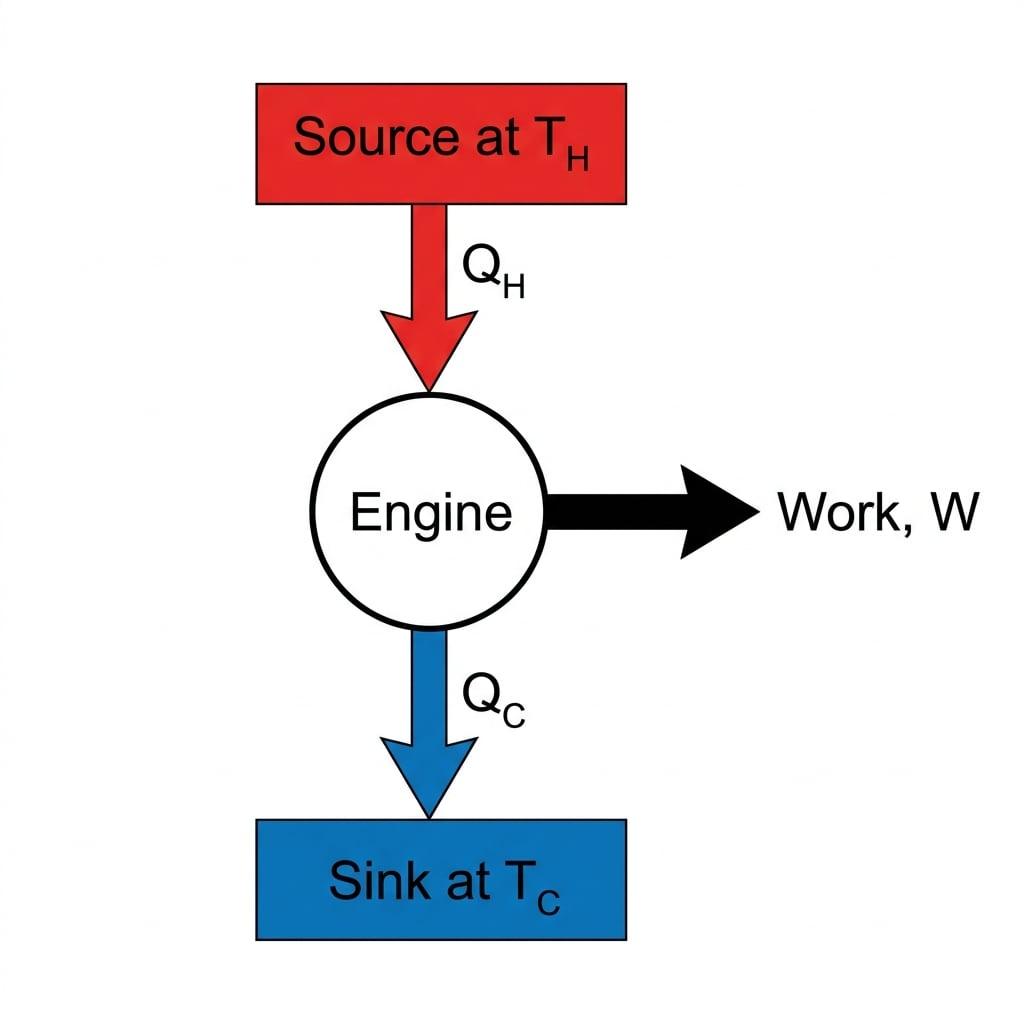
In the diagram above:
- QHQ_HQH is the heat energy transferred into the engine from the source.
- WWW is the useful mechanical work done by the engine.
- QCQ_CQC is the waste heat energy rejected from the engine to the sink.
Because energy must still be conserved (the First Law still applies!), the total energy entering the engine must equal the total energy leaving it:
QH=W+QC Q_H = W + Q_C QH=W+QCRearranging this gives us the work done:
W=QH−QC W = Q_H - Q_C W=QH−QCCalculating Engine Efficiency
The efficiency of any system is the useful output divided by the total input. For a heat engine, the useful output is the work WWW, and the energy we had to "pay for" is the heat from the hot source QHQ_HQH.
efficiency=WQH \text{efficiency} = \frac{W}{Q_H} efficiency=QHWBy substituting W=QH−QCW = Q_H - Q_CW=QH−QC into the equation, we can also write it purely in terms of the heat transfers:
efficiency=QH−QCQH \text{efficiency} = \frac{Q_H - Q_C}{Q_H} efficiency=QHQH−QC(Note: Efficiency is a ratio and has no units. It can be expressed as a decimal or multiplied by 100 to give a percentage).
Calculating actual efficiency
A car engine takes in 2500 joules of heat energy from the combustion of petrol during one cycle. It exhausts 1800 joules of heat to the surroundings. Calculate the mechanical work done by the engine and its thermal efficiency.
- Use the First Law conservation equation to find the work done: W=QH−QCW = Q_H - Q_CW=QH−QC.
- Substitute the known values: W=2500−1800=700 JW = 2500 - 1800 = 700 \text{ J}W=2500−1800=700 J.
- State the efficiency formula: efficiency=WQH\text{efficiency} = \frac{W}{Q_H}efficiency=QHW.
- Substitute the work and the input heat: efficiency=7002500\text{efficiency} = \frac{700}{2500}efficiency=2500700.
- Calculate the final answer: efficiency=0.28\text{efficiency} = 0.28efficiency=0.28 (or 28%28\%28%).
Using the wrong heat value
Students often accidentally divide the work by the net heat difference or the waste heat. Always remember: efficiency is what you get out (WWW) divided by the total energy you put in from the source (QHQ_HQH).
Maximum Theoretical Efficiency
In the 19th century, Sadi Carnot proved that even a perfectly frictionless, ideal engine has a strict efficiency limit. This maximum limit depends entirely on the absolute temperatures of the hot source and the cold sink.
maximum theoretical efficiency=TH−TCTH \text{maximum theoretical efficiency} = \frac{T_H - T_C}{T_H} maximum theoretical efficiency=THTH−TCThis is often called the Carnot efficiency. It represents the absolute best-case scenario for an engine operating between those two temperatures. No real engine can ever exceed, or even perfectly reach, this value.
To increase the maximum theoretical efficiency, you must either:
- Increase the temperature of the hot source (THT_HTH).
- Decrease the temperature of the cold sink (TCT_CTC).
Absolute Temperatures Only!
When using the maximum theoretical efficiency formula, THT_HTH and TCT_CTC must be in Kelvin (K\text{K}K). If a question gives you temperatures in degrees Celsius, you must add 273 to convert them to Kelvin before doing any calculations!
Calculating maximum theoretical efficiency
A steam turbine operates between a high-temperature boiler at 500 ∘C500 \text{ }^\circ\text{C}500 ∘C and a river used as a cooling sink at 15 ∘C15 \text{ }^\circ\text{C}15 ∘C. Calculate the maximum theoretical efficiency of this turbine.
- Convert both temperatures to Kelvin by adding 273.
- Source temperature: TH=500+273=773 KT_H = 500 + 273 = 773 \text{ K}TH=500+273=773 K.
- Sink temperature: TC=15+273=288 KT_C = 15 + 273 = 288 \text{ K}TC=15+273=288 K.
- Write down the maximum theoretical efficiency formula: efficiency=TH−TCTH\text{efficiency} = \frac{T_H - T_C}{T_H}efficiency=THTH−TC.
- Substitute the Kelvin values: efficiency=773−288773\text{efficiency} = \frac{773 - 288}{773}efficiency=773773−288.
- Calculate the result: efficiency=485773≈0.627\text{efficiency} = \frac{485}{773} \approx 0.627efficiency=773485≈0.627 (or 62.7%62.7\%62.7%).
Real Engines and CHP Schemes
In the previous example, the absolute best the turbine could do was about 63%63\%63%. In reality, the actual efficiency of that turbine would likely be closer to 40%40\%40%.
Why do practical engines have much lower efficiencies than the theoretical maximum?
- Friction: Moving parts (like pistons and bearings) rub against each other, converting some useful work back into unrecoverable heat.
- Heat losses: Heat escapes through the engine casing to the surroundings before it can be used to do work.
- Non-ideal processes: The Carnot formula assumes the engine cycle happens infinitely slowly and reversibly, which is impossible in a machine designed to deliver power quickly.
Combined Heat and Power (CHP)
We know from the Second Law that we must reject heat (QCQ_CQC) to a cold sink. Usually, this heat is just dumped into the atmosphere or a nearby river—it is completely wasted.
We can maximise our use of the energy by capturing this waste heat. In a Combined Heat and Power (CHP) scheme, a power plant generates electricity (the work, WWW), but instead of venting the waste heat (QCQ_CQC) from the steam, it pipes that hot water into local homes, hospitals, or factories to provide central heating.
The Benefit of CHP
A CHP scheme does not break the Second Law, and it doesn't make the engine itself more efficient at generating electricity. Instead, it captures the unavoidable waste heat (QCQ_CQC) and uses it for heating. This significantly increases the overall efficiency of how we use the fuel.
In the exam
- Always check your temperature units. The very first thing you should do if you see degrees Celsius in an engine question is write down the conversion to Kelvin.
- Watch your prefixes. Heat energies (QHQ_HQH, QCQ_CQC) and work (WWW) are often given in kilojoules (kJ\text{kJ}kJ) or megajoules (MJ\text{MJ}MJ). Make sure your units match when subtracting them.
- Be ready to compare. A classic 3-mark question asks you to calculate the actual efficiency, then the theoretical maximum efficiency, and finally suggest one practical reason why the actual value is lower. Have "friction in moving parts" or "heat loss to the surroundings" ready as your go-to answers.
Check yourself
- Why is it impossible for a heat engine to convert 100% of its thermal energy input into mechanical work?
- If a heat engine is rejecting less heat to the cold sink while the input heat remains constant, what is happening to the work done and the efficiency?
- What are the required temperature units for calculating maximum theoretical efficiency, and how do you convert to them?
- How does a Combined Heat and Power (CHP) plant make better use of fuel compared to a standard power station?