Reversed heat engines (A-level only)
What you'll learn
- The difference between a standard heat engine and a reversed heat engine.
- Why refrigerators and heat pumps are fundamentally the same machine with different purposes.
- How to calculate the Coefficient of Performance (COP) for both devices.
- How to use Kelvin temperatures to find the theoretical maximum COP of a system.
Running an engine backwards
By naturally occurring thermodynamic rules, thermal energy always flows from a hotter region to a colder region. A standard heat engine exploits this natural flow: as heat drops from hot to cold, the engine taps into it to extract useful work.
But what if we want to move heat the other way—from a cold space to a hot space?
Reversed heat engine
A reversed heat engine is a device that requires an input of work to transfer thermal energy from a colder space to a hotter space.
Pumping water uphill
A standard heat engine is like a water wheel placed in a waterfall: water naturally falls downhill, and the wheel extracts useful work.
A reversed heat engine is like a water pump: water will not naturally flow uphill, so you must input work (turn the pump) to force the water from the lower reservoir up to the higher one.
Here is the block diagram of a reversed heat engine. Notice the direction of the arrows compared to a standard heat engine:
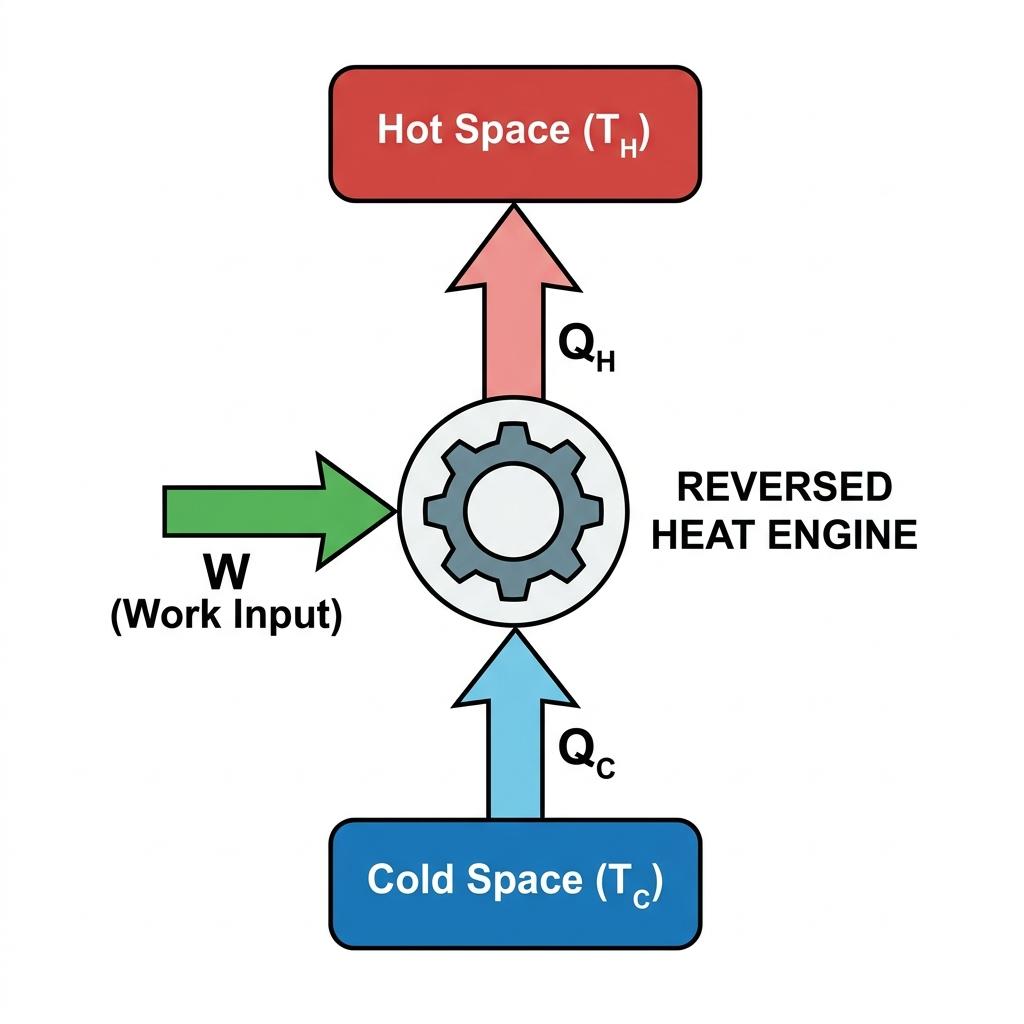
The First Law of Thermodynamics
Because energy must be conserved, the thermal energy delivered to the hot space (QHQ_HQH) is the sum of the thermal energy extracted from the cold space (QCQ_CQC) plus the work put into the system (WWW):
QH=QC+W Q_H = Q_C + W QH=QC+WRearranging this, the work input required is:
W=QH−QC W = Q_H - Q_C W=QH−QCRefrigerators vs. Heat Pumps
Practically, reversed heat engines are everywhere. They are used in domestic fridges, freezers, air conditioners, and home heat pump systems.
The physical mechanism for all of them is identical (usually a cycle of expanding and compressing a refrigerant gas). The only difference between a refrigerator and a heat pump is what you are trying to achieve.
Purpose dictates the name
- Refrigerator / Air Conditioner: Your goal is to cool down the cold space. You care about how much heat you can remove (QCQ_CQC). The heat dumped into the hot room (QHQ_HQH) is just a waste by-product.
- Heat Pump: Your goal is to heat up the hot space. You care about how much heat you can deliver to the room (QHQ_HQH). The heat extracted from the cold outdoors (QCQ_CQC) is just where the energy was sourced.
Coefficient of Performance (COP)
For standard heat engines, we measure performance using "efficiency," which can never exceed 111 (or 100%100\%100%).
For reversed heat engines, we use the Coefficient of Performance (COP). Because a reversed engine moves heat rather than creating it from scratch, it can often transfer far more thermal energy than the electrical work put into it. Therefore, COP is frequently much greater than 1.
The general logic for any performance metric is:
Performance=What you wantWhat you pay for (work input) \text{Performance} = \frac{\text{What you want}}{\text{What you pay for (work input)}} Performance=What you pay for (work input)What you wantCOP of a Refrigerator
For a refrigerator, "what you want" is the heat extracted from the cold space, QCQ_CQC. "What you pay for" is the work input, WWW.
COPref=QCW COP_{\text{ref}} = \frac{Q_C}{W} COPref=WQCBecause W=QH−QCW = Q_H - Q_CW=QH−QC, we can also write this as:
COPref=QCQH−QC COP_{\text{ref}} = \frac{Q_C}{Q_H - Q_C} COPref=QH−QCQCIf the refrigerator operates flawlessly as a theoretically perfect (Carnot) cycle, we can swap the heat transfers for their absolute temperatures in Kelvin to find the theoretical maximum COP:
COPref (max)=TCTH−TC COP_{\text{ref (max)}} = \frac{T_C}{T_H - T_C} COPref (max)=TH−TCTCPower instead of Energy
In exam questions, you are often given the rate of energy transfer (Power) instead of total energy. Because Power is just Energy per second (P=Q/tP = Q/tP=Q/t), you can safely use power values in the COP equation: COP=Pcooling/PelectricalCOP = P_{\text{cooling}} / P_{\text{electrical}}COP=Pcooling/Pelectrical.
Calculating Refrigerator COP
A domestic refrigerator maintains an internal temperature of 4 ∘C4~^\circ\text{C}4 ∘C in a kitchen that is at 22 ∘C22~^\circ\text{C}22 ∘C. The compressor requires 45 W45\text{ W}45 W of electrical power.
Calculate the theoretical maximum coefficient of performance, and use it to find the maximum possible rate at which heat can be extracted from the inside of the fridge.
- Convert all temperatures from Celsius to Kelvin.
- Apply the theoretical maximum formula for a refrigerator.
- Use the general COP formula to find the maximum cooling power (rate of heat extraction). Here, WWW is the electrical power input (45 W45\text{ W}45 W).
COP of a Heat Pump
For a heat pump, "what you want" is the heat delivered to the hot space, QHQ_HQH. "What you pay for" is still the work input, WWW.
COPhp=QHW COP_{\text{hp}} = \frac{Q_H}{W} COPhp=WQHSubstitute W=QH−QCW = Q_H - Q_CW=QH−QC to get:
COPhp=QHQH−QC COP_{\text{hp}} = \frac{Q_H}{Q_H - Q_C} COPhp=QH−QCQHAnd the theoretical maximum (Carnot) coefficient of performance is:
COPhp (max)=THTH−TC COP_{\text{hp (max)}} = \frac{T_H}{T_H - T_C} COPhp (max)=TH−TCTHUsing the wrong numerator
A very common mistake is using TCT_CTC on the top of the fraction when calculating the COP for a heat pump. Always remember: Heat pumps want Hot (THT_HTH on top). Refrigerators want Cold (TCT_CTC on top).
Real vs Theoretical Heat Pump
A ground source heat pump is used to heat a house to 20 ∘C20~^\circ\text{C}20 ∘C by extracting thermal energy from the ground outside, which is at 5 ∘C5~^\circ\text{C}5 ∘C. The electrical power input to the heat pump is 2.5 kW2.5\text{ kW}2.5 kW, and it delivers heat to the house at a steady rate of 9.0 kW9.0\text{ kW}9.0 kW.
Determine the actual COP of the heat pump and compare it to the theoretical maximum COP.
- Calculate the actual COP using the real power values. The heat delivered (QHQ_HQH per second) is 9.0 kW9.0\text{ kW}9.0 kW, and the work input (WWW per second) is 2.5 kW2.5\text{ kW}2.5 kW.
- Convert temperatures to Kelvin to find the theoretical maximum.
- Calculate the theoretical maximum COP for a heat pump.
- Conclude your comparison. The actual COP (3.63.63.6) is much lower than the theoretical maximum (19.519.519.5). This is due to energy losses, friction in the compressor, and the fact that real heat pump cycles are not perfectly reversible Carnot cycles.
Watch out for 'Work Done' vs 'Heat Transfer'
If an exam question tells you a heat pump "extracts 500 J500\text{ J}500 J of heat from the outdoors and uses 200 J200\text{ J}200 J of work", you cannot just do 500/200500 / 200500/200.
The 500 J500\text{ J}500 J is QCQ_CQC, but a heat pump COP requires QHQ_HQH. You must first calculate QH=QC+W=500+200=700 JQ_H = Q_C + W = 500 + 200 = 700\text{ J}QH=QC+W=500+200=700 J, and then calculate COP=700/200=3.5COP = 700 / 200 = 3.5COP=700/200=3.5.
In the exam
- Check the device: Read the question carefully to identify if it's a refrigerator/air-con or a heat pump. This dictates whether the numerator in your COP equation is QCQ_CQC or QHQ_HQH.
- Kelvin conversion: Whenever you use the theoretical maximum formulas containing THT_HTH and TCT_CTC, you must convert Celsius to Kelvin. Using Celsius will give you wildly incorrect answers (and sometimes negative COPs).
- Denominator trick: Notice that the denominator in the theoretical maximum equations (TH−TCT_H - T_CTH−TC) is a temperature difference. A difference in Celsius is numerically identical to a difference in Kelvin. You only strictly need to convert the numerator to Kelvin—though converting everything is the safest habit!
- Relating the two: If you look closely at the math, COPhp=COPref+1COP_{\text{hp}} = COP_{\text{ref}} + 1COPhp=COPref+1 for the exact same operating temperatures.
Check yourself
- Can you write down the First Law of Thermodynamics as it applies to a reversed heat engine?
- Why is it incorrect to call the Coefficient of Performance "efficiency"?
- If a refrigerator and a heat pump operate between the exact same hot and cold reservoirs, which one will have the higher theoretical maximum COP, and why?