Rutherford scattering (A-level only)
What you'll learn
- Why the famous alpha-scattering experiment was conducted.
- The three key observations made by Geiger and Marsden.
- How these observations directly led to three major conclusions about the structure of the atom.
- How scientific models evolve over time when new experimental evidence emerges.
The Old View: The Plum Pudding Model
At the start of the 20th century, scientists knew that atoms contained tiny, negatively charged particles called electrons. Because atoms themselves are electrically neutral, there had to be some positive charge to balance things out.
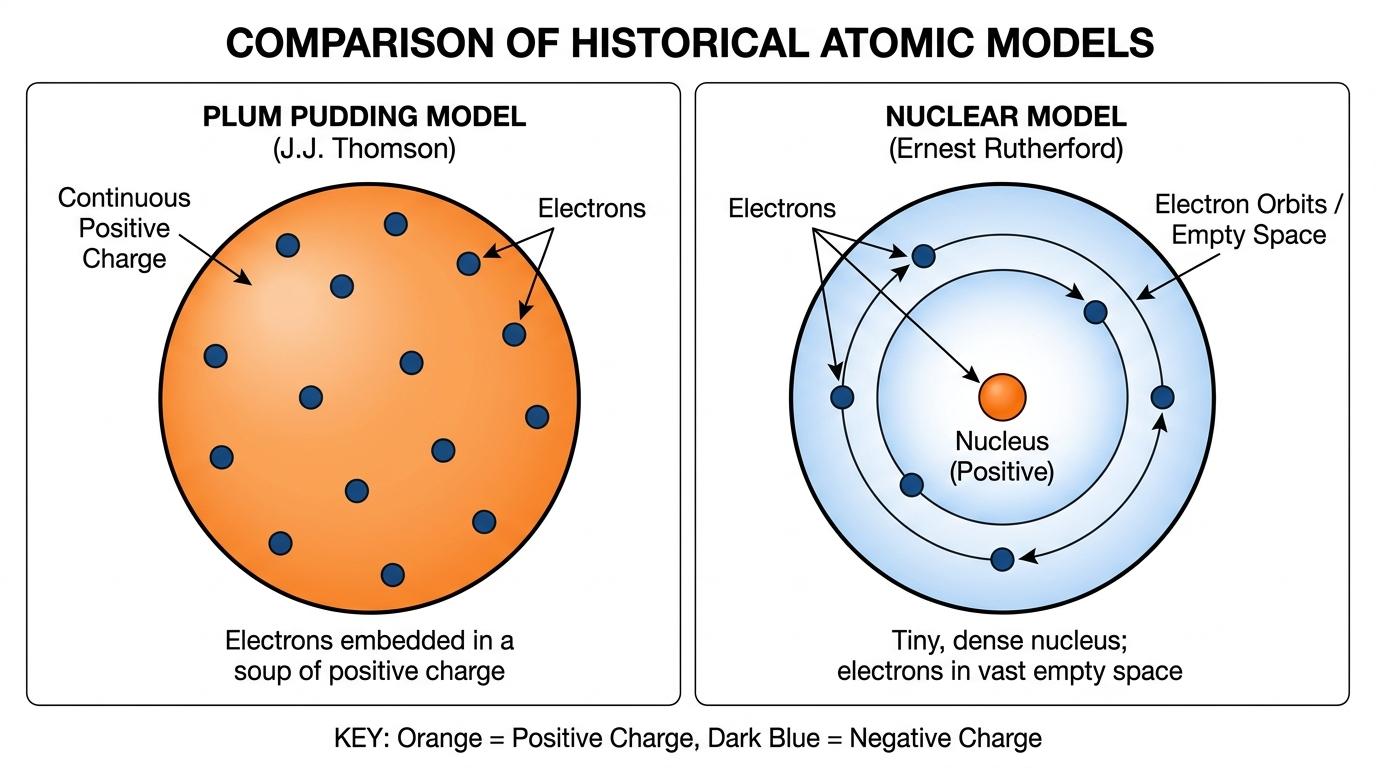
J.J. Thomson proposed the plum pudding model. He suggested that the atom was a solid sphere of spread-out, diffuse positive charge, with the negative electrons dotted inside it like raisins in a plum pudding.
Plum pudding model
An early historical model of the atom proposing that it consists of a sphere of continuous positive charge with negatively charged electrons embedded within it.
In 1909, Ernest Rutherford instructed two of his researchers, Hans Geiger and Ernest Marsden, to test this model by firing tiny, positively charged particles at a piece of gold foil.
The Alpha Scattering Setup
Geiger and Marsden used α\alphaα-particles (alpha particles) as their projectiles.
Alpha () particle
A particle consisting of two protons and two neutrons (essentially a helium nucleus). It has a relative charge of +2+2+2 and is relatively massive compared to an electron.
The experiment was set up with great care to ensure the results were reliable:
- An alpha source was placed inside a lead box with a narrow slit. This acted as a collimator, producing a fine, parallel beam of α\alphaα-particles.
- A very thin gold foil was used as the target. Gold is highly malleable, meaning it can be beaten into incredibly thin sheets (just a few hundred atoms thick). This ensured that any scattering was likely the result of a single collision with a gold atom, rather than multiple scattering events.
- A fluorescent screen coated with zinc sulfide surrounded the foil. Whenever an α\alphaα-particle hit the screen, it produced a tiny flash of light that the researchers could count through a microscope.
- A vacuum chamber enclosed the whole apparatus. α\alphaα-particles are easily absorbed by air molecules, so the vacuum ensured the particles reached the foil and the screen without losing energy or being deflected by air.
The Results that Broke the Model
If the plum pudding model were true, the positive charge in the gold atoms would be spread out and very weak. The fast, heavy α\alphaα-particles should have punched straight through the foil like cannonballs through tissue paper, perhaps with very tiny deflections.
Instead, Geiger and Marsden observed three distinct things that changed physics forever:
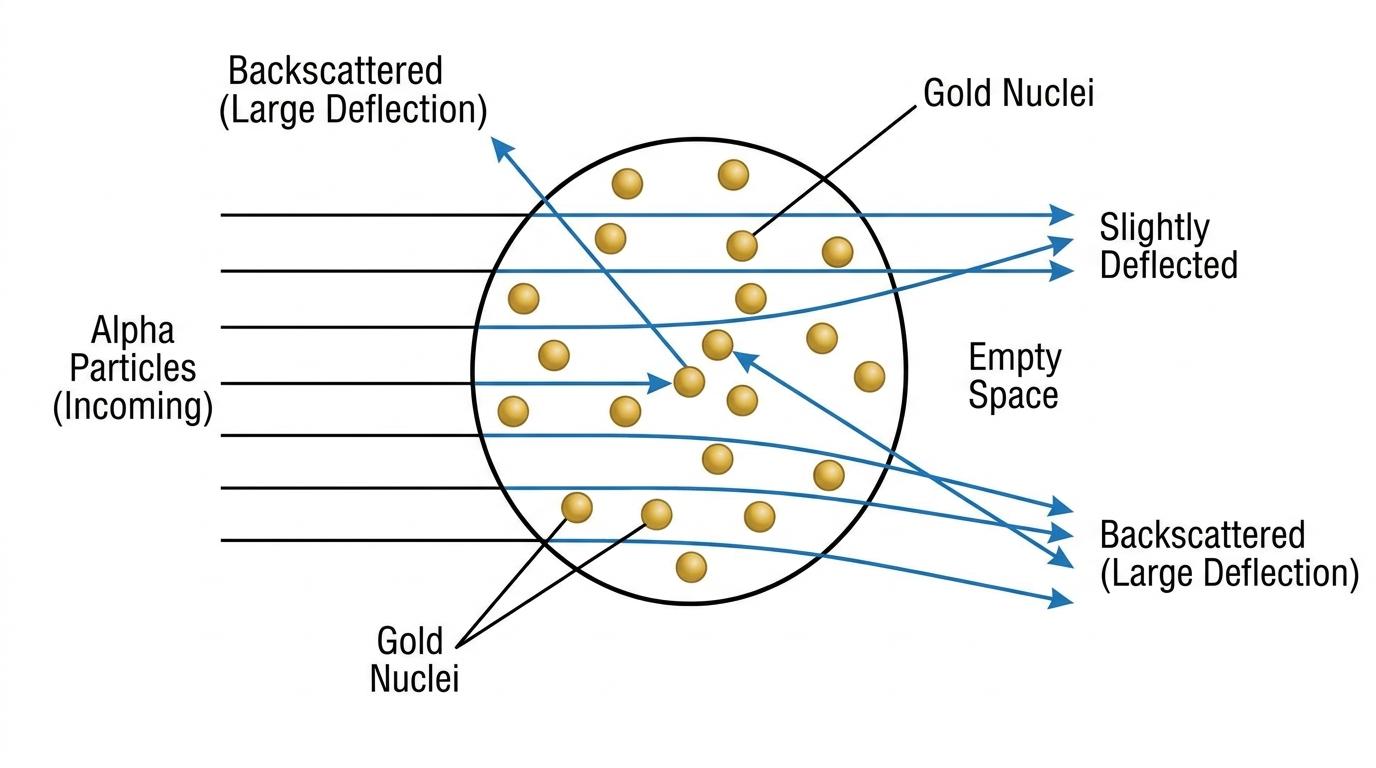
1. Most went straight through
The vast majority of the α\alphaα-particles passed straight through the gold foil with virtually no deflection. Conclusion: The atom is mostly empty space.
2. Some were deflected by small angles
A small proportion of the α\alphaα-particles were deflected from their original path. Because α\alphaα-particles are positively charged, they must have experienced electrostatic repulsion from another concentrated positive charge. Conclusion: The atom contains a central core (the nucleus) that has a positive charge.
3. A very few bounced back
About 1 in 10,000 α\alphaα-particles were deflected by huge angles, greater than 90∘90^\circ90∘ (backscattering). For a fast-moving α\alphaα-particle to be turned completely around, it must have hit something incredibly massive (so the target doesn't just get knocked away) and incredibly concentrated (to provide a strong enough electrostatic repulsive force). Conclusion: The central positive nucleus is extremely tiny but contains almost all of the atom's mass.
The Birth of the Nuclear Model
Rutherford concluded that the plum pudding model was wrong. He proposed the Nuclear Model: an atom consists of a tiny, incredibly dense, positively charged central nucleus, with negatively charged electrons orbiting it far away in the vast empty space.
Mass vs. Density
Students often say the nucleus is "very heavy". This is imprecise. An individual gold nucleus is incredibly light in everyday terms. The correct phrasing is that the nucleus contains almost all the mass of the atom and is extremely dense.
How Knowledge Changes Over Time
The AQA specification requires you to appreciate how scientific understanding evolves.
The shift from the plum pudding model to the nuclear model is a classic example of the scientific method in action. Models are only accepted as long as they fit the experimental evidence. When new experimental evidence (backscattering of α\alphaα-particles) contradicts the existing model (plum pudding), the scientific community must abandon or refine the model to propose a new one (the nuclear model) that explains the new data.
Linking observations to conclusions
Question: In the Rutherford scattering experiment, a beam of α\alphaα-particles is fired at a thin gold foil. State and explain the three main observations of the experiment and how they lead to the nuclear model of the atom. (6 marks)
Solution:
- Observation 1: The majority of α\alphaα-particles passed straight through the foil without any deflection.
- Conclusion 1: This shows that the atom is mostly empty space.
- Observation 2: A small number of α\alphaα-particles were deflected through small angles.
- Conclusion 2: This shows there is a concentrated positive charge in the atom causing electrostatic repulsion, which we now call the nucleus.
- Observation 3: A very small fraction of α\alphaα-particles (roughly 1 in 10,000) were deflected by angles greater than 90∘90^\circ90∘.
- Conclusion 3: This shows the nucleus is extremely tiny but contains nearly all the mass of the atom, providing enough repulsive force to reverse the α\alphaα-particle's momentum without the nucleus itself being easily knocked aside.
Memorising the pairs
In exams, observations and conclusions are usually marked in pairs. Never write a conclusion without stating the specific observation that proves it.
- Straight through →\to→ Empty space
- Deflected →\to→ Positive centre
- Bounced back →\to→ Tiny and massive centre
In the exam
- Be precise with your vocabulary. Use "deflected by angles greater than 90∘90^\circ90∘" rather than "bounced off".
- If asked why the gold foil had to be thin, state that it prevents α\alphaα-particles from being scattered multiple times, which would make the results impossible to analyse.
- If asked why the experiment took place in a vacuum, state that α\alphaα-particles are highly ionising and would be easily absorbed or scattered by air molecules before reaching the foil.
- Remember that this topic explicitly tests your understanding of the scientific method. Be prepared for a 1- or 2-mark question asking why Thomson's model was replaced by Rutherford's.
Check yourself
- Why were α\alphaα-particles chosen for this experiment instead of β\betaβ-particles?
- What would the results of the experiment have looked like if the plum pudding model had been completely correct?
- Can you list the three key observations and pair each with its corresponding conclusion about atomic structure?