α\alphaα , β\betaβ and γ\gammaγ radiation (A-level only)
Radioactivity is a completely random process, but the behaviour of the radiation emitted by unstable nuclei is predictable and measurable. In this section, we'll look at the three main types of ionising radiation and how their physical properties dictate their uses (and dangers) in the real world.
What you'll learn
- How to define and correct for background radiation.
- The properties of α\alphaα, β\betaβ, and γ\gammaγ radiation and how to identify them using absorption experiments.
- Real-world applications, such as thickness monitoring in manufacturing.
- How to apply the inverse-square law for γ\gammaγ radiation (and how it links to your required practical).
1. Background Radiation
Before we can study a radioactive source, we have to deal with the radiation that is already there. Even without a specific source in the room, a Geiger-Muller (GM) tube will still click. This is due to background radiation.
Background Radiation
The low-level ionising radiation that is present in the environment at all times.
Background radiation comes from both natural and artificial origins:
- Radon gas: Released from rocks (like granite) in the ground. This is usually the largest single contributor.
- Cosmic rays: High-energy particles from space that collide with our atmosphere.
- Rocks and building materials: Many contain trace amounts of radioactive isotopes.
- Artificial sources: Medical procedures (X-rays, tracers), nuclear power, and fallout from historical nuclear weapons testing.
Correcting for background radiation
Whenever you take a reading (count rate) from a radioactive source, your GM tube is actually measuring the source plus the background radiation.
Corrected Count Rate
To find the true activity of a source, you must always measure the background count rate first, then subtract it from all subsequent readings.
Corrected Count Rate=Measured Count Rate−Background Count Rate\text{Corrected Count Rate} = \text{Measured Count Rate} - \text{Background Count Rate}Corrected Count Rate=Measured Count Rate−Background Count Rate
Correcting for background radiation
- A student leaves a GM tube running for 10 minutes10 \text{ minutes}10 minutes with no source present. It records 300300300 counts. The background count rate is therefore 30010=30 counts per minute\frac{300}{10} = 30 \text{ counts per minute}10300=30 counts per minute.
- The student places a radioactive source in front of the detector. Over 5 minutes5 \text{ minutes}5 minutes, the detector records 425042504250 counts.
- The measured count rate with the source is 42505=850 counts per minute\frac{4250}{5} = 850 \text{ counts per minute}54250=850 counts per minute.
- The true (corrected) count rate of the source alone is 850−30=820 counts per minute850 - 30 = 820 \text{ counts per minute}850−30=820 counts per minute.
2. Properties and Identification
There are three main types of ionising radiation emitted by unstable nuclei. Their differing masses and charges give them very different properties.
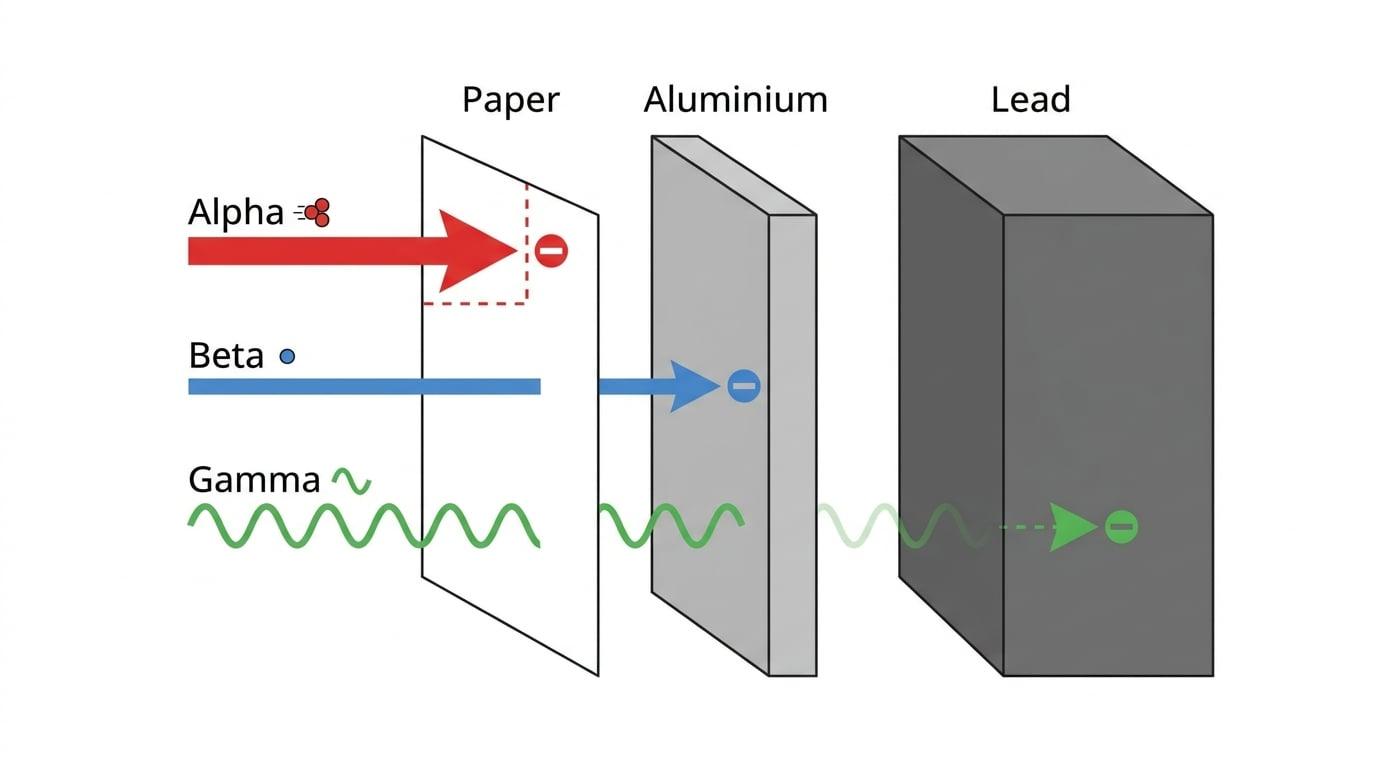
- Alpha (α\alphaα) radiation: A helium nucleus (two protons, two neutrons). Highly ionising because of its +2e+2e+2e charge and relatively large mass. Because it ionises so many atoms along its path, it loses energy rapidly and has a very short range (a few centimetres in air).
- Beta (β\betaβ) radiation: A fast-moving electron (or positron). Moderately ionising (charge −e-e−e or +e+e+e) and has a range of about a metre in air.
- Gamma (γ\gammaγ) radiation: A high-frequency electromagnetic wave (photon). It has no mass and no charge, making it weakly ionising but highly penetrating. It can travel huge distances in air.
The Ionisation-Penetration Trade-off
Think of ionisation as "crashing into things". Alpha particles are heavy and highly charged, so they crash into lots of atoms, losing all their energy very quickly. Gamma rays rarely interact, so they can penetrate much further. High ionising power always means low penetrating power, and vice versa!
Simple Absorption Experiments
You can identify the type of radiation emitted by an unknown source by placing different absorbers between the source and a detector.
- Measure the background count rate and subtract it from all readings.
- Place the source near the detector and measure the corrected count rate with no absorber.
- Place a sheet of paper between them. If the count rate drops significantly, α\alphaα radiation is present (paper absorbs α\alphaα).
- Replace the paper with a few millimetres of aluminium. If the count rate drops further, β\betaβ radiation is present.
- Replace the aluminium with several centimetres of lead. If a measurable count rate still persists but is reduced, γ\gammaγ radiation is present.
3. Applications of Radiation
Thickness Monitoring
In industry, radiation is used to monitor the thickness of materials as they are rolled out. A radioactive source is placed on one side of the material, and a detector on the other. If the material comes out too thick, less radiation reaches the detector. A computer registers the drop in count rate and automatically tightens the rollers.
Crucially, the type of radiation must be matched to the material:
- Aluminium foil or Paper: Requires a β\betaβ source. An α\alphaα source is useless because the paper/foil would block it completely regardless of slight thickness changes. A γ\gammaγ source is also useless because it would pass straight through thin foil without any measurable drop in count rate.
- Steel sheets: Requires a γ\gammaγ source. Both α\alphaα and β\betaβ would be completely stopped by thick steel.
Relative Hazards to Humans
The danger of radiation depends on where the source is relative to your body.
- Outside the body (Irradiation): Gamma and beta are the most dangerous. Gamma is highly penetrating and can easily pass through the skin to damage internal organs. Alpha is the least dangerous externally, as it is stopped by the dead layer of skin cells on the surface of your body.
- Inside the body (Contamination): Alpha is the most dangerous. If an alpha source is swallowed or inhaled, its high ionising power means it dumps all its destructive energy into a very small area of living tissue, causing massive cellular damage and mutating DNA. Gamma is the least dangerous internally, as it mostly passes straight out of the body without interacting.
Medical Uses: Risk vs Benefit
Radiation is widely used in medicine. γ\gammaγ sources with short half-lives are injected into patients as tracers to image internal organs (because the γ\gammaγ escapes the body to be detected). High doses of radiation are also targeted at tumours to destroy cancer cells.
Medical professionals must constantly weigh the risk (damaging healthy tissue or causing secondary cancers) against the benefit (accurately diagnosing a life-threatening condition or curing an existing cancer).
4. The Inverse-Square Law for γ\gammaγ Radiation
When a point source emits γ\gammaγ radiation, the gamma rays spread out uniformly in all directions (a sphere). As the distance from the source increases, the same amount of radiation energy is spread over a much larger area.
Because the surface area of a sphere is 4πx24\pi x^24πx2, the intensity of the radiation is inversely proportional to the square of the distance xxx.
I=kx2 I = \frac{k}{x^2} I=x2kWhere:
- III is the intensity (or count rate), usually in W m−2\text{W m}^{-2}W m−2 or counts per second (Bq\text{Bq}Bq).
- xxx is the distance from the source in metres (m\text{m}m).
- kkk is a constant of proportionality.
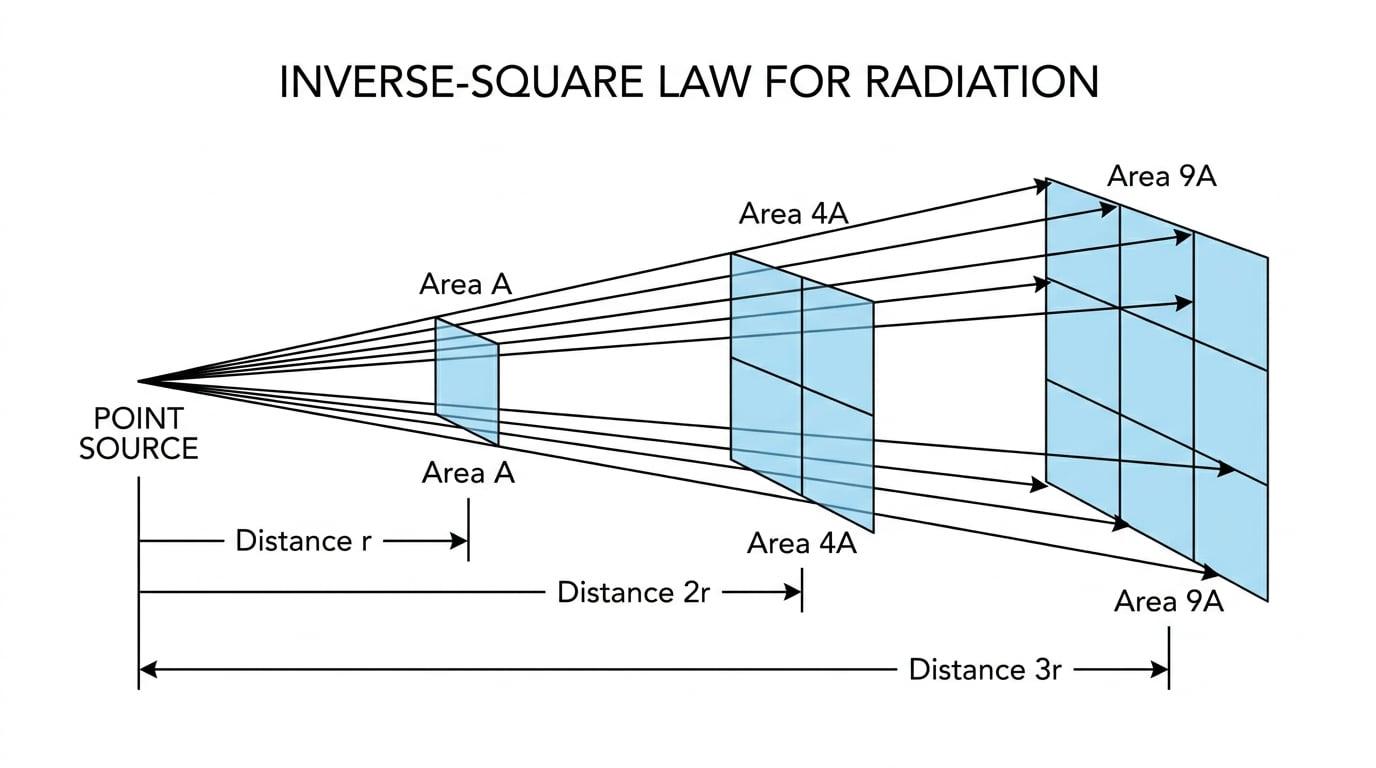
If you double the distance from a gamma source (2x2x2x), the radiation is spread over four times the area, so the count rate drops to a quarter (1/41/41/4). If you triple the distance, the count rate drops to a ninth (1/91/91/9).
Calculating count rate at a new distance
A small gamma source produces a measured count rate of 550 Bq550 \text{ Bq}550 Bq at a distance of 0.20 m0.20 \text{ m}0.20 m from a detector. The background count rate is 50 Bq50 \text{ Bq}50 Bq. Calculate the expected measured count rate at a distance of 0.50 m0.50 \text{ m}0.50 m.
- Correct the initial count rate for background radiation:
I1=550−50=500 BqI_1 = 550 - 50 = 500 \text{ Bq}I1=550−50=500 Bq. - Set up the inverse-square relationship. Since I=kx2I = \frac{k}{x^2}I=x2k, we know that k=I1x12=I2x22k = I_1 x_1^2 = I_2 x_2^2k=I1x12=I2x22.
500×(0.20)2=I2×(0.50)2500 \times (0.20)^2 = I_2 \times (0.50)^2500×(0.20)2=I2×(0.50)2 - Rearrange and solve for I2I_2I2:
I2=500×0.040.25=80 BqI_2 = \frac{500 \times 0.04}{0.25} = 80 \text{ Bq}I2=0.25500×0.04=80 Bq. - The question asks for the measured count rate, so we must add the background back on:
Measured rate=80+50=130 Bq\text{Measured rate} = 80 + 50 = 130 \text{ Bq}Measured rate=80+50=130 Bq.
Required Practical 12: Experimental Verification
To verify the inverse-square law experimentally:
- Measure the background count rate.
- Place a γ\gammaγ source at various distances xxx from a GM tube and record the count rate.
- Calculate the corrected count rate III.
- Plot a graph of III on the y-axis against 1x2\frac{1}{x^2}x21 on the x-axis.
- If the inverse-square law holds, the graph will be a straight line through the origin.
Systematic errors in distance
If your graph of III against 1x2\frac{1}{x^2}x21 is a straight line but doesn't quite pass through the origin, it means there is a systematic error in xxx. This is usually because the actual radioactive material is buried slightly deeper inside its plastic casing than the front surface where you placed your ruler!
Safe Handling of Sources
The inverse-square law is the main reason why we handle radioactive sources using long-handled tongs. Moving your hand just a few centimetres further away from the source dramatically reduces the intensity of radiation reaching your living cells.
Other safety precautions include:
- Keeping the source pointed away from people.
- Minimising exposure time.
- Storing sources in lead-lined boxes when not in use.
In the exam
- Always hunt for background radiation: If a question gives you a count rate and a background rate, subtract the background immediately before doing any half-life or inverse-square math. Add it back at the end if the question asks for the "measured" or "detector" reading.
- Thickness applications: Remember the material! Paper/Aluminium = β\betaβ, Steel = γ\gammaγ. Never suggest α\alphaα for thickness monitoring.
- Inverse-square law: Remember that the law strictly applies to γ\gammaγ radiation from a point source in a vacuum (or air, since air hardly absorbs γ\gammaγ). It doesn't work well for α\alphaα or β\betaβ because they are rapidly absorbed by the air itself, meaning the count rate drops off much faster than 1/x21/x^21/x2.
Check yourself
- What are three main sources of background radiation?
- Why is an alpha source highly dangerous inside the body, but relatively safe outside the body?
- Why is a beta source, rather than a gamma source, used to monitor the thickness of paper?
- If the distance from a gamma source is increased by a factor of 4, by what factor does the intensity decrease?