Fields (A-level only)
What you'll learn
- What a force field is and how it causes "action at a distance".
- How we use vectors and field lines to visually represent fields.
- The fundamental sources of force fields in physics.
- The key similarities and differences between gravitational and electrostatic fields.
What is a Force Field?
In everyday life, most forces we experience are contact forces—like pushing a door, friction rubbing against your shoes, or tension in a stretched string. But some forces act across empty space without any physical contact.
To explain how objects can push or pull each other through a vacuum, physicists use the concept of a force field.
Force Field
A force field is a region of space in which an object experiences a non-contact force.
If you place a susceptible object (like a mass, or a charge) into a region where a field exists, it will instantly feel a force. The field acts as the "middleman" communicating the force.
The Origins of Fields
Fields do not just appear out of nowhere; they are generated by specific properties of matter. In your A-level Physics course, you will study three main types of field, each arising from a different source:
- Gravitational fields: Arise from the interaction of masses. Any object with mass creates a gravitational field around it.
- Electrostatic fields: Arise from the interaction of static (stationary) charges. Any electrically charged object creates an electrostatic field around it.
- Magnetic fields: Arise from the interaction between moving charges. When charge moves (for example, as a current in a wire), it generates a magnetic field.
The Golden Rule of Fields
To experience a force from a specific type of field, the object entering the field must have the same property that creates the field. Masses feel gravitational fields; charges feel electric fields; moving charges feel magnetic fields.
Representing Fields as Vectors
A force has both a magnitude (size) and a direction, which makes it a vector quantity. Because a force field tells us what force an object would experience, the field itself is also a vector.
We represent fields using field lines.
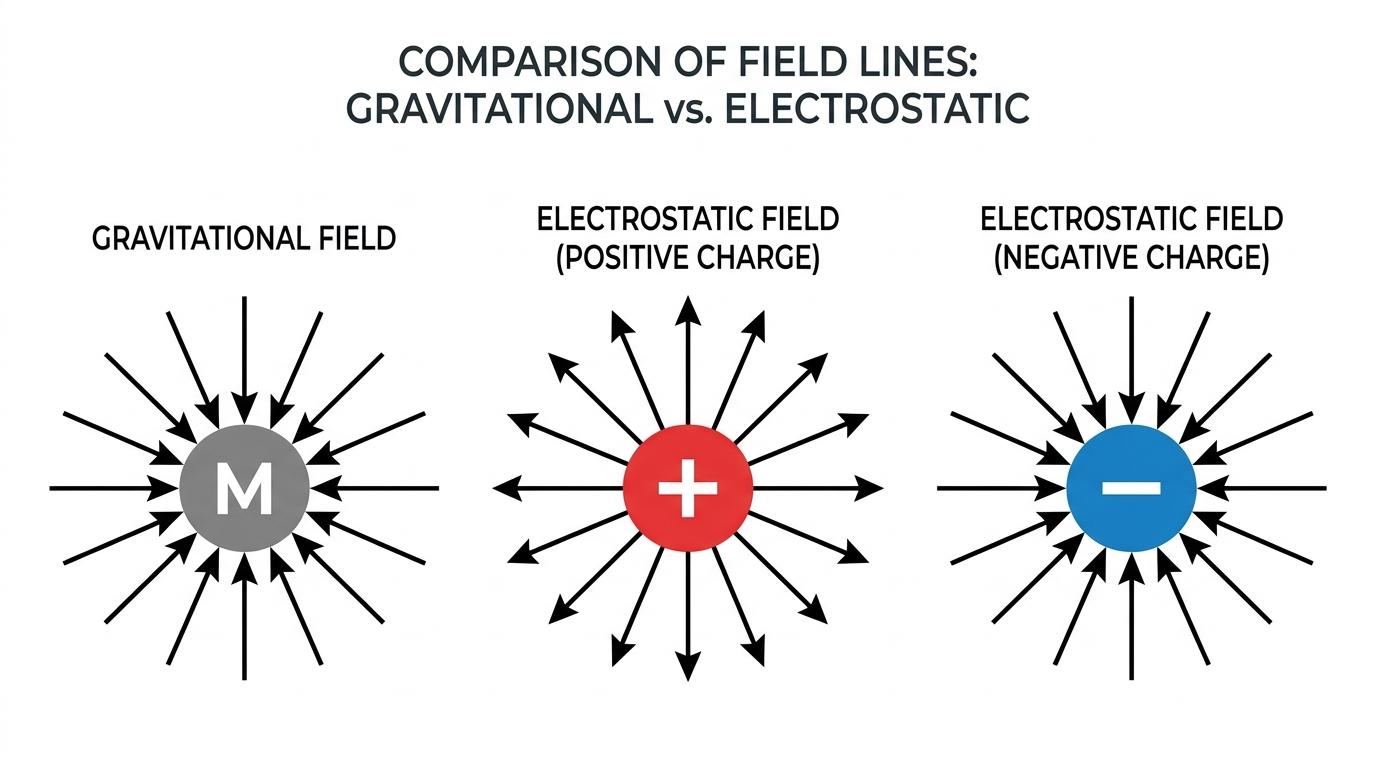
When drawing or interpreting field lines, we look at two things:
- Direction: The arrows on the lines show the direction of the force that a "test object" would feel. This is determined by inspection (looking at the rules for that specific field). For gravity, lines point towards the mass. For positive charges, they point away.
- Strength (Magnitude): The closer together the field lines are drawn, the stronger the field is in that region. Where lines spread out, the field is getting weaker.
Determining Direction by Inspection
When asked to determine field direction by inspection, ask yourself: "Which way would a small, positive test mass/charge be pushed?" For gravity, a test mass is always pulled inwards. For an electric field, a positive test charge is repelled outwards by positive charges, but pulled inwards by negative ones.
Comparing Gravitational and Electrostatic Fields
The mathematical models for gravitational fields and electrostatic fields are remarkably similar. Historically, physicists mapped the equations of electrostatics directly from Newton's laws of gravitation because the geometry of both forces is identical.
You need to know the specific similarities and differences between them. These frequently appear as comparison questions in exams.
Key Similarities
Both fields are described by forces that spread out from a point source in three dimensions. As the fields spread out over a spherical area, their strength drops rapidly.
- Inverse-square force laws: For both fields, the force between two point sources is inversely proportional to the square of the distance between them (F∝1r2F \propto \frac{1}{r^2}F∝r21). If you double the distance, the force becomes four times weaker.
- Field lines: Both fields can be mapped visually using vector field lines that show direction and strength.
- Potential: Both fields use the concept of potential, which describes the potential energy per unit mass (or unit charge) at a specific point in the field.
- Equipotential surfaces: Both fields feature surfaces of constant potential (like concentric shells around a point mass/charge) where moving an object along the surface requires no work.
Key Differences
Despite the mathematical similarities, the physical nature of the matter interacting creates distinct differences.
- Attractive vs Repulsive: Gravitational forces are always attractive (masses always pull together). Electrostatic forces can be attractive or repulsive (opposite charges attract, like charges repel).
- Interacting property: Gravitational fields interact with mass, while electrostatic fields interact with charge.
- Shielding: You cannot shield or block a gravitational field—it affects all mass. Electrostatic fields can be shielded (for example, by placing an object inside a conductive metal box like a Faraday cage).
Confusing the inverse-square law
A very common mistake in multiple-choice questions is thinking that doubling the distance halves the force. Because of the inverse-square law (F∝1r2F \propto \frac{1}{r^2}F∝r21), doubling the distance means the force is divided by 22=42^2 = 422=4. Tripling the distance divides the force by 9.
Worked Examples
Let's look at how AQA tests your understanding of inverse-square laws and field comparisons.
Calculating changes using inverse-square laws
A space probe is launched away from a newly discovered planet. When the probe is at a distance rrr from the planet's centre, the gravitational force on it is 1800 N1800 \text{ N}1800 N. Calculate the gravitational force on the probe when it has moved to a distance of 3r3r3r.
- State the mathematical relationship for a gravitational field. Gravitational force follows an inverse-square law:
- Identify the scale factor for the distance. The distance has increased from rrr to 3r3r3r, meaning it has been multiplied by a factor of 3.
- Apply the scale factor to the force. Because of the square in the formula, if the distance is multiplied by 3, the force must be divided by 323^232:
- Calculate the new force.
The new gravitational force is 200 N200 \text{ N}200 N.
Written comparison of fields
An exam question asks: "State two similarities and one difference between the gravitational field of a point mass and the electric field of a point charge." (3 marks)
- Recall the similarities list. Both follow an inverse-square law, both use the concept of potential, both can be represented by field lines.
- Select two distinct similarities to write down.
- Similarity 1: Both exert a force that obeys an inverse-square law (F∝1r2F \propto \frac{1}{r^2}F∝r21).
- Similarity 2: Both fields have equipotential surfaces.
- Recall the differences list and select one.
- Difference: The gravitational force is always attractive, whereas the electric force can be either attractive or repulsive.
In the exam
- When sketching field lines for a point mass or point charge, always draw them as radial lines (straight lines meeting at the centre) and ensure your arrows point in the correct direction.
- Never draw field lines crossing each other. A field vector can only point in one resultant direction at any specific point in space.
- If an exam question asks for "similarities", use specific physics vocabulary: mention "inverse-square laws", "equipotential surfaces", or "potential". Avoid vague answers like "both get weaker further away".
- When doing inverse-square ratio calculations, check your common sense: if the object moves further away, the force must decrease. If you get a larger number, you have multiplied instead of dividing!
Check yourself
- Can you define what a force field is in terms of non-contact forces?
- How do we determine the direction of an electrostatic field line?
- What are the three fundamental sources of fields you need to know?
- If the distance between two point charges is halved, by what factor does the electrostatic force between them change?
- Can you confidently state two physical differences between a gravitational field and an electrostatic field?