What you'll learn:
- Why moment of inertia is the rotational equivalent of mass.
- How to calculate the moment of inertia for a point mass using I=mr2I = mr^2I=mr2.
- How to find the total moment of inertia for extended objects using I=∑mr2I = \sum mr^2I=∑mr2.
- The qualitative factors that determine an object's moment of inertia.
The Rotational Equivalent of Mass
In linear mechanics, you know that mass is a measure of an object's inertia—its "stubbornness" to changes in motion. It is much harder to push a heavy lorry into motion than a light bicycle.
In rotational dynamics, we have a very similar concept. If you try to spin a heavy merry-go-round, it takes a lot of effort to get it moving, and equally a lot of effort to stop it. However, in rotational physics, it's not just the mass that matters. Where that mass is placed makes a massive difference.
Rotational Stubbornness
Mass determines how hard it is to accelerate an object in a straight line. Moment of inertia determines how hard it is to give an object angular acceleration.
Moment of Inertia for a Point Mass
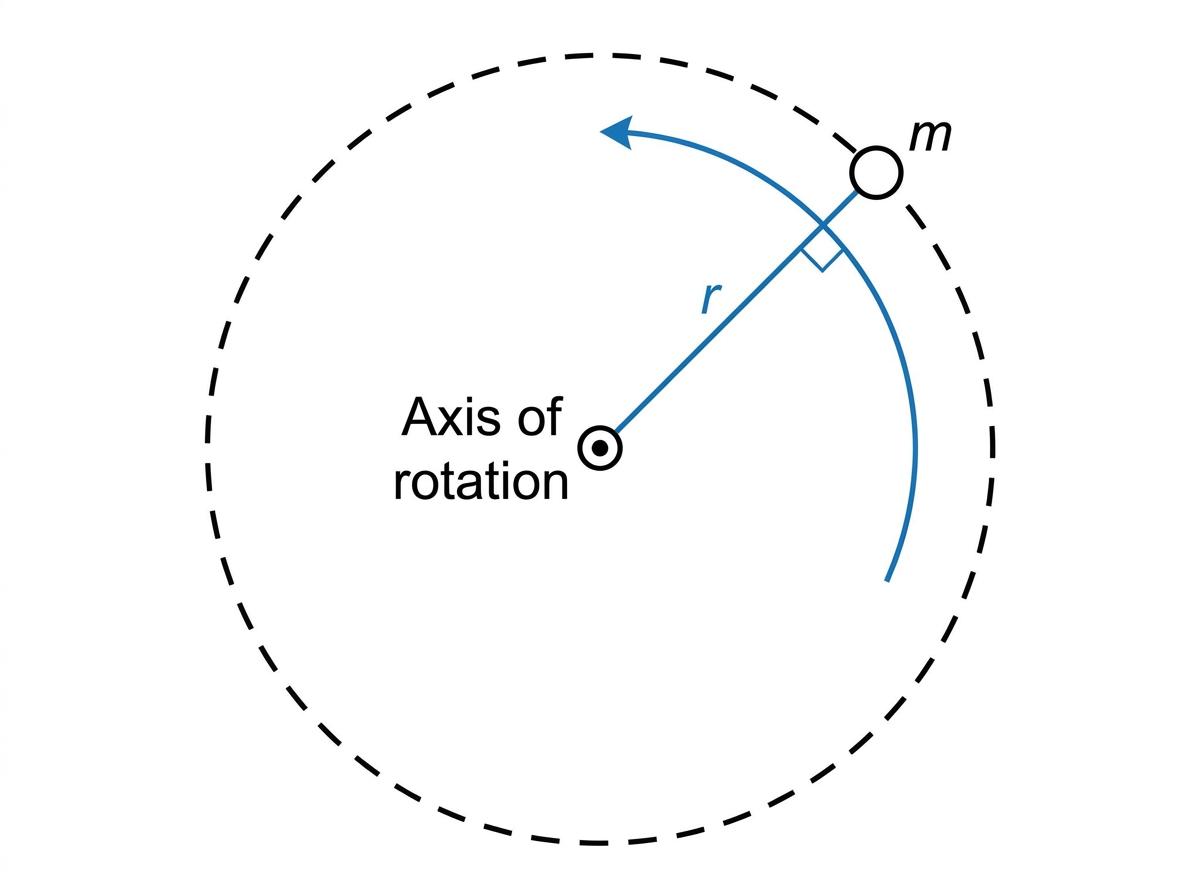
Let's start with the simplest possible case: a single, tiny mass (a "point mass") rotating around a fixed axis, like a small ball swung on the end of a very light string.
Moment of Inertia
The moment of inertia (III) of a point mass is the product of its mass (mmm) and the square of its perpendicular distance from the axis of rotation (rrr).
I=mr2 I = mr^2 I=mr2The SI unit for moment of inertia is kg m2\text{kg m}^2kg m2.
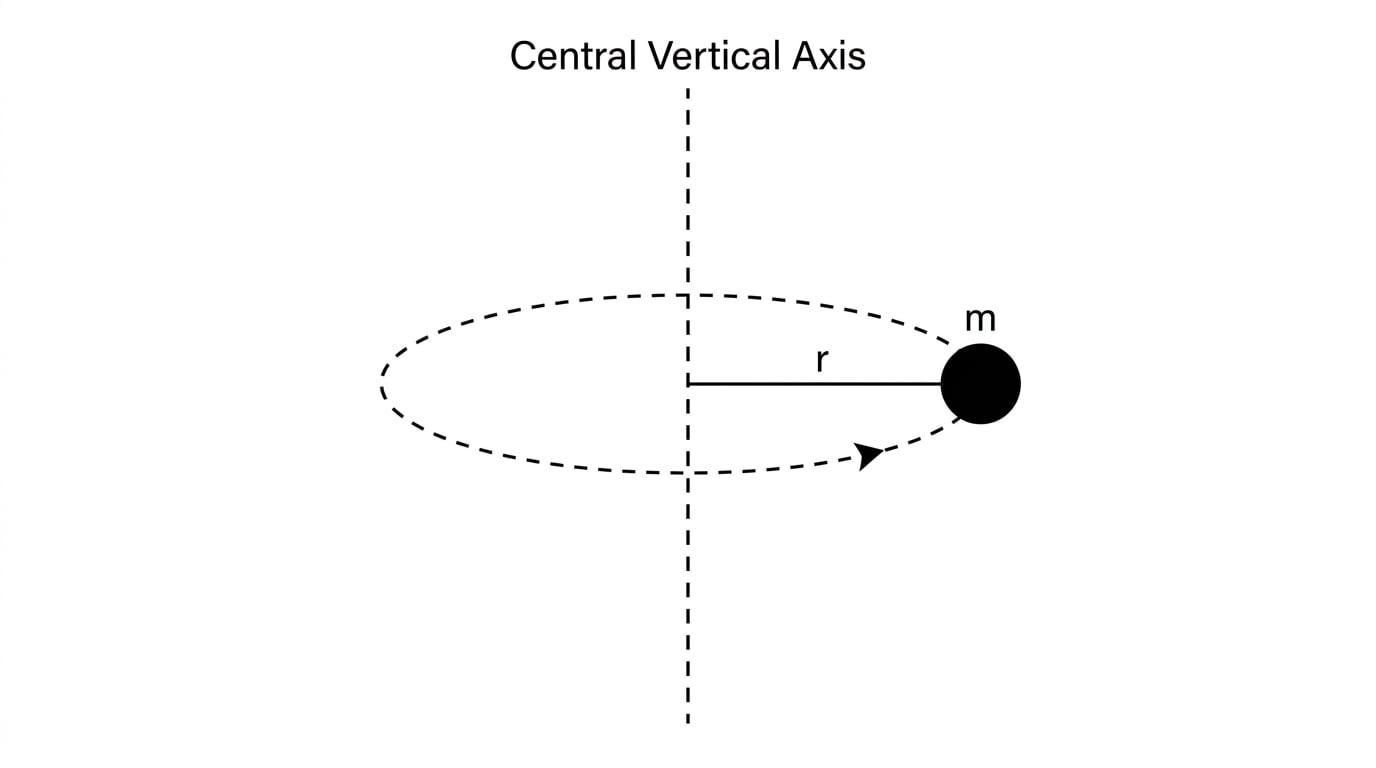
Notice the r2r^2r2 term in the equation. This is incredibly important! It means that moving a mass twice as far away from the axis of rotation will increase its moment of inertia by a factor of four.
Calculating I for a point mass
A small heavy ball of mass 0.40 kg is attached to the end of a light rigid string of length 1.5 m. The ball is whirled in a horizontal circle. Calculate its moment of inertia.
- Identify the variables: The mass is m=0.40 kgm = 0.40 \text{ kg}m=0.40 kg. The perpendicular distance to the axis is the length of the string, so r=1.5 mr = 1.5 \text{ m}r=1.5 m.
- State the formula:
- Substitute the values and calculate:
- State the final answer with units: The moment of inertia is 0.90 kg m20.90 \text{ kg m}^20.90 kg m2.
Perpendicular distance only
The distance rrr must always be measured at right angles (perpendicularly) from the axis of rotation to the mass. If a mass is sitting directly on the axis of rotation, its rrr is zero, so its contribution to the moment of inertia is zero!
Extended Objects: Adding it all up
Real-world objects, like wheels, gears, or flywheels, are not point masses. They are "extended objects" made up of trillions of tiny particles, each at a slightly different distance from the axis of rotation.
To find the total moment of inertia of an extended object, we imagine breaking it down into many tiny point masses (m1,m2,m3,…m_1, m_2, m_3, \dotsm1,m2,m3,…). We calculate mr2mr^2mr2 for each tiny piece, and then add them all together.
Mathematically, we write this using the sum symbol (∑\sum∑):
I=∑mr2 I = \sum mr^2 I=∑mr2For continuous solid shapes (like a solid disc or a sphere), calculating this sum requires calculus, which is beyond the AQA A-Level Physics specification. You will not be asked to derive these formulas from scratch. If an exam question involves a standard shape, AQA will provide the specific formula (e.g., I=12mr2I = \frac{1}{2}mr^2I=21mr2 for a uniform solid cylinder).
However, you will be expected to calculate I=∑mr2I = \sum mr^2I=∑mr2 for simple systems made of a few discrete masses joined together.
Factors Affecting Moment of Inertia
If we look closely at I=∑mr2I = \sum mr^2I=∑mr2, we can see that the moment of inertia depends on three key factors:
- The total mass of the object: A heavier object generally has a larger moment of inertia.
- The distribution of the mass: Mass positioned further from the axis (larger rrr) has a much greater effect than mass positioned close to the center, because the radius is squared.
- The chosen axis of rotation: The same object will have a completely different moment of inertia depending on where you spin it. (Imagine spinning a meter ruler around its center like a propeller, versus spinning it along its long edge like a rolling pin. The latter is much easier!).
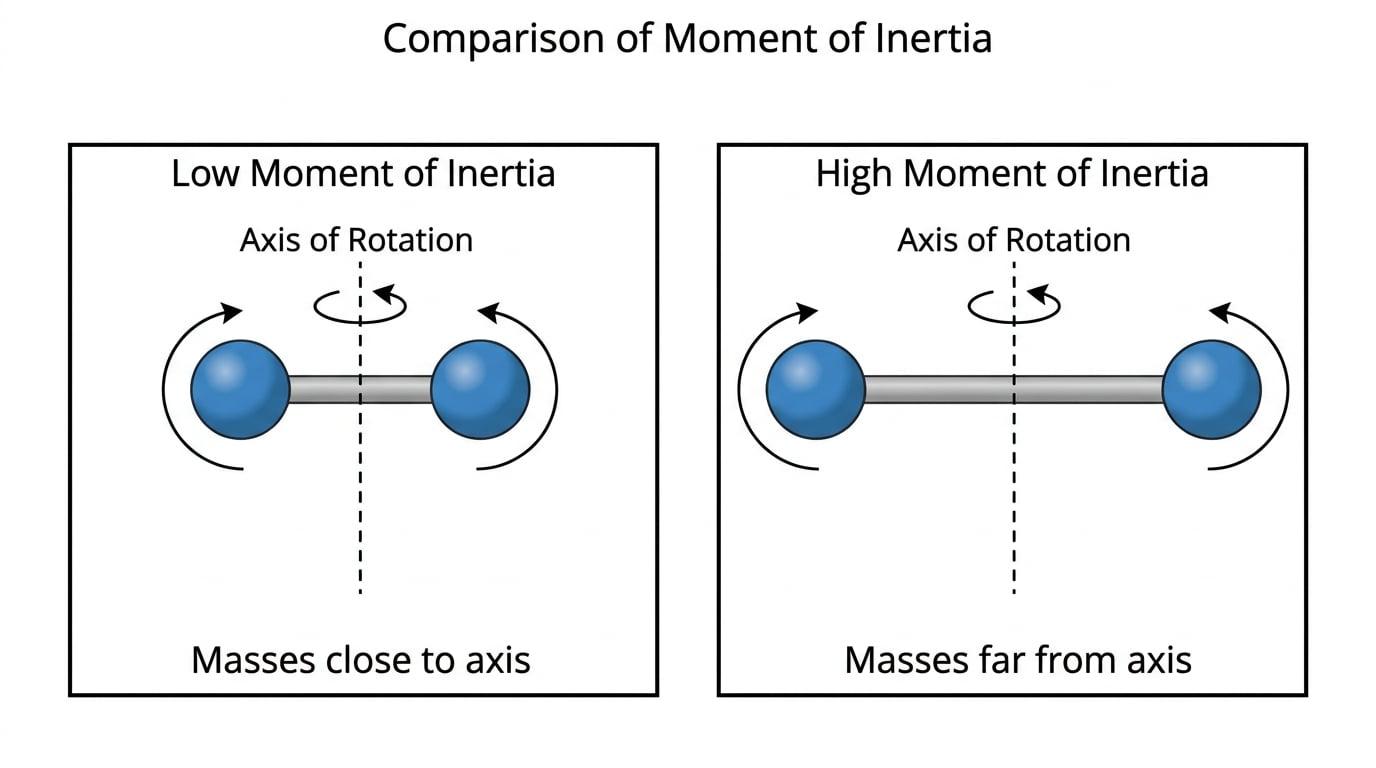
Both dumbbells above might have the exact same total mass, but the one on the right has a much larger moment of inertia because the mass is distributed further from the axis.
Assuming mass is everything
A very common error is to assume that two objects with the same mass must have the same moment of inertia. Always check how the mass is distributed. A hollow bicycle wheel has a much larger moment of inertia than a solid metal disc of the exact same mass and radius, because all of the wheel's mass is concentrated at the maximum possible distance rrr.
Discrete mass system
Two point masses, each of 2.0 kg, are attached to the ends of a light rod of length 0.80 m. The rod is rotated about an axis perpendicular to the rod. Calculate the moment of inertia of the system: (a) when the axis passes through the exact center of the rod. (b) when the axis passes through one of the masses at the end of the rod.
(a) Axis through the center:
- Determine the distance of each mass from the central axis. If the rod is 0.80 m long, the center is 0.40 m from each end. So, r1=0.40 mr_1 = 0.40 \text{ m}r1=0.40 m and r2=0.40 mr_2 = 0.40 \text{ m}r2=0.40 m.
- Apply I=∑mr2I = \sum mr^2I=∑mr2:
(b) Axis through one end:
- Determine the new distances from the new axis. One mass is exactly on the axis, so r1=0 mr_1 = 0 \text{ m}r1=0 m. The other mass is at the far end of the rod, so r2=0.80 mr_2 = 0.80 \text{ m}r2=0.80 m.
- Apply I=∑mr2I = \sum mr^2I=∑mr2:
- Notice how changing the axis of rotation drastically changed the moment of inertia, even though the physical object didn't change!
In the exam
- Check for "light" or "negligible mass": If a question mentions a "light rod" or "string", it means you can ignore its mass and only calculate the inertia of the point masses attached to it.
- Don't forget to square rrr: It is incredibly common to write I=mr2I = mr^2I=mr2 but then accidentally calculate m×rm \times rm×r in your calculator. Always double-check your squaring!
- Watch out for diameters: Exam questions often try to catch you out by giving you the diameter of a circular path. Always halve it to find the radius rrr before using the formula.
- Accept given formulas: If AQA gives you an expression like I=25mr2I = \frac{2}{5}mr^2I=52mr2 for a solid sphere, just plug your numbers straight into it. Do not try to derive it or question it.
Check yourself
- Can you define moment of inertia in words, without just stating the formula?
- If you double the distance of a point mass from the axis of rotation, what happens to its moment of inertia?
- Why do flywheels (designed to store rotational kinetic energy) have almost all of their heavy metal concentrated at the outer rim?