Resistivity
Welcome to the topic of resistivity! You already know that a resistor limits the flow of current. But what determines how much resistance a given piece of wire actually has? In this section, we'll look at the physical properties that cause resistance, and how changes in temperature can dramatically alter the electrical behaviour of different materials.
What you'll learn:
- The difference between resistance and resistivity.
- How to calculate resistivity and use the formula ρ=RAL\rho = \frac{RA}{L}ρ=LRA.
- The core details of Required Practical 5 (measuring the resistivity of a wire).
- How and why temperature affects metals and NTC thermistors differently.
- What superconductivity is and why it's so useful.
1. Resistance vs Resistivity
If you have two copper wires of different thicknesses and lengths, they will have different resistances. However, because they are both made of copper, they share the exact same resistivity.
Mass vs Density
Think of it like mass and density:
- Resistance is like mass: it depends on how much of the object you have (the specific size and shape of the wire).
- Resistivity is like density: it is a fundamental property of the material itself, regardless of its shape or size.
The resistance of a wire depends on three main factors:
- Length (LLL): The longer the wire, the further the electrons have to travel, meaning more collisions with the metal lattice. Resistance is directly proportional to length (R∝LR \propto LR∝L).
- Cross-sectional area (AAA): A wider wire gives the electrons more parallel paths to flow through. Resistance is inversely proportional to area (R∝1AR \propto \frac{1}{A}R∝A1).
- The material: Different materials have different internal structures and numbers of free charge carriers.
Putting this together gives us the definition of resistivity.
Resistivity
The resistivity (ρ\rhoρ) of a material is defined as the resistance of a 1-metre length of the material with a 1-square-metre cross-sectional area.
The formula is:
ρ=RAL \rho = \frac{RA}{L} ρ=LRAWhere:
- ρ\rhoρ (the Greek letter rho) is resistivity in ohm-metres (Ω m\Omega\text{ m}Ω m).
- RRR is resistance in ohms (Ω\OmegaΩ).
- AAA is cross-sectional area in square metres (m2\text{m}^2m2).
- LLL is length in metres (m\text{m}m).
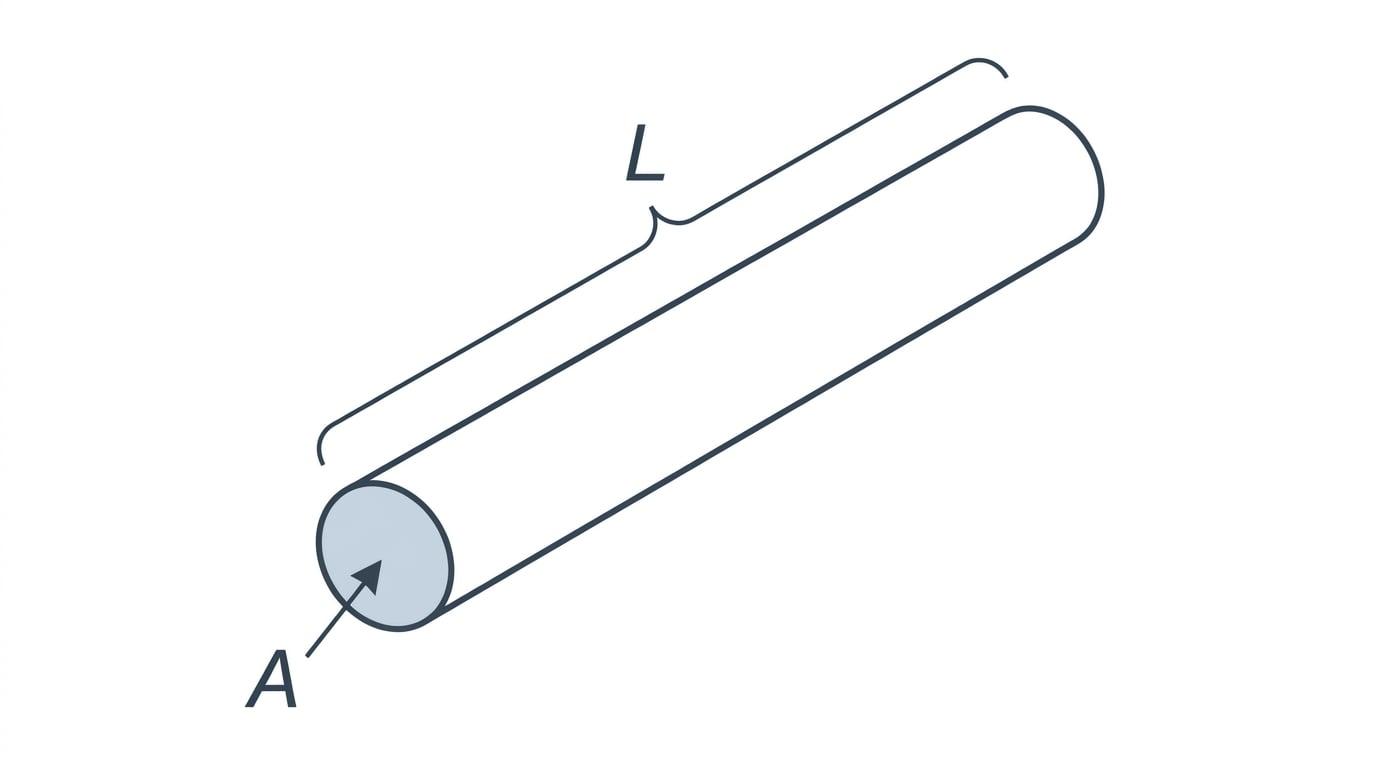
You will frequently need to rearrange this formula to find the resistance of a specific wire:
R=ρLA R = \frac{\rho L}{A} R=AρLUnits of resistivity
Students frequently write the unit of resistivity as Ω m−1\Omega\text{ m}^{-1}Ω m−1 (ohms per metre). This is wrong! Look at the formula: ρ=RAL\rho = \frac{RA}{L}ρ=LRA. In units, this is Ω×m2m\frac{\Omega \times \text{m}^2}{\text{m}}mΩ×m2. One of the metres cancels out, leaving you with just Ω m\Omega\text{ m}Ω m.
Working with Cross-Sectional Area
Wires are typically cylinders, meaning their cross-section is a circle. You will almost always be given the diameter (ddd) of the wire and will need to calculate the area AAA using:
A=πr2=πd24 A = \pi r^2 = \frac{\pi d^2}{4} A=πr2=4πd2Calculating the resistance of a wire
A piece of copper wire has a length of 2.5 m and a diameter of 0.80 mm. The resistivity of copper is 1.68×10⁻⁸ Ω m1.68 \times 10^{-8} \ \Omega\text{ m}1.68×10⁻⁸ Ω m. Calculate the resistance of the wire.
- Convert the diameter to metres. The diameter is 0.80 mm, which is 0.80×10⁻³ m0.80 \times 10^{-3}\text{ m}0.80×10⁻³ m.
- Calculate the cross-sectional area. Using A=πd24A = \frac{\pi d^2}{4}A=4πd2:
- Use the rearranged resistivity formula.
- State the final answer with units. The resistance is 0.084 Ω0.084 \ \Omega0.084 Ω (to 2 s.f., matching the given diameter).
2. Required Practical 5: Measuring Resistivity
A classic AQA practical and a very common exam question involves determining the resistivity of a metal wire. Here is the standard procedure you need to know.
The Measurements
To find ρ=RAL\rho = \frac{RA}{L}ρ=LRA, you need three measurements:
- Diameter (to find AAA): Use a micrometer. Measure the diameter at several points along the wire and in different orientations, then calculate a mean diameter. This reduces random error and accounts for the wire not being perfectly cylindrical.
- Length (LLL): Use a standard metre ruler. Measure from the point where the wire connects to the circuit to the point where it leaves.
- Resistance (RRR): Do not use an ohmmeter. The specification requires you to use an ammeter in series and a voltmeter in parallel with the test wire. Read the current (III) and potential difference (VVV), then calculate R=VIR = \frac{V}{I}R=IV.
The Graphical Method
Rather than taking one set of readings, you should vary the length LLL of the wire (by sliding a "flying lead" or crocodile clip along it) and record the resistance RRR for at least six different lengths.
If you plot a graph of Resistance (RRR) on the y-axis against Length (LLL) on the x-axis, you get a straight line through the origin.
- The equation of a straight line is y=mx+cy = mx + cy=mx+c.
- Our formula is R=(ρA)LR = \left(\frac{\rho}{A}\right)LR=(Aρ)L.
- Therefore, the gradient of your graph is equal to ρA\frac{\rho}{A}Aρ.
To find the resistivity, you simply calculate the gradient of your line of best fit and multiply it by the cross-sectional area:
ρ=gradient×A \rho = \text{gradient} \times A ρ=gradient×AWhy bother with a graph?
AQA often asks why we use graphical methods rather than just taking an average of multiple calculations. Plotting a graph helps identify anomalous results easily and reduces the impact of random errors on your final value, as the line of best fit averages out the variations. Also, if the line doesn't go through the origin, it immediately indicates a systematic error (like a zero error on the ruler or contact resistance at the clips).
3. Temperature and Resistance
So far, we've assumed the resistance of our wire is constant. However, changing the temperature of a material changes its resistance. The exact effect depends entirely on the type of material.
Metal Conductors
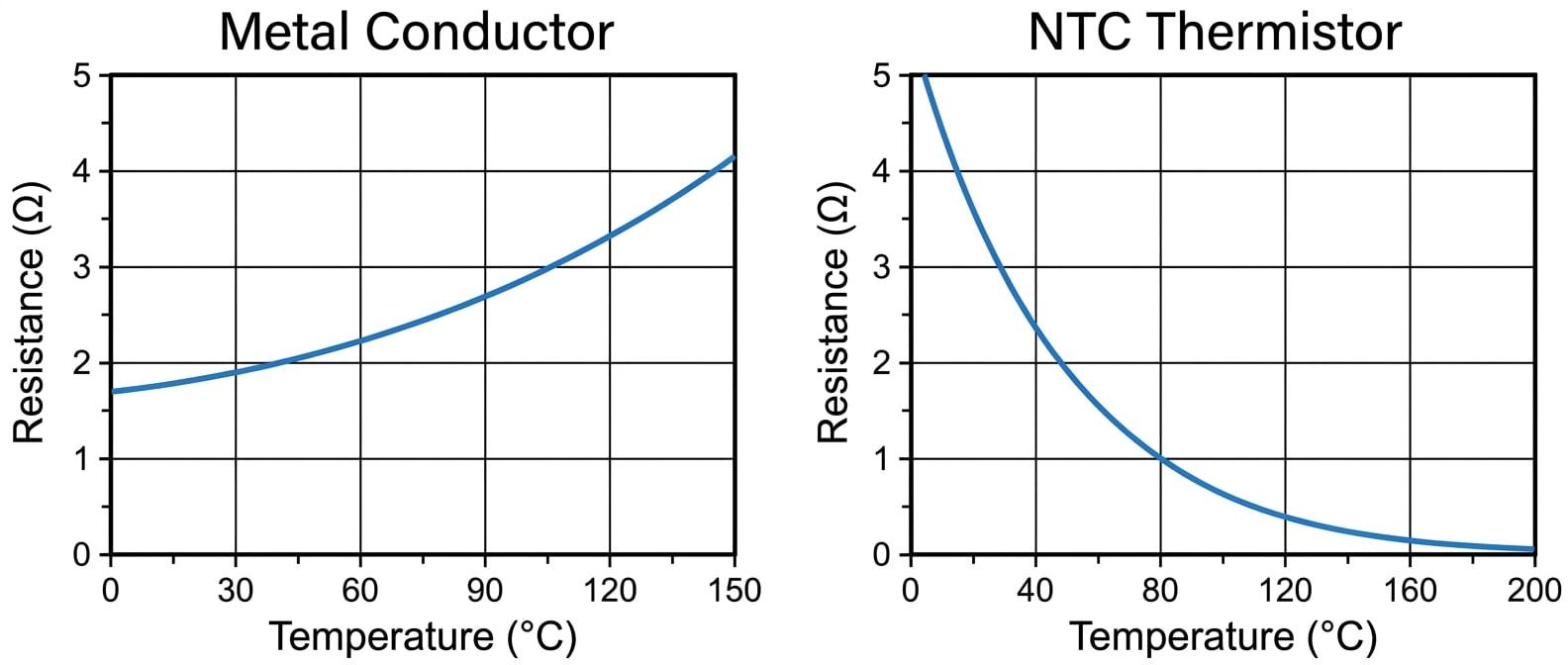
When you heat a metal wire, its resistance increases.
- Metals contain a lattice of positive ions surrounded by a "sea" of free, delocalised conduction electrons.
- As temperature rises, the thermal energy causes the positive metal ions in the lattice to vibrate more vigorously with a greater amplitude.
- This makes it harder for the conduction electrons to pass through the lattice. The electrons undergo more frequent collisions with the ions.
- More collisions mean a lower drift velocity for a given voltage, hence a lower current and a higher resistance.
NTC Thermistors
A thermistor is a type of semiconductor component. AQA only tests Negative Temperature Coefficient (NTC) thermistors. "Negative coefficient" means that as temperature goes up, resistance goes down.
- Semiconductors have far fewer free charge carriers (electrons) than metals at room temperature.
- When you heat an NTC thermistor, the thermal energy gives bound electrons enough energy to break free from their atoms.
- This massively increases the number density of free charge carriers in the material.
- Even though the lattice ions are vibrating more (just like in a metal), the huge influx of new free charge carriers far outweighs the effect of the collisions.
- Therefore, it becomes much easier for current to flow, and the resistance drops sharply.
Applications of Thermistors
Because the resistance of an NTC thermistor changes so dramatically with temperature, they make excellent temperature sensors. You will often see them used in potential divider circuits (which we cover later in the course) to act as automatic switches for thermostats, fire alarms, or frost-protection heaters.
4. Superconductivity
Normally, all materials have some electrical resistance because conduction electrons inevitably collide with the atomic lattice, losing energy as heat (which is why wires get warm). But some materials behave very strangely at extremely low temperatures.
Superconductivity
Superconductivity is a property of certain materials which have exactly zero resistivity when cooled at or below a specific critical temperature (TcT_cTc).
When a material becomes a superconductor:
- There is absolutely no electrical resistance (ρ=0\rho = 0ρ=0).
- A current can flow through it indefinitely without losing any energy to heat.
- The critical temperature (TcT_cTc) depends on the specific material. For most elements (like mercury or lead), TcT_cTc is very close to absolute zero (e.g. below 10 Kelvin).
Applications of Superconductors
Because they waste zero energy as heat (I2RI^2RI2R power loss is zero), superconductors are incredibly useful. You need to know two specific applications for the AQA exam:
- The production of strong magnetic fields: Electromagnets require huge currents to generate strong magnetic fields. In normal wires, huge currents would melt the wire due to heat loss. Superconducting wires can carry massive currents with no heat loss, allowing for the creation of incredibly powerful magnets used in MRI scanners and particle accelerators (like the LHC at CERN).
- Reduction of energy loss in power transmission: In theory, power cables made of superconducting materials would transmit electricity across the country with zero energy wasted as heat. (In practice, keeping hundreds of miles of cable cooled below TcT_cTc using liquid nitrogen/helium is currently too expensive, but it remains a major goal of materials science).
Explaining a resistance-temperature graph for a superconductor
Exam questions frequently show a graph of resistance against temperature for a material, where the line suddenly drops vertically to zero. You might be asked to "Explain the shape of the graph".
- Identify the behavior above TcT_cTc. State that at higher temperatures, the resistance decreases gradually as it cools down, behaving like a normal metal.
- Identify the transition. State that at a specific temperature called the critical temperature (TcT_cTc), the material undergoes a transition.
- Define the superconducting state. State that at and below TcT_cTc, the resistivity of the material drops exactly to zero, meaning it becomes a superconductor.
In the exam
- Watch your prefixes: You will almost always have to convert millimetres (mm) to metres (m) for diameter, or mm2\text{mm}^2mm2 to m2\text{m}^2m2 for area. Remember that 1 mm2=1×10⁻⁶ m21 \text{ mm}^2 = 1 \times 10^{-6} \text{ m}^21 mm2=1×10⁻⁶ m2.
- Radius vs Diameter: If the question gives you a diameter, the safest method is to immediately halve it to find the radius before doing A=πr2A = \pi r^2A=πr2. If you use diameter, do not forget to divide by 4 in A=πd24A = \frac{\pi d^2}{4}A=4πd2.
- NTC Explanation: If asked why an NTC thermistor's resistance decreases when heated, always use the phrase "increase in the number density of charge carriers". It's a guaranteed mark on AQA mark schemes.
- Practical details: If asked how to measure the diameter of a wire, you must say "use a micrometer" and "take measurements at several places along the wire to calculate a mean".
Check yourself
- Can you state the definition of resistivity in words, without just reciting the formula?
- If a wire is stretched to twice its original length while keeping its volume constant, what happens to its cross-sectional area, and consequently, its resistance?
- Why does the resistance of a standard copper wire increase when its temperature increases?
- What are the required conditions for a material to exhibit superconductivity?
- Name two applications of superconductors.