

What you'll learn:
- The fundamental conservation laws that govern all electrical circuits.
- How to combine resistors in series and parallel to find total resistance.
- How to calculate the electrical energy transferred and the power dissipated by components.
- The rules for connecting multiple power cells together.
The Rules of the Game: Conservation Laws
Before we start doing calculations, we need to understand the two fundamental rules that dictate how current and voltage behave in any circuit.
Conservation of Charge
Charge cannot be created or destroyed. In a circuit, this means that whatever amount of current flows into a junction must flow exactly out of it.
Junction
A junction is any point in a circuit where the wire splits into two or more paths, or where multiple paths join together.
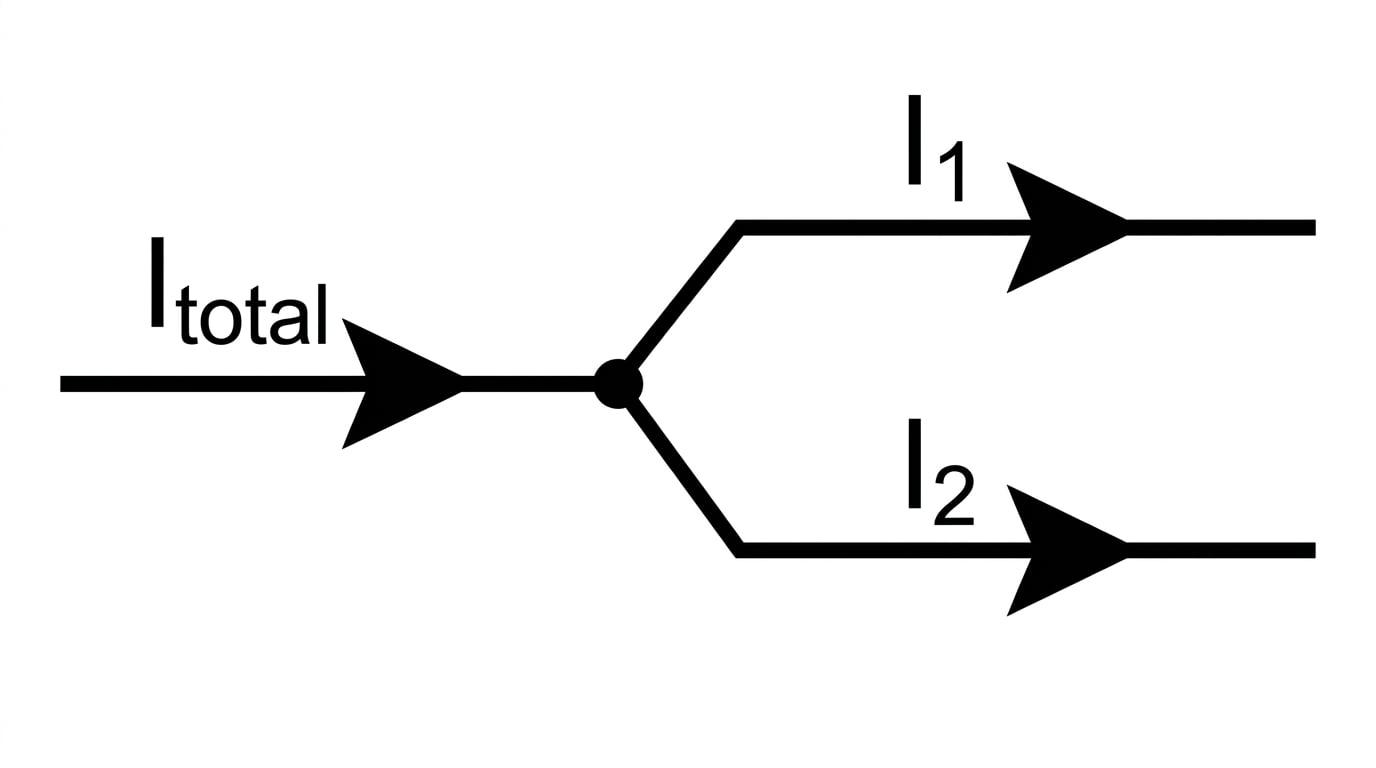
If you have 5 amps of current flowing down a wire and it splits into two branches, the sum of the currents in the two branches must equal 5 amps. This principle is sometimes called Kirchhoff's First Law.
Conservation of Energy
Energy must also be conserved. The energy provided to the charge carriers by the power supply (the electromotive force, or emf) must be completely transferred to the components in the circuit (the potential difference, or p.d.) by the time the charges return to the supply.
In any closed loop of a circuit, the total voltage provided by the cells equals the sum of the potential differences across the components in that loop. This principle is sometimes called Kirchhoff's Second Law.
Current and Voltage rules
- In a series circuit: The current is the same everywhere. The total voltage is shared between the components.
- In a parallel circuit: The total current is shared between the branches. The voltage across each parallel branch is the same.
Resistors in Series and Parallel
In many circuits, you will find multiple resistors connected together. To figure out the total current drawn from the battery, you need to find the equivalent total resistance of the whole circuit network.
Resistors in Series
When components are connected one after another in a single path, they are in series. Because the current has to push through every single resistor in turn, the total resistance simply adds up.
RT=R1+R2+R3+… R_T = R_1 + R_2 + R_3 + \dots RT=R1+R2+R3+…Resistors in Parallel
When components are connected in parallel, the current has multiple possible paths it can take. Adding more parallel branches is like opening extra checkout lanes at a supermarket — it actually makes it easier for the current to flow, so the total resistance decreases.
To calculate the total resistance RTR_TRT of resistors in parallel, we use reciprocal fractions:
1RT=1R1+1R2+1R3+… \frac{1}{R_T} = \frac{1}{R_1} + \frac{1}{R_2} + \frac{1}{R_3} + \dots RT1=R11+R21+R31+…The 'Product over Sum' shortcut
If you only have two resistors in parallel, you can use a quicker mathematical shortcut instead of dealing with fractions:
RT=R1×R2R1+R2 R_T = \frac{R_1 \times R_2}{R_1 + R_2} RT=R1+R2R1×R2Be careful: this shortcut only works for exactly two resistors at a time!
Forgetting to flip the final fraction
When using the parallel formula, your calculation gives you 1RT\frac{1}{R_T}RT1, not RTR_TRT. Always remember to turn your final fraction upside down to get the actual total resistance. A good sanity check: the total resistance of a parallel group will always be smaller than the smallest individual resistor in that group.
Mixed Circuits
Most exam questions will combine series and parallel elements. The trick is to break the circuit down into smaller chunks, calculate the resistance of the parallel parts first, and then treat them as single resistors in series with the rest of the circuit.
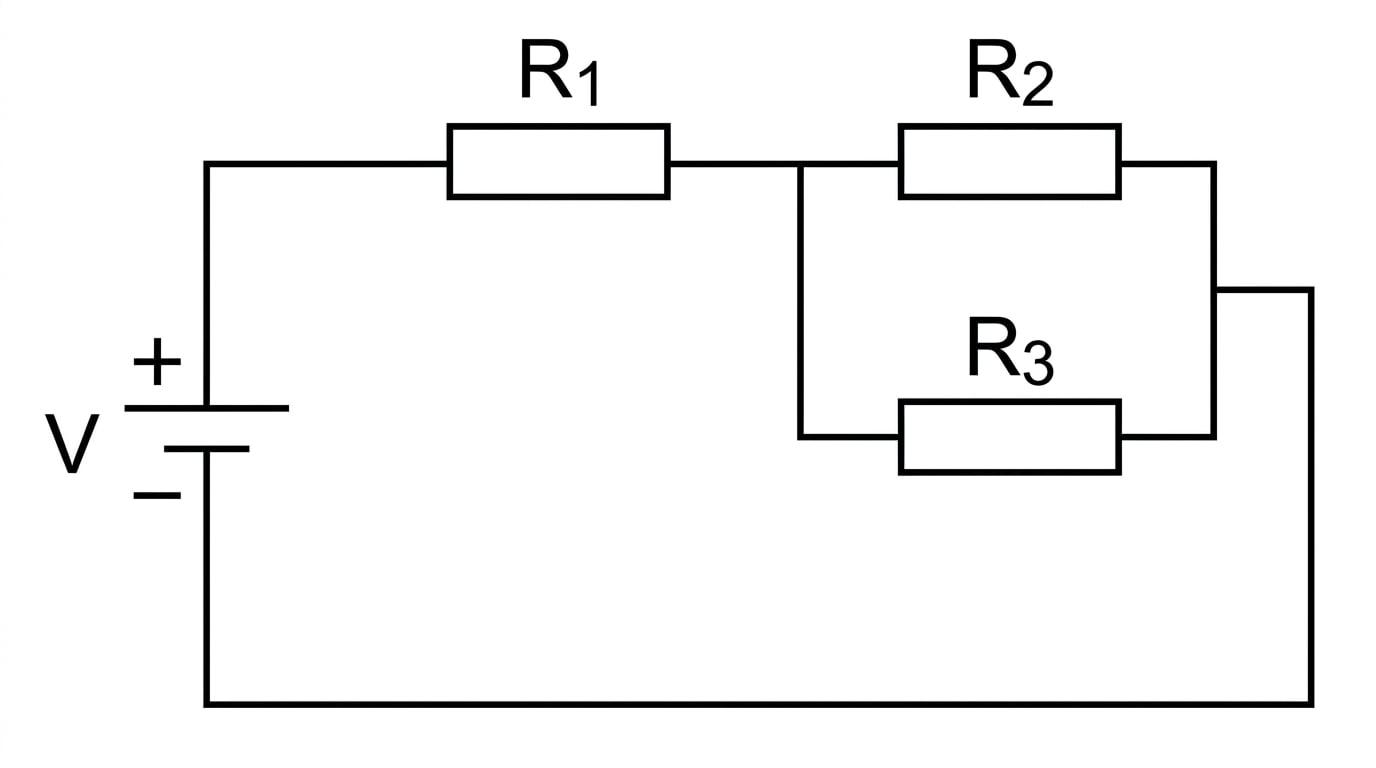
Calculating total resistance in a mixed circuit
Find the total resistance of the circuit shown in the diagram above if R1=15 ΩR_1 = 15 \text{ }\OmegaR1=15 Ω, R2=40 ΩR_2 = 40 \text{ }\OmegaR2=40 Ω, and R3=60 ΩR_3 = 60 \text{ }\OmegaR3=60 Ω.
- Identify the parallel section. Resistors R2R_2R2 and R3R_3R3 are in parallel with each other. We need to find their combined equivalent resistance, which we will call RpR_pRp.
- Calculate the parallel resistance. Using the parallel formula: 1Rp=140+1601Rp=3120+21201Rp=5120Rp=1205=24 Ω\begin{aligned} \frac{1}{R_p} &= \frac{1}{40} + \frac{1}{60} \\ \frac{1}{R_p} &= \frac{3}{120} + \frac{2}{120} \\ \frac{1}{R_p} &= \frac{5}{120} \\ R_p &= \frac{120}{5} = 24 \text{ }\Omega \end{aligned} Rp1Rp1Rp1Rp=401+601=1203+1202=1205=5120=24 Ω
- Add the series component. The entire parallel block (now effectively acting as a single 24 Ω24 \text{ }\Omega24 Ω resistor) is in series with R1R_1R1. We add them together to find the total circuit resistance RTR_TRT: RT=R1+RpRT=15+24=39 Ω\begin{aligned} R_T &= R_1 + R_p \\ R_T &= 15 + 24 = 39 \text{ }\Omega \end{aligned} RTRT=R1+Rp=15+24=39 Ω
Cells in Series and Parallel
Just like resistors, you can connect multiple power supplies (cells) together to form a battery.
Cells in Series
Connecting cells in series means joining them end-to-end (positive terminal to negative terminal). The total voltage (emf) is simply the sum of their individual voltages. If you connect a 1.5 V cell and a 3.0 V cell in series, the total voltage is 4.5 V.
Note: If a cell is connected backwards (positive to positive), it works against the other cells, and you must subtract its voltage.
Identical Cells in Parallel
If you connect identical cells in parallel (joining all positive terminals together, and all negative terminals together), the total voltage of the circuit is the same as the voltage of just one cell.
Two 1.5 V cells in parallel will only provide 1.5 V to the circuit. So why do it? Because the cells are sharing the workload. The battery pack will last twice as long before running out of energy, and it can safely supply a higher maximum current.
Non-identical cells in parallel
You should only ever connect identical cells in parallel. If you connect cells with different voltages in parallel, the one with the higher voltage will force current backwards through the one with the lower voltage, rapidly draining the battery and potentially causing damage!
Energy and Power
Electrical components transfer electrical energy into other forms (like light, heat, or kinetic energy).
Electrical Power
Power (PPP) is the rate at which energy is transferred. It is measured in watts (W), where 1 watt equals 1 joule per second.
The fundamental equation for electrical power relates it to current (III) and voltage (VVV):
P=IV P = IV P=IVBecause we know from Ohm's Law that V=IRV = IRV=IR, we can substitute this into the power equation to get two incredibly useful variations:
- Substitute V=IRV = IRV=IR into P=IVP = IVP=IV:
- Substitute I=VRI = \frac{V}{R}I=RV into P=IVP = IVP=IV:
To find the total energy (EEE) transferred over a certain amount of time (ttt), we simply multiply the power by the time in seconds.
E=IVt E = IVt E=IVtUsing the wrong voltage for power
When calculating the power dissipated by a specific resistor using P=V2RP = \frac{V^2}{R}P=RV2, make sure VVV is the potential difference across that specific resistor, not the total voltage of the entire circuit! If you aren't sure of the voltage across a specific component, it is often safer to find the current through it first and use P=I2RP = I^2RP=I2R.
Calculating energy and power
A 12 V power supply is connected in series to a 4 Ω4 \text{ }\Omega4 Ω resistor and an 8 Ω8 \text{ }\Omega8 Ω resistor. Calculate the power dissipated by the 8 Ω8 \text{ }\Omega8 Ω resistor, and the total energy transferred by the whole circuit in 2 minutes.
- Calculate the total circuit resistance. Because they are in series, add them directly:
- Calculate the total current. Using Ohm's Law for the whole circuit: I=VtotalRTI=1212=1 A\begin{aligned} I &= \frac{V_{\text{total}}}{R_T} \\ I &= \frac{12}{12} = 1 \text{ A} \end{aligned} II=RTVtotal=1212=1 A
- Calculate the power of the 8 ohm resistor. Since it's a series circuit, the current is 1 A everywhere. We use the current and the component's specific resistance: P=I2RP=12×8=8 W\begin{aligned} P &= I^2R \\ P &= 1^2 \times 8 = 8 \text{ W} \end{aligned} PP=I2R=12×8=8 W
- Calculate total energy over 2 minutes. Convert time to seconds: 2×60=120 s2 \times 60 = 120 \text{ s}2×60=120 s. Use the total voltage and total current for the whole circuit: E=IVtE=1×12×120E=1440 J\begin{aligned} E &= IVt \\ E &= 1 \times 12 \times 120 \\ E &= 1440 \text{ J} \end{aligned} EEE=IVt=1×12×120=1440 J
In the exam
- Draw on the diagram: Exam questions often feature complex circuit diagrams. Don't just stare at them — draw arrows to show the current splitting, and write down the voltages across branches as you figure them out.
- Check your parallel resistance: Always do a quick mental check when you calculate a parallel resistance. Is your answer smaller than the smallest resistor in that parallel group? If not, you probably forgot to flip the fraction!
- Watch your units: Power must be in watts and time must be in seconds before you use E=IVtE = IVtE=IVt to calculate energy in joules. Watch out for times given in minutes or hours.
Check yourself
- What happens to the total resistance of a circuit if you add another resistor in parallel?
- If a 6 V battery is connected to two parallel branches, what is the voltage drop across each individual branch?
- What are the three equations you can use to calculate electrical power?
- Why might you connect identical cells in parallel rather than using just a single cell?

