Current-voltage characteristics
What you'll learn
- How to measure and plot the current-voltage (I-V) characteristic for any electrical component.
- The precise definition of Ohm's law (and why it doesn't apply to everything).
- How to explain the unique shapes of I-V graphs for an ohmic conductor, a filament lamp, and a semiconductor diode.
- How to handle exam questions where the axes of the graph have been swapped.
Measuring I-V characteristics
A current-voltage characteristic (usually just called an "I-V characteristic") is simply a graph showing how the current flowing through a component changes as the potential difference across it is varied.
To sketch these graphs, we need to gather data pairs of current (III) and potential difference (VVV). We do this by placing the component in a circuit with a variable power supply or a variable resistor, which allows us to sweep through a range of voltages—including negative voltages, which we achieve by simply reversing the connections to the power supply.
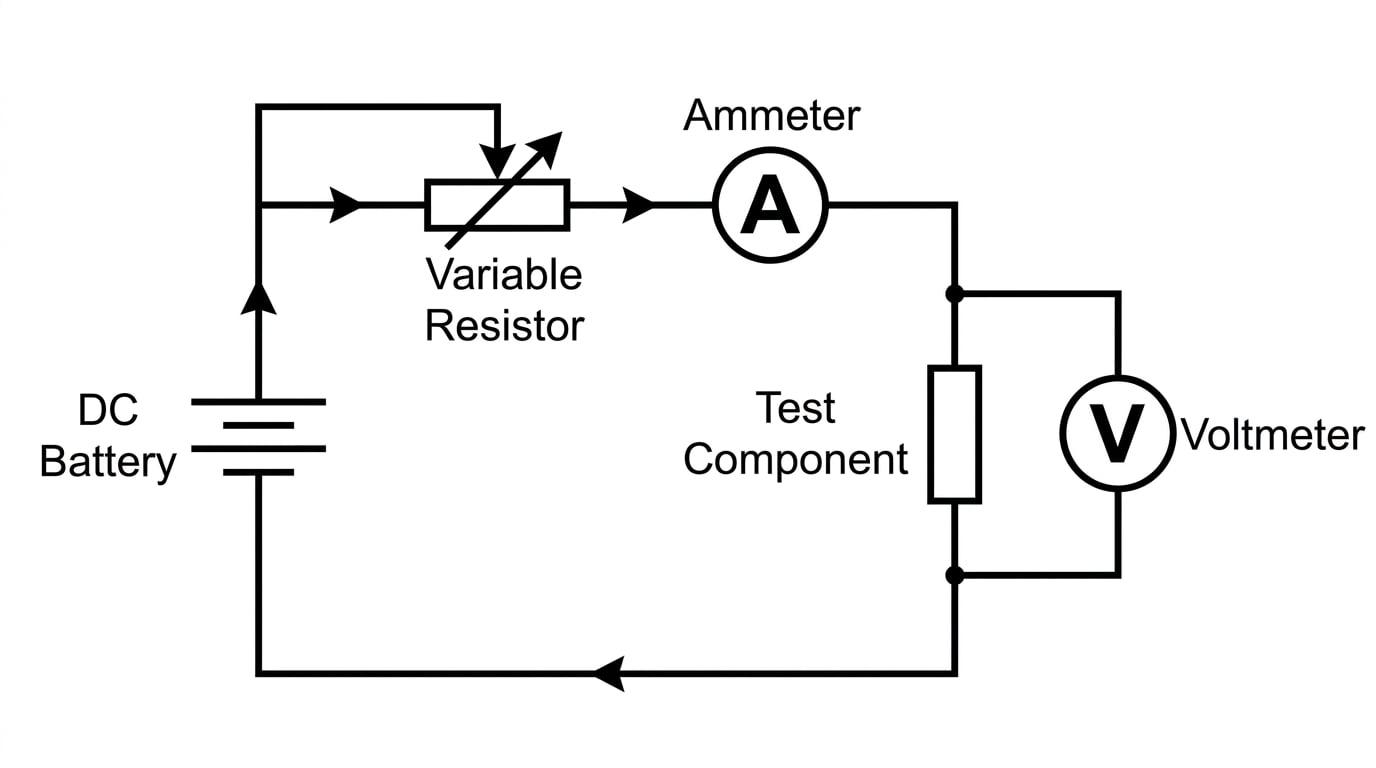
Notice the placement of the measuring instruments. We place an ammeter in series with the component to measure the current passing through it, and a voltmeter in parallel across the component to measure the potential difference.
In AQA Physics, unless a question specifically tells you otherwise, you should always assume these measuring instruments are ideal.
Ideal meters
- Ideal ammeter: Assumed to have zero resistance. This means it requires no potential difference to push current through it, so it doesn't alter the circuit's total resistance.
- Ideal voltmeter: Assumed to have infinite resistance. This means absolutely zero current flows through the voltmeter branch, ensuring the component gets the exact same current that the ammeter measures.
Ohm's law and Ohmic conductors
You have probably used the equation V=IRV = IRV=IR many times. However, a very common misconception is thinking that this equation is Ohm's law. In fact, R=VIR = \frac{V}{I}R=IV is simply the definition of resistance. It is true for any component at a specific point in time.
Ohm's law is a much stricter, special case that only applies to certain materials under certain conditions.
Ohm's Law
Ohm's law states that the current flowing through a conductor is directly proportional to the potential difference across it, provided that the physical conditions (such as temperature) remain constant. Mathematically: I∝VI \propto VI∝V
Components that obey Ohm's law are called ohmic conductors. A standard metal wire at a constant temperature is a perfect example. Because III is directly proportional to VVV, the resistance (RRR) remains perfectly constant regardless of how much current is flowing.
The Big Three: Standard I-V Graphs
You need to recognize, sketch, and explain the I-V characteristics for three specific components: the ohmic conductor, the filament lamp, and the semiconductor diode.
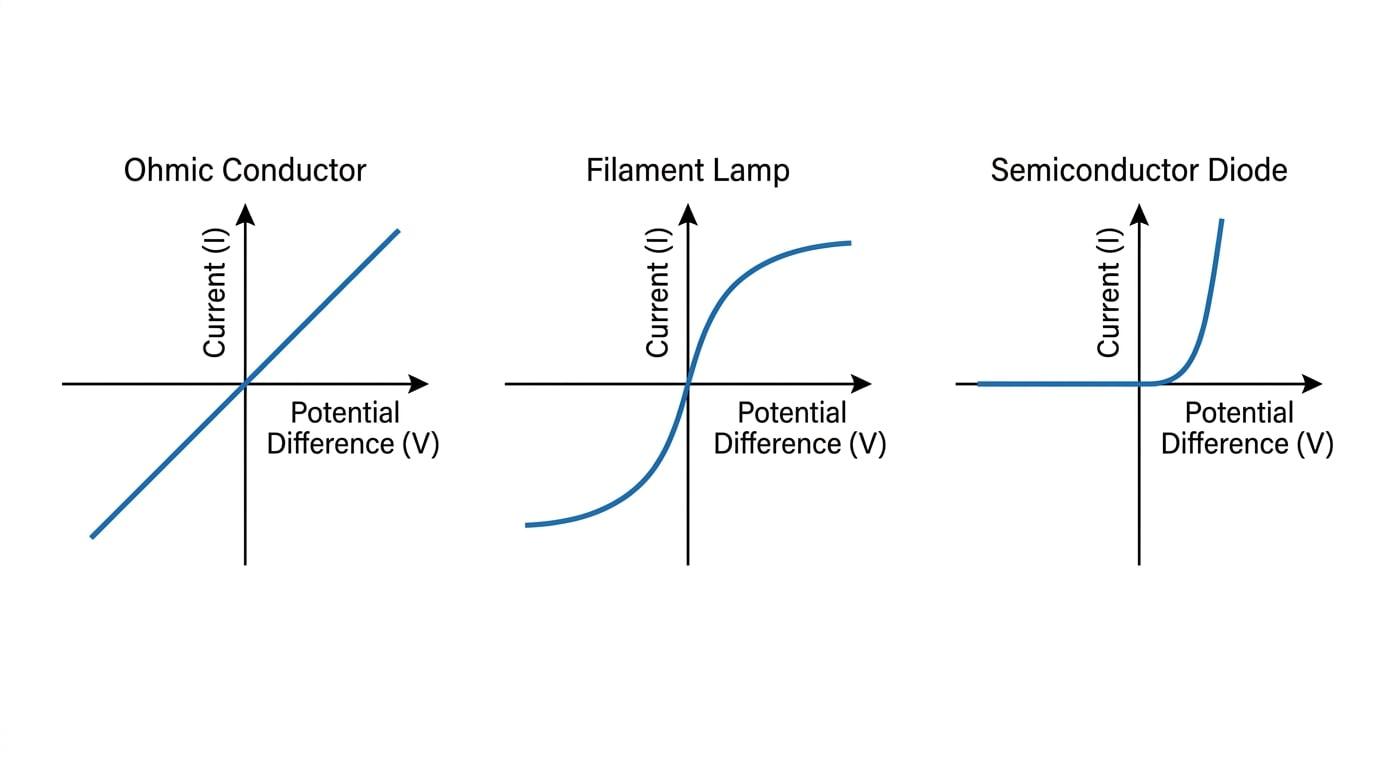
Let's break down the physics behind each shape.
1. The Ohmic Conductor
- Shape: A straight line passing exactly through the origin (0,00, 00,0).
- Explanation: Because it obeys Ohm's law, doubling the voltage exactly doubles the current. The ratio of VVV to III is constant, meaning the resistance is constant. This straight-line behaviour holds in both the positive and negative directions (whether the current flows forwards or backwards).
2. The Filament Lamp
- Shape: An "S-shape" curve that passes through the origin. It starts steep but its gradient decreases as the voltage gets higher in both the positive and negative directions.
- Explanation: A filament lamp is non-ohmic. As the current increases, more electrical energy is converted to heat, increasing the temperature of the metal filament. The positive metal ions in the crystal lattice vibrate with a greater amplitude. The drifting electrons now collide more frequently with these vibrating ions, making it harder for current to flow. Therefore, as voltage increases, the resistance increases, and the current does not rise as quickly.
3. The Semiconductor Diode
- Shape: Flat along the zero line for negative voltages, remaining flat until a small positive voltage, after which it shoots up very steeply.
- Explanation: A diode is a component that only allows current to flow in one direction.
- Forward bias (positive VVV): The diode will not conduct until a specific threshold voltage is reached (usually around 0.6 V0.6 \text{ V}0.6 V to 0.7 V0.7 \text{ V}0.7 V for silicon). After this point, its resistance drops rapidly, and current flows freely.
- Reverse bias (negative VVV): The resistance of the diode is incredibly high. The current is effectively zero, regardless of the potential difference (until it reaches a very high "breakdown voltage", which is usually off the edge of standard A-level graphs).
Comparing gradients
On a standard I-V graph (where Current is on the y-axis and Voltage is on the x-axis), a steeper line means a lower resistance. Why? Because a steep line means you get a very large increase in current for only a tiny increase in voltage.
Dealing with swapped axes
The AQA specification explicitly warns that questions can place either III or VVV on the horizontal axis. You must always check the axis labels before assuming the shape of the graph!
If a graph plots VVV on the y-axis and III on the x-axis, the visual rules flip:
- A steeper line now represents a higher resistance (a large voltage is required to produce a small current).
- A filament lamp on a V−IV-IV−I graph will curve upwards (the gradient gets steeper as III increases, showing that resistance is increasing).
Resistance from a curve
For non-ohmic components (like the filament lamp), students often think that the resistance at a specific point is equal to 1÷gradient1 \div \text{gradient}1÷gradient of the tangent to the curve at that point. This is false. Resistance is always defined as the ratio R=VIR = \frac{V}{I}R=IV. To find the resistance at any point on a curve, you simply read the VVV coordinate and the III coordinate at that exact point and divide them. Ignore the gradient of the curve completely!
Worked Example
Calculating resistance from a non-ohmic graph
A student plots an I-V characteristic for a filament lamp. Current (III) is on the y-axis in Amperes (A\text{A}A) and potential difference (VVV) is on the x-axis in Volts (V\text{V}V). At V=2.0 VV = 2.0 \text{ V}V=2.0 V, the current is 0.40 A0.40 \text{ A}0.40 A. At V=6.0 VV = 6.0 \text{ V}V=6.0 V, the current is 0.80 A0.80 \text{ A}0.80 A.
Calculate the resistance of the lamp at 6.0 V6.0 \text{ V}6.0 V and explain how the data shows the lamp is non-ohmic.
- First, identify the formula for resistance at a specific point.
- Substitute the coordinates for the second point (V=6.0 VV = 6.0 \text{ V}V=6.0 V).
- Calculate the resistance at 6.0 V6.0 \text{ V}6.0 V.
- To prove it is non-ohmic, show that the resistance changes (it is not constant). Calculate the resistance at 2.0 V2.0 \text{ V}2.0 V.
- State your conclusion clearly. Because 5.0 \Omega≠7.5 \Omega5.0 \text{ \Omega} \neq 7.5 \text{ \Omega}5.0 \Omega=7.5 \Omega, the resistance has increased as the potential difference increased. Therefore, III is not directly proportional to VVV, so the lamp does not obey Ohm's law.
In the exam
- Check the axes immediately: Don't jump to conclusions. An S-shape curve might look like a filament lamp, but if the axes are VVV (y-axis) against III (x-axis), an S-shape would actually mean resistance is decreasing! Always read the labels.
- Watch your units: I-V graphs often put current in milliamperes (mA\text{mA}mA). Don't forget to multiply by 10−310^{-3}10−3 when calculating resistance (R=VIR = \frac{V}{I}R=IV).
- Use the right vocabulary: If asked to explain a filament lamp's characteristic, examiners actively look for the phrase "ions vibrate with greater amplitude". Do not say "atoms vibrate more" or "electrons vibrate".
Check yourself
- If a component obeys Ohm's law, what must remain constant?
- What is the difference between an ideal ammeter and an ideal voltmeter?
- Why does the resistance of a semiconductor diode depend heavily on the polarity (direction) of the potential difference?
- If a graph plots VVV on the y-axis and III on the x-axis, how do you calculate resistance for a point on a curve?