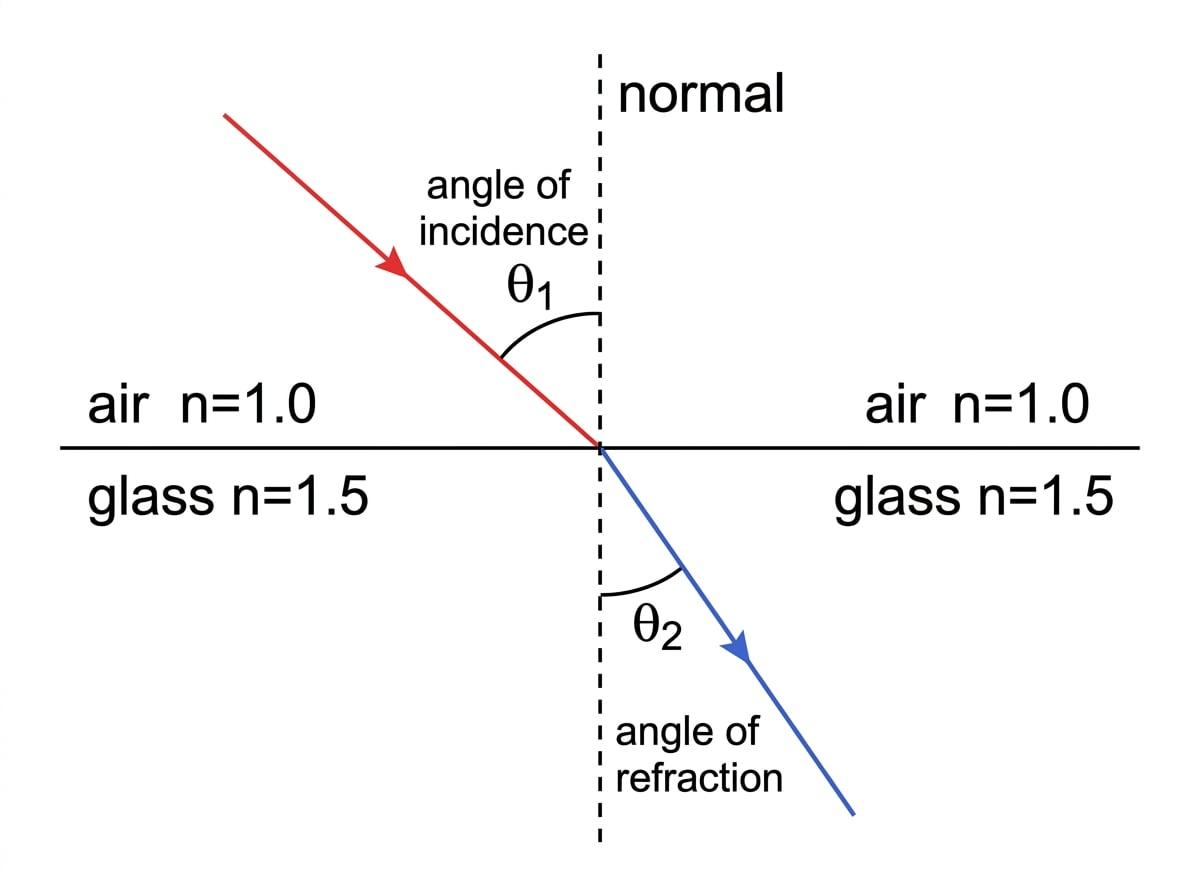
When light travels from one medium (like air) into another (like glass), it changes speed. If it hits the boundary at an angle, this change in speed causes the light to change direction. This bending of light is called refraction.
What you'll learn:
- How to calculate the absolute refractive index of a material.
- How to use Snell's law to find angles of refraction.
- The conditions required for Total Internal Reflection (TIR).
- How optical fibres use TIR, and the challenges of pulse broadening and absorption.
1. Absolute Refractive Index
Every transparent material has an optical density, which tells us how much it slows down light. We measure this using the absolute refractive index.
Absolute Refractive Index
The absolute refractive index, nnn, of a substance is the ratio of the speed of light in a vacuum to the speed of light in that substance:
n=ccs n = \frac{c}{c_s} n=cscWhere:
- ccc is the speed of light in a vacuum (3.00×10⁸ m s−13.00 \times 10^8 \text{ m s}^{-1}3.00×10⁸ m s−1)
- csc_scs is the speed of light in the substance (in m s−1\text{m s}^{-1}m s−1)
Because ccc is the maximum possible speed for light, csc_scs is always less than or equal to ccc. This means the absolute refractive index nnn is always greater than or equal to 1.
The Refractive Index of Air
For A-Level Physics, the speed of light in air is so close to the speed of light in a vacuum that you must assume the refractive index of air is exactly 111 (nair≈1n_{\text{air}} \approx 1nair≈1).
Calculating refractive index
The speed of light in a block of crown glass is 1.97×10⁸ m s−11.97 \times 10^8 \text{ m s}^{-1}1.97×10⁸ m s−1. Calculate the absolute refractive index of the glass.
- State the formula for refractive index:
- Substitute the known values. The speed of light in a vacuum is c=3.00×10⁸ m s−1c = 3.00 \times 10^8 \text{ m s}^{-1}c=3.00×10⁸ m s−1:
- Calculate the final answer. Notice that the units cancel out, so refractive index has no units:
2. Snell's Law of Refraction
When light crosses a boundary between two materials with different refractive indices, we can predict exactly how much it will bend using Snell's Law.
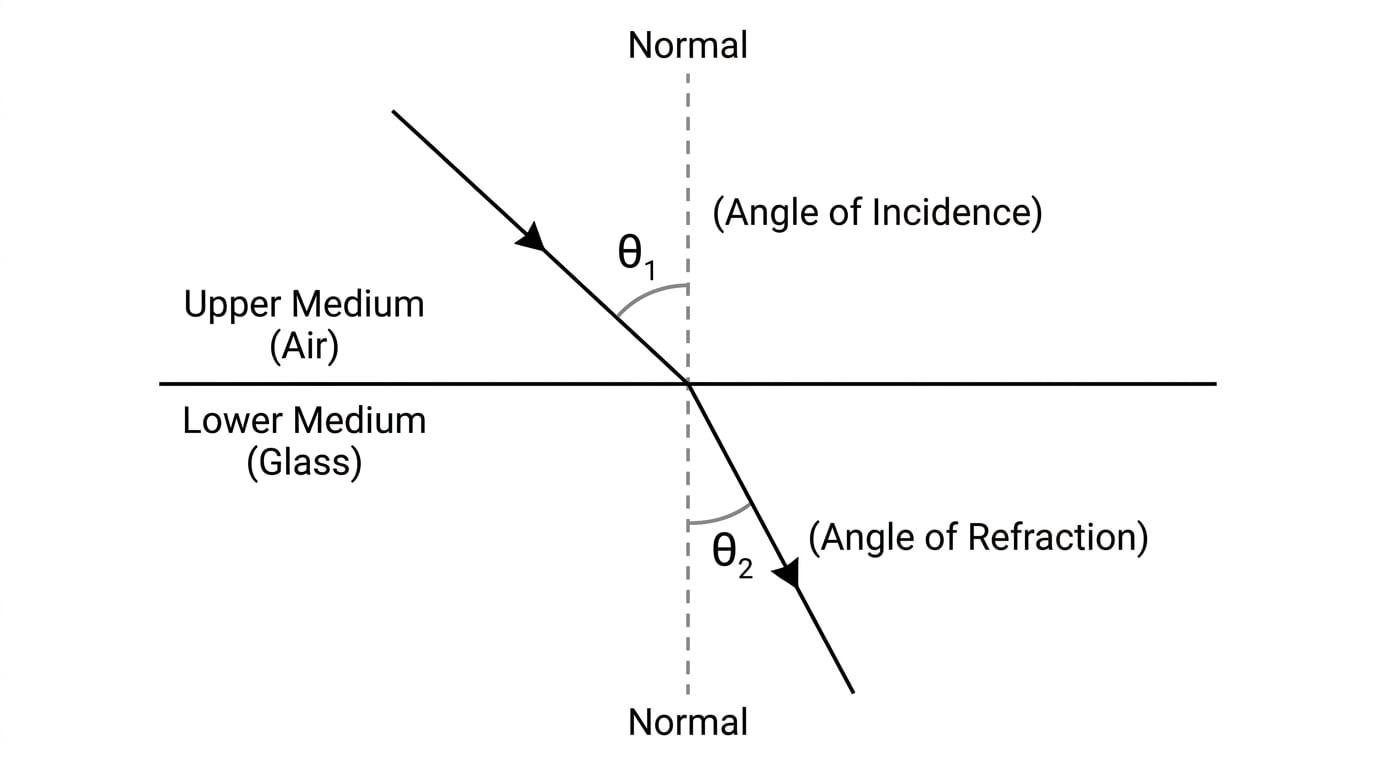
- If light enters an optically denser medium (higher nnn), it slows down and bends towards the normal.
- If light enters an optically less dense medium (lower nnn), it speeds up and bends away from the normal.
Snell's Law links the refractive indices of the two materials to the angles the light ray makes with the normal line:
n1sinθ1=n2sinθ2 n_1 \sin \theta_1 = n_2 \sin \theta_2 n1sinθ1=n2sinθ2Where:
- n1n_1n1 is the refractive index of the first material.
- θ1\theta_1θ1 is the angle of incidence (the angle the incoming ray makes with the normal).
- n2n_2n2 is the refractive index of the second material.
- θ2\theta_2θ2 is the angle of refraction (the angle the outgoing ray makes with the normal).
Measuring from the boundary
Always measure your angles from the normal (the imaginary line drawn at 90∘90^\circ90∘ to the boundary), never from the boundary surface itself. If an exam question says "a ray strikes the glass surface at an angle of 30∘30^\circ30∘ to the surface", your angle of incidence θ1\theta_1θ1 is actually 90∘−30∘=60∘90^\circ - 30^\circ = 60^\circ90∘−30∘=60∘.
Using Snell's Law
A light ray travelling in air hits a flat pool of water (n=1.33n = 1.33n=1.33) at an angle of incidence of 40∘40^\circ40∘. Calculate the angle of refraction.
- List your known values. Since the first material is air, n1=1n_1 = 1n1=1. The angle of incidence θ1=40∘\theta_1 = 40^\circθ1=40∘, and n2=1.33n_2 = 1.33n2=1.33.
- State Snell's Law:
- Substitute the values into the equation:
- Rearrange to make sinθ2\sin \theta_2sinθ2 the subject:
- Take the inverse sine to find the angle:
3. Total Internal Reflection (TIR)
When light travels from an optically denser medium to a less dense one (e.g., from glass to air), it bends away from the normal. As you increase the angle of incidence, the angle of refraction also increases.
Eventually, you reach a specific angle of incidence where the light bends so much that it travels perfectly along the boundary between the two materials (an angle of refraction of 90∘90^\circ90∘). This specific angle of incidence is called the critical angle (θc\theta_cθc).
If you increase the angle of incidence beyond the critical angle, refraction is no longer possible. All the light is reflected back inside the denser material. This is Total Internal Reflection (TIR).
Conditions for TIR
For TIR to occur, two conditions must be met:
- The light must be travelling from a material with a higher refractive index to a material with a lower refractive index (n1>n2n_1 > n_2n1>n2).
- The angle of incidence must be greater than the critical angle (θ1>θc\theta_1 > \theta_cθ1>θc).
We can calculate the critical angle by plugging θ2=90∘\theta_2 = 90^\circθ2=90∘ into Snell's Law. Because sin(90∘)=1\sin(90^\circ) = 1sin(90∘)=1, the equation simplifies to:
sinθc=n2n1 \sin \theta_c = \frac{n_2}{n_1} sinθc=n1n2Finding the critical angle
Calculate the critical angle for a boundary between diamond (n1=2.42n_1 = 2.42n1=2.42) and air.
- Identify the two refractive indices. The ray travels from diamond (n1=2.42n_1 = 2.42n1=2.42) into air (n2=1n_2 = 1n2=1).
- State the critical angle formula:
- Substitute the values:
- Take the inverse sine:
4. Fibre Optics
Total internal reflection is incredibly useful. It allows us to trap light inside long, thin glass tubes called optical fibres and transmit data (like internet signals) over vast distances. AQA expects you to understand the "step-index" optical fibre.
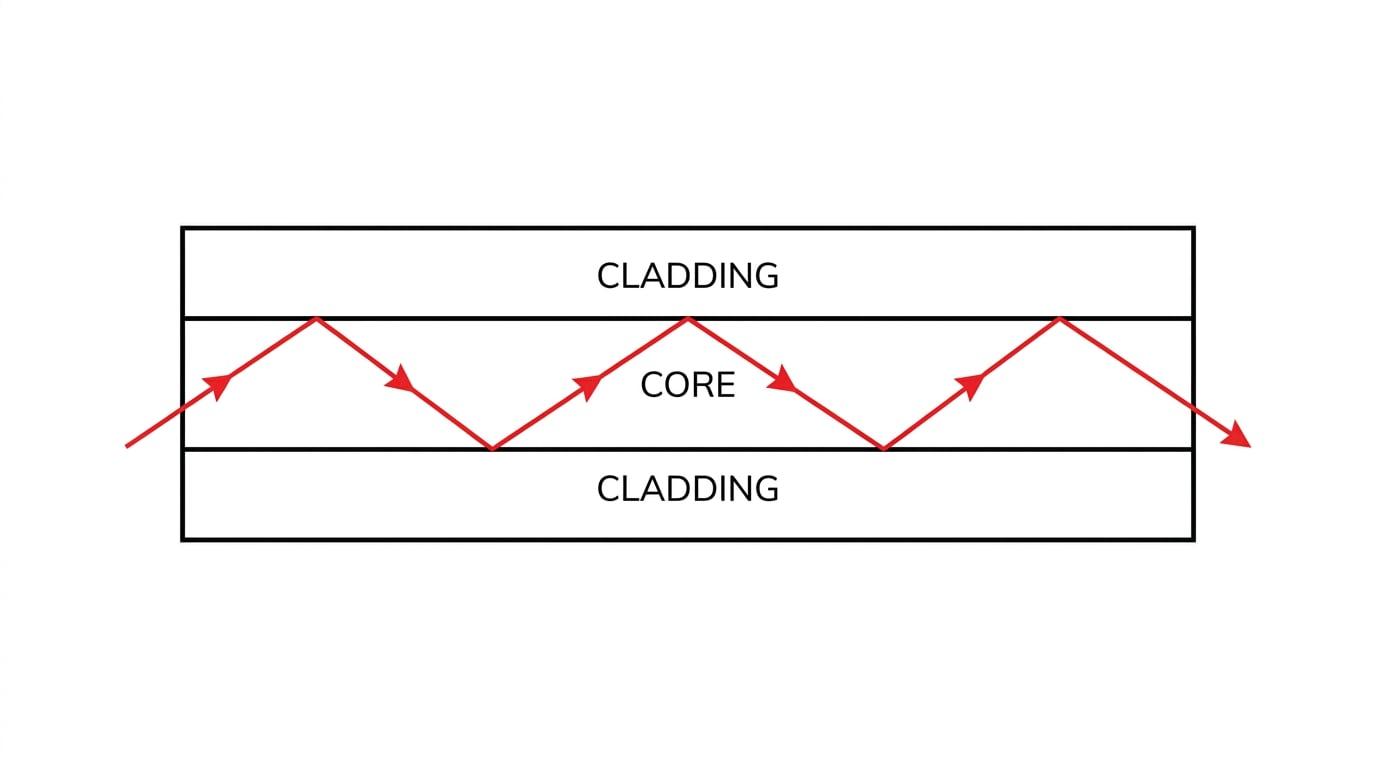
A step-index optical fibre consists of two main parts:
- The Core: The highly transparent central channel where the light travels.
- The Cladding: An outer layer of glass surrounding the core.
The Function of the Cladding
The cladding is not just there for protection. It must have a lower refractive index than the core. This is essential because TIR can only happen when light travels from a higher nnn to a lower nnn.
The cladding also prevents "crosstalk" (light leaking from one fibre into an adjacent one, which would corrupt data) and protects the core boundary from scratches that would let light escape.
Signal Degradation
As signals travel down an optical fibre, the quality of the signal degrades. There are two main problems you need to know about: absorption and pulse broadening.
1. Absorption
Even the clearest glass is not perfectly transparent. As light travels through the fibre, some energy is absorbed by the material itself. This reduces the amplitude (intensity) of the signal, meaning the signal becomes fainter. If a fibre is too long, the signal might drop below the threshold the receiver can detect.
2. Pulse Broadening (Dispersion)
Digital signals are sent as sharp, distinct pulses of light. Over a long distance, these pulses can spread out (broaden) in time. If pulses broaden too much, they overlap, and the receiver cannot distinguish one pulse from the next (leading to lost data). Pulse broadening is caused by two types of dispersion:
- Modal dispersion: Light rays entering the fibre at different angles will take different paths (modes). A ray bouncing back and forth heavily down the core travels a longer total distance than a ray travelling straight down the middle. Therefore, different rays arrive at different times, stretching the pulse. Solution: Make the core as narrow as possible, creating a single-mode fibre where light can only take one path.
- Material dispersion: White light is made of different colours (wavelengths), and the refractive index of glass is slightly different for each colour. This means blue light travels slightly slower through the glass than red light. As a result, the colours separate and arrive at different times, smearing the pulse. Solution: Use perfectly monochromatic light (e.g., from a high-quality laser) so all the light travels at the exact same speed.
In the exam
- Check your calculator mode: Exam questions on refraction always use degrees, so make sure your calculator is in Degree (DEG) mode, not Radians (RAD).
- Sanity check the angle: If light enters a denser material, the angle with the normal must get smaller. If your calculated θ2\theta_2θ2 is larger than your θ1\theta_1θ1, you have likely swapped n1n_1n1 and n2n_2n2.
- Justify TIR: If a question asks "Explain the path of the light ray", you must calculate the critical angle and explicitly state "because the angle of incidence (X∘X^\circX∘) is greater than the critical angle (Y∘Y^\circY∘), total internal reflection occurs".
Check yourself
- What is the value of the absolute refractive index of air, and why is the refractive index of a material never less than 1?
- Why must the cladding of an optical fibre have a lower refractive index than the core?
- What is the difference between modal dispersion and material dispersion?
- How does absorption affect a light pulse differently from dispersion?