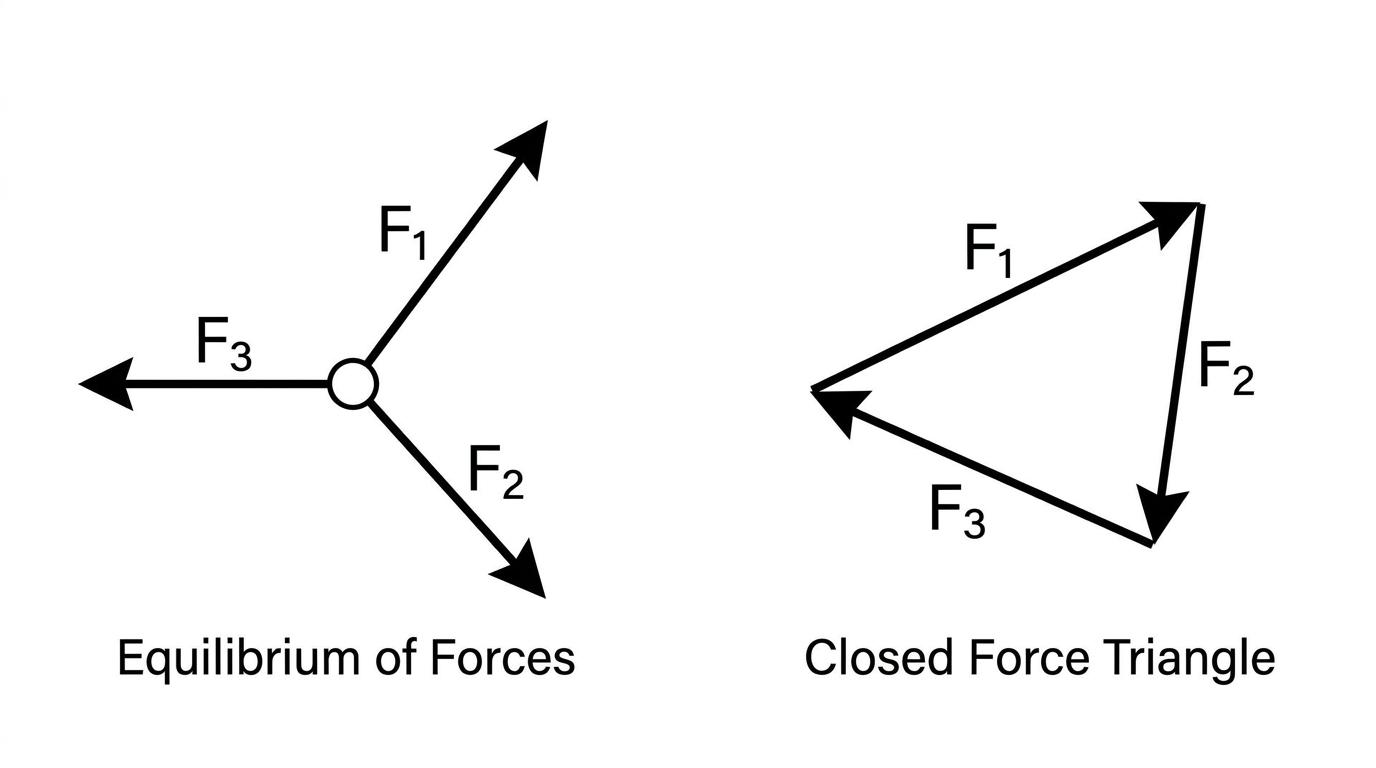
In exam questions, you can prove three forces are in equilibrium (or find a missing force) in two ways:
- By resolving: Resolve all forces horizontally and vertically. The sum of the upward forces must equal the downward forces, and the sum of leftward forces must equal rightward forces.
- By drawing a closed triangle: Draw a scale diagram of the forces tip-to-tail and verify that they form a closed loop.
Example
Finding an unknown force in equilibrium
An object is hanging from a ceiling, suspended by two strings. The tension in string A is 15 N15 \text{ N}15 N pulling at an angle of 40∘40^\circ40∘ to the vertical. The string B pulls completely horizontally. The object is stationary. Calculate the weight of the object.
- Recognise the state: The object is stationary, meaning it is in equilibrium. The sum of all vertical forces is zero, and the sum of all horizontal forces is zero.
- Identify vertical forces: The only force pulling downwards is the weight, WWW. The only force with an upward component is the tension in string A. String B is perfectly horizontal, so it has no vertical component.
- Resolve the upward force: The vertical component of tension A is adjacent to the 40∘40^\circ40∘ angle (from the vertical).
- Equate upward and downward forces:
Exam technique
In the exam
- Watch out for "constant velocity" / "terminal velocity". Examiners love stating a car is moving at constant velocity, and then asking for the resultant force. Don't waste time calculating – if velocity is constant, the resultant force is 0 N0 \text{ N}0 N.
- Identify the angle before you resolve. Never guess whether to use sine or cosine. Quickly draw the right-angled triangle. Ask yourself: "Is the component I want opposite or adjacent to the angle I have?"
- Check your scale diagram arrows. When drawing closed triangles for equilibrium, make sure the arrows actually follow each other around the loop tip-to-tail. If two arrows meet tip-to-tip, your triangle is wrong!
Self review
Check yourself
- Can you name three scalar quantities and three vector quantities?
- If an object is moving at 20 m s−120 \text{ m s}^{-1}20 m s−1 in a straight line with no acceleration, what can you say about the coplanar forces acting on it?
- When resolving the weight of an object on a ramp, which trigonometric function gives the component parallel to the slope: sine or cosine?
- How do you graphically arrange two vectors to find their resultant?