Diffraction
Welcome to Diffraction! When light encounters an obstacle or a gap, it doesn't just cast a perfectly sharp shadow — it spreads out. This topic is all about understanding exactly how and why that happens, and how we can use this behaviour to split light into precise spectra.
What you'll learn:
- How a single slit diffracts monochromatic light compared to white light.
- How changing the slit width or the wavelength alters the diffraction pattern.
- How a diffraction grating produces incredibly sharp, bright interference patterns.
- How to derive and use the diffraction grating formula, dsinθ=nλd \sin \theta = n \lambdadsinθ=nλ.
Single Slit Diffraction
When waves pass through a gap or around an obstacle, they spread out into the "shadow" region.
Diffraction
Diffraction is the spreading out of a wave when it passes through a gap or around the edge of an obstacle.
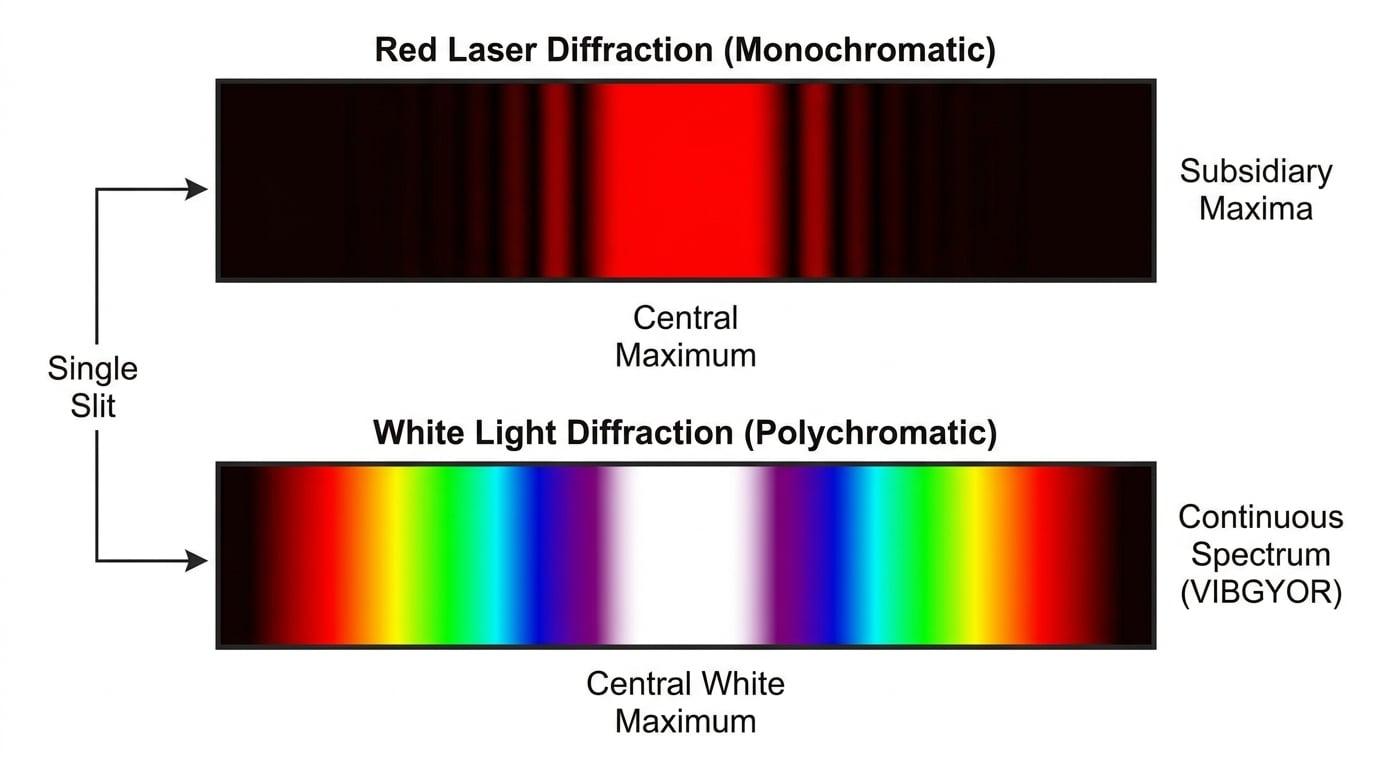
For diffraction to be noticeable, the size of the gap must be similar to the wavelength of the wave. If you shine a laser beam (which is monochromatic, meaning it has exactly one wavelength) through a very narrow single slit onto a screen, you don't just see a single line of light. Instead, interference between wavelets originating from different points across the slit creates a distinctive pattern of bright and dark fringes.
The Monochromatic Pattern
If you use a monochromatic light source, the pattern on the screen has three key features:
- A central maximum: This is a bright band in the very middle. It is exactly twice as wide as any of the other bright bands, and it is overwhelmingly the brightest part of the pattern.
- Subsidiary maxima: These are the narrower, much dimmer bright bands on either side of the central maximum. They fade rapidly in brightness the further you look from the centre.
- Dark fringes (minima): These exist between the bright bands where the light waves cancel each other out (destructive interference).
Changing the Pattern
You need to know qualitatively (without numbers) how the central maximum changes if you alter your setup. The amount of diffraction depends on the ratio of the wavelength, λ\lambdaλ, to the slit width, aaa.
- Increasing the wavelength: If you switch from a blue laser (≈400 nm\approx 400 \text{ nm}≈400 nm) to a red laser (≈650 nm\approx 650 \text{ nm}≈650 nm), the wavelength is larger, so the waves diffract more. The central maximum becomes wider.
- Decreasing the slit width: If you make the gap narrower, the gap size approaches the wavelength of the light, causing more diffraction. The central maximum becomes wider and dimmer (because less light is getting through the gap overall).
Wider gap = narrower pattern
It feels totally backward, but remember: opening the slit up (making it wider) causes the light to spread out less. A wider slit produces a narrower, brighter central maximum.
Diffraction with White Light
White light is a mixture of all the visible wavelengths. When white light passes through a single slit, each wavelength diffracts by a different amount.
- The central maximum is white, because all the wavelengths arrive directly in the middle with zero path difference, constructively interfering together.
- The subsidiary maxima are spectra (miniature rainbows).
- Because blue light has the shortest wavelength, it diffracts the least. Red light has the longest visible wavelength, so it diffracts the most. Therefore, in the coloured bands, blue is closest to the centre and red is furthest away.
The Diffraction Grating
A double-slit experiment produces blurry fringes because there are only two wave sources interfering. If we want really sharp, precise lines of light, we use a diffraction grating.
Diffraction Grating
A diffraction grating is a slide containing thousands of equally spaced parallel slits.
Because there are thousands of slits, the waves passing through them only perfectly align (constructively interfere) at very specific, exact angles. At any other angle, the huge number of overlapping waves completely cancel each other out. The result is a pattern of extremely sharp, incredibly bright dots or lines called orders or maxima.
- The straight-through line is the zero-order maximum (n=0n = 0n=0).
- The first lines on either side are the first-order maxima (n=1n = 1n=1).
- The next ones are the second-order maxima (n=2n = 2n=2), and so on.
Deriving the Grating Equation
To find the angle θ\thetaθ where these bright maxima occur, we use the grating equation: dsinθ=nλd \sin \theta = n \lambdadsinθ=nλ. You need to be able to derive this from scratch.
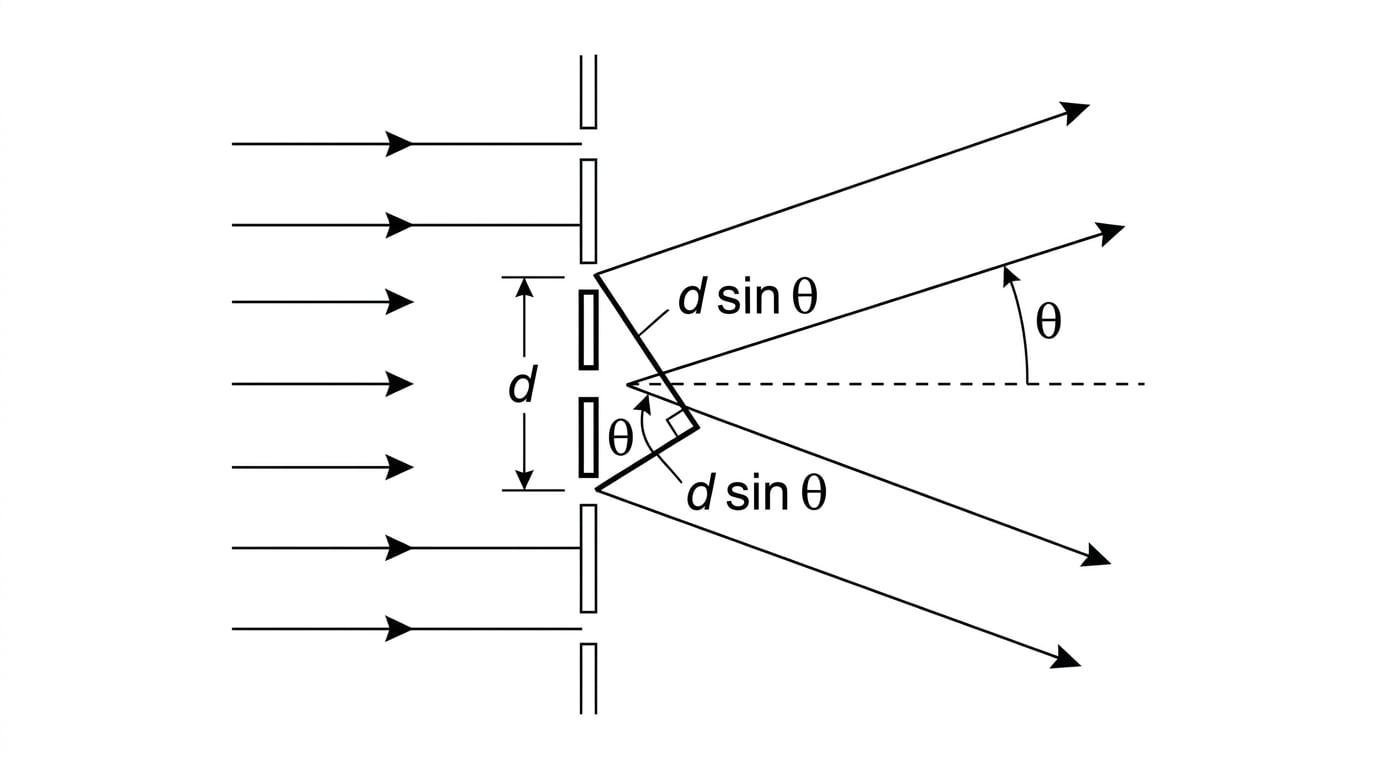
Let's look closely at two adjacent slits on the grating, separated by a distance ddd.
For light from these two slits to constructively interfere and form a bright maximum at an angle θ\thetaθ, the wave from the bottom slit must travel exactly a whole number of wavelengths (nλn \lambdanλ) further than the wave from the top slit. We call this the path difference.
- We draw a right-angled triangle between the two adjacent slits. The hypotenuse is the slit spacing, ddd.
- The angle of diffraction is θ\thetaθ. Using geometry, the angle inside the triangle is also θ\thetaθ.
- The opposite side of this triangle represents the extra distance the bottom wave must travel. This is our path difference.
- Using basic trigonometry: sinθ=OppositeHypotenuse\sin \theta = \frac{\text{Opposite}}{\text{Hypotenuse}}sinθ=HypotenuseOpposite.
- Rearranging gives: Opposite=dsinθ\text{Opposite} = d \sin \thetaOpposite=dsinθ.
- For a bright maximum to form, the path difference must equal a whole number of wavelengths. Therefore, we set the opposite side equal to nλn \lambdanλ.
- This gives our final equation: dsinθ=nλd \sin \theta = n \lambdadsinθ=nλ.
The Diffraction Grating Equation
Where:
- ddd is the distance between adjacent slits in metres (m\text{m}m).
- θ\thetaθ is the angle between the zero-order maximum and the nthn^{\text{th}}nth order maximum.
- nnn is the order of the maximum (an integer: 0,1,2,…0, 1, 2, \dots0,1,2,…).
- λ\lambdaλ is the wavelength of the light in metres (m\text{m}m).
Using the Grating Equation
The hardest part of these calculations is usually finding ddd. Exam questions rarely give you the slit spacing directly in metres. Instead, they give you the number of lines per millimetre (often written as lines mm−1\text{lines mm}^{-1}lines mm−1).
Finding slit spacing d
To find ddd in metres, you must first convert the grating's rating to "lines per metre", and then take the reciprocal:
d=1lines per metre d = \frac{1}{\text{lines per metre}} d=lines per metre1For example, if a grating has 300 lines mm−1300 \text{ lines mm}^{-1}300 lines mm−1, it has 300×103 lines m−1300 \times 10^3 \text{ lines m}^{-1}300×103 lines m−1. So, d=1300×103 md = \frac{1}{300 \times 10^3} \text{ m}d=300×1031 m.
Finding the angle of a maximum
A diffraction grating with 500 lines mm−1500 \text{ lines mm}^{-1}500 lines mm−1 is illuminated normally with monochromatic light of wavelength 630 nm630 \text{ nm}630 nm. Calculate the angle of the second-order maximum.
- First, find ddd in metres. The grating has 500 lines per mm500 \text{ lines per mm}500 lines per mm, which is 500×103 lines per metre500 \times 10^3 \text{ lines per metre}500×103 lines per metre.
- Note down your other variables: n=2n = 2n=2, and λ=630×10−9 m\lambda = 630 \times 10^{-9} \text{ m}λ=630×10−9 m.
- Write out the grating equation and substitute the values in.
- Rearrange to solve for sinθ\sin \thetasinθ.
- Take the inverse sine to find θ\thetaθ.
Maximum Number of Orders
Sometimes you will be asked to calculate the total number of orders (maxima) that can be observed on a screen. The light cannot be diffracted backwards through the grating, so the maximum possible angle of diffraction is exactly 90∘90^\circ90∘ (which means sinθ\sin \thetasinθ can never exceed 111).
Calculating the maximum number of orders
Using the same grating and light as above (d=2.0×10⁻⁶ md = 2.0 \times 10^{-6} \text{ m}d=2.0×10⁻⁶ m, λ=630×10−9 m\lambda = 630 \times 10^{-9} \text{ m}λ=630×10−9 m), what is the highest order maximum visible?
- Set the diffraction angle to the absolute theoretical limit, θ=90∘\theta = 90^\circθ=90∘. This means sinθ=1\sin \theta = 1sinθ=1.
- Rearrange the grating equation to make nnn the subject.
- Substitute in the maximum possible value for sinθ\sin \thetasinθ.
- You must always round down to the nearest whole integer. A maximum is a physical line of light — you cannot see 0.170.170.17 of a line. So, the highest order is n=3n = 3n=3.
Total number of visible spots
If an exam asks for the total number of visible maxima (spots) on the screen, remember that the pattern is symmetrical! If nmax=3n_{\text{max}} = 3nmax=3, you have three spots on the left, three on the right, plus the central zero-order spot. Total spots = 3+3+1=73 + 3 + 1 = 73+3+1=7.
Applications of Diffraction Gratings
Because diffraction gratings separate different wavelengths so cleanly and sharply, they are incredibly useful tools in physics and chemistry, primarily for spectroscopy.
- Identifying elements: When you excite a gas, it emits light. If you pass this light through a grating, it splits into distinct, bright coloured lines (an atomic emission spectrum). Since every element has a unique set of energy levels, the pattern of lines perfectly identifies the element. We use this to figure out the chemical composition of distant stars.
- Measuring Red Shift: By looking at the spectra of galaxies through a diffraction grating, astronomers can measure exactly how much the specific spectral lines have been shifted towards the red end of the spectrum. This helps us calculate how fast the galaxy is receding, proving the universe is expanding.
In the exam
- Watch out for aaa versus ddd. In single slit, aaa is the width of the gap. For gratings, ddd is the spacing between gaps.
- Double-check your unit prefixes! Wavelength is almost always given in nanometres (nm\text{nm}nm, which is ×10−9 m\times 10^{-9} \text{ m}×10−9 m), and slit spacings in millimetres (mm\text{mm}mm, which is ×10−3 m\times 10^{-3} \text{ m}×10−3 m).
- When finding maximum orders, never round mathematically. Even if your calculation gives n=4.98n = 4.98n=4.98, the highest whole maximum you can physically see is n=4n = 4n=4. Rounding up would imply you can see a line at an angle greater than 90∘90^\circ90∘, which is impossible.
- When deriving the grating equation, make sure your diagram clearly labels θ\thetaθ, ddd, and the path difference as dsinθd \sin \thetadsinθ.
Check yourself
- What happens to the width of the central maximum of a single-slit pattern if you switch from a green laser to a red laser?
- In a single-slit diffraction pattern of white light, which colour is positioned closest to the central white maximum?
- How do you convert a grating rated at 600 lines mm−1600 \text{ lines mm}^{-1}600 lines mm−1 into a slit spacing ddd in metres?
- Why is a diffraction grating used in spectroscopy rather than a Young's double slit?