Nuclear radius (A-level only)
Welcome to the incredibly small world of the atomic nucleus! In earlier topics, you learned about the structure of the atom. Now, we are going to measure it.
Here is what you'll learn:
- The typical size of a nucleus.
- How to estimate nuclear radius using the closest approach of alpha particles.
- How to determine nuclear radius more accurately using high-energy electron diffraction.
- The mathematical link between a nucleus's radius and its nucleon number.
- How to prove that all atomic nuclei share the same unbelievable density.
How big is a nucleus?
To describe the nucleus, we need a unit of measurement suited to the subatomic world. The standard SI unit is still the metre, but we use a very specific prefix.
Femtometre (fm)
A common unit of length in nuclear physics. 1 fm=10−15 m1 \text{ fm} = 10^{-15} \text{ m}1 fm=10−15 m.
For context, a typical atom has a radius of about 10−10 m10^{-10} \text{ m}10−10 m. A typical nucleus has a radius of roughly 10−15 m10^{-15} \text{ m}10−15 m (or 1 fm1 \text{ fm}1 fm). This means the nucleus is about 100,000100,000100,000 times smaller than the atom itself!
To figure out exactly how large a specific nucleus is, physicists use two main experimental techniques. Let's look at both.
Method 1: Distance of closest approach
The oldest way to estimate the size of a nucleus is to fire an alpha particle directly at it. This is exactly what Ernest Rutherford did in his famous scattering experiment.
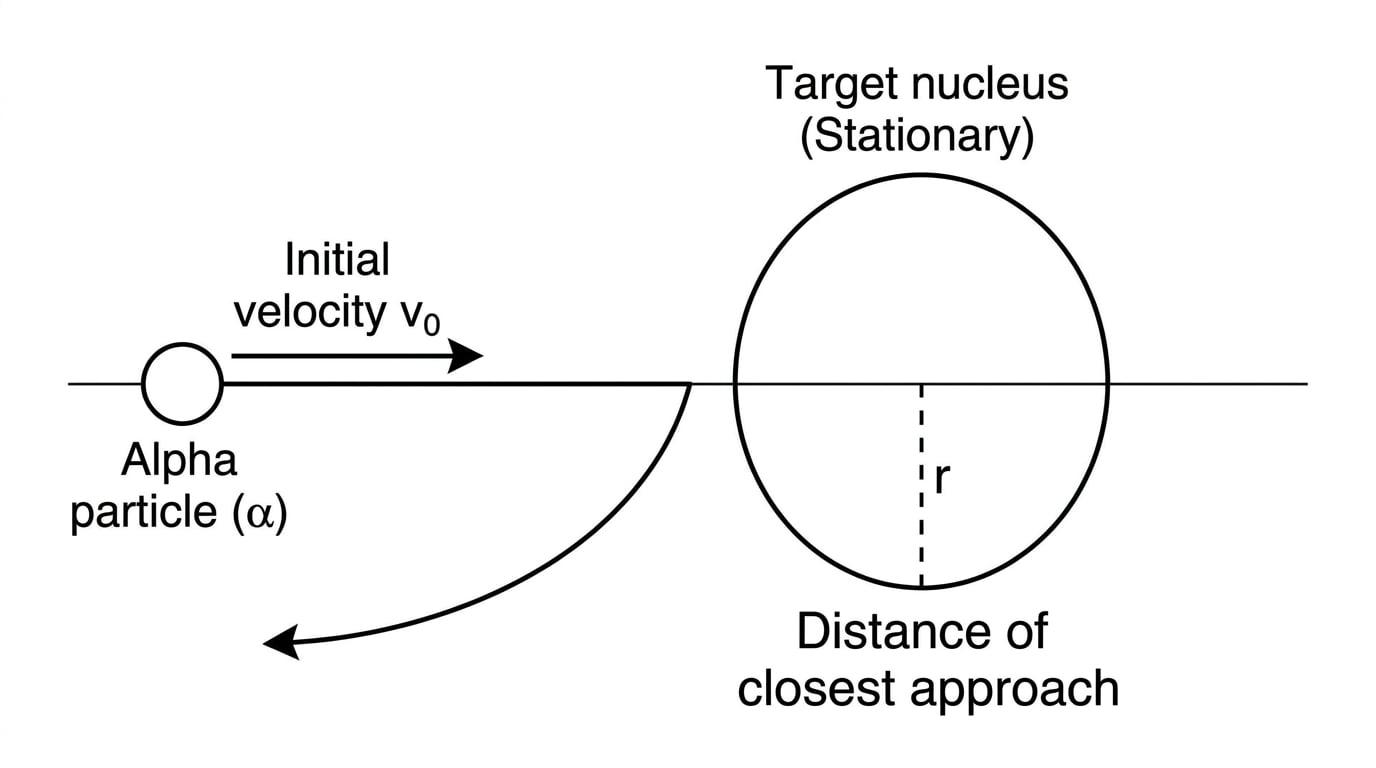
Because both the alpha particle and the target nucleus are positively charged, they repel each other via the electrostatic force. As the alpha particle gets closer, it slows down, losing kinetic energy and gaining electric potential energy.
Eventually, for a brief moment, the alpha particle comes to a complete stop before turning around and flying back. The distance between the centre of the nucleus and the point where the alpha particle stops is called the distance of closest approach.
Conservation of Energy
At the point of closest approach, all of the alpha particle's initial kinetic energy (EkE_kEk) has been converted into electric potential energy (EpE_pEp).
Ek=Ep=Q1Q24πε0rE_k = E_p = \frac{Q_1 Q_2}{4 \pi \varepsilon_0 r}Ek=Ep=4πε0rQ1Q2Where rrr is the distance of closest approach, Q1Q_1Q1 is the charge of the alpha particle, Q2Q_2Q2 is the charge of the target nucleus, and ε0\varepsilon_0ε0 is the permittivity of free space.
This distance rrr provides an upper limit for the size of the nucleus. We know the nucleus must be smaller than rrr, otherwise the alpha particle would have crashed into it!
Calculating closest approach
An alpha particle with an initial kinetic energy of 4.0 MeV4.0 \text{ MeV}4.0 MeV is fired head-on at a stationary gold nucleus (atomic number Z=79Z = 79Z=79). Estimate the maximum radius of the gold nucleus.
- Find the kinetic energy in Joules: Convert 4.0 MeV4.0 \text{ MeV}4.0 MeV into standard SI units using the conversion factor 1 eV=1.60×10⁻¹⁹ J1 \text{ eV} = 1.60 \times 10^{-19} \text{ J}1 eV=1.60×10⁻¹⁹ J. Ek=4.0×106×1.60×10−19=6.4×10⁻¹³ JE_k = 4.0 \times 10^6 \times 1.60 \times 10^{-19} = 6.4 \times 10^{-13} \text{ J}Ek=4.0×106×1.60×10−19=6.4×10⁻¹³ J
- Determine the charges involved: The charge of an alpha particle (2 protons) is Q1=2eQ_1 = 2eQ1=2e. The charge of a gold nucleus (79 protons) is Q2=79eQ_2 = 79eQ2=79e. Where the elementary charge e=1.60×10⁻¹⁹ Ce = 1.60 \times 10^{-19} \text{ C}e=1.60×10⁻¹⁹ C.
- Set up the Coulomb potential energy equation: Equate the initial kinetic energy to the electric potential energy at distance rrr. Ek=(2e)(79e)4πε0rE_k = \frac{(2e)(79e)}{4 \pi \varepsilon_0 r}Ek=4πε0r(2e)(79e)
- Rearrange for the distance of closest approach (rrr): r=158×(1.60×10−19)24πε0Ekr = \frac{158 \times (1.60 \times 10^{-19})^2}{4 \pi \varepsilon_0 E_k}r=4πε0Ek158×(1.60×10−19)2
- Substitute values and calculate: Using ε0=8.85×10⁻¹² F m−1\varepsilon_0 = 8.85 \times 10^{-12} \text{ F m}^{-1}ε0=8.85×10⁻¹² F m−1. r=158×2.56×10−384π(8.85×10⁻¹²)(6.4×10⁻¹³)=5.68×10⁻¹⁴ m\begin{aligned} r &= \frac{158 \times 2.56 \times 10^{-38}}{4 \pi (8.85 \times 10^{-12}) (6.4 \times 10^{-13})} \\ &= 5.68 \times 10^{-14} \text{ m} \end{aligned}r=4π(8.85×10⁻¹²)(6.4×10⁻¹³)158×2.56×10−38=5.68×10⁻¹⁴ m
The maximum radius of the gold nucleus is estimated to be 5.7×10⁻¹⁴ m5.7 \times 10^{-14} \text{ m}5.7×10⁻¹⁴ m.
Atomic vs Mass Number
When finding the target nucleus charge Q2Q_2Q2, students often mistakenly use the nucleon (mass) number AAA instead of the atomic (proton) number ZZZ. Remember, neutrons have no charge! The charge of the nucleus is strictly Z×eZ \times eZ×e.
Why is this only an estimate?
This method has a few flaws. First, it only gives an upper limit — it tells us where the alpha particle stopped, not where the nuclear surface actually begins. Second, alpha particles are hadrons, meaning they experience the strong nuclear force. If the alpha particle gets close enough to feel the strong force, the simple electrostatic equations we used above break down. Finally, the alpha particle has its own finite size, which blurs the measurement.
Method 2: Electron diffraction
To get a much more accurate measurement of nuclear radius, physicists use high-energy electron diffraction.
Why electrons? Because electrons are leptons. They do not experience the strong nuclear force, so their paths aren't altered by the complicated nuclear forces that affect alpha particles.
From quantum physics, we know that particles can behave like waves. If we accelerate electrons to extremely high energies, their de Broglie wavelength (λ=hp\lambda = \frac{h}{p}λ=ph) becomes comparable to the size of a nucleus (around 10−15 m10^{-15} \text{ m}10−15 m). When a beam of these high-energy electrons is directed at a thin sample of atoms, they diffract around the nuclei.
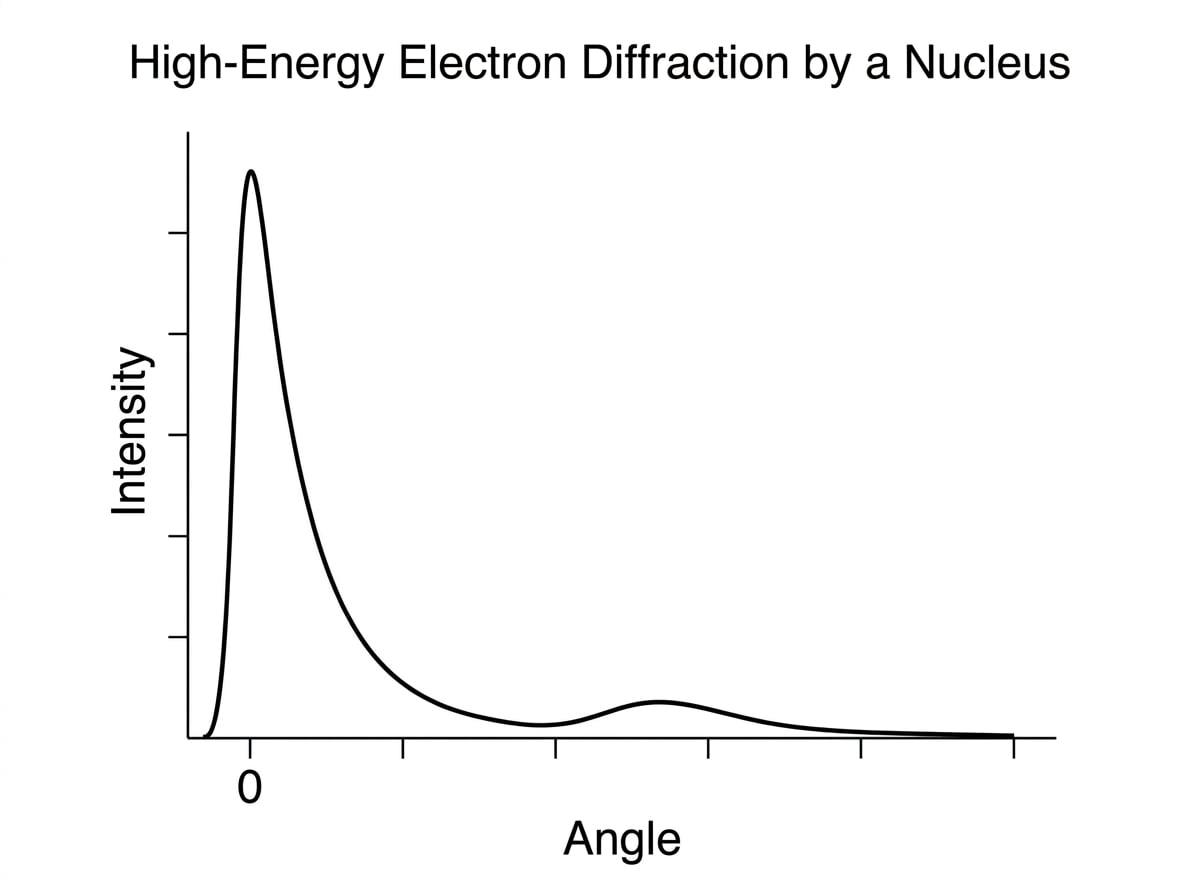
A detector is moved around the sample to measure the number of electrons scattered at different angles.
Intensity-Angle Graph
When the scattered electron intensity is plotted against the diffraction angle θ\thetaθ, the graph shows a very tall central maximum, followed by a sharp drop, and then a series of smaller "ripples" called secondary maxima.
By finding the angle θ\thetaθ of the first minimum (the dip before the first ripple), physicists can use wave diffraction equations to calculate the exact diameter of the nucleus. This is currently our most precise way to measure nuclear dimensions!
The Nuclear Radius Equation
By repeating these diffraction experiments on many different elements, physicists discovered a clear mathematical relationship between the radius of a nucleus (RRR) and its total number of nucleons (AAA).
Nuclear Radius Formula
The radius of a nucleus is directly proportional to the cube root of its nucleon number:
R=R0A1/3R = R_0 A^{1/3}R=R0A1/3Where:
- RRR is the nuclear radius (in m\text{m}m).
- R0R_0R0 is a constant, approximately 1.2×10⁻¹⁵ m1.2 \times 10^{-15} \text{ m}1.2×10⁻¹⁵ m (or 1.2 fm1.2 \text{ fm}1.2 fm).
- AAA is the nucleon number (total number of protons and neutrons).
If you plot a graph of RRR against A1/3A^{1/3}A1/3, you will get a straight line passing through the origin. The gradient of this line is the constant R0R_0R0.
Using the radius formula
Calculate the radius of a Carbon-12 nucleus. Use R0=1.2×10⁻¹⁵ mR_0 = 1.2 \times 10^{-15} \text{ m}R0=1.2×10⁻¹⁵ m.
- Identify the variables: For Carbon-12, the nucleon number A=12A = 12A=12.
- State the formula: R=R0A1/3R = R_0 A^{1/3}R=R0A1/3
- Substitute and calculate: R=(1.2×10−15)×121/3=(1.2×10−15)×2.289=2.7×10−15 m\begin{aligned} R &= (1.2 \times 10^{-15}) \times 12^{1/3} \\ &= (1.2 \times 10^{-15}) \times 2.289 \\ &= 2.7 \times 10^{-15} \text{ m} \end{aligned}R=(1.2×10−15)×121/3=(1.2×10−15)×2.289=2.7×10−15 m
Nuclear Density
One of the most fascinating consequences of the R=R0A1/3R = R_0 A^{1/3}R=R0A1/3 equation is what it tells us about the density of nuclear matter.
Let's calculate the density (ρ\rhoρ) of a generic nucleus. We will assume the nucleus is perfectly spherical, and we will use the atomic mass unit (u=1.661×10⁻²⁷ kgu = 1.661 \times 10^{-27} \text{ kg}u=1.661×10⁻²⁷ kg) as an approximation for the mass of a single nucleon.
Proving nuclear density is constant
Show that the density of nuclear material is independent of the nucleon number AAA.
- Write the formula for density: Density is mass divided by volume. ρ=mV\rho = \frac{m}{V}ρ=Vm
- Express the mass (mmm): The total mass of the nucleus is the number of nucleons (AAA) multiplied by the mass of a single nucleon (uuu). m=A⋅um = A \cdot um=A⋅u
- Express the volume (VVV): Assuming a spherical nucleus, V=43πR3V = \frac{4}{3} \pi R^3V=34πR3. Substitute the radius equation R=R0A1/3R = R_0 A^{1/3}R=R0A1/3 into the volume formula. V=43π(R0A1/3)3=43πR03A\begin{aligned} V &= \frac{4}{3} \pi (R_0 A^{1/3})^3 \\ &= \frac{4}{3} \pi R_0^3 A \end{aligned}V=34π(R0A1/3)3=34πR03A
- Substitute mass and volume back into the density formula: ρ=A⋅u43πR03A\rho = \frac{A \cdot u}{\frac{4}{3} \pi R_0^3 A}ρ=34πR03AA⋅u
- Cancel the AAA terms: ρ=u43πR03\rho = \frac{u}{\frac{4}{3} \pi R_0^3}ρ=34πR03u
Because uuu and R0R_0R0 are both constants, the density ρ\rhoρ is a constant too! The nucleon number AAA completely cancels out.
This proves that every nucleus, from lightweight helium to super-heavy uranium, has exactly the same density. If you calculate the value, it comes out to roughly 1.4×10¹⁷ kg m−31.4 \times 10^{17} \text{ kg m}^{-3}1.4×10¹⁷ kg m−3. A mere teaspoon of nuclear material would weigh over a billion tonnes!
Grapes in a jar
Why is nuclear density constant? Think of the nucleus like a jar filled with identically sized grapes (the nucleons). If you add more grapes, the jar needs to be bigger to hold them (volume increases). However, the individual grapes don't get squished to become smaller, nor do they spread out. Because the mass increases at the exact same rate as the required volume, the overall density of the "grape cluster" stays perfectly constant.
In the exam
- Always convert energy values from MeV\text{MeV}MeV or eV\text{eV}eV into Joules before plugging them into the Coulomb potential energy formula.
- In electron diffraction questions, remember to explicitly state that electrons are used because they are leptons and do not feel the strong nuclear force.
- If asked to plot a graph to prove R∝A1/3R \propto A^{1/3}R∝A1/3, explicitly state that plotting RRR against A1/3A^{1/3}A1/3 yields a straight line through the origin, and the gradient equals R0R_0R0.
- Be ready to reproduce the algebraic proof showing that nuclear density is constant. It is a highly common multi-mark question.
Check yourself
- Can you describe the energy transfer that takes place as an alpha particle approaches a nucleus?
- Why does the closest approach method usually overestimate the true size of the nucleus?
- What does the graph of intensity against angle look like for electron diffraction by a nucleus?
- Why does the formula R=R0A1/3R = R_0 A^{1/3}R=R0A1/3 imply that all nuclei have the same density?