

Welcome to the mathematics of radioactive decay! You already know what alpha, beta, and gamma radiation are, but now we need to predict how quickly a radioactive sample will disappear.
Here is what you'll learn:
- Why radioactive decay is a truly random process, yet behaves predictably for large numbers of nuclei.
- How to calculate the activity of a sample using the decay constant and Avogadro's constant.
- How to use the exponential decay equations and natural logarithms.
- How to analyse graphs (both decay curves and straight-line log graphs) to determine a substance's half-life.
The Random Nature of Decay
Radioactive decay is completely random. This means two things:
- We cannot predict which specific nucleus will decay next.
- We cannot predict exactly when a specific nucleus will decay.
However, each individual nucleus has a constant decay probability per unit time.
Rolling Dice
Imagine you have 100010001000 six-sided dice, and rolling a 666 represents a nucleus "decaying". You can't point to a specific die and know it will roll a 666 on the next throw. But because the probability of rolling a 666 is exactly 16\frac{1}{6}61 for every die, you can confidently predict that about 167167167 dice will "decay" on the first throw. As the number of dice (undecayed nuclei) drops, the number of 666s you roll per throw (the activity) will also drop.
Activity and the Decay Constant
To formalise this constant probability, we introduce a new term called the decay constant.
Decay Constant,
The decay constant (λ\lambdaλ) is the probability of an individual nucleus decaying per unit time interval. Its unit is s−1\text{s}^{-1}s−1 (though it is sometimes given in hr−1\text{hr}^{-1}hr−1 or yr−1\text{yr}^{-1}yr−1).
If we know the probability of one nucleus decaying (λ\lambdaλ), and we know the total number of undecayed nuclei in the sample (NNN), we can find the overall rate of decay. We call this rate the Activity, AAA.
A=λN A = \lambda N A=λNActivity is measured in Becquerels (Bq\text{Bq}Bq), where 1 Bq=1 decay per second1 \text{ Bq} = 1 \text{ decay per second}1 Bq=1 decay per second.
Often, exam questions won't just give you NNN. Instead, you'll be given the mass of the radioactive sample. You must use molar mass and the Avogadro constant (NA=6.02×10²³ mol−1N_A = 6.02 \times 10^{23} \text{ mol}^{-1}NA=6.02×10²³ mol−1) to find NNN first.
Calculating Activity using Molar Mass
A sample contains 1.50 g1.50 \text{ g}1.50 g of pure Carbon-14. The decay constant of Carbon-14 is 3.84×10⁻¹² s−13.84 \times 10^{-12} \text{ s}^{-1}3.84×10⁻¹² s−1. Calculate the activity of the sample.
- Find the number of moles: Divide the mass by the molar mass (14 g mol−114 \text{ g mol}^{-1}14 g mol−1).
- Find the total number of nuclei (NNN): Multiply the moles by the Avogadro constant.
- Calculate Activity (AAA): Use the equation A=λNA = \lambda NA=λN.
The Exponential Decay Equations
Activity is the rate of change of the number of nuclei over time. Mathematically, we write this as:
ΔNΔt=−λN \frac{\Delta N}{\Delta t} = -\lambda N ΔtΔN=−λNThe minus sign is crucial: it shows that the number of undecayed nuclei NNN is decreasing over time.
Because the rate of decay is directly proportional to the number of nuclei remaining, the decay follows an exponential curve. Using A-Level maths (integration), that rate-of-change equation turns into the exponential decay equation:
N=N0e−λt N = N_0 e^{-\lambda t} N=N0e−λtWhere:
- NNN is the number of undecayed nuclei remaining at time ttt.
- N0N_0N0 is the initial number of undecayed nuclei (at t=0t = 0t=0).
- eee is Euler's number (the exponential function on your calculator).
- λ\lambdaλ is the decay constant.
- ttt is the elapsed time.
Because Activity (AAA) and Count Rate (CCC) are both directly proportional to NNN, they follow the exact same exponential pattern:
A=A0e−λt A = A_0 e^{-\lambda t} A=A0e−λtWatch your units!
The unit of time ttt must always match the unit of the decay constant λ\lambdaλ. If λ\lambdaλ is in years−1\text{years}^{-1}years−1, ttt must be in years\text{years}years. If λ\lambdaλ is in s−1\text{s}^{-1}s−1, ttt must be in seconds.
Half-Life
Instead of the decay constant, we often describe how fast a substance decays using its half-life.
Half-life,
The half-life (T1/2T_{1/2}T1/2) is the time taken for half the number of radioactive nuclei in an initial sample to decay. (Or, equivalently, the time for the activity to halve).
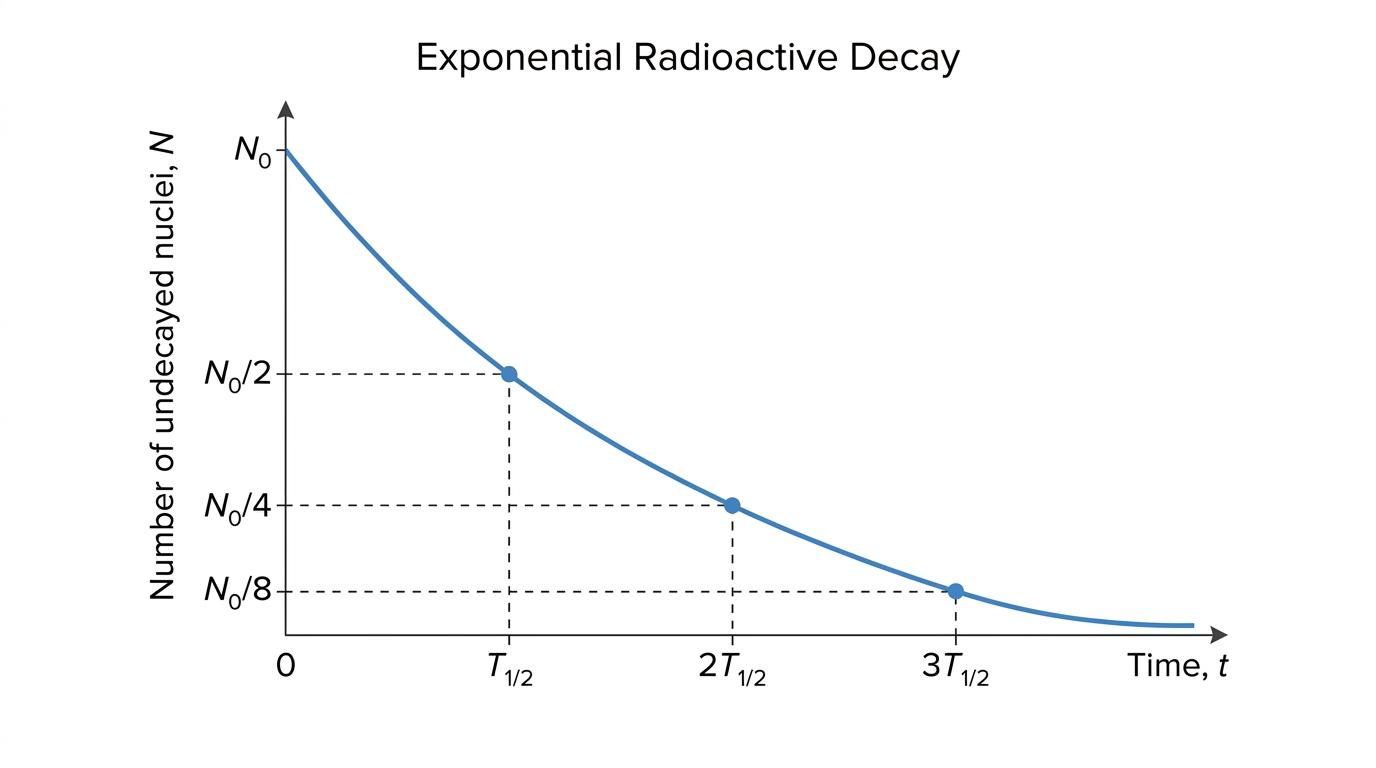
We can derive a simple equation linking T1/2T_{1/2}T1/2 and λ\lambdaλ. After one half-life (t=T1/2t = T_{1/2}t=T1/2), the number of nuclei drops to half of the original amount (N=N02N = \frac{N_0}{2}N=2N0). Let's substitute this into the exponential equation:
N02=N0e−λT1/2 \frac{N_0}{2} = N_0 e^{-\lambda T_{1/2}} 2N0=N0e−λT1/2Cancel N0N_0N0 from both sides:
0.5=e−λT1/2 0.5 = e^{-\lambda T_{1/2}} 0.5=e−λT1/2Take the natural logarithm (ln\lnln) of both sides. Remember that ln(ex)=x\ln(e^x) = xln(ex)=x, and ln(0.5)=−ln2\ln(0.5) = -\ln 2ln(0.5)=−ln2:
−ln2=−λT1/2 -\ln 2 = -\lambda T_{1/2} −ln2=−λT1/2Rearranging gives us the half-life equation:
T1/2=ln2λ T_{1/2} = \frac{\ln 2}{\lambda} T1/2=λln2Using exponential decay in Carbon Dating
Living wood has a Carbon-14 activity of 0.25 Bq0.25 \text{ Bq}0.25 Bq per gram of carbon. A piece of ancient wood found in an archaeological dig has an activity of 0.15 Bq0.15 \text{ Bq}0.15 Bq per gram. The half-life of Carbon-14 is 5730 years5730 \text{ years}5730 years. Calculate the age of the ancient wood.
- Find the decay constant (λ\lambdaλ): Using the half-life equation. Since T1/2T_{1/2}T1/2 is in years, λ\lambdaλ will be in yr−1\text{yr}^{-1}yr−1.
- Set up the exponential equation: We know A0=0.25A_0 = 0.25A0=0.25, A=0.15A = 0.15A=0.15, and λ=1.21×10⁻⁴\lambda = 1.21 \times 10^{-4}λ=1.21×10⁻⁴. We need to find ttt.
- Rearrange and solve for ttt: First, divide both sides by 0.250.250.25.
- Use natural logs: Take ln\lnln of both sides to remove the exponential.
Graphical Analysis using Log Graphs
Drawing a curve like the one above is useful, but curves are hard to analyse accurately. Physicists prefer straight lines. We can turn the exponential curve into a straight line by taking the natural log of the exponential equation:
A=A0e−λt A = A_0 e^{-\lambda t} A=A0e−λt lnA=ln(A0e−λt) \ln A = \ln(A_0 e^{-\lambda t}) lnA=ln(A0e−λt) lnA=lnA0+ln(e−λt) \ln A = \ln A_0 + \ln(e^{-\lambda t}) lnA=lnA0+ln(e−λt) lnA=−λt+lnA0 \ln A = -\lambda t + \ln A_0 lnA=−λt+lnA0Notice how this exactly matches the equation of a straight line, y=mx+cy = mx + cy=mx+c:
- yyy-axis: lnA\ln AlnA
- xxx-axis: ttt
- Gradient (mmm): −λ-\lambda−λ
- yyy-intercept (ccc): lnA0\ln A_0lnA0
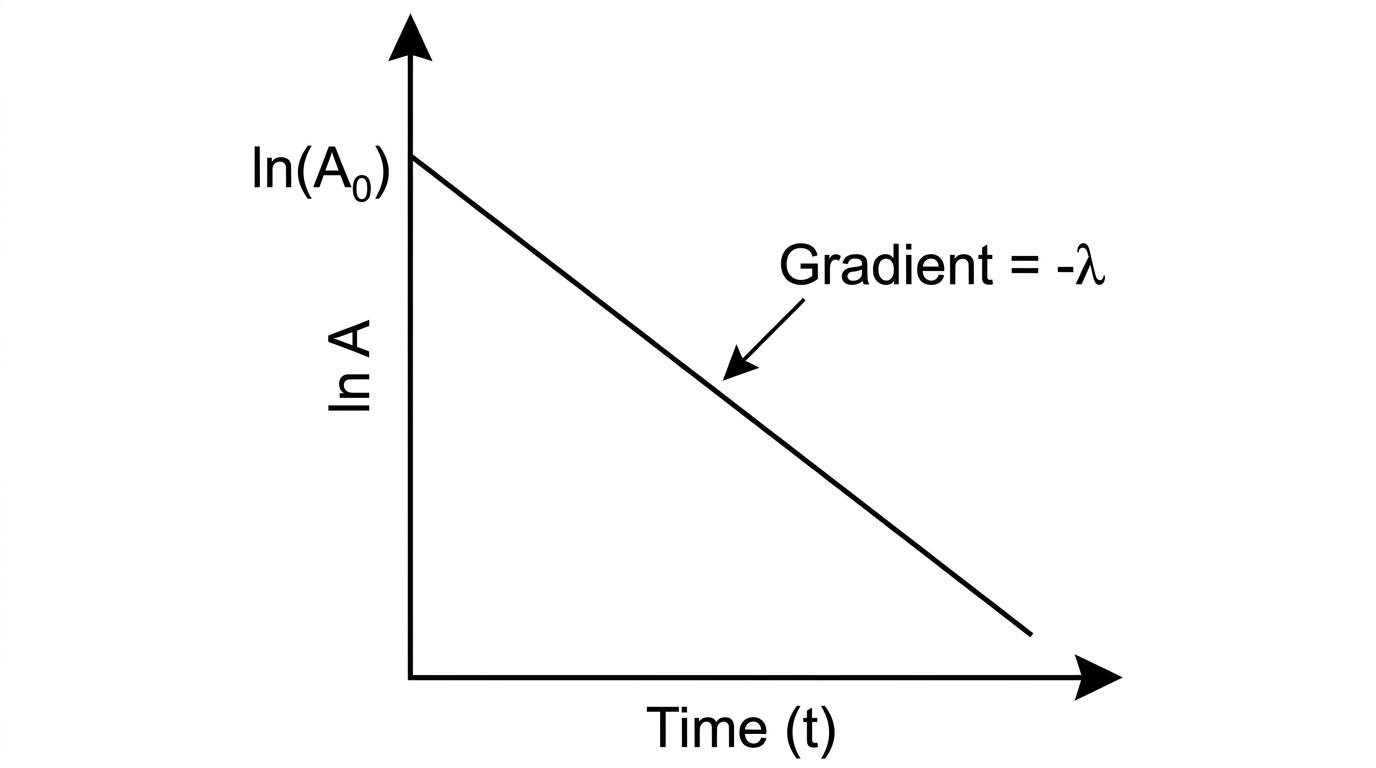
If you are given a table of Activity against Time in an exam, the standard practical technique is to add a column for lnA\ln AlnA, plot lnA\ln AlnA against ttt, find the gradient of the line of best fit, and use it to find λ\lambdaλ. You can then easily calculate T1/2T_{1/2}T1/2.
Missing the negative sign
When you calculate the gradient from your log graph, you will get a negative number (because the line slopes downwards). Remember that the gradient is −λ-\lambda−λ. Since λ\lambdaλ is a probability, it must be positive. Don't forget to drop the minus sign before you calculate the half-life!
Applications in the Real World
You must be aware of how these concepts apply to real situations:
Radioactive Dating: As shown in the example above, measuring the ratio of Carbon-14 to stable Carbon-12 in organic material allows us to date once-living objects. Limits: Carbon dating is only useful for things up to about 50,000 years50,000 \text{ years}50,000 years old. Beyond that, the activity drops so low it becomes indistinguishable from background radiation. For older objects (like rocks), we use elements with much longer half-lives, such as Uranium-238 decaying to Lead-206.
Storage of Radioactive Waste: Nuclear reactors produce waste with a huge variety of half-lives.
- Short half-lives: Highly radioactive and dangerous now (high activity because A=λNA = \lambda NA=λN and λ\lambdaλ is large), but they decay to safe levels in a few years. They are stored in cooling ponds until safe.
- Long half-lives: Not as intensely radioactive day-to-day, but they will remain dangerous for thousands of years. They must be sealed in glass (vitrification) and buried deep underground in geologically stable areas to prevent them ever entering the water supply.
In the exam
- Check your units before you calculate: If time ttt is given in hours and half-life T1/2T_{1/2}T1/2 is in seconds, you must convert them so they match before you calculate λ\lambdaλ or put them into the exponential equation.
- Be ready to find λ\lambdaλ from a graph: AQA loves to give you a graph of lnN\ln NlnN against ttt. Pick two widely spaced points on the line of best fit, calculate the gradient (m=ΔyΔxm = \frac{\Delta y}{\Delta x}m=ΔxΔy), and state λ=−m\lambda = -mλ=−m.
- Know your Avogadro trick: If a question gives you mass instead of NNN, immediately think: Mass→Moles→Nuclei\text{Mass} \to \text{Moles} \to \text{Nuclei}Mass→Moles→Nuclei. Use the nucleon number as the molar mass (e.g., Uranium-235 has a molar mass of 235 g mol−1235 \text{ g mol}^{-1}235 g mol−1).
Check yourself
- What does it mean to say that radioactive decay is a "random" process?
- Can you write down the relationship linking activity, decay constant, and number of undecayed nuclei?
- If you plot a graph of ln(Count Rate)\ln(\text{Count Rate})ln(Count Rate) against time, what do the gradient and yyy-intercept represent?
- Why is it difficult to carbon-date an object that is hundreds of millions of years old?
