Nuclear instability (A-level only)
Welcome to the final piece of the radioactivity puzzle! So far, you've looked at the types of radiation and how they behave. Now, we are going to look inside the nucleus to answer a fundamental question: Why do some nuclei decay while others remain stable for billions of years?
Here is what you'll learn in this topic:
- How to use an NNN against ZZZ graph to predict whether a nucleus is stable or unstable.
- The specific decay modes (α\alphaα, β−\beta^-β−, β+\beta^+β+, and electron capture) that nuclei use to reach stability.
- How to interpret nuclear energy level diagrams.
- Why Technetium-99m is the superstar of medical imaging.
The NNN vs ZZZ Graph
A nucleus is a battleground between two fundamental forces. The strong nuclear force acts between all nucleons (protons and neutrons) and pulls them together. The electromagnetic force acts only between protons, pushing them apart.
For a nucleus to be stable, these forces must be balanced. We can visualise this balance by plotting the number of neutrons (NNN) against the number of protons (ZZZ) for all known isotopes.
Line of Stability
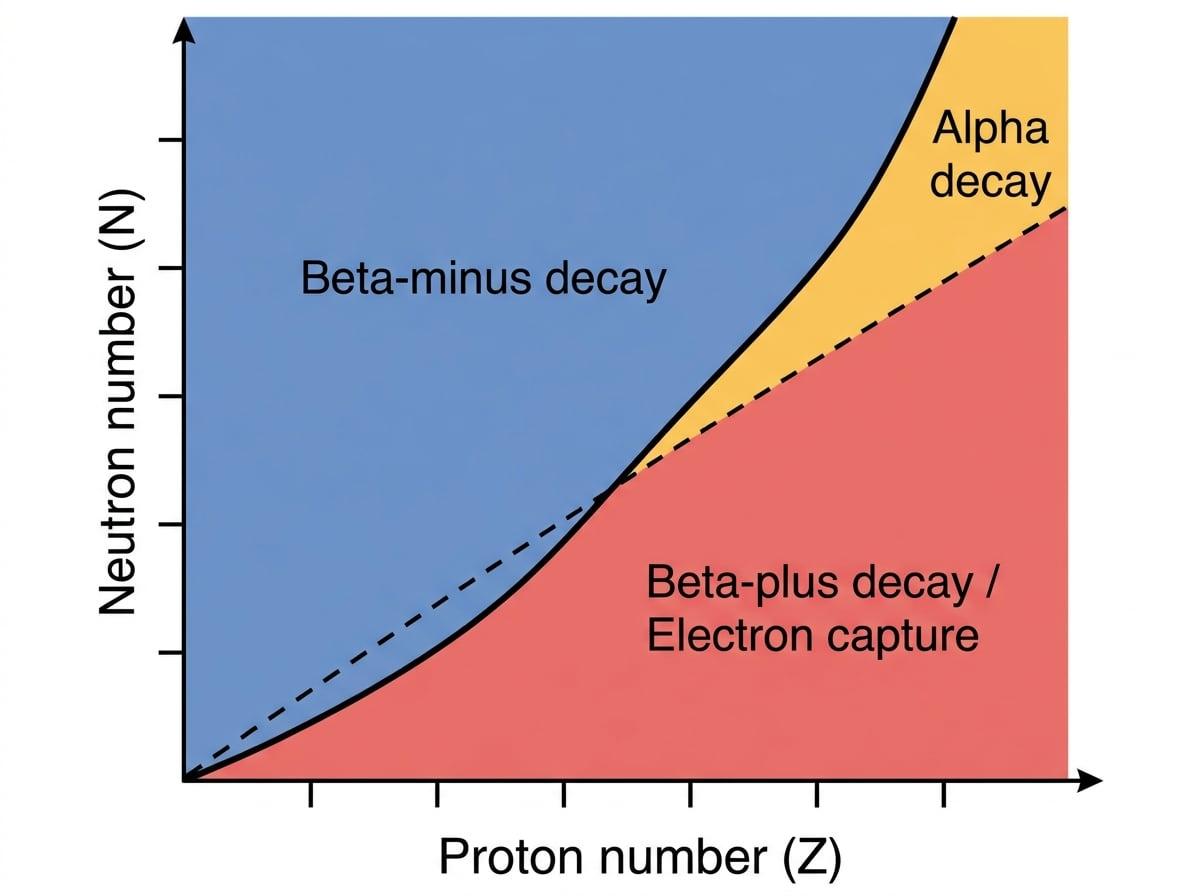
The line of stability is the curve on an NNN against ZZZ graph that connects all naturally occurring stable nuclei. If an isotope lies on this line, it will not undergo radioactive decay.
For light elements (up to about Z=20Z = 20Z=20), stable nuclei have roughly equal numbers of protons and neutrons, meaning they follow the line N=ZN = ZN=Z.
However, as nuclei get heavier, they need relatively more neutrons to stay stable. Why? Because the strong nuclear force has a very short range (up to ∼3 fm\sim 3 \text{ fm}∼3 fm), so a nucleon only attracts its closest neighbours. The electromagnetic force, however, has an infinite range, so every proton repels every other proton in the nucleus. To keep a large nucleus stable without adding more repulsive protons, the nucleus needs extra neutrons to provide "extra strong-force glue".
Because of this, the line of stability curves upwards, drifting higher than the N=ZN = ZN=Z line.
Decay Modes on the N−ZN-ZN−Z Graph
If a nucleus does not sit on the line of stability, it is unstable and will decay. The position of the nucleus relative to the line tells you exactly how it will decay.
1. Alpha (α\alphaα) Decay
Alpha decay happens in very heavy, massive nuclei (typically where Z>82Z > 82Z>82 and N>120N > 120N>120). These nuclei are simply too large for the strong force to hold them together. Emitting an alpha particle (a helium nucleus, 24α^4_2\alpha24α) sheds a lot of mass quickly.
- Change: Loses 2 protons and 2 neutrons.
- Movement on graph: Moves down by 2 on the NNN-axis and left by 2 on the ZZZ-axis.
2. Beta-Minus (β−\beta^-β−) Decay
Nuclei above the line of stability are "neutron-rich". To become more stable, a neutron turns into a proton, emitting an electron (the β−\beta^-β− particle) and an electron antineutrino (νˉe\bar{\nu}_eνˉe).
- Change: Loses 1 neutron, gains 1 proton.
- Movement on graph: Moves down by 1 on the NNN-axis and right by 1 on the ZZZ-axis (diagonally towards the stable curve).
3. Beta-Plus (β+\beta^+β+) Decay
Nuclei below the line of stability are "proton-rich". To become more stable, a proton turns into a neutron, emitting a positron (the β+\beta^+β+ particle) and an electron neutrino (νe\nu_eνe).
- Change: Loses 1 proton, gains 1 neutron.
- Movement on graph: Moves up by 1 on the NNN-axis and left by 1 on the ZZZ-axis.
4. Electron Capture
Proton-rich nuclei (below the line) have an alternative to β+\beta^+β+ decay: electron capture. Instead of emitting a positron, the nucleus captures one of its own inner-shell electrons. This electron merges with a proton to form a neutron and an electron neutrino.
- Change: Exactly the same as β+\beta^+β+ decay (loses 1 proton, gains 1 neutron).
Reading the graph
The N−ZN-ZN−Z graph is a map. If a nucleus is "lost" above the line, it uses β−\beta^-β− decay to head down-and-right towards safety. If it is "lost" below the line, it uses β+\beta^+β+ decay or electron capture to head up-and-left. If it's too far top-right, it uses α\alphaα decay to slide diagonally down-and-left.
Worked Example: Identifying Decay from Coordinates
An unstable isotope of Carbon, 0614C^{14}_{\phantom{0}6}\text{C}0614C, undergoes a single radioactive decay to become a stable isotope of Nitrogen, 0714N^{14}_{\phantom{0}7}\text{N}0714N. By considering the changes in NNN and ZZZ, deduce the decay mode of Carbon-14.
- First, calculate NNN and ZZZ for the starting nucleus (Carbon-14). The atomic number Z=6Z = 6Z=6. The neutron number is N=A−Z=14−6=8N = A - Z = 14 - 6 = 8N=A−Z=14−6=8.
- Calculate NNN and ZZZ for the daughter nucleus (Nitrogen-14). Z=7Z = 7Z=7, and N=14−7=7N = 14 - 7 = 7N=14−7=7.
- Compare the values to find the change: the nucleus has gained 111 proton (ZZZ goes 6→76 \to 76→7) and lost 111 neutron (NNN goes 8→78 \to 78→7).
- Because a neutron has turned into a proton, the decay mode must be beta-minus (β−\beta^-β−) decay. (This matches the fact that Carbon-14 is neutron-rich and sits above the line of stability).
Watch out for A vs N!
AQA exam questions often try to catch you out by labelling the y-axis with the nucleon number (AAA) instead of the neutron number (NNN). If the axis is AAA, a β−\beta^-β− decay moves the nucleus purely horizontally to the right (since AAA doesn't change, but ZZZ increases by 1). Always check the axis labels carefully!
Nuclear Energy Levels and Gamma (γ\gammaγ) Decay
Just like electrons in an atom, the protons and neutrons inside a nucleus exist in specific, discrete energy levels.
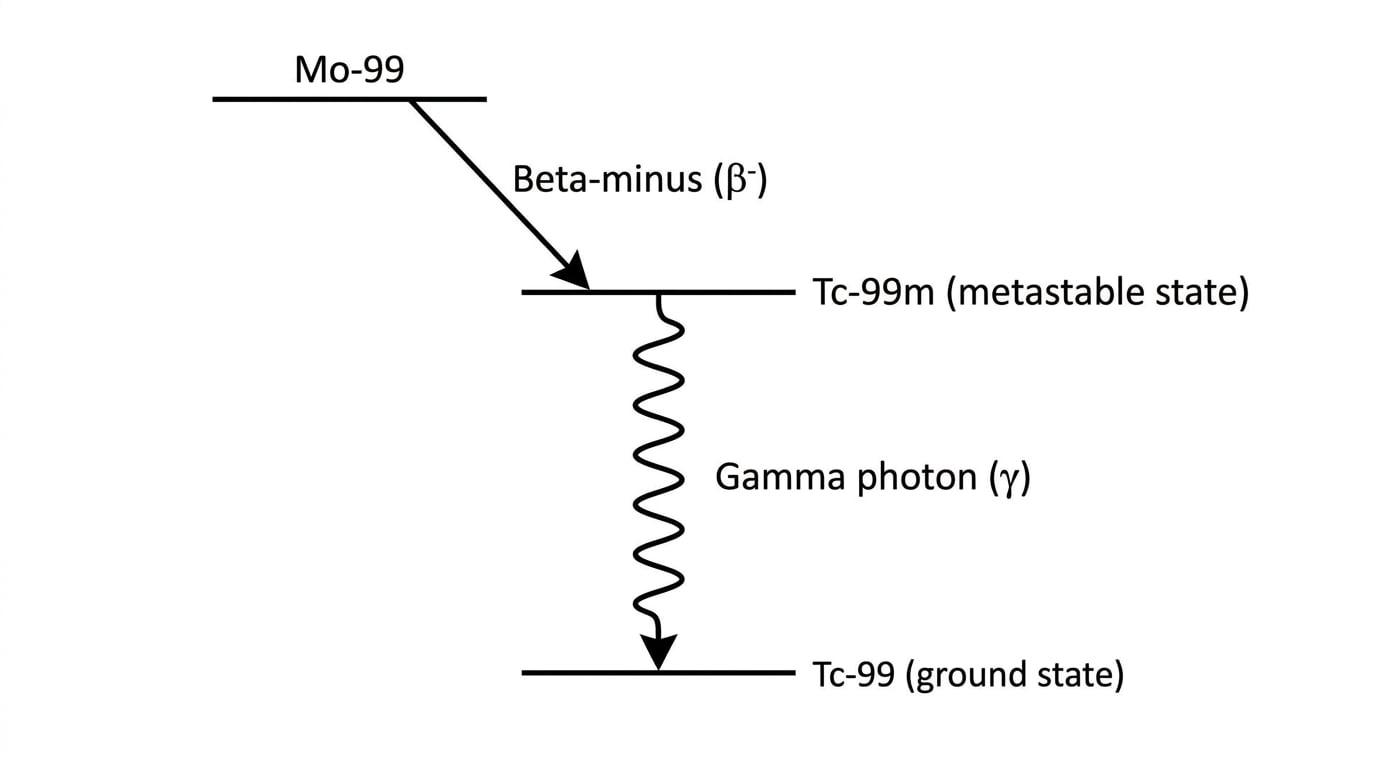
When a nucleus undergoes alpha or beta decay, the new "daughter" nucleus is often formed with its nucleons in an excited (higher energy) state rather than the ground state. Because the nucleus "wants" to be in its lowest possible energy state, it quickly drops down to the ground state.
To shed the excess energy, it emits a highly energetic photon—a gamma (γ\gammaγ) ray. Because energy levels are discrete, the emitted gamma photons have specific, constant energies that are characteristic of that specific nucleus.
Technetium-99m in Medical Diagnosis
Usually, a nucleus drops from an excited state to the ground state almost instantly (in fractions of a nanosecond). However, a few excited nuclei stick around in their high-energy state for much longer—sometimes hours. We call these long-lasting excited states metastable states.
Metastable State
A metastable state is an excited state of a nucleus that has an unusually long half-life before it decays by emitting a gamma photon. We indicate it by adding an "m" to the mass number, for example, Technetium-99m (Tc-99m).
Technetium-99m is exceptionally useful in medicine as a radioactive tracer. A doctor injects it into a patient's bloodstream, where it travels to specific organs. As the Tc-99m decays to its ground state (Tc-99), it emits gamma rays that pass completely out of the patient's body to be detected by a gamma camera.
Why is Tc-99m so perfect for this?
- Pure gamma emitter: It only emits gamma rays, not alpha or beta particles. Gamma is the least ionising, meaning it causes minimal damage to the patient's cells and can easily escape the body to be detected.
- Ideal half-life: Its half-life is 6 hours. This is long enough to complete a medical scan, but short enough that the radioactivity quickly drops to safe levels, meaning the patient doesn't remain radioactive for months.
- Optimal energy: The emitted gamma photons have an energy of 140 keV140 \text{ keV}140 keV, which is easily detectable by modern hospital equipment.
Worked Example: Gamma Ray Frequency
A Technetium-99m nucleus drops to its ground state by emitting a single gamma photon with an energy of 140 keV140 \text{ keV}140 keV. Calculate the frequency of the emitted gamma photon. (Planck constant, h=6.63×10⁻³⁴ J sh = 6.63 \times 10^{-34} \text{ J s}h=6.63×10⁻³⁴ J s; Elementary charge, e=1.60×10⁻¹⁹ Ce = 1.60 \times 10^{-19} \text{ C}e=1.60×10⁻¹⁹ C)
- Identify the energy of the photon in electronvolts: E=140 keV=140,000 eVE = 140 \text{ keV} = 140,000 \text{ eV}E=140 keV=140,000 eV.
- Convert this energy into Joules by multiplying by the elementary charge:
- Recall the photon energy equation linking energy and frequency:
- Rearrange for frequency (fff) and substitute the values:
Checking your answer
Gamma rays belong to the high-frequency end of the electromagnetic spectrum. A frequency on the order of 1019 Hz10^{19} \text{ Hz}1019 Hz or 1020 Hz10^{20} \text{ Hz}1020 Hz is exactly what you should expect for a gamma photon. If you get 1014 Hz10^{14} \text{ Hz}1014 Hz, you've probably calculated the frequency of visible light and forgotten to convert from keV\text{keV}keV to eV\text{eV}eV!
In the exam
- Check the axes: Before drawing any arrows on a decay graph, verify if the vertical axis is NNN (neutron number) or AAA (nucleon number). Your decay paths look entirely different depending on the axis.
- Remember the neutrinos: When writing β−\beta^-β− or β+\beta^+β+ decay equations, don't forget the antineutrino (νˉe\bar{\nu}_eνˉe) and neutrino (νe\nu_eνe). An easy way to remember: an anti-particle (β+\beta^+β+, a positron) gets a normal neutrino, while a normal particle (β−\beta^-β−, an electron) gets an anti-neutrino.
- Electron capture looks different: Remember that in electron capture, the electron is on the left side of the arrow because it is a reactant being absorbed, not a product being emitted.
- Use exact terms for Tc-99m: If asked why Tc-99m is useful, say "pure gamma emitter" and explicitly state its "6-hour half-life". Vague answers like "short half-life" often miss the mark on AQA mark schemes.
Check yourself
- Can you describe the shape of the line of stability on an NNN against ZZZ graph?
- Why do heavier nuclei require more neutrons than protons to remain stable?
- Where on the N−ZN-ZN−Z graph would you find nuclei that are likely to undergo β−\beta^-β− decay?
- What distinguishes a metastable state from a standard excited nuclear state?
- Can you write down the full balanced decay equation for the electron capture of an arbitrary nucleus ZAX^{A}_{Z}\text{X}ZAX?