Quasars (A-level only)
What you'll learn
- How quasars were first discovered as mysterious radio sources.
- Why their optical spectra indicate extreme distance.
- How to estimate the staggering power output of a quasar using the inverse square law.
- The physical mechanism that powers them: active supermassive black holes.
The Discovery of Quasars
In the 1950s, astronomers started mapping the sky using early radio telescopes. They discovered several very intense sources of radio waves, but when they pointed ordinary optical telescopes at these locations, they saw what just looked like faint, blue stars.
Unlike galaxies, which appear as fuzzy, extended blobs of light, these objects were "point sources"—indistinguishable from ordinary stars. Because they looked like stars but emitted strong radio waves, astronomers named them quasi-stellar radio sources.
Quasar
A quasar is a highly active galactic nucleus powered by a supermassive black hole. They were initially discovered as bright radio sources that appeared point-like (stellar) through optical telescopes.
Massive Optical Red Shifts
The real breakthrough came when astronomers analysed the optical emission spectra of these objects. At first, the dark absorption lines and bright emission lines in the spectrum made absolutely no sense—they didn't match the known spectral lines of any element on Earth.
Eventually, astronomers realised that the lines did belong to known elements (like the hydrogen Balmer series), but they had been shifted enormously towards the red end of the spectrum.
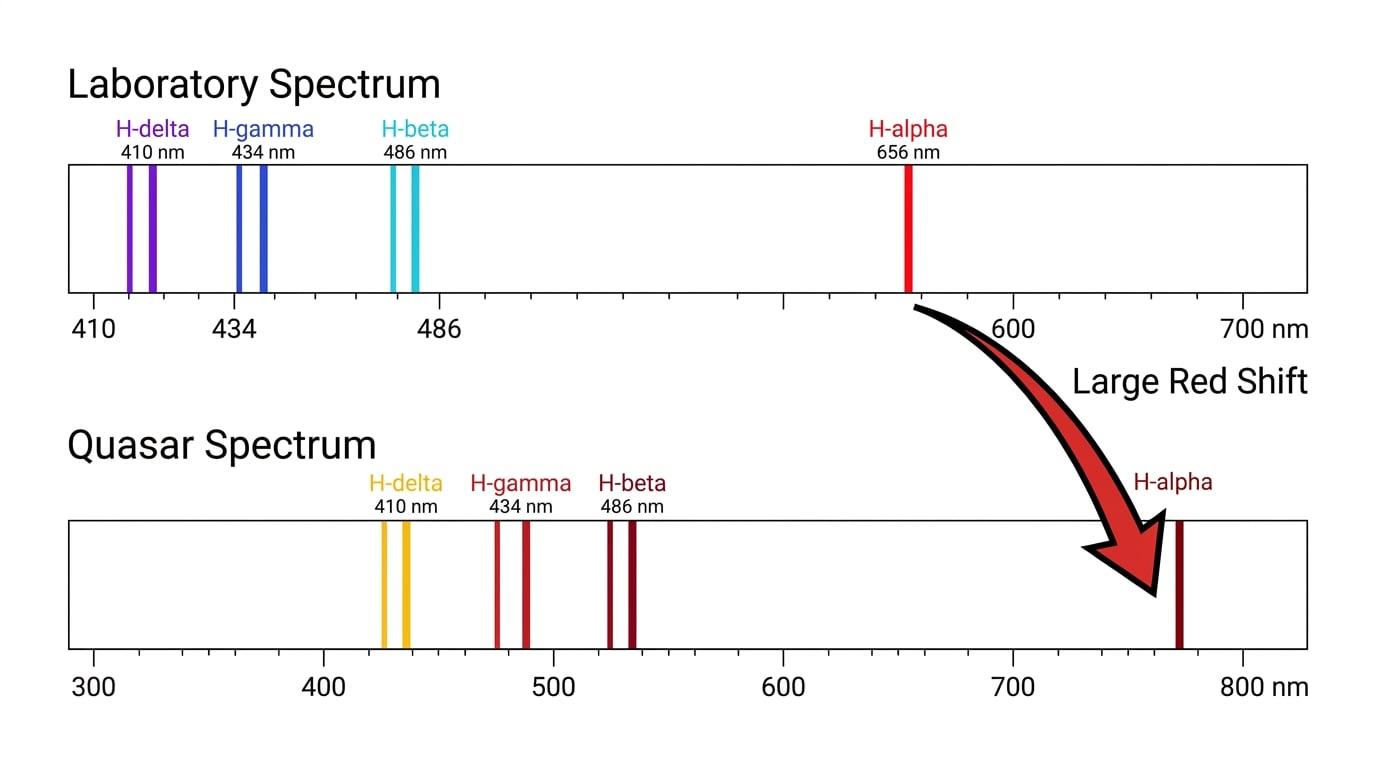
These massive optical red shifts indicated that quasars are moving away from Earth at massive recessional velocities—some at a significant fraction of the speed of light.
By applying Hubble's Law (v=Hdv = Hdv=Hd), an enormous recessional velocity means an enormous distance. This finding was revolutionary: quasars are the most distant measurable objects in the universe.
The Distance to Quasars
A quasar's huge optical red shift proves it is moving away from us incredibly fast. Because of the expansion of the universe (Hubble's Law), this high velocity means the quasar must be extremely far away.
Calculating recessional velocity and distance
A quasar has an observed optical red shift that gives it a recessional velocity of 4.5×10⁴ km s−14.5 \times 10^4 \text{ km s}^{-1}4.5×10⁴ km s−1. Calculate its distance in Mpc. Assume the Hubble constant H=65 km s−1 Mpc−1H = 65 \text{ km s}^{-1} \text{ Mpc}^{-1}H=65 km s−1 Mpc−1.
- State Hubble's Law.
- Rearrange the equation to make distance ddd the subject.
- Substitute the values into the equation. Because vvv is in km s−1\text{km s}^{-1}km s−1 and HHH is in km s−1 Mpc−1\text{km s}^{-1} \text{ Mpc}^{-1}km s−1 Mpc−1, the units of distance will come out directly in Mpc\text{Mpc}Mpc.
- Calculate the final answer.
Estimating Power Output
If quasars are billions of light-years away, how can we possibly see them from Earth? For them to appear as bright as they do in our telescopes across such vast distances, their power output (luminosity) must be staggering.
We can estimate a quasar's power output using the inverse square law for radiation. If we measure the intensity of the quasar's light reaching Earth, and we know its distance (calculated from its red shift), we can work out how much energy it is radiating at the source.
Intensity vs Power
Don't mix up intensity and power. Power is the total energy emitted by the quasar per second, measured in watts (W). Intensity is the power received per unit area here on Earth, measured in W m−2\text{W m}^{-2}W m−2.
Estimating the power output of a quasar
The quasar from our previous example is at a distance of 692 Mpc692 \text{ Mpc}692 Mpc. Measurements on Earth show it has an intensity of 1.2×10⁻¹² W m−21.2 \times 10^{-12} \text{ W m}^{-2}1.2×10⁻¹² W m−2. Estimate the power output of the quasar. (1 parsec =3.08×10¹⁶ m= 3.08 \times 10^{16} \text{ m}=3.08×10¹⁶ m)
- Convert the distance from Mpc to metres. The inverse square law requires standard SI units.
- State the inverse square law for intensity.
- Rearrange the formula to solve for power PPP.
- Substitute the values and calculate the power.
To put an answer of 6.8×1039 W6.8 \times 10^{39} \text{ W}6.8×1039 W into perspective, our Sun has a power output of about 4×1026 W4 \times 10^{26} \text{ W}4×1026 W. A single quasar can outshine an entire galaxy containing hundreds of billions of stars!
What is a Quasar?
Astronomers also noticed that quasars vary in brightness over relatively short periods—sometimes just days or months. In physics, if an object can significantly change its brightness in a month, the region emitting the light cannot be larger than a "light-month" across.
This presents a massive puzzle: a quasar produces the power of a trillion stars, but from a region not much larger than our solar system. Ordinary nuclear fusion inside stars cannot possibly generate this much energy in such a small space.
The only accepted explanation is that quasars are formed by active supermassive black holes at the centre of young galaxies.
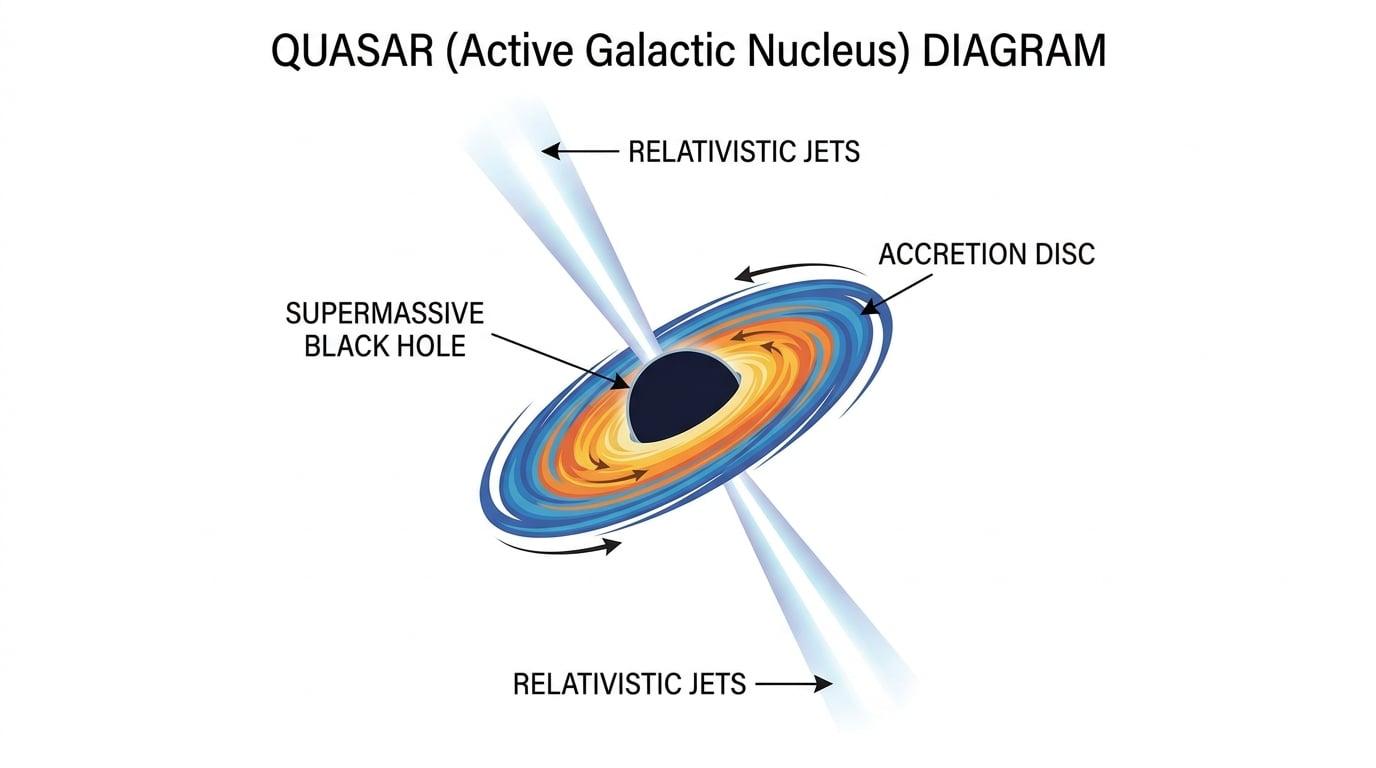
Here is how the mechanism works:
- Massive amounts of matter (gas, dust, and whole stars) are pulled towards the central supermassive black hole by immense gravitational forces.
- As the matter falls inward, it conserves angular momentum and forms a swirling structure called an accretion disc.
- As the material spirals closer to the event horizon, it accelerates to massive speeds. Extreme friction and gravitational forces heat the disc to millions of degrees.
- This superheated plasma emits the astonishing amounts of radiation (from X-rays down to radio waves) that we detect on Earth. Additionally, powerful magnetic fields channel some of the infalling matter into massive jets that blast outward from the poles at near-light speeds.
A phase of galactic life
Quasars are mostly found in the very distant (and therefore very early) universe. Astronomers believe the "quasar phase" happens early in a galaxy's life. Once the black hole has consumed all the nearby gas and dust, the quasar "turns off", leaving behind a quiet supermassive black hole—just like the one currently sitting at the centre of our own Milky Way!
In the exam
- If asked to describe what a quasar is, you must state that they are highly active supermassive black holes. Mention the accretion disc and the heating of infalling matter.
- In calculation questions, always remember the logical chain: optical red shift →\to→ recessional velocity →\to→ Hubble's Law →\to→ distance →\to→ inverse square law →\to→ power output.
- Watch your units carefully during the inverse square law calculation. You will almost certainly need to convert parsecs or light-years into metres before squaring the distance.
Check yourself
- What does the term 'quasi-stellar' mean, and why was it applied to quasars?
- What piece of evidence proves that quasars are the most distant objects we can measure?
- Why does the rapid fluctuation in a quasar's brightness tell us it must be relatively small?
- Describe the mechanism by which a supermassive black hole generates the enormous power output of a quasar.