

What you'll learn
- How Edwin Hubble linked a galaxy's distance to its recessional velocity using v=Hdv = Hdv=Hd.
- How to estimate the age of the universe by converting the Hubble constant into SI units.
- The qualitative evidence for the Big Bang theory, including Cosmic Microwave Background Radiation (CMBR) and the relative abundance of hydrogen and helium.
Red shift and recessional velocity
In the previous topic, you learned about cosmological red shift. When we look at light from distant galaxies, the characteristic absorption lines in their spectra are shifted towards the red end of the spectrum. This tells us that the galaxies are moving away from us. We call this speed of retreat the recessional velocity, symbol vvv.
In the 1920s, Edwin Hubble made a ground-breaking observation. He measured the recessional velocities of many galaxies and compared them to their distances from Earth. He found a direct proportionality: the further away a galaxy is, the faster it is moving away from us.
The expansion of the universe
Hubble's simple interpretation of this direct proportionality was profound: the universe itself is expanding. Because space is stretching in all directions, every galaxy appears to be moving away from every other galaxy.
Hubble's law
Hubble's findings are summarised in a single, vital equation.
Hubble's law
The recessional velocity of a galaxy is directly proportional to its distance from Earth.
v=Hd v = Hd v=HdWhere:
- vvv is the recessional velocity, usually measured in km s−1\text{km s}^{-1}km s−1
- ddd is the distance to the galaxy, usually measured in megaparsecs (Mpc\text{Mpc}Mpc)
- HHH is the Hubble constant, measured in km s−1 Mpc−1\text{km s}^{-1} \text{ Mpc}^{-1}km s−1 Mpc−1
Because vvv is directly proportional to ddd, a graph of recessional velocity against distance produces a straight line through the origin. The gradient of this line is the Hubble constant, HHH.
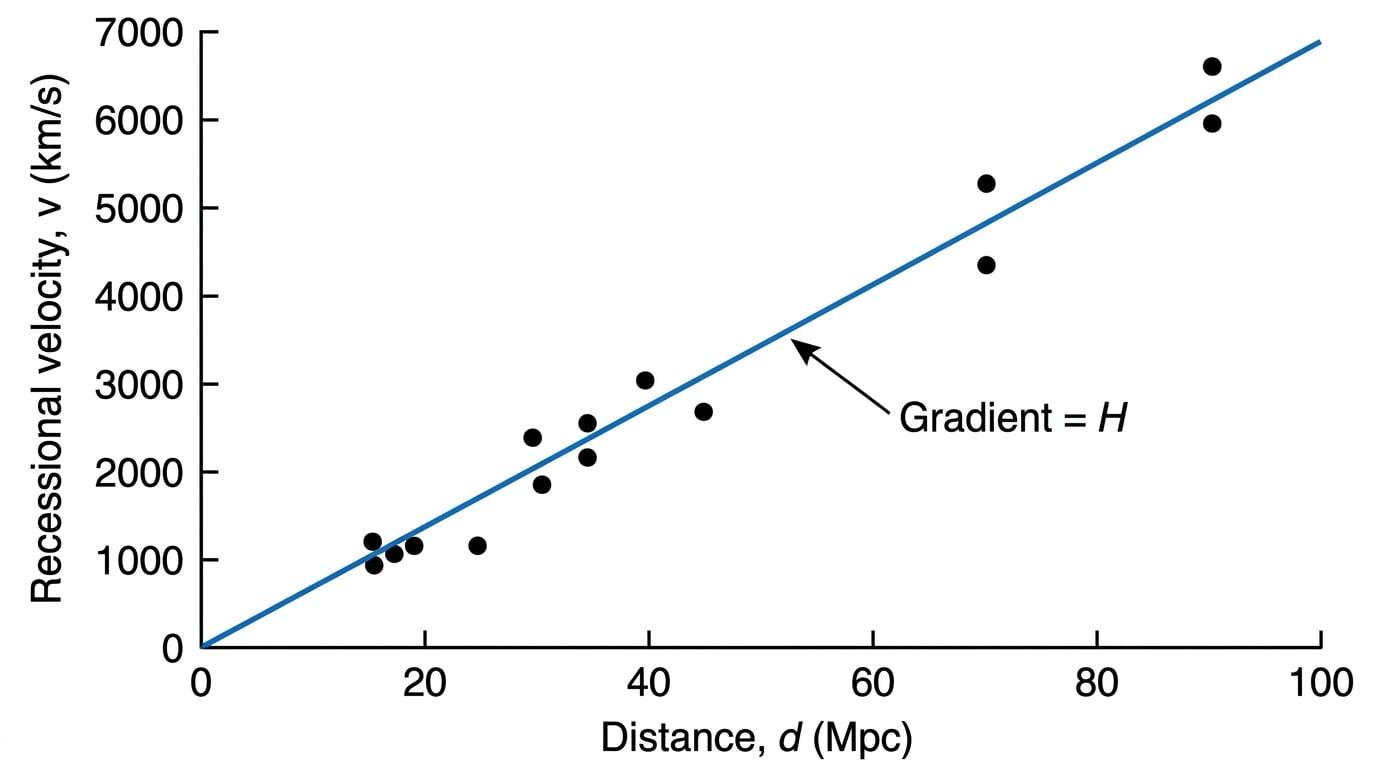
Astronomers are continually refining the exact value of HHH as our telescopes improve, but it is currently accepted to be around 656565 to 75 km s−1 Mpc−175 \text{ km s}^{-1} \text{ Mpc}^{-1}75 km s−1 Mpc−1.
Worked example: Using Hubble's law
A galaxy is observed at a distance of 45 Mpc45 \text{ Mpc}45 Mpc from Earth. Assume the Hubble constant HHH is 70 km s−1 Mpc−170 \text{ km s}^{-1} \text{ Mpc}^{-1}70 km s−1 Mpc−1. Calculate the recessional velocity of the galaxy and state its direction of motion relative to Earth.
- State Hubble's law:
- Substitute the given values (since ddd is in Mpc\text{Mpc}Mpc and HHH is in km s−1 Mpc−1\text{km s}^{-1} \text{ Mpc}^{-1}km s−1 Mpc−1, the units are already compatible):
- Calculate the final velocity:
- State the direction: The red shift implies expansion, so the galaxy is moving away from Earth.
Estimating the age of the universe
If the universe has been expanding at a constant rate since its creation, we can "rewind" the clock to find out when all galaxies were at a single point.
Time is distance divided by speed (t=dvt = \frac{d}{v}t=vd). If we rearrange Hubble's law, we get dv=1H\frac{d}{v} = \frac{1}{H}vd=H1. Therefore, we can estimate the age of the universe, ttt, using the reciprocal of the Hubble constant:
t=1H t = \frac{1}{H} t=H1Assumption alert
This calculation assumes that HHH has been constant throughout the entire history of the universe (i.e. the universe has expanded at a constant rate). In reality, astronomers now know that the expansion of the universe is accelerating due to dark energy, making this simple t=1Ht = \frac{1}{H}t=H1 calculation only an estimate.
Handling the units
To calculate the age of the universe in seconds, HHH must be in standard SI units of s−1\text{s}^{-1}s−1. The units of HHH are often given as km s−1 Mpc−1\text{km s}^{-1} \text{ Mpc}^{-1}km s−1 Mpc−1, which is a mixture of kilometres, seconds, and megaparsecs. Converting this is one of the most common AQA calculations.
Forgetting to convert distances
When converting km s−1 Mpc−1\text{km s}^{-1} \text{ Mpc}^{-1}km s−1 Mpc−1 to s−1\text{s}^{-1}s−1, students often forget that the top unit is kilometres (which must be multiplied by 10310^3103 to reach metres) while the bottom unit is megaparsecs (which must be converted to metres using 1 pc≈3.08×10¹⁶ m1 \text{ pc} \approx 3.08 \times 10^{16} \text{ m}1 pc≈3.08×10¹⁶ m).
Worked example: Calculating the age of the universe
Estimate the age of the universe in years, assuming H=65 km s−1 Mpc−1H = 65 \text{ km s}^{-1} \text{ Mpc}^{-1}H=65 km s−1 Mpc−1. (Given: 1 pc=3.08×10¹⁶ m1 \text{ pc} = 3.08 \times 10^{16} \text{ m}1 pc=3.08×10¹⁶ m and 1 year=3.15×10⁷ s1 \text{ year} = 3.15 \times 10^7 \text{ s}1 year=3.15×10⁷ s)
- Identify the goal: We need to convert HHH into SI units (s−1\text{s}^{-1}s−1), then use t=1Ht = \frac{1}{H}t=H1.
- Convert the numerator (km\text{km}km) into metres:
- Convert the denominator (Mpc\text{Mpc}Mpc) into metres:
- Divide the converted numerator by the converted denominator to find HHH in s−1\text{s}^{-1}s−1:
- Calculate the age ttt in seconds:
- Convert the age from seconds into years:
The Big Bang theory
The simple interpretation of Hubble's law is that if everything is currently flying apart, it must have all started from a single point.
The Big Bang theory states that the universe began from an infinitely hot, infinitely dense singularity, and has been expanding and cooling ever since.
AQA expects you to know two major pieces of qualitative evidence that support this theory.
Evidence 1: Cosmological Microwave Background Radiation (CMBR)
In the extremely hot early universe, space was filled with high-energy gamma photons. As the universe expanded, space itself stretched. As space stretched, the wavelengths of these original gamma photons were stretched along with it.
Over billions of years, these wavelengths have stretched so much that they are now in the microwave region of the electromagnetic spectrum.
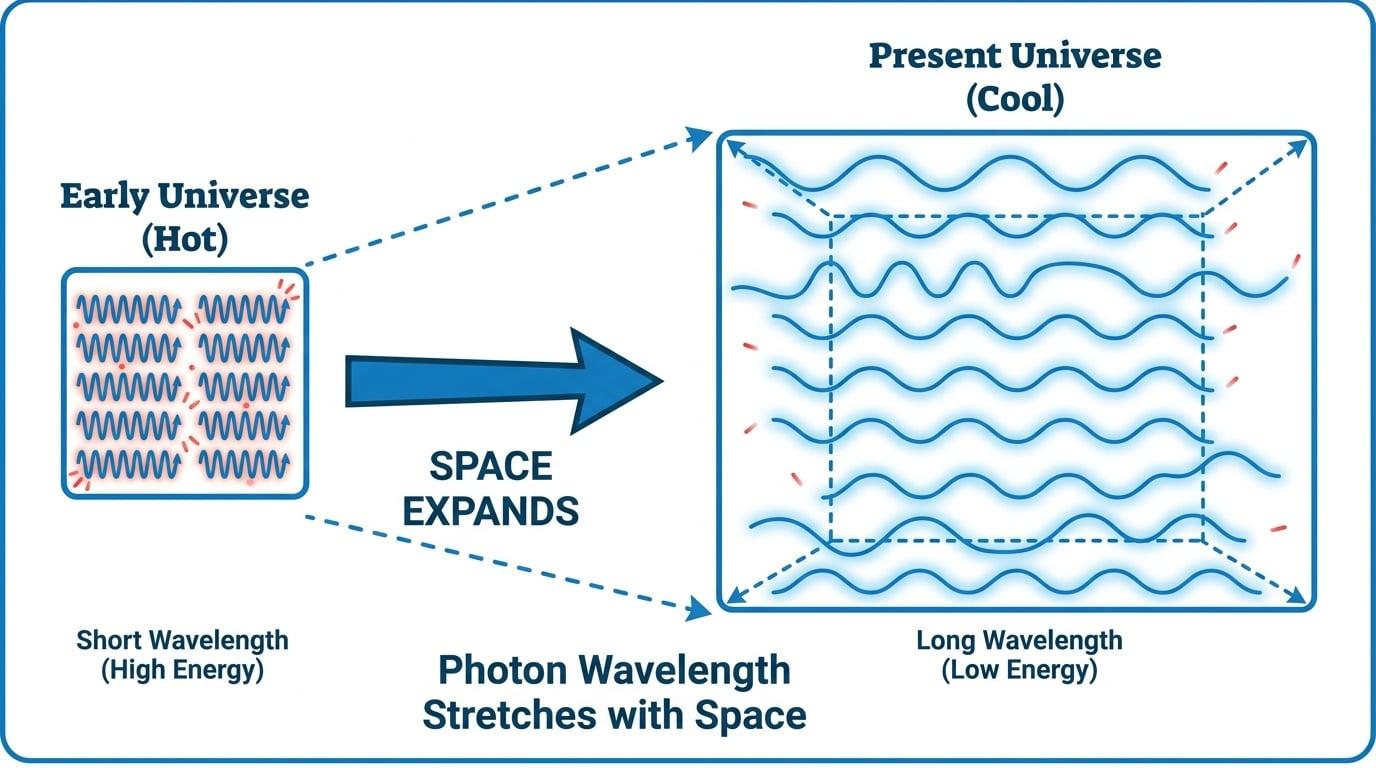
When astronomers point radio telescopes at the sky, they detect a continuous, uniform background of microwave radiation coming from all directions in space. This is the Cosmological Microwave Background Radiation (CMBR). Its spectrum perfectly matches the radiation profile expected of an object that has cooled to about 2.7 K, which exactly aligns with Big Bang predictions.
Evidence 2: Relative abundance of hydrogen and helium
In the first few minutes after the Big Bang, the universe was incredibly hot—hot enough for nuclear fusion to occur. Protons and neutrons fused to create helium nuclei.
However, because the universe was expanding rapidly, it quickly cooled down. The "window" for fusion only lasted a few minutes. The Big Bang theory predicts that during this brief window, about a quarter of the total mass of the universe was fused into helium, leaving the rest mostly as hydrogen.
When we observe the modern universe (looking at the composition of stars and nebulae), we find exactly this: a mass ratio of roughly 3:1 (or 73% to 25%, with traces of other light elements). There is far too much helium in the universe to have been made purely by stellar fusion in stars, so it must have been forged in the extreme heat of the early universe.
Memorise the keywords
When writing about Big Bang evidence, examiners look for specific phrasing. For CMBR: "Gamma photons from the early universe were stretched to microwaves as the universe expanded and cooled". For elemental abundance: "A 3:1 mass ratio of hydrogen to helium".
In the exam
- Watch the units on the Hubble constant: If HHH is given in km s−1 Mpc−1\text{km s}^{-1} \text{ Mpc}^{-1}km s−1 Mpc−1, you do not need to convert it if you are just calculating vvv in km s−1\text{km s}^{-1}km s−1 from a distance in Mpc\text{Mpc}Mpc. Only convert to standard SI units (s−1\text{s}^{-1}s−1) if you are asked to find the age of the universe.
- Be clear on the cause of CMBR: Avoid saying the photons "lost energy so they became microwaves". The precise AQA phrasing is that the universe expanded, which stretched the wavelengths of the background photons.
- State the assumption: If a question asks "What assumption is made when calculating the age of the universe using 1H\frac{1}{H}H1?", state clearly: "The assumption is that the rate of expansion (the Hubble constant) has been constant over time."
Check yourself
- What does the gradient of a graph plotting recessional velocity against distance represent?
- What are the standard SI units for the Hubble constant, HHH?
- Why does the abundance of helium in the universe support the Big Bang theory rather than the Steady State theory?
- How did the original high-energy gamma photons from the early universe become microwave radiation today?
