Detection of exoplanets (A-level only)
What you'll learn:
- Why it is incredibly difficult to capture direct images of planets outside our solar system.
- How the radial velocity method uses the Doppler effect to detect the "wobble" of a host star.
- How the transit method detects exoplanets by analyzing characteristic "dips" in a star's light curve.
The difficulty of direct detection
An exoplanet is simply a planet that orbits a star other than our Sun.
Exoplanet
An extrasolar planet (exoplanet) is a planet orbiting a star outside of our own solar system.
You might wonder why astronomers don't just point powerful telescopes at nearby stars and take photographs of their planets. While direct imaging is occasionally possible, it is exceptionally rare because of three massive hurdles:
- Extreme distances: The nearest star to Earth (Proxima Centauri) is over four light-years away. At these vast distances, the angular separation between a star and its planet is incredibly small. The planet is essentially "lost" in the glare of the star.
- Extreme brightness differences: Stars are blindingly bright because they undergo nuclear fusion. Planets do not; they only reflect their host star's light. A typical star is millions or even billions of times brighter than any planet orbiting it.
- Low resolution: To resolve two distinct points of light (the star and the planet) very close together, a telescope needs an enormous resolving power (as dictated by the Rayleigh criterion), which requires a physically massive objective mirror.
Because direct detection is so hard, astronomers usually have to rely on indirect methods—observing the effect the planet has on its host star.
Method 1: Radial velocity (Doppler shift)
Gravity is a two-way street. We usually think of a planet orbiting a stationary star, but Newton's Third Law tells us the planet pulls on the star just as hard as the star pulls on the planet.
Because of this mutual attraction, both bodies actually orbit their common centre of mass. The star is much more massive, so the centre of mass is very close to (or even inside) the star. This means while the planet moves in a huge orbit, the star traces a tiny, slow orbit. The star appears to "wobble".
If the plane of this orbit aligns somewhat with our line of sight on Earth, the star will periodically move towards us and away from us. We can detect this motion using the Doppler effect.
- When the star moves towards Earth, its emitted light waves are compressed, decreasing the wavelength. The star's spectral lines shift towards the blue end of the spectrum (blueshift).
- When the star moves away from Earth, the light waves are stretched, increasing the wavelength. The spectral lines shift towards the red end of the spectrum (redshift).
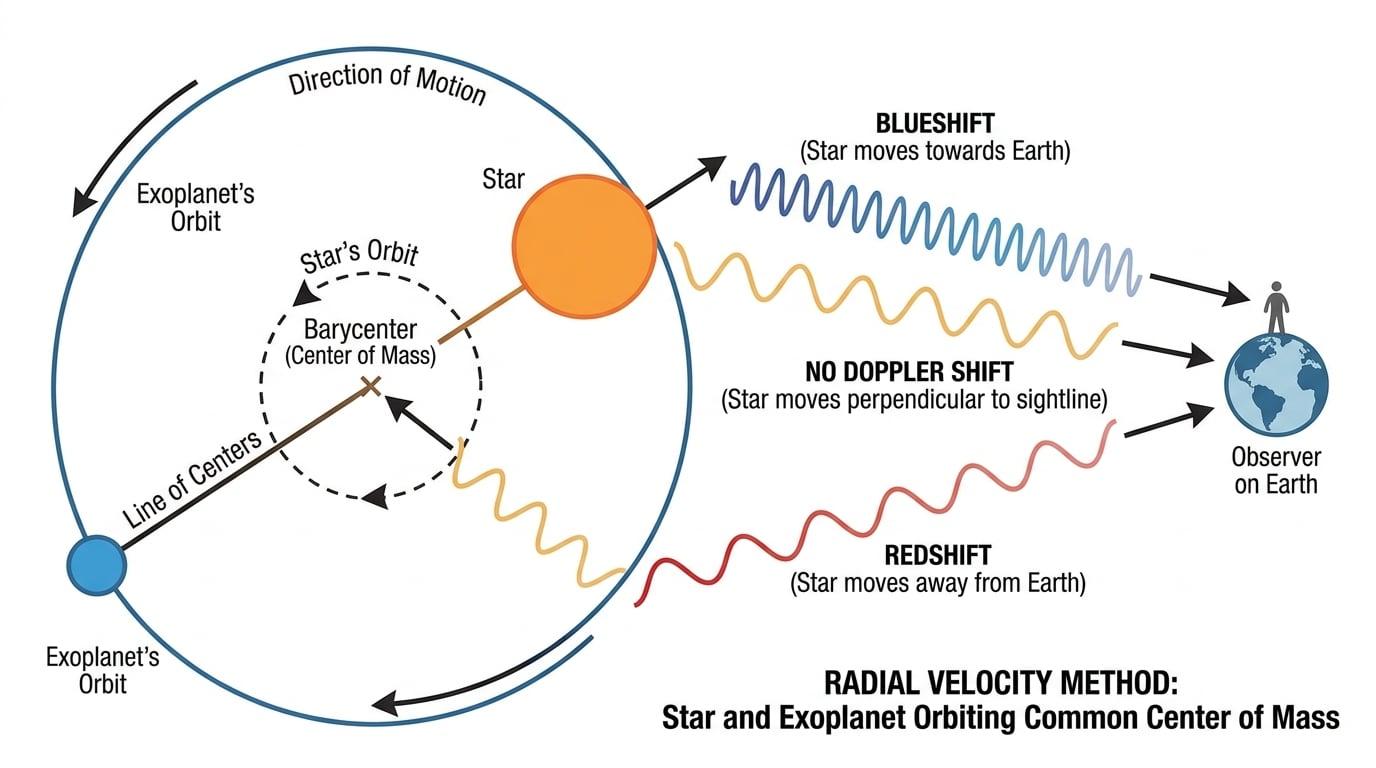
By taking spectra of a star over many nights, astronomers can plot its radial velocity (velocity along our line of sight) against time. If a planet is present, this graph will show a sinusoidal curve. The time taken for one complete cycle of the curve is equal to the orbital period of the planet.
Confusing the star's velocity with the planet's
Remember that the radial velocity calculated from the Doppler shift is the velocity of the star, not the planet! The star moves much slower than the planet.
You can calculate the maximum radial velocity of the star, vvv, using the Doppler equation:
Δλλ=vc \frac{\Delta \lambda}{\lambda} = \frac{v}{c} λΔλ=cvWhere Δλ\Delta \lambdaΔλ is the maximum change in wavelength, λ\lambdaλ is the rest wavelength of the spectral line, and ccc is the speed of light (3.00×10⁸ m s−13.00 \times 10^8 \text{ m s}^{-1}3.00×10⁸ m s−1).
Calculating stellar radial velocity
A distant star is observed over several months. A specific hydrogen absorption line, which has a laboratory wavelength of 656.280 nm656.280 \text{ nm}656.280 nm, is observed to shift between a maximum of 656.315 nm656.315 \text{ nm}656.315 nm and a minimum of 656.245 nm656.245 \text{ nm}656.245 nm. Calculate the maximum radial velocity of the star.
- First, find the maximum change in wavelength from the rest position, Δλ\Delta \lambdaΔλ.
- Note that the shift in the other direction is the same (656.280−656.245=0.035 nm656.280 - 656.245 = 0.035 \text{ nm}656.280−656.245=0.035 nm).
- Use the Doppler equation, Δλλ=vc\frac{\Delta \lambda}{\lambda} = \frac{v}{c}λΔλ=cv, to solve for vvv.
- Substitute the values. Because it's a ratio, you can leave wavelengths in nanometres (they cancel out), but ensure you use the speed of light in m s−1\text{m s}^{-1}m s−1.
The star reaches a maximum radial velocity of 1.6×10⁴ m s−11.6 \times 10^4 \text{ m s}^{-1}1.6×10⁴ m s−1.
Method 2: The transit method
The second major way to detect exoplanets is the transit method.
A transit occurs when a planet crosses exactly between us and its host star, blocking a tiny fraction of the star's light. By constantly monitoring the brightness of thousands of stars, we can look for characteristic, periodic "dips" in their apparent magnitude.
A graph of apparent brightness against time is called a light curve.
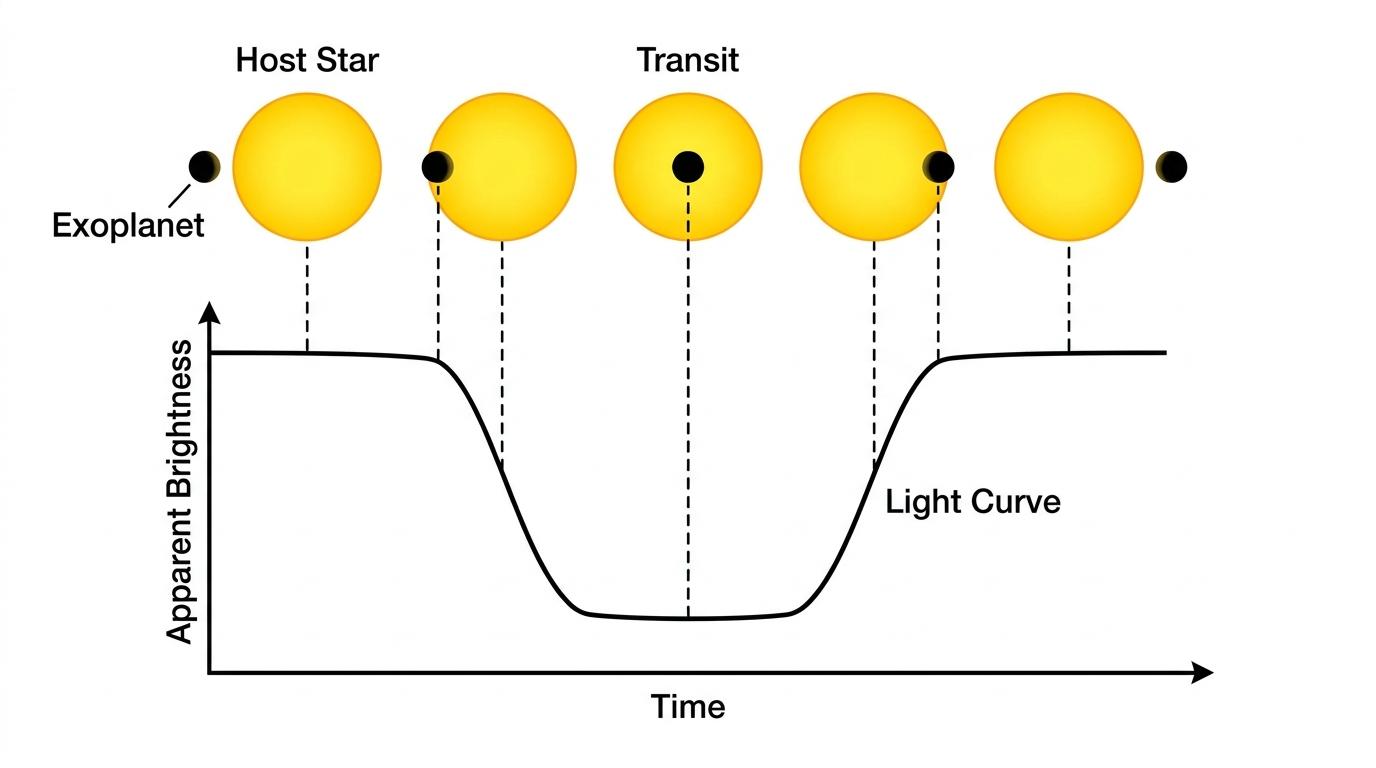
A typical transit light curve has a very specific shape:
- The baseline: The star's normal, un-eclipsed brightness.
- The ingress: The brightness drops sharply as the planet begins to move in front of the stellar disk.
- The flat bottom: The planet is fully silhouetted against the star. The brightness remains constantly lowered while the planet travels across the main face of the star.
- The egress: The brightness rises sharply back to the baseline as the planet exits the stellar disk.
What the light curve tells us
The depth of the dip tells us the size of the planet relative to the star. The duration of the dip (and the time between successive dips) tells us the planet's orbital period and distance from the star.
The amount of light blocked is proportional to the cross-sectional area of the planet compared to the cross-sectional area of the star. If we assume both the star and the planet are spherical, their projected areas are circles (A=πr2A = \pi r^2A=πr2).
Therefore, the fractional drop in brightness is:
ΔII=Area of planetArea of star=πr2πR2=(rR)2 \frac{\Delta I}{I} = \frac{\text{Area of planet}}{\text{Area of star}} = \frac{\pi r^2}{\pi R^2} = \left( \frac{r}{R} \right)^2 IΔI=Area of starArea of planet=πR2πr2=(Rr)2Where rrr is the radius of the planet, RRR is the radius of the star, III is the baseline brightness, and ΔI\Delta IΔI is the drop in brightness.
Calculating planet radius from a transit
A star with a radius of 7.0×10⁸ m7.0 \times 10^8 \text{ m}7.0×10⁸ m is observed undergoing a periodic transit. During the transit, its apparent brightness drops by 1.2%1.2\%1.2%. Calculate the radius of the transiting exoplanet.
- State the relationship between the fractional brightness drop and the radii of the bodies.
- Convert the percentage drop into a decimal to use as the fraction.
- Rearrange the formula to make the planet's radius, rrr, the subject.
- Substitute the known values.
- Give the final answer to two significant figures, matching the given data.
Limitations of the transit method
The transit method is excellent, but it requires a very lucky alignment. If the planet's orbit is "face-on" to Earth (like looking down onto a plate), the planet will never cross in front of the star from our perspective, and no transit will be observed. Furthermore, the transit method is strongly biased toward detecting massive planets in small orbits (often called "Hot Jupiters") because they block more light and transit more frequently.
In the exam
- Be prepared to state the reasons why direct detection is difficult: "glare of the host star outshines the planet" and "angular separation is too small to resolve".
- When interpreting a light curve, remember that the lowest flat section represents the time the planet is completely in front of the star.
- In Doppler shift questions, always read the axis scales carefully. Sometimes velocity is given in km s−1\text{km s}^{-1}km s−1, which must be converted to m s−1\text{m s}^{-1}m s−1 before using ccc in standard units.
- For transit math, do not confuse diameter with radius. If the exam question asks for the diameter, multiply your calculated rrr by 222.
Check yourself
- Why can't we simply take photographs of most exoplanets?
- What physical movement of the star causes the Doppler shift used in the radial velocity method?
- How does the depth of the dip in a transit light curve relate to the physical properties of the planet and the star?
- Why might an exoplanet perfectly suited for life go completely undetected by the transit method?