Motion along a straight line
Welcome to kinematics! This topic is all about describing how things move, without worrying too much about why they move (we leave that to dynamics and forces).
What you'll learn:
- The precise differences between distance and displacement, and speed and velocity.
- How to extract displacements, velocities, and accelerations from motion graphs.
- How to use the "SUVAT" equations to solve uniform acceleration problems.
- How to carry out and analyse Required Practical 3 (determining the acceleration due to gravity, ggg).
1. The Core Definitions
To describe motion accurately in physics, we need to be incredibly precise with our vocabulary.
Displacement, Velocity, and Acceleration
- Displacement (sss): The straight-line distance from an origin to a point, in a specified direction. It is a vector, measured in metres (m\text{m}m).
- Velocity (vvv): The rate of change of displacement. It is a vector, measured in metres per second (m s−1\text{m s}^{-1}m s−1).
- Acceleration (aaa): The rate of change of velocity. It is a vector, measured in metres per second squared (m s−2\text{m s}^{-2}m s−2).
You will often need to calculate average values for velocity and acceleration over a time interval Δt\Delta tΔt:
v=ΔsΔta=ΔvΔt\begin{aligned} v &= \frac{\Delta s}{\Delta t} \\ a &= \frac{\Delta v}{\Delta t} \end{aligned}va=ΔtΔs=ΔtΔvAverage vs Instantaneous
If you drive 100 km100 \text{ km}100 km in 2 hours2 \text{ hours}2 hours, your average speed is 50 km h−150 \text{ km h}^{-1}50 km h−1. But your speedometer wasn't glued to 505050 the entire way; it went up and down. The reading on your speedometer at any exact millisecond is your instantaneous speed.
In physics, we find instantaneous velocity by looking at the gradient of a displacement–time graph at one specific point (often by drawing a tangent).
2. Motion Graphs
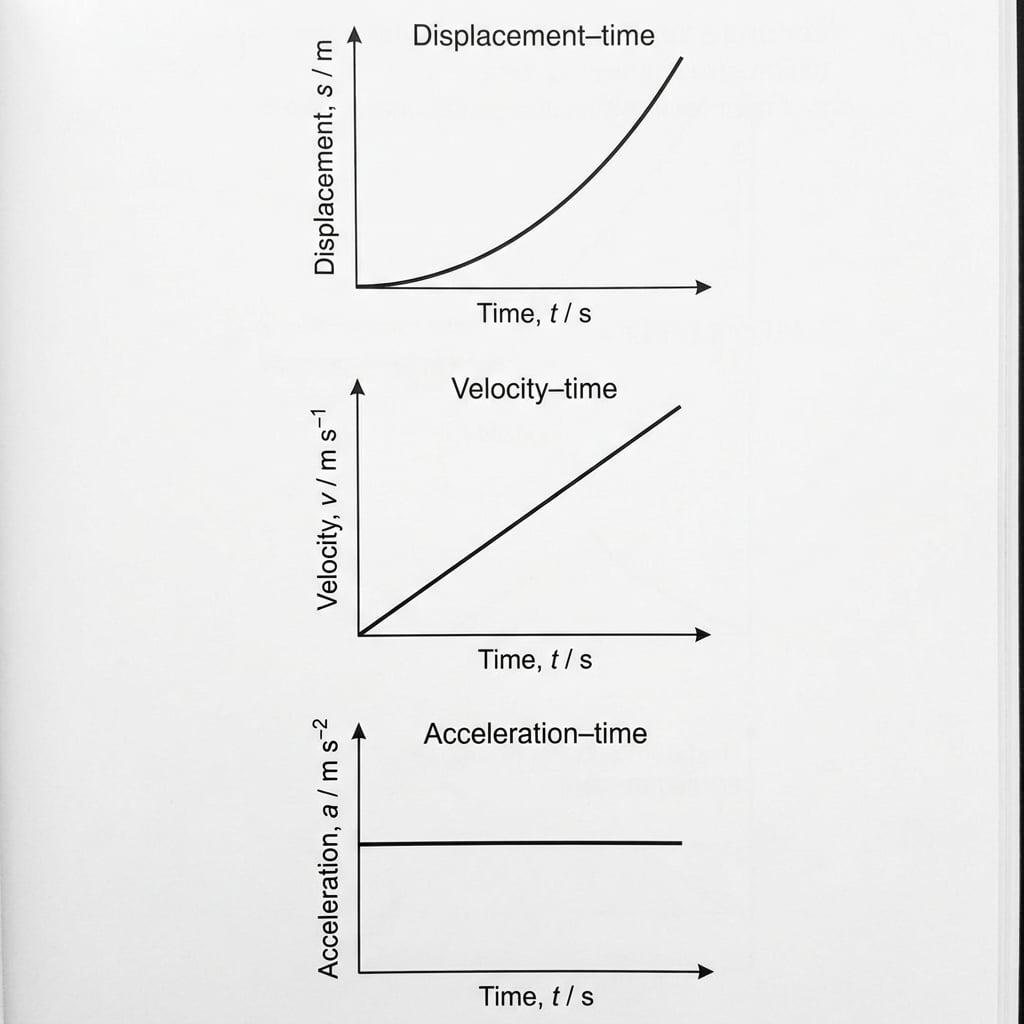
Graphs are the ultimate tool for visualising motion. You must be completely fluent in translating between displacement–time (sss-ttt), velocity–time (vvv-ttt), and acceleration–time (aaa-ttt) graphs.
Gradients and Areas
- The gradient of a displacement–time graph gives the velocity.
- The gradient of a velocity–time graph gives the acceleration.
- The area under a velocity–time graph gives the displacement.
- The area under an acceleration–time graph gives the change in velocity.
Non-Uniform Acceleration: The Bouncing Ball
The rule of thumb for A-Level is that you only do hard maths for uniform (constant) acceleration. However, you are expected to interpret graphs for non-uniform acceleration.
A classic AQA scenario is a bouncing ball. Let's define the upward direction as positive.
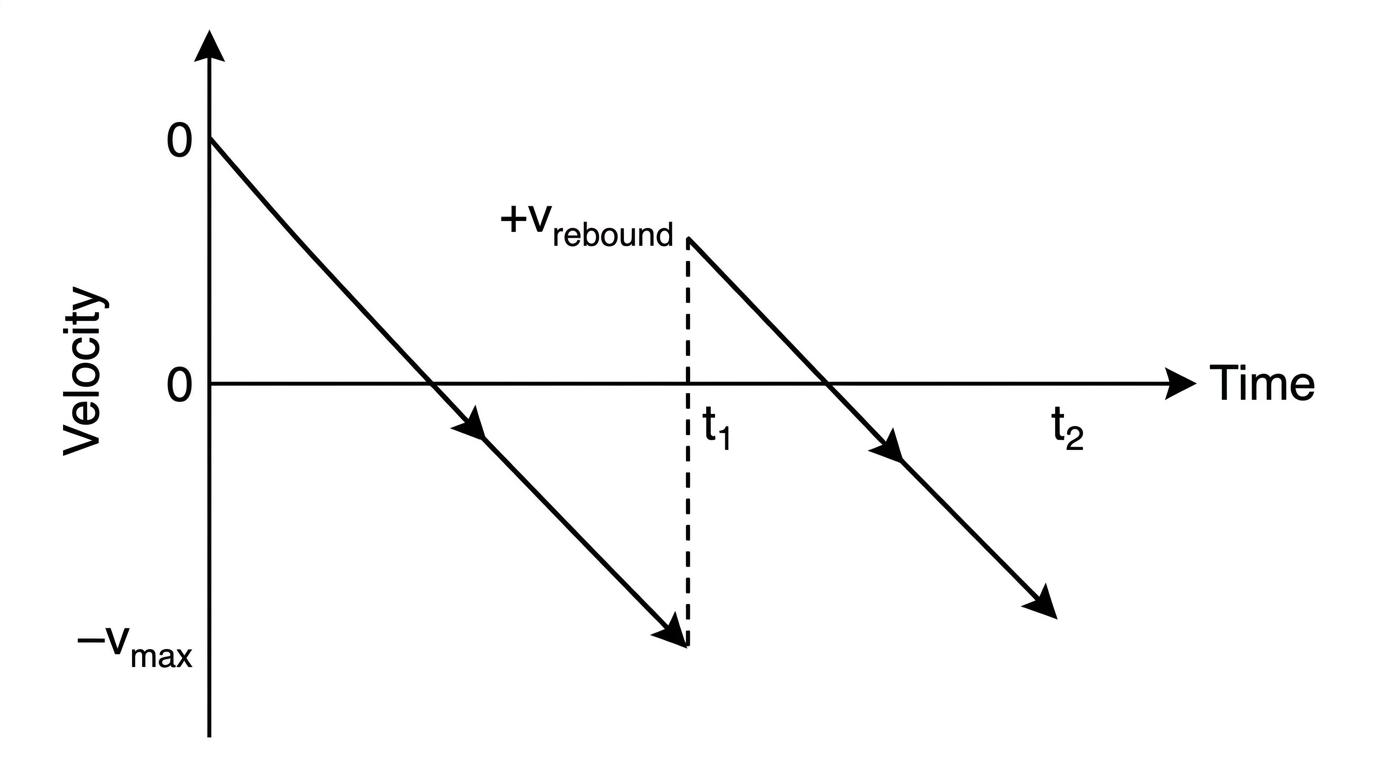
Notice the distinct features of this graph:
- The diagonal lines: The ball accelerates downwards due to gravity at a constant rate (gradient is −9.81 m s−2-9.81 \, \text{m s}^{-2}−9.81m s−2). Because gravity is constant, these lines are perfectly parallel.
- The vertical gaps: When the ball hits the floor, it undergoes a massive acceleration over a tiny fraction of a second, changing its velocity from a large negative value (moving down) to a large positive value (moving up).
- The peaks: Each successive positive peak is slightly lower than the last. The ball loses kinetic energy to thermal energy and sound during the impact.
3. The SUVAT Equations
When an object accelerates at a constant, uniform rate, we can relate its initial velocity (uuu), final velocity (vvv), acceleration (aaa), displacement (sss), and time (ttt) using four key equations.
You must commit these to memory:
v=u+ats=(u+v2)ts=ut+12at2v2=u2+2as\begin{aligned} v &= u + at \\ s &= \left(\frac{u+v}{2}\right)t \\ s &= ut + \frac{1}{2}at^2 \\ v^2 &= u^2 + 2as \end{aligned}vssv2=u+at=(2u+v)t=ut+21at2=u2+2asChoosing the right equation
Every SUVAT equation contains exactly four of the five variables. To pick the right one, write down the three variables you know, and the one variable you want to find. Then pick the equation that contains exactly those four letters.
Using SUVAT
A car is travelling at 22 m s−122 \text{ m s}^{-1}22 m s−1. The driver spots a hazard and hits the brakes, decelerating at a constant rate of 4.0 m s−24.0 \text{ m s}^{-2}4.0 m s−2 until the car comes to a complete stop. Calculate the braking distance.
-
Extract your variables and watch the signs: The car is moving forwards, so let's call forwards positive. Initial velocity is u=22 m s−1u = 22 \text{ m s}^{-1}u=22 m s−1. The car stops, so final velocity is v=0 m s−1v = 0 \text{ m s}^{-1}v=0 m s−1. It is decelerating, so acceleration acts in the opposite direction to motion: a=−4.0 m s−2a = -4.0 \text{ m s}^{-2}a=−4.0 m s−2. We want to find displacement, sss.
-
Select the correct equation: We have uuu, vvv, and aaa, and we need sss. The variable we don't care about is time, ttt. The only equation without ttt is v2=u2+2asv^2 = u^2 + 2asv2=u2+2as.
-
Rearrange for the unknown:
2as=v2−u22as = v^2 - u^22as=v2−u2 s=v2−u22as = \frac{v^2 - u^2}{2a}s=2av2−u2 -
Substitute the values to find the answer:
s=02−2222×(−4.0)s = \frac{0^2 - 22^2}{2 \times (-4.0)}s=2×(−4.0)02−222 s=−484−8.0=60.5 ms = \frac{-484}{-8.0} = 60.5 \text{ m}s=−8.0−484=60.5 m
Signs and Directions
The most frequent error in kinematics is forgetting that sss, uuu, vvv, and aaa are vectors. If you throw a ball upwards and call upwards positive, the acceleration due to gravity must be entered as a=−9.81 m s−2a = -9.81 \, \text{m s}^{-2}a=−9.81m s−2. If you forget the minus sign, the maths thinks gravity is firing the ball into space!
4. Freefall and Acceleration due to Gravity
When an object is in freefall, the only force acting on it is its weight (we ignore air resistance). Under these conditions, all objects accelerate towards the Earth at exactly the same rate, regardless of their mass.
We give this acceleration the symbol ggg. On Earth, g=9.81 m s−2g = 9.81 \, \text{m s}^{-2}g=9.81m s−2.
Required Practical 3: Determining ggg
You need to know how to measure ggg experimentally. The most common laboratory method uses a heavy steel ball bearing, an electromagnet, and a trapdoor (or light gates) wired to an electronic timer.
The setup:
- A steel ball is held by an electromagnet at a measured height hhh above a trapdoor.
- A switch breaks the circuit, turning off the electromagnet and simultaneously starting a timer.
- The ball falls. When it hits the trapdoor, it breaks a second circuit, stopping the timer.
The analysis: Using the SUVAT equation s=ut+12at2s = ut + \frac{1}{2}at^2s=ut+21at2:
- The initial velocity u=0 m s−1u = 0 \text{ m s}^{-1}u=0 m s−1.
- The displacement is the height hhh.
- The acceleration is ggg.
This simplifies to:
h=12gt2h = \frac{1}{2}gt^2h=21gt2If you drop the ball from several different heights and measure the time squared (t2t^2t2) for each, you can plot a graph of hhh against t2t^2t2. Because h=(g2)t2h = \left(\frac{g}{2}\right)t^2h=(2g)t2 is in the form y=mxy = mxy=mx, the graph will be a straight line through the origin with a gradient of g2\frac{g}{2}2g. You just multiply the gradient by 222 to find your experimental value for ggg.
Systematic Errors in RP3
If the electromagnet retains a tiny bit of magnetism after being switched off, it will hold onto the ball for a fraction of a second after the timer has started. This makes the measured time artificially long. Because this extra time delay is the same for every drop, it is a systematic error.
In the exam
- Always declare your positive direction. Write a tiny arrow with a "+" next to it in the margin of your working out. It saves you from sign errors.
- Look out for hidden "zeros" in the text. "Starts from rest" means u=0u = 0u=0. "Comes to a halt" means v=0v = 0v=0. "Dropped" means u=0u = 0u=0.
- Check graph axes carefully. Is it a vvv-ttt graph or an sss-ttt graph? Students frequently calculate the gradient of a vvv-ttt graph when the question asked for displacement (which requires the area under the line).
- Beware of air resistance. If a question asks "State and explain one reason why the experimental value of ggg is less than 9.819.819.81", air resistance is the primary culprit, as it provides an upward force that reduces the resultant downward force.
Check yourself
- Can you list all four SUVAT equations from memory?
- If an object is thrown upwards, what is its velocity at the exact maximum height? What is its acceleration at that exact moment?
- How do you find the change in velocity from an acceleration-time graph?
- Why is a heavy steel ball bearing preferred over a plastic ball when determining ggg in a freefall experiment?