Longitudinal and transverse waves
What you'll learn:
- The fundamental difference between transverse and longitudinal waves.
- Examples of each type, including a special look at electromagnetic waves.
- What polarisation is and why it acts as proof that a wave is transverse.
- Real-world applications of polarising filters and aligned aerials.
Energy on the move
Whenever a wave travels through a medium (like a ripple on a pond or sound through the air), it transfers energy from one place to another. However, it does this without permanently moving any physical matter.
If you drop a leaf on a pond, the water ripples push the leaf up and down, but the leaf doesn't travel across the pond with the wave. Instead, the individual particles of the water vibrate (or oscillate) around a fixed position. The way these particles vibrate compared to the direction the energy is travelling determines whether the wave is transverse or longitudinal.
Transverse waves
Most of the waves you will study in A-Level Physics are transverse waves.
Transverse wave
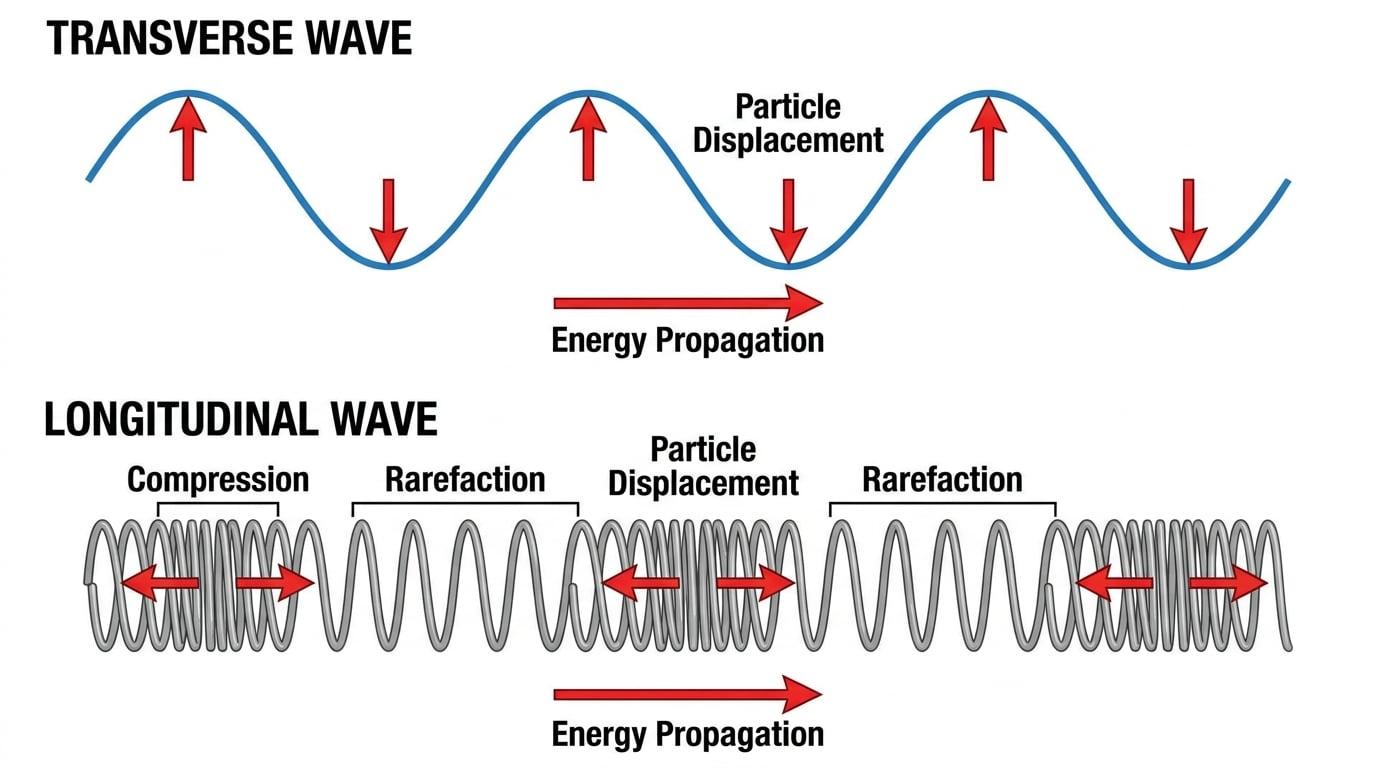
A wave where the displacement of the oscillating particles (or fields) is perpendicular to the direction of energy propagation.
If a transverse wave is travelling horizontally from left to right, the particles carrying the wave are moving vertically up and down.
Common examples of transverse waves include:
- Waves on a string: If you flick a stretched string up and down, the wave travels away from you, but the string itself only moves vertically.
- Ripples on the surface of water.
- Electromagnetic (EM) waves: This includes light, microwaves, radio waves, and X-rays.
A special note on electromagnetic waves
EM waves are unique. Unlike waves on a string or sound waves, EM waves do not need physical particles to travel through. They can travel through a perfect vacuum.
Instead of physical particles oscillating, EM waves consist of oscillating electric and magnetic fields. These fields oscillate perfectly perpendicular to the direction of energy transfer.
The speed of EM waves
All electromagnetic waves, regardless of their frequency or wavelength, travel at the same constant speed in a vacuum: 3.00×10⁸ m s−13.00 \times 10^8 \text{ m s}^{-1}3.00×10⁸ m s−1.
Longitudinal waves
The second category of wave behaves quite differently.
Longitudinal wave
A wave where the displacement of the oscillating particles is parallel to the direction of energy propagation.
Instead of peaks and troughs, longitudinal waves are made up of compressions (where particles are squashed close together) and rarefactions (where particles are spread far apart).
The most common example is sound. When you speak, your vocal cords push the air molecules back and forth in the same direction that the sound is travelling.
Example 1: Classifying wave properties
A student is using a slinky spring to demonstrate wave motion. First, they flick the end of the spring side-to-side. Then, they push and pull the end of the spring back-and-forth. State the type of wave produced in each case and compare the motion of a single coil on the spring to the direction of energy transfer.
- First, identify the type of wave created by a side-to-side motion. Since the movement of the student's hand (and therefore the displacement of the coils) is at right angles to the direction the wave travels down the slinky, this produces a transverse wave.
- State the relationship clearly: In the transverse wave, the displacement of the coil is perpendicular to the direction of energy propagation.
- Next, identify the push-and-pull motion. This creates compressions and rarefactions travelling down the slinky. This is a longitudinal wave.
- State the relationship: In the longitudinal wave, the displacement of the coil is parallel to the direction of energy propagation.
Confusing 'propagation' with 'movement'
In exam answers, avoid saying "the wave moves left". Use the precise phrasing "the direction of energy propagation" or "the direction of energy transfer". AQA examiners look for this specific terminology to award full marks.
Polarisation
If you imagine a transverse wave on a string, you could flick the string vertically up and down, but you could also flick it horizontally side to side. In both cases, the displacement is perpendicular to the wave's travel. In fact, you could flick it at any angle, as long as it remains perpendicular to the travel direction.
When a source produces waves oscillating in many different random planes (all perpendicular to the direction of travel), we call the wave unpolarised. A lightbulb produces unpolarised light.
Polarisation
The restriction of the oscillations of a transverse wave to a single plane. When a wave's oscillations are confined to one plane, it is said to be plane-polarised.
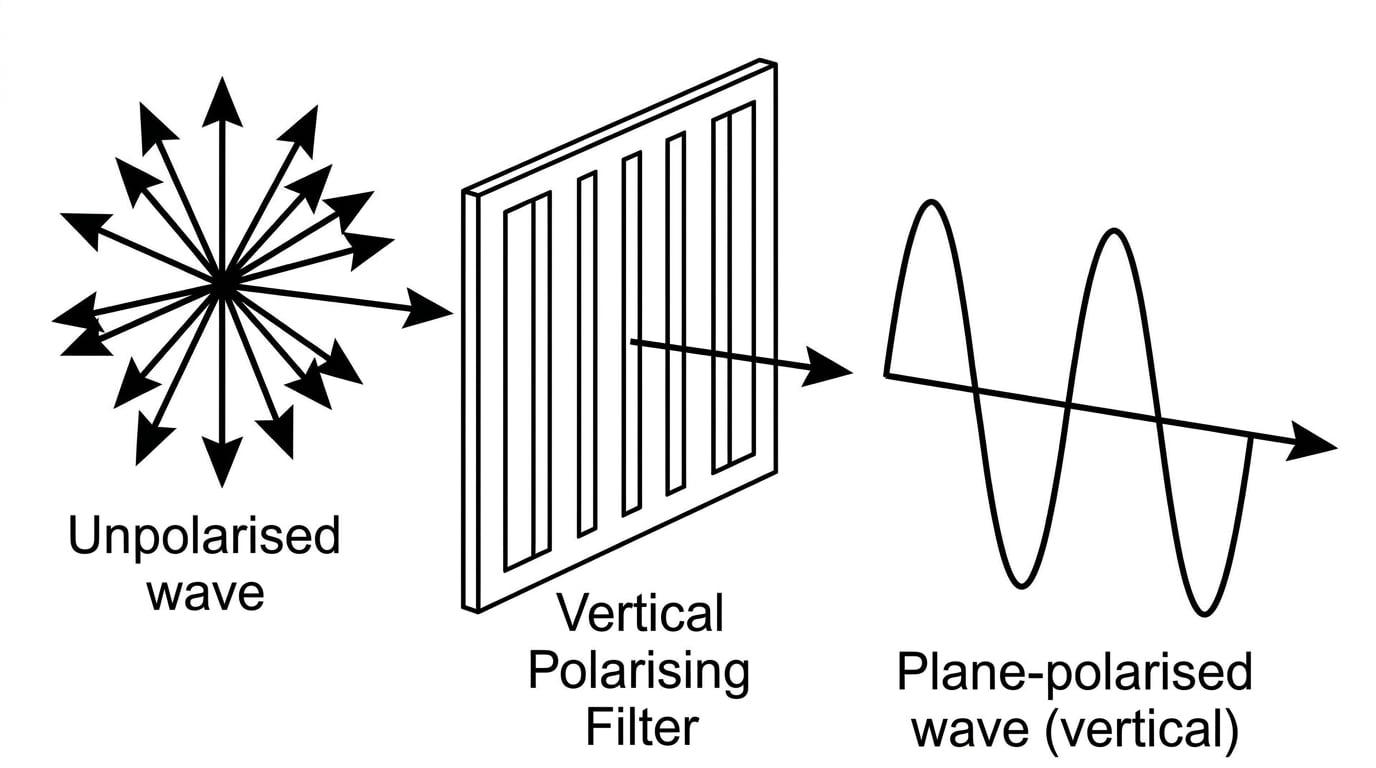
We can polarise a wave by passing it through a polarising filter. This filter acts a bit like a picket fence. If you try to send a wave on a string through a vertical slit in a fence, only vertical oscillations can slip through. Any horizontal oscillations are blocked.
The ultimate proof
Polarisation can only occur if a wave's oscillations are perpendicular to its direction of travel. Therefore, if a wave can be polarised, it acts as absolute proof that the wave is transverse. Longitudinal waves cannot be polarised.
Example 2: Justifying the nature of a wave
An ultrasound wave travels through human tissue. Explain why it is impossible to polarise this wave.
- Identify the wave type. Ultrasound is a sound wave, which means it is a longitudinal wave.
- Recall the definition of a longitudinal wave. The particles in the tissue oscillate parallel to the direction of energy propagation.
- Apply the concept of polarisation. Polarisation requires restricting oscillations to a single plane perpendicular to the direction of travel. Because the oscillations are already restricted to the parallel axis, there are no perpendicular planes of oscillation to filter out.
Polarisation of EM waves
Because electromagnetic waves consist of both electric and magnetic fields, we define the "plane of polarisation" based entirely on the direction the electric field is oscillating.
Applications of Polarisation
Polarisation isn't just an abstract concept; it has incredibly useful everyday applications that often appear in exam contexts.
Polaroid material
Polaroid sunglasses use polarising filters to reduce glare. When unpolarised sunlight reflects off a horizontal surface (like water or a wet road), it becomes partially polarised in the horizontal plane.
To combat this, the lenses in Polaroid sunglasses contain polarising filters that are aligned vertically. They allow vertically polarised light through (so you can still see the world around you) but strongly absorb the horizontally polarised reflected light, cutting out the glare completely.
Transmission and reception aerials
Radio and TV signals are transmitted as electromagnetic waves. The transmitting aerial is usually a long metal rod. As alternating current flows up and down this rod, it emits an EM wave where the electric field oscillates in the same plane as the rod.
If the transmitting aerial is vertical, the broadcasted radio wave is vertically polarised.
To receive the maximum signal strength, the receiving aerial must be perfectly aligned with the transmitting aerial.
Example 3: Aligning a television aerial
A television transmitter broadcasts a vertically polarised electromagnetic signal. A homeowner installs a receiving aerial on their roof but accidentally mounts it horizontally. Explain why the television signal is very weak.
- State the condition of the incoming wave. The transmitter emits a vertically polarised wave, meaning the electric field of the EM wave oscillates in the vertical plane.
- Explain how an aerial works. For an aerial to pick up the signal, the incoming oscillating electric field must force the free electrons in the aerial's metal rods to oscillate, creating an alternating current.
- Link the alignment to the result. Because the receiving aerial is horizontal, the vertical electric field cannot push the electrons along the length of the rods. Therefore, very little alternating current is generated, resulting in a very weak signal.
In the exam
- Never use the word "move" when describing particle oscillations. Use "displaced" or "oscillate".
- Be extremely explicit with your geometry words. State exactly what is parallel or perpendicular to what. (e.g., "The displacement of the particle is perpendicular to the direction of energy propagation").
- If an AQA question asks for "evidence that light is a transverse wave", a one-word answer is usually sufficient: "Polarisation".
- When discussing aerials, remember to state that the receiving aerial must be aligned parallel to the electric field of the transmitted wave.
Check yourself
- Can you state the difference in particle displacement between longitudinal and transverse waves?
- Are sound waves longitudinal or transverse? What about radio waves?
- Why is it impossible to polarise a sound wave?
- If light reflects off a horizontal puddle and becomes horizontally polarised, in which direction must the polarising filters in your sunglasses be oriented to block the glare?