The Mathematics of the First Harmonic
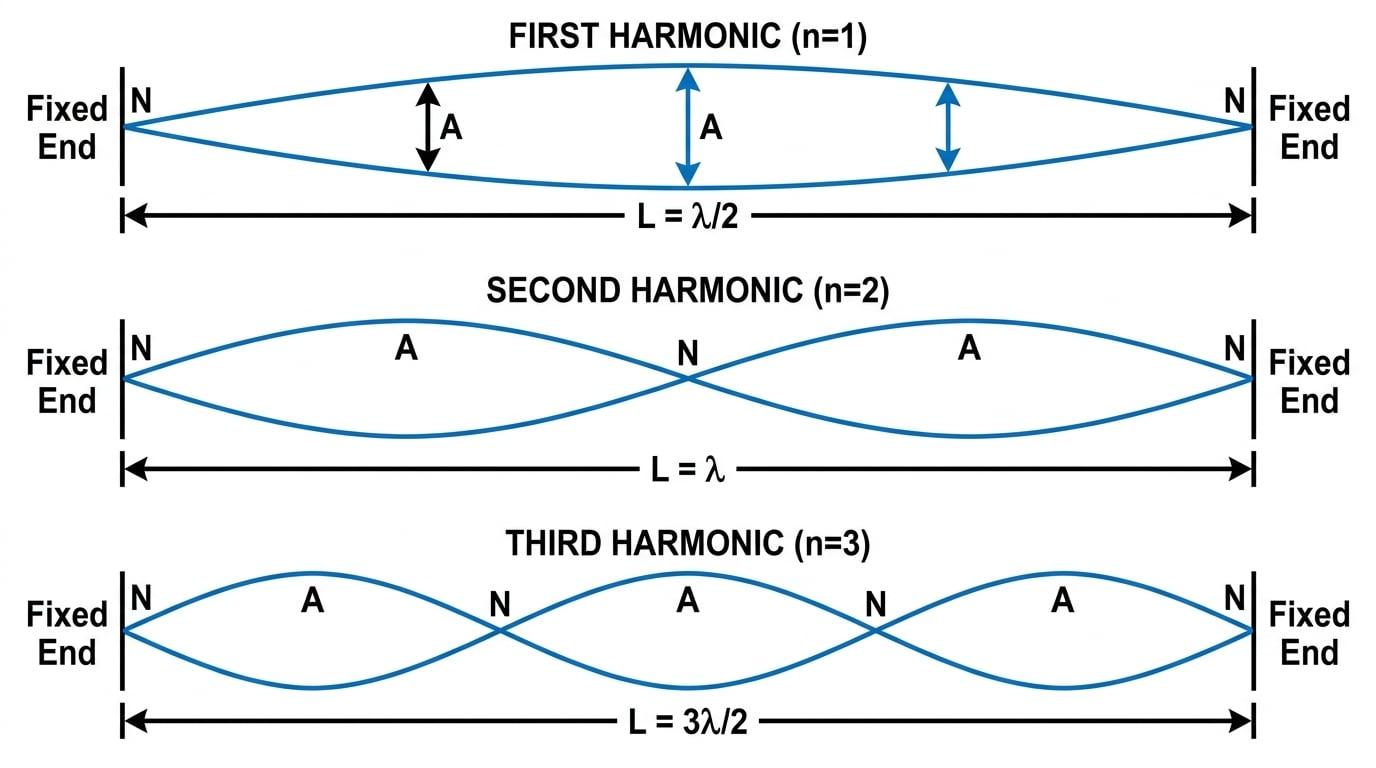
The frequency of the first harmonic depends on the physical properties of the string. A tighter, lighter, or shorter string will vibrate faster (at a higher frequency).
The formula for the frequency of the first harmonic is:
f=12lTμ f = \frac{1}{2l} \sqrt{\frac{T}{\mu}} f=2l1μTWhere:
- fff is the frequency of the first harmonic in hertz (Hz\text{Hz}Hz)
- lll is the length of the vibrating string in metres (m\text{m}m)
- TTT is the tension in the string in newtons (N\text{N}N)
- μ\muμ is the mass per unit length of the string in kilograms per metre (kg m−1\text{kg m}^{-1}kg m−1)
Mass vs. Mass per unit length
A very common mistake is plugging the total mass of the string (mmm) into the formula instead of μ\muμ. If a question gives you the mass and the length, you must first calculate the mass per unit length using μ=ml\mu = \frac{m}{l}μ=lm before using the main equation!
Calculating string tension
A guitar string has a length of 0.65 m0.65 \text{ m}0.65 m and a mass of 3.0×10⁻³ kg3.0 \times 10^{-3} \text{ kg}3.0×10⁻³ kg. The frequency of its first harmonic is 330 Hz330 \text{ Hz}330 Hz. Calculate the tension in the string.
- First, calculate the mass per unit length, μ\muμ:
- State the formula for the first harmonic:
- Rearrange the formula to make Tension (TTT) the subject. First, multiply by 2l2l2l:
- Square both sides:
- Multiply by μ\muμ:
- Substitute the values into the rearranged equation:
- Calculate the final answer:
Link to Required Practical 1
You will investigate this formula in your first Required Practical. By using a vibration generator and changing weights on a string, you can verify that the frequency fff is proportional to 1l\frac{1}{l}l1 (if you plot fff against 1l\frac{1}{l}l1, you get a straight line through the origin) and that fff is proportional to T\sqrt{T}T (plotting fff against T\sqrt{T}T also yields a straight line through the origin).
Stationary Waves with Other Types of Waves
Stationary waves are not limited to strings; any wave can form them if reflected back on itself.
Microwaves: If you direct a microwave transmitter at a flat metal plate, the microwaves reflect back. The reflected wave superposes with the incoming wave, creating a stationary microwave pattern. If you move a microwave detector probe between the transmitter and the plate, the signal will repeatedly drop to zero (at the nodes) and rise to a maximum (at the antinodes).
Sound Waves: Stationary sound waves can form in pipes. A loudspeaker playing a single tone into a glass tube closed at one end will create a stationary wave. The closed end of the tube forces the air molecules to stop moving, making it a displacement node. You can sometimes see this by sprinkling a fine powder into the tube; the powder is thrown away from the fiercely vibrating antinodes and settles quietly at the nodes.
In the exam
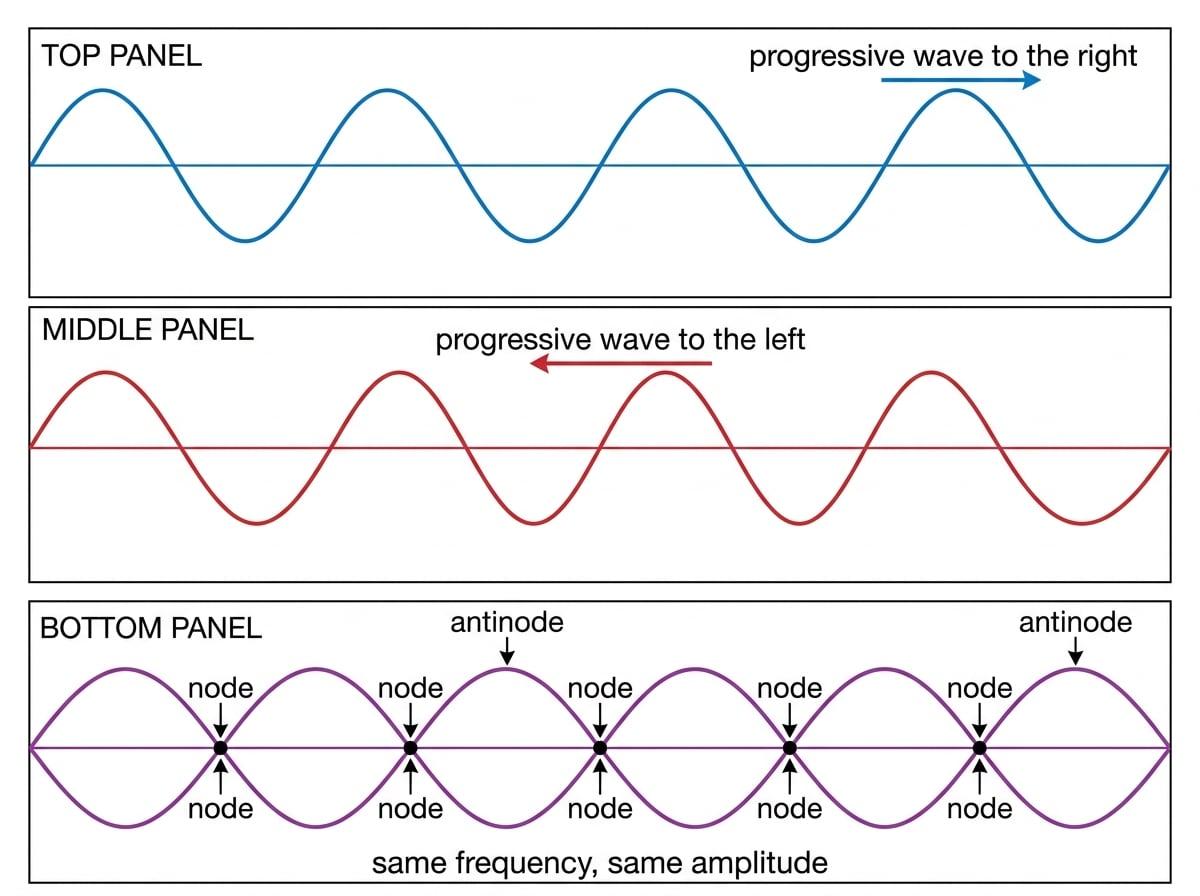
- If asked "how a stationary wave is formed", your answer must always include: "two progressive waves", "same frequency/wavelength", "travelling in opposite directions", and "superposition".
- Pay strict attention to the units of μ\muμ. If mass is given in grams, convert to kg\text{kg}kg immediately.
- Remember that frequency is constant across all points on the stationary wave (except at the exact nodes, where there is zero amplitude). Every point on the wave reaches its maximum displacement at the exact same time.
Check yourself
- What is the distance between a node and the adjacent antinode in terms of wavelength (λ\lambdaλ)?
- How many nodes and antinodes are present in the second harmonic on a fixed string?
- If you quadruple the tension in a string (T→4TT \rightarrow 4TT→4T), by what factor does the frequency of the first harmonic change?