Interference
What you'll learn
- How path difference determines whether waves interfere constructively or destructively.
- What makes two wave sources coherent, and why this is vital for stable interference patterns.
- How to set up and analyse Young's double-slit experiment using lasers or white light.
- How to use the fringe spacing equation w=λDsw = \frac{\lambda D}{s}w=sλD.
Superposition and Coherence
Before we look at interference patterns, we need to quickly remember the principle of superposition. When two waves meet at a point, their total displacement is the vector sum of their individual displacements. If two peaks meet, they add up to make a bigger peak (constructive interference). If a peak meets a trough, they cancel each other out (destructive interference).
For us to see a stable, predictable pattern of constructive and destructive interference, the two sources of the waves must be coherent.
Coherent sources
Two sources are coherent if they produce waves with the same frequency and a constant phase difference.
If the sources had different frequencies, or if they kept randomly shifting out of sync, the interference pattern would shift around incredibly fast. To our eyes, the light would just blur into an average, uniform brightness, and we wouldn't see a pattern at all.
Path Difference
Imagine two speakers playing the exact same note (they are coherent). You stand somewhere in the room. The sound wave from Speaker 1 travels a certain distance to reach your ear. The sound wave from Speaker 2 travels a slightly different distance to reach your ear. The difference between these two distances is called the path difference.
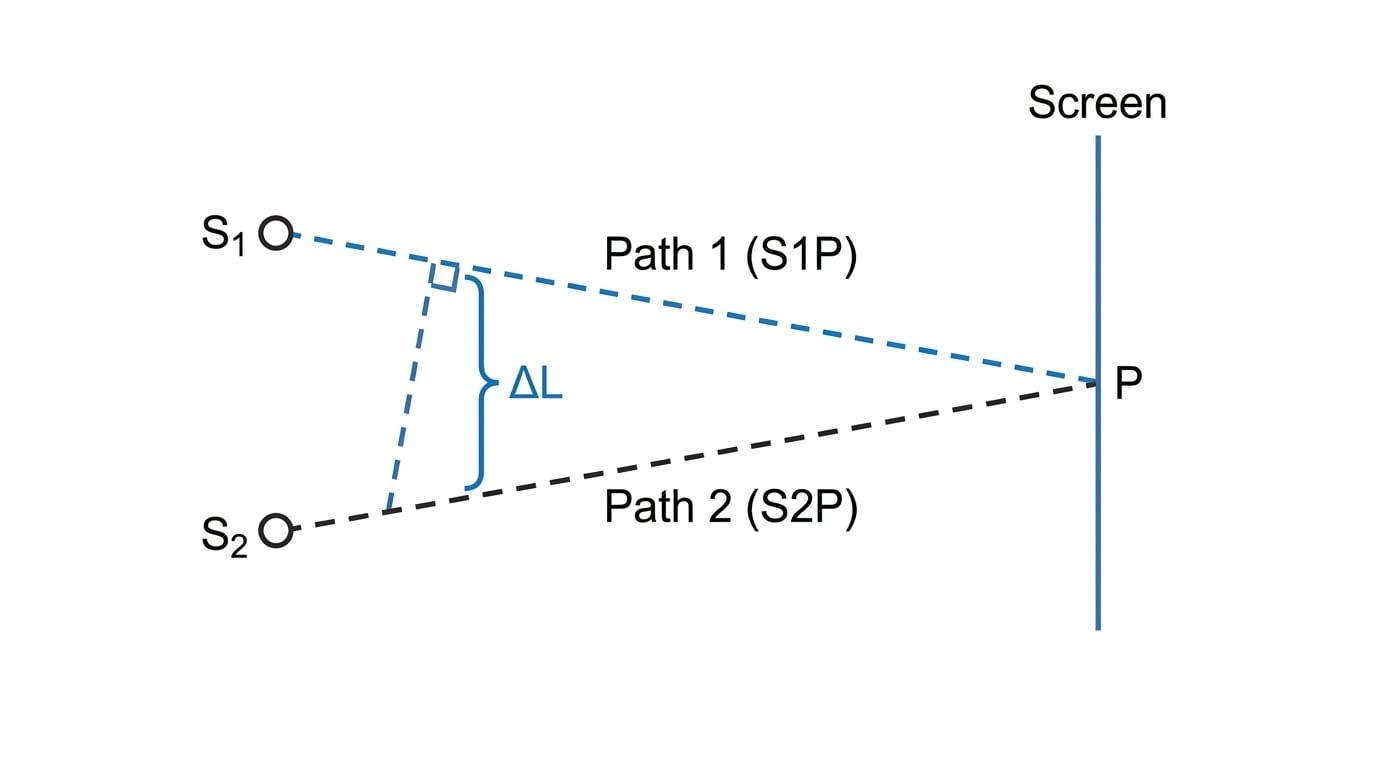
Whether you hear a loud sound or a quiet sound depends entirely on this path difference, measured in wavelengths (λ\lambdaλ):
- Constructive interference (a maximum): This happens when the path difference is exactly a whole number of wavelengths. The waves arrive exactly in phase (peaks line up with peaks). Path difference=nλ\text{Path difference} = n\lambdaPath difference=nλ (where nnn is an integer like 0, 1, 2, ...)
- Destructive interference (a minimum): This happens when the path difference is a whole number of wavelengths plus a half. The waves arrive completely out of phase (peaks line up with troughs). Path difference=(n+0.5)λ\text{Path difference} = (n + 0.5)\lambdaPath difference=(n+0.5)λ
Calculating path difference
Two coherent wave sources, emitting waves of wavelength 0.15 m0.15 \text{ m}0.15 m, are placed in a tank. Point P is 1.20 m1.20 \text{ m}1.20 m from the first source and 1.65 m1.65 \text{ m}1.65 m from the second source. Determine whether constructive or destructive interference occurs at P.
- Find the path difference by subtracting the shorter distance from the longer distance. Path difference=1.65−1.20=0.45 m\text{Path difference} = 1.65 - 1.20 = 0.45 \text{ m}Path difference=1.65−1.20=0.45 m
- Divide the path difference by the wavelength to find out how many wavelengths this is. 0.450.15=3\frac{0.45}{0.15} = 30.150.45=3
- Evaluate the result. Because 3 is exactly a whole number (nλn\lambdanλ), the waves arrive in phase. Therefore, constructive interference occurs at P.
Young's Double-Slit Experiment
In 1801, Thomas Young used interference to prove that light acts as a wave. He passed light through a single narrow slit, and then let that light spread out to hit a barrier with two more narrow slits. The two slits acted as two coherent wave sources.
Today, we usually simplify the experiment by using a laser. Lasers are fantastic for this because they are already coherent and monochromatic (they emit light of a single wavelength/colour). We just point the laser directly at the double slits.

When the laser beam hits the double slits, the light diffracts (spreads out) from each slit. The overlapping diffracted waves interfere. When we place a screen on the other side, we see a striking pattern of alternating bright and dark lines called fringes.
- The bright fringes are where the path difference is nλn\lambdanλ.
- The dark fringes are where the path difference is (n+0.5)λ(n + 0.5)\lambda(n+0.5)λ.
Laser Safety
Because lasers emit a very concentrated beam of light, they can cause permanent eye damage. When doing this practical, you must:
- Never look directly into the laser beam.
- Avoid shining the laser at reflective surfaces.
- Display clear warning signs when lasers are in use.
The Fringe Spacing Equation
We can mathematically predict how far apart the bright fringes will be on the screen using the fringe spacing equation.
Fringe spacing equation
Where:
- www is the fringe spacing (the distance from the centre of one bright fringe to the centre of the next bright fringe), in metres.
- λ\lambdaλ is the wavelength of the light, in metres.
- DDD is the distance from the double slits to the screen, in metres.
- sss is the slit spacing (the distance between the centres of the two slits), in metres.
Confusing the 's' and the 'w'
Be careful! It is incredibly easy to accidentally swap sss and www in your head during an exam. Remember that s is the slit spacing (usually very small, around 0.1 mm0.1 \text{ mm}0.1 mm) and www is the fringe spacing on the screen (usually a few millimetres).
Calculating wavelength from fringe spacing
A student points a red laser at a double slit with a slit spacing of 0.30 mm0.30 \text{ mm}0.30 mm. The screen is placed 2.40 m2.40 \text{ m}2.40 m away. The student measures the distance across 5 consecutive bright fringes to be 21.0 mm21.0 \text{ mm}21.0 mm. Calculate the wavelength of the laser light.
- First, find the single fringe spacing, www. The distance across 5 bright fringes spans 4 gaps between them. w=21.04=5.25 mm=5.25×10⁻³ mw = \frac{21.0}{4} = 5.25 \text{ mm} = 5.25 \times 10^{-3} \text{ m}w=421.0=5.25 mm=5.25×10⁻³ m
- Identify and convert the other variables into standard SI units (metres). D=2.40 mD = 2.40 \text{ m}D=2.40 m s=0.30 mm=0.30×10⁻³ ms = 0.30 \text{ mm} = 0.30 \times 10^{-3} \text{ m}s=0.30 mm=0.30×10⁻³ m
- Rearrange the fringe spacing equation to make λ\lambdaλ the subject. w=λDs ⟹ λ=wsDw = \frac{\lambda D}{s} \implies \lambda = \frac{w s}{D}w=sλD⟹λ=Dws
- Substitute the values to find the wavelength. λ=5.25×10−3×0.30×10−32.40=6.56×10⁻⁷ m\lambda = \frac{5.25 \times 10^{-3} \times 0.30 \times 10^{-3}}{2.40} = 6.56 \times 10^{-7} \text{ m}λ=2.405.25×10−3×0.30×10−3=6.56×10⁻⁷ m (or 656 nm656 \text{ nm}656 nm)
White Light Fringes
What happens if we stop using a monochromatic laser and use a white light source instead?
White light is a mixture of all the visible colours, meaning it contains a continuous range of wavelengths. Because fringe spacing depends on wavelength (w∝λw \propto \lambdaw∝λ), each colour creates its own interference pattern with slightly different spacing.
These patterns overlap on the screen, creating a very specific effect:
Describing the white light pattern
An exam question often asks you to describe the interference pattern produced when white light passes through double slits. Here is how you construct your answer:
- The central fringe: State that the central maximum is white. This is because all wavelengths of light have a path difference of zero at the exact centre, so they all constructively interfere there and mix back together into white light.
- The outer fringes: State that the fringes on either side become continuous spectra (little rainbows) rather than sharp lines.
- The order of colours: Explain that blue light (which has the shortest visible wavelength) diffracts least and has the smallest fringe spacing. Therefore, blue forms the inner edge of each spectrum, while red (the longest wavelength) forms the outer edge.
- Fading out: Point out that after a few fringes, the colours overlap so much that the pattern completely washes out and disappears.
Other Waves and Historical Context
The math of interference doesn't just apply to light. It works for any wave, provided you have two coherent sources.
Interference with sound waves
Two loudspeakers are connected to the same audio signal generator. A student walks slowly along a straight line parallel to the speakers. Describe what they hear.
- Recognise the setup: The speakers act as two coherent sources of sound waves.
- Identify the maxima: As the student walks, they will hear louder sounds at points where the path difference is a whole number of wavelengths (nλn\lambdanλ), due to constructive interference.
- Identify the minima: They will hear much quieter sound at regions where the path difference is an odd number of half-wavelengths ((n+0.5)λ(n + 0.5)\lambda(n+0.5)λ), due to destructive interference.
Microwaves can also be used. By passing microwaves from a single transmitter through two slits in a metal barrier, and moving a microwave receiver along a line parallel to the barrier, you will detect alternating maxima and minima in signal strength.
Changing nature of EM radiation
Throughout history, scientific understanding evolves. In the late 17th century, Isaac Newton argued that light was made of tiny particles (corpuscles), while Christiaan Huygens argued it was a wave. Newton's enormous reputation meant his particle theory was accepted for over 100 years.
It wasn't until Thomas Young performed his double-slit experiment in 1801 that the wave theory triumphed. Young showed that light produces interference patterns—a behaviour unique to waves. Particles simply cannot cancel each other out to create dark fringes! (Though, as you will see in Quantum Physics, the story doesn't quite end there...)
In the exam
- Measuring www accurately: Exam questions love to test your practical skills. To find the fringe spacing www accurately, you should measure across multiple fringes (e.g. 10 fringes) and divide by the number of gaps between them, not the number of bright spots.
- Standard form conversions: AQA will almost always give you slit spacing sss in millimetres (mm\text{mm}mm) and wavelengths λ\lambdaλ in nanometres (nm\text{nm}nm). Convert everything to metres (×10−3\times 10^{-3}×10−3 and ×10−9\times 10^{-9}×10−9 respectively) before putting them into w=λDsw = \frac{\lambda D}{s}w=sλD.
- Single vs Double Slits: Read carefully to ensure the question is about Young's double slit and not single slit diffraction (which has a completely different intensity pattern with a massive central maximum).
Check yourself
- Can you define the term 'coherent' in the context of wave sources?
- What path difference is required for a dark fringe (destructive interference) to form?
- In a white light interference pattern, which colour is closest to the central white fringe, and why?
- How would the distance between bright fringes change if you moved the screen further away from the slits?