Parallel plate capacitor (A-level only)
What you'll learn:
- How the physical dimensions of a capacitor (area and separation) determine its capacitance.
- What relative permittivity (the dielectric constant) means.
- The microscopic "dielectric action" of polar molecules in an electric field.
- How to apply the equation C=Aε0εrdC = \frac{A\varepsilon_0\varepsilon_r}{d}C=dAε0εr in exam questions.
The geometry of a capacitor
Most of the capacitors you have looked at so far have just been a symbol in a circuit diagram. Now, we are going to look at how they are actually built.
A simple capacitor consists of two parallel, conductive metal plates separated by an insulating gap. This gap can be a complete vacuum, filled with air, or filled with a solid insulating material (which we call a dielectric).
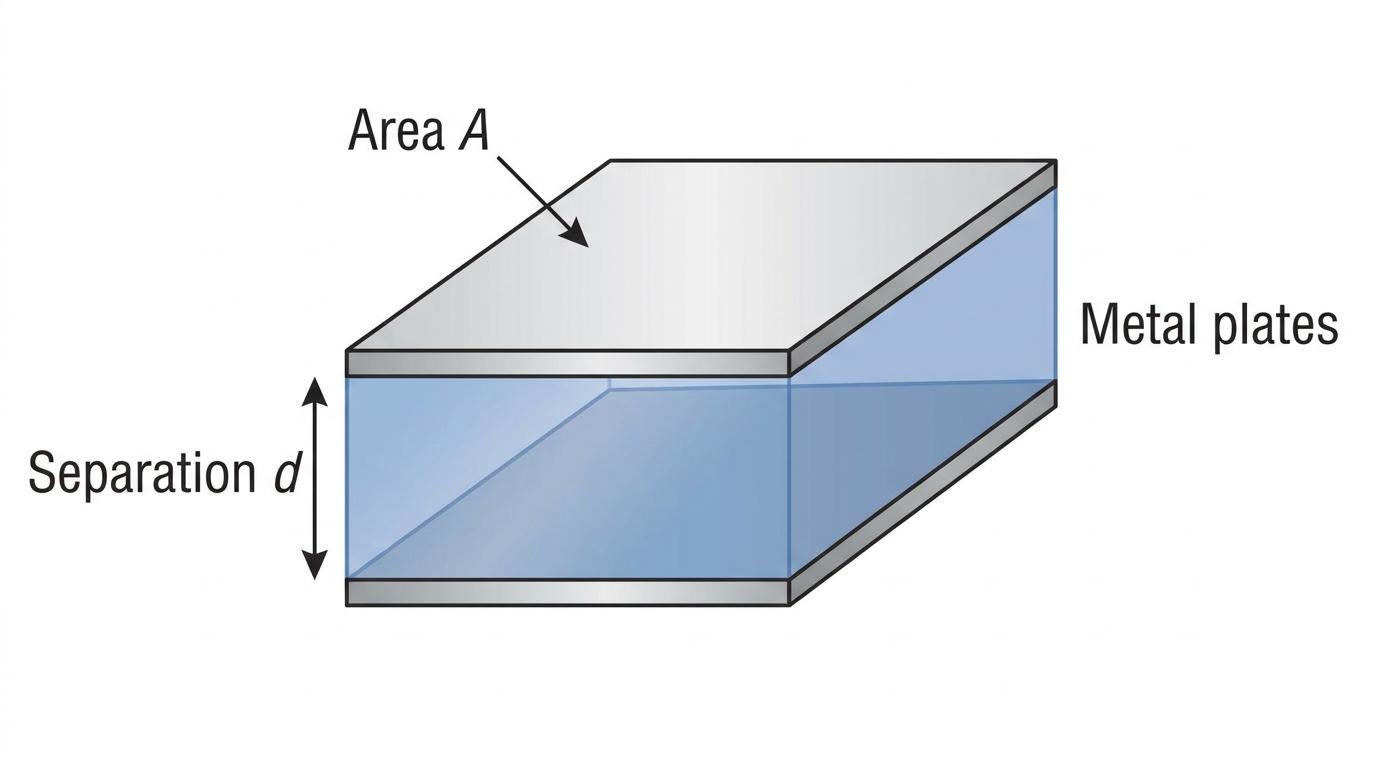
The capacitance CCC (the amount of charge it can store per volt) depends on three physical factors:
- The area of the plates (AAA): A larger overlapping area means more physical space to store electrons. Capacitance is directly proportional to area.
- The separation of the plates (ddd): If the plates are closer together, the positive and negative charges on opposite plates pull on each other more strongly, making it easier to pack more charge onto the plates. Capacitance is inversely proportional to separation distance.
- The material between the plates: Different insulators affect the electric field between the plates in different ways.
If the gap between the plates is a completely empty vacuum, the capacitance is given by:
C=Aε0dC = \frac{A \varepsilon_0}{d}C=dAε0Here, ε0\varepsilon_0ε0 is the permittivity of free space (a fundamental constant provided on your data sheet, ≈8.85×10⁻¹² F m−1\approx 8.85 \times 10^{-12}\text{ F m}^{-1}≈8.85×10⁻¹² F m−1).
Air behaves like a vacuum
For A-level Physics, the permittivity of air is so incredibly close to the permittivity of a vacuum that you can treat an air-filled capacitor exactly as if it were a vacuum-filled one.
Introducing the dielectric
To make a capacitor physically smaller while keeping its capacitance high, manufacturers insert a solid insulating material between the plates. This material is called a dielectric. Examples include waxed paper, ceramics, or plastics.
Every material has a property called its relative permittivity (sometimes called the dielectric constant).
Relative permittivity ()
The ratio of the charge stored by a capacitor with the dielectric in place to the charge stored when the capacitor has a vacuum between its plates (for the same potential difference).
Because it is a ratio, εr\varepsilon_rεr has no units.
When a dielectric is inserted, the formula for the parallel plate capacitor becomes:
C=Aε0εrdC = \frac{A \varepsilon_0 \varepsilon_r}{d}C=dAε0εrIf the material is a vacuum (or air), εr=1\varepsilon_r = 1εr=1, and the equation neatly simplifies back to the vacuum version. For any other insulator, εr\varepsilon_rεr is greater than 1, meaning the dielectric increases the capacitance.
Mixing up permittivity constants
Do not confuse the absolute permittivity of free space (ε0\varepsilon_0ε0, which has units of F m−1\text{F m}^{-1}F m−1) with relative permittivity (εr\varepsilon_rεr, which is just a dimensionless ratio). The actual permittivity of the material is the product of the two: ε=ε0εr\varepsilon = \varepsilon_0 \varepsilon_rε=ε0εr.
How to use the equation
Let's look at a typical calculation you might face in an exam.
Worked Example: Calculating plate area
A parallel plate capacitor is constructed using a sheet of paper of thickness 0.05 mm0.05\text{ mm}0.05 mm as a dielectric. The relative permittivity of the paper is 3.53.53.5. Calculate the plate area required to produce a capacitance of 4.7 nF4.7\text{ nF}4.7 nF. (Permittivity of free space ε0=8.85×10⁻¹² F m−1\varepsilon_0 = 8.85 \times 10^{-12}\text{ F m}^{-1}ε0=8.85×10⁻¹² F m−1)
- Extract the given values and convert them to standard SI units:
- C=4.7×10⁻⁹ FC = 4.7 \times 10^{-9}\text{ F}C=4.7×10⁻⁹ F
- d=0.05×10⁻³ md = 0.05 \times 10^{-3}\text{ m}d=0.05×10⁻³ m
- εr=3.5\varepsilon_r = 3.5εr=3.5
- ε0=8.85×10⁻¹² F m−1\varepsilon_0 = 8.85 \times 10^{-12}\text{ F m}^{-1}ε0=8.85×10⁻¹² F m−1
- State the relevant formula:
- Rearrange the formula to make Area (AAA) the subject: Multiply both sides by ddd and divide by ε0εr\varepsilon_0 \varepsilon_rε0εr:
- Substitute the values:
- Calculate the final answer with units:
Dielectric action: The microscopic view
You need to be able to explain why inserting a dielectric increases the capacitance. This is a very common written question in AQA exams.
Dielectric materials are made of molecules. Some of these are polar molecules. This means that although the molecule is electrically neutral overall, one end of the molecule is slightly positive and the other end is slightly negative. It has a permanent dipole.
When there is no electric field, the thermal movement of these molecules means they point in random directions. Their electric fields cancel each other out.
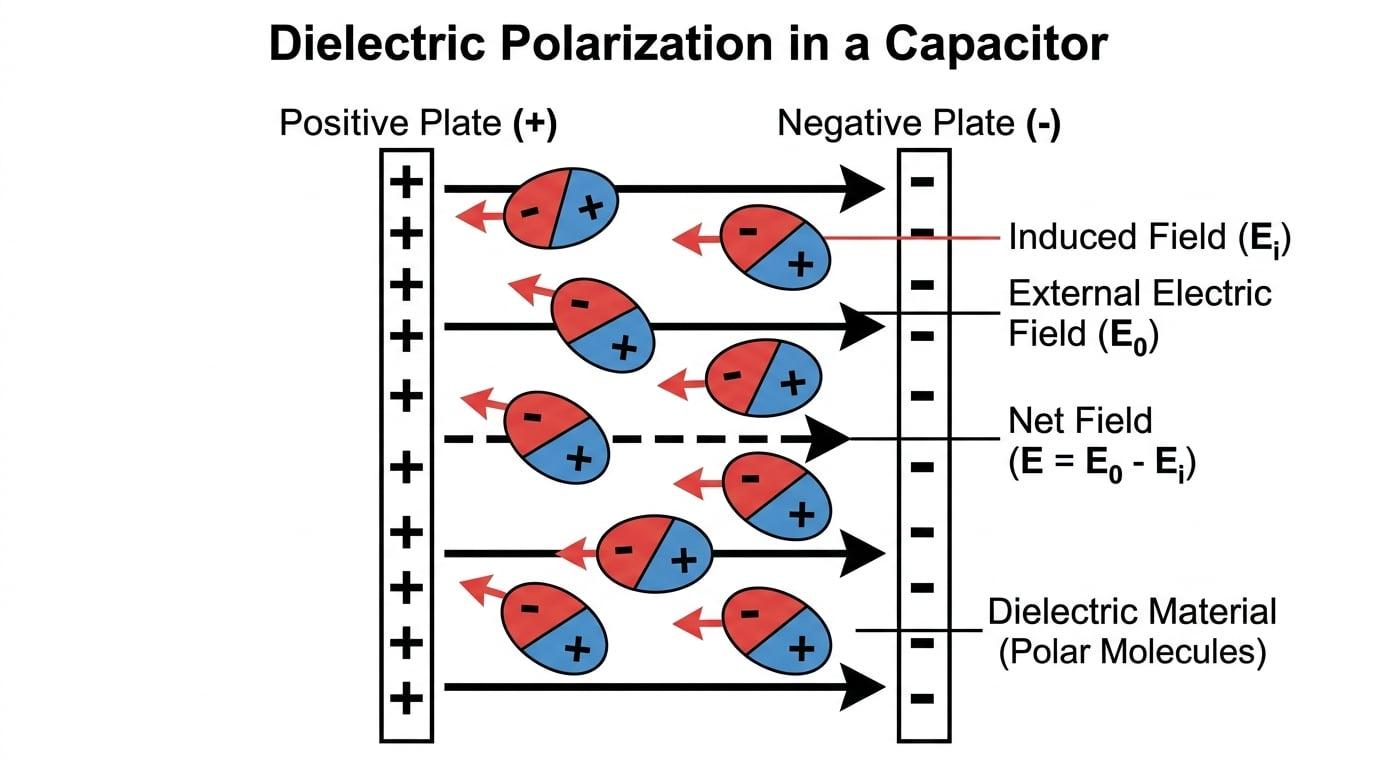
When a potential difference is applied across the capacitor plates, an electric field is created between them. Here is the step-by-step logic of what happens next (memorise this sequence!):
- The positive end of each polar molecule is repelled by the positive plate and attracted to the negative plate (and vice versa).
- This creates a turning force (torque), causing the polar molecules to rotate and align themselves anti-parallel to the applied electric field.
- Because the molecules are now aligned, they produce their own, weaker electric field that opposes the applied electric field.
- This opposing field reduces the overall net electric field between the plates.
- Since the potential difference is directly proportional to the electric field (V=EdV = EdV=Ed), reducing the net electric field reduces the potential difference required to store the same amount of charge.
- Finally, because C=QVC = \frac{Q}{V}C=VQ, a smaller VVV for a given QQQ results in a larger capacitance.
Step-by-step logic
Whenever AQA asks you to "explain the action of a dielectric", walk exactly through that 6-step logical chain: Alignment →\to→ Opposing field →\to→ Net field drops →\to→ VVV drops →\to→ CCC increases.
Worked Example: Explaining dielectric action
A capacitor with a vacuum between its plates is fully charged and then disconnected from the power supply. A slab of dielectric material is then inserted between the plates. Explain what happens to the potential difference across the plates. (4 marks)
- State the microscopic effect on the molecules: The polar molecules in the dielectric align themselves with their positive ends pointing towards the negative plate.
- Describe the effect on the electric field: The aligned molecules produce their own electric field which opposes the applied electric field from the plates, reducing the net electric field.
- Link the electric field to the potential difference: The potential difference decreases, because potential difference is proportional to electric field strength (V=EdV = EdV=Ed).
- Confirm the conservation of charge: Because the capacitor was disconnected, the charge QQQ on the plates must remain constant, so the potential difference strictly drops as CCC increases (V=Q/CV = Q/CV=Q/C).
Investigating the parallel plate capacitor
You may be asked how to determine the relative permittivity of a material experimentally.
To do this, you would use a parallel plate capacitor where the distance ddd can be varied, and a capacitance meter to measure CCC.
- Measure the diameter of the circular plates to calculate the overlapping area AAA.
- Measure the separation ddd using vernier callipers.
- Record the capacitance CCC for various separations ddd.
Because C=(Aε0εr)⋅1dC = (A\varepsilon_0\varepsilon_r) \cdot \frac{1}{d}C=(Aε0εr)⋅d1, if you plot a graph of Capacitance (CCC on the y-axis) against 1d\frac{1}{d}d1 (on the x-axis), you will get a straight line through the origin. The gradient of this line will be equal to Aε0εrA\varepsilon_0\varepsilon_rAε0εr. By dividing your gradient by AAA and ε0\varepsilon_0ε0, you can find the relative permittivity εr\varepsilon_rεr.
In the exam
- Check your prefixes: Plate areas are often given in cm2\text{cm}^2cm2 or mm2\text{mm}^2mm2. Remember that 1 cm2=10−4 m21\text{ cm}^2 = 10^{-4}\text{ m}^21 cm2=10−4 m2 and 1 mm2=10−6 m21\text{ mm}^2 = 10^{-6}\text{ m}^21 mm2=10−6 m2. Separations are usually in mm\text{mm}mm, so don't forget the ×10−3\times 10^{-3}×10−3 multiplier.
- Identify isolated vs connected capacitors: If a capacitor is connected to a battery while a dielectric is inserted, the potential difference VVV is fixed, so the charge QQQ must increase. If the capacitor is charged and disconnected before the dielectric is inserted, the charge QQQ is fixed, so the potential difference VVV must decrease.
- Keywords for dielectric explanations: Always use the words "polar molecules", "rotate/align", and "opposing electric field". These are heavily rewarded on AQA mark schemes.
Check yourself
- What happens to the capacitance if the distance between the plates is halved?
- Does relative permittivity have units?
- In terms of electric fields, why does a dielectric decrease the potential difference required to hold a specific amount of charge?