What you'll learn
- What a capacitor is and how it functions in a basic electrical circuit.
- The formal definition of capacitance and its SI unit, the Farad.
- How to use the defining equation C=QVC = \frac{Q}{V}C=VQ to solve circuit problems.
- How to confidently handle standard prefixes (micro, nano, pico) in capacitance calculations.
Meet the Capacitor
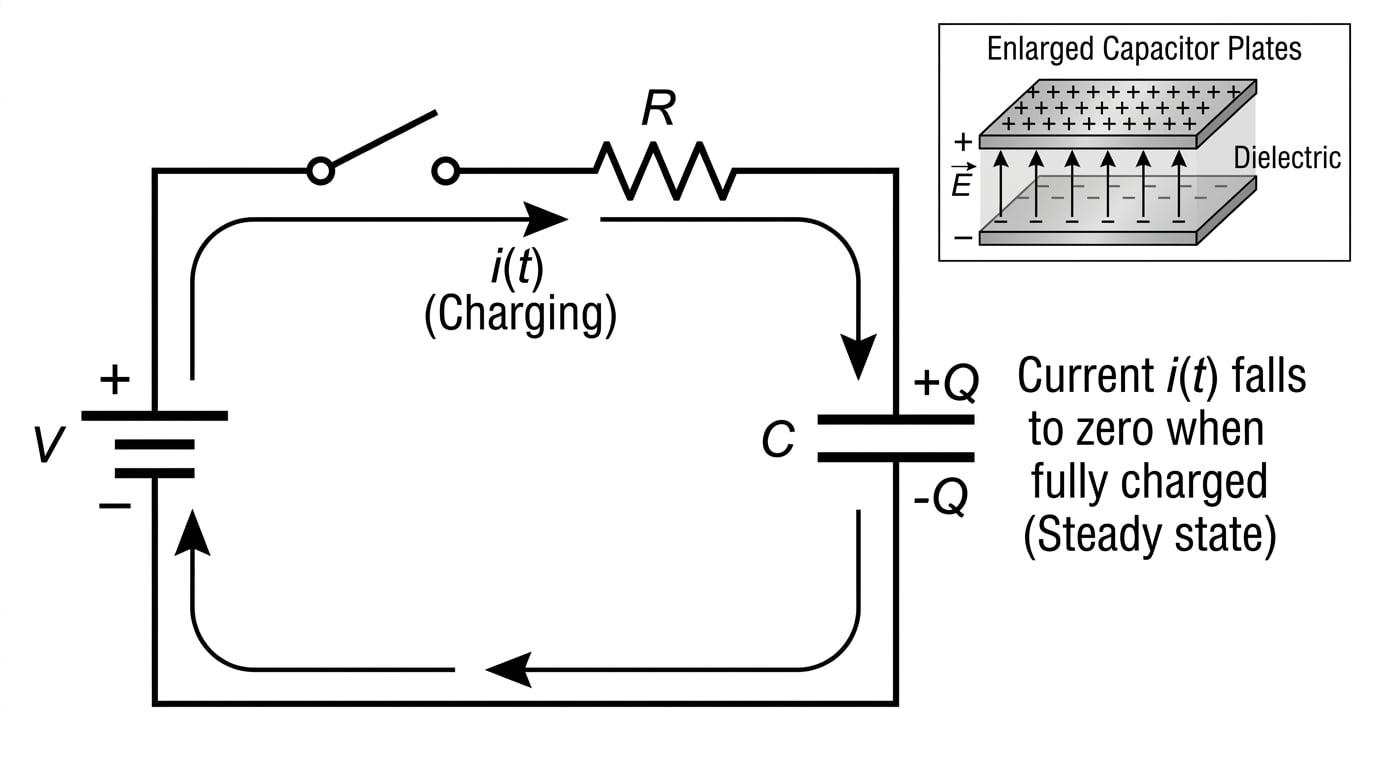
A capacitor is an electrical component designed specifically to store charge and electrical energy. In its simplest form, a parallel-plate capacitor consists of two parallel, conducting metal plates separated by an insulating material called a dielectric (which can be air, paper, ceramic, or plastic).
Because of the insulator between the plates, a direct current (DC) cannot simply flow through a capacitor. Instead, when a capacitor is connected in a circuit with a power supply, charge builds up on the plates.
How charge is stored
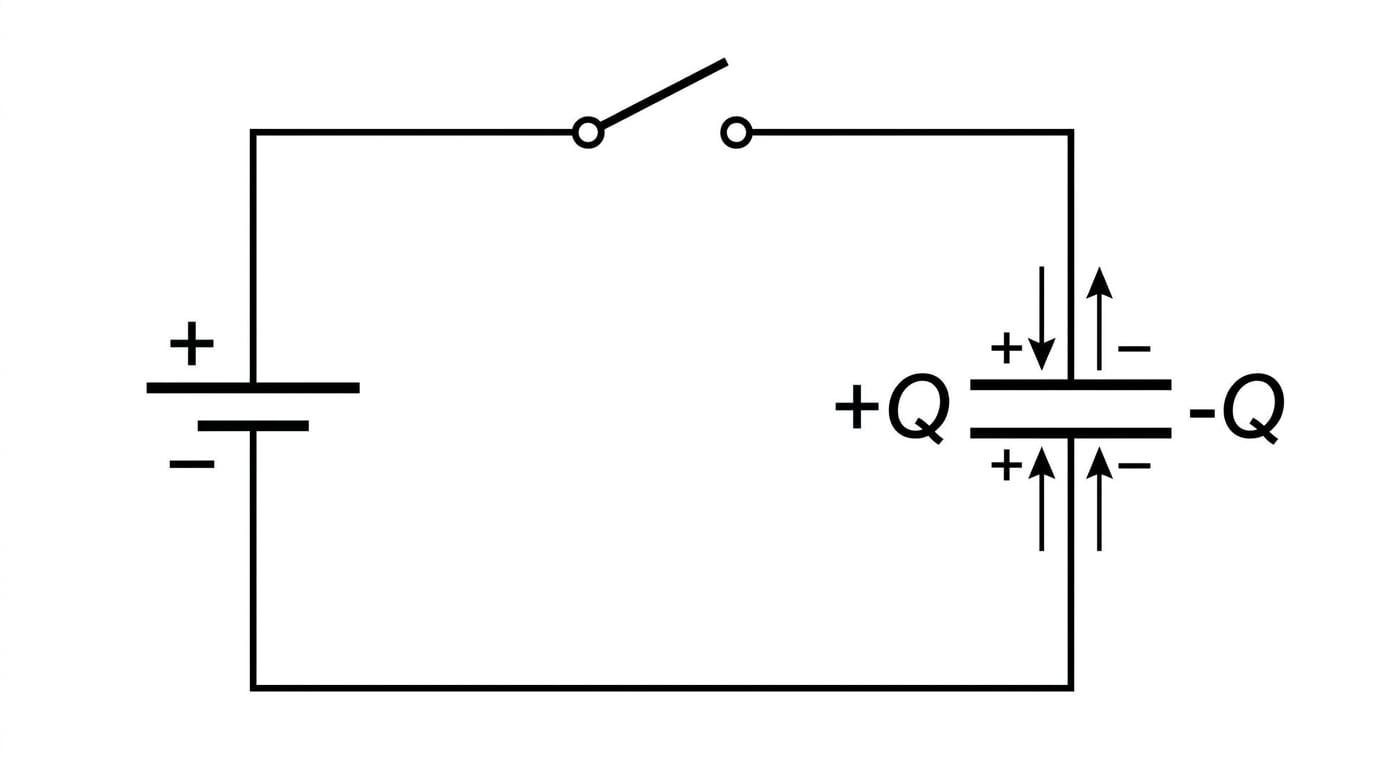
Imagine connecting an uncharged capacitor to a battery. The battery provides an electromotive force (emf) that does work on the electrons in the wires:
- Electrons are "pulled" away from one plate by the positive terminal of the battery, leaving that plate positively charged (+Q+Q+Q).
- The battery "pushes" these electrons onto the opposite plate, making it negatively charged (−Q-Q−Q).
Because the two plates are close to each other, the positive and negative charges attract one another across the gap. This electrostatic attraction helps "hold" the charge in place. As more charge builds up, a potential difference (VVV) develops across the plates.
This process continues until the potential difference across the capacitor exactly equals the emf of the battery. At this point, the capacitor is fully charged and the flow of electrons (the current) in the circuit falls to zero.
Total charge vs. Stored charge
It is very common to think that because there is +Q+Q+Q on one plate and −Q-Q−Q on the other, the total charge is 2Q2Q2Q. However, the net charge on the entire capacitor is always exactly zero (+Q+−Q=0+Q + -Q = 0+Q+−Q=0). When physicists and exam questions refer to the "charge stored", they mean the magnitude of the charge on one of the plates, QQQ.
Defining Capacitance
If you want to store more charge, you have two options: increase the voltage of the battery pushing the electrons, or use a "better" capacitor. The measure of how "good" a capacitor is at storing charge is called its capacitance.
Capacitance
Capacitance (CCC) is defined as the charge stored per unit potential difference across a capacitor.
This definition gives us the fundamental equation for this topic:
C=QVC = \frac{Q}{V}C=VQWhere:
- CCC is the capacitance in Farads (F)
- QQQ is the charge stored in Coulombs (C)
- VVV is the potential difference across the plates in Volts (V)
From this equation, we can see that a 1 Farad capacitor will store 1 Coulomb of charge when a potential difference of 1 Volt is applied across it.
The Graph of QQQ against VVV
If we plot the charge stored (QQQ) against the potential difference (VVV) applied, we get a straight line passing through the origin. This shows that the charge stored is directly proportional to the potential difference (Q∝VQ \propto VQ∝V).
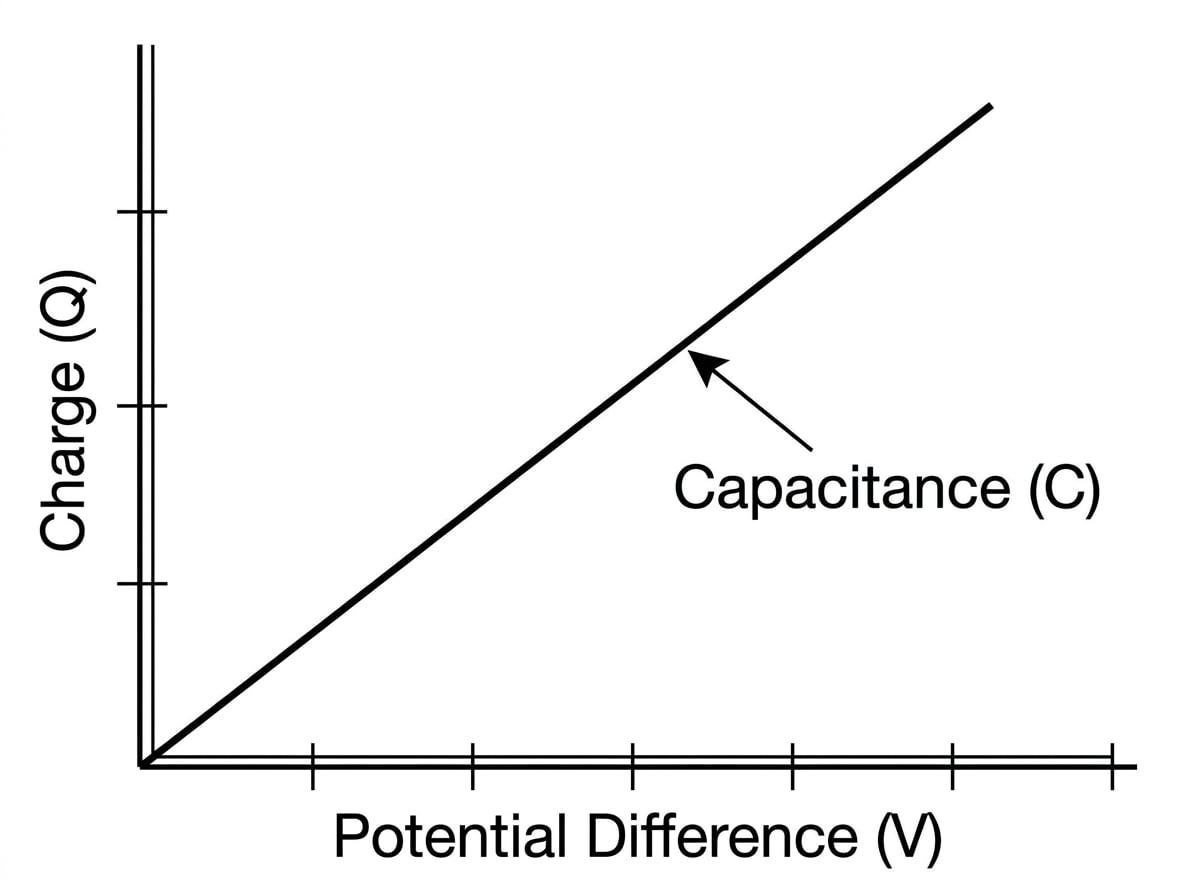
Because C=QVC = \frac{Q}{V}C=VQ, the gradient of a QQQ-VVV graph represents the capacitance. A steeper line means a higher capacitance: more charge is stored for the same voltage.
The Farad is huge
One Farad is a massive unit. If you had a 1 Farad capacitor in your school lab, it would likely be the size of a filing cabinet! Because of this, standard components used in electronics have much smaller capacitances. You must be completely fluent with these standard prefixes.
Crucial Prefixes
In A-level Physics exam questions, you will almost never deal with whole Farads. Ensure you know how to convert these standard prefixes into standard form:
- Milli (mF\text{mF}mF): ×10−3 F\times 10^{-3} \text{ F}×10−3 F
- Micro (μF\mu\text{F}μF): ×10−6 F\times 10^{-6} \text{ F}×10−6 F
- Nano (nF\text{nF}nF): ×10−9 F\times 10^{-9} \text{ F}×10−9 F
- Pico (pF\text{pF}pF): ×10−12 F\times 10^{-12} \text{ F}×10−12 F
Working with the Equation
Let's look at how this equation is tested. The most common errors come from mishandling prefixes, not from the algebra itself.
Calculating stored charge
A capacitor of capacitance 470 μF470 \text{ }\mu\text{F}470 μF is connected to a 9.0 V9.0 \text{ V}9.0 V battery and allowed to fully charge. Calculate the charge stored by the capacitor.
- First, identify the known values and convert the prefix into standard SI units. The capacitance C=470×10−6 FC = 470 \times 10^{-6} \text{ F}C=470×10−6 F and the potential difference V=9.0 VV = 9.0 \text{ V}V=9.0 V.
- State the defining equation for capacitance: C=QVC = \frac{Q}{V}C=VQ
- Rearrange the formula to make charge (QQQ) the subject: Q=C×VQ = C \times VQ=C×V
- Substitute the values into the rearranged equation to find the final answer: Q=(470×10−6)×9.0Q=4.23×10⁻³ C\begin{aligned} Q &= (470 \times 10^{-6}) \times 9.0 \\ Q &= 4.23 \times 10^{-3} \text{ C} \end{aligned}QQ=(470×10−6)×9.0=4.23×10⁻³ C
Sometimes you will be asked to find the capacitance given experimental data, or to find the voltage required to store a specific amount of charge.
Finding the potential difference
A camera flash requires 0.015 C0.015 \text{ C}0.015 C of charge to be stored in a 3.3 mF3.3 \text{ mF}3.3 mF capacitor before it can fire. Calculate the potential difference required across the capacitor.
- Convert the given values into standard SI units. The stored charge Q=0.015 CQ = 0.015 \text{ C}Q=0.015 C. The capacitance is given in millifarads, so C=3.3×10⁻³ FC = 3.3 \times 10^{-3} \text{ F}C=3.3×10⁻³ F.
- State the defining equation: C=QVC = \frac{Q}{V}C=VQ
- Rearrange the formula to make potential difference (VVV) the subject. Multiply both sides by VVV, then divide by CCC: V=QCV = \frac{Q}{C}V=CQ
- Substitute the standard-form values into the equation: V=0.0153.3×10−3V=4.545... V\begin{aligned} V &= \frac{0.015}{3.3 \times 10^{-3}} \\ V &= 4.545... \text{ V} \end{aligned}VV=3.3×10−30.015=4.545... V
- Round the final answer to an appropriate number of significant figures (2 sig figs, matching the input data): V=4.5 VV = 4.5 \text{ V}V=4.5 V
In the exam
- Watch the axes on graphs: When dealing with a QQQ-VVV graph, the gradient is exactly CCC only if QQQ is plotted on the y-axis and VVV is on the x-axis. If the exam board reverses the axes (VVV on the y-axis, QQQ on the x-axis), the gradient will be 1C\frac{1}{C}C1.
- Check the axis units: Even if the axes are standard, the charge axis is frequently given in μC\mu\text{C}μC or mC\text{mC}mC. Always multiply your gradient by the appropriate power of ten.
- Carry through your units: When substituting into C=QVC = \frac{Q}{V}C=VQ, write out the ×10−6\times 10^{-6}×10−6 or ×10−12\times 10^{-12}×10−12 on your exam paper. Examiners award marks for seeing the correct substitution, even if you mis-key it into your calculator.
Check yourself
- Can you define capacitance in words?
- If the potential difference across a given capacitor is doubled, what happens to the charge stored on it?
- How many Farads are in 220 pF220 \text{ pF}220 pF?
- Why is the total net charge on a fully charged capacitor equal to zero, and what do we actually mean by "charge stored"?