Energy stored by a capacitor (A-level only)
What you'll learn:
- Why charging a capacitor requires work to be done.
- How to interpret the area under a graph of charge against potential difference.
- How to derive and use the three main formulas for the energy stored by a capacitor.
Why does a capacitor store energy?
When you connect a capacitor to a battery, electrons flow onto one plate and are pulled away from the other. As more and more charge builds up, the plates become increasingly negatively and positively charged.
Because like charges repel, the battery has to do work to push additional electrons onto the already-negative plate. This work done by the battery is transferred to the capacitor and stored as electrical potential energy within the electric field between the two plates.
Energy stored by a capacitor
The electrical potential energy stored in the electric field between the plates of a charged capacitor, equal to the work done to deposit the charge onto the plates.
You might remember from earlier topics that the work done moving a charge QQQ across a potential difference VVV is given by W=QVW = QVW=QV. However, for a capacitor, you cannot just multiply the total charge by the final potential difference. As the capacitor charges up, the potential difference across it is not constant—it starts at zero and gradually increases to the final voltage VVV.
The Charge-Voltage (QQQ-VVV) Graph
To find the energy stored correctly, we can plot a graph of the charge QQQ stored on the capacitor against the potential difference VVV across it.
For a standard fixed capacitor, charge is directly proportional to potential difference (Q=CVQ = CVQ=CV). This means a graph of charge against pd is a straight line through the origin.
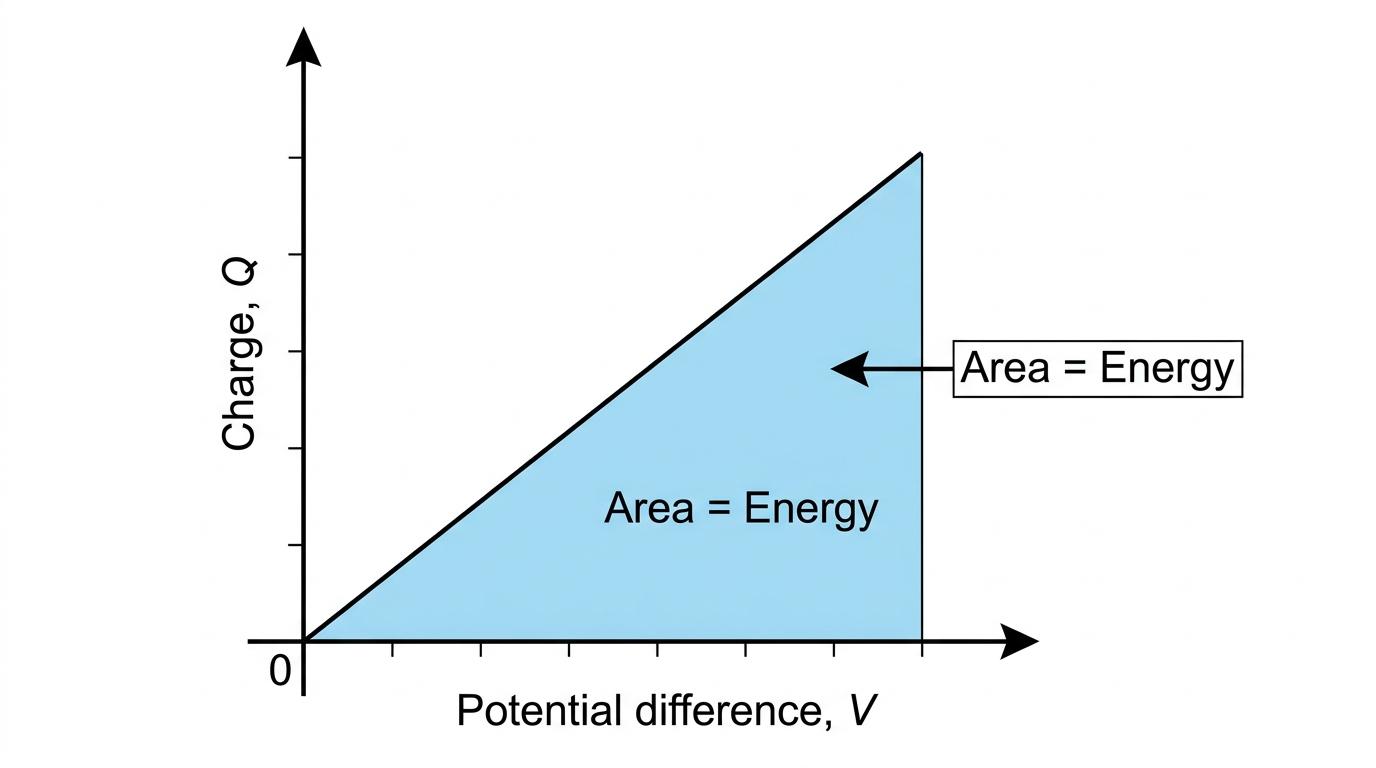
In physics, the area under a graph often represents a physical quantity. If we multiply the units of the y-axis (charge) by the units of the x-axis (potential difference), we get work done (energy). Therefore, the area under the graph equals the energy stored.
Area under a Q-V graph
The area under a graph of charge against potential difference represents the total energy stored by the capacitor.
Because the line is straight and starts at the origin, the area forms a right-angled triangle. The formula for the area of a triangle is 12×base×height\frac{1}{2} \times \text{base} \times \text{height}21×base×height.
Substituting our variables from the graph:
- Base = potential difference, VVV
- Height = total charge, QQQ
This gives us our first key equation for energy EEE:
E=12QVE = \frac{1}{2} Q VE=21QVForgetting the half
A very common mistake is using E=QVE = QVE=QV instead of E=12QVE = \frac{1}{2} Q VE=21QV. Remember that E=QVE = QVE=QV applies to a constant pd (like moving a charge through a uniform field), but a capacitor's pd builds up from zero. The 12\frac{1}{2}21 accounts for the fact that the average potential difference during the charging process is exactly half of the final potential difference!
Deriving the other energy equations
Often in exam questions, you won't be given both the charge and the potential difference. You might only know the capacitance and the voltage. We can combine our new energy equation with the capacitance equation, Q=CVQ = CVQ=CV, to create two more incredibly useful formulas.
Deriving EEE in terms of CCC and VVV: If we replace QQQ in our energy equation with CVCVCV:
E=12QVE=12(CV)VE=12CV2\begin{aligned} E &= \frac{1}{2} Q V \\ E &= \frac{1}{2} (C V) V \\ E &= \frac{1}{2} C V^2 \end{aligned}EEE=21QV=21(CV)V=21CV2Deriving EEE in terms of QQQ and CCC: We can rearrange Q=CVQ = CVQ=CV to get V=QCV = \frac{Q}{C}V=CQ. Substituting this into the energy equation gives:
E=12QVE=12Q(QC)E=12Q2C\begin{aligned} E &= \frac{1}{2} Q V \\ E &= \frac{1}{2} Q \left( \frac{Q}{C} \right) \\ E &= \frac{1}{2} \frac{Q^2}{C} \end{aligned}EEE=21QV=21Q(CQ)=21CQ2You now have three equations for energy. Choosing the right one simply depends on which values you are given in the question.
Using the energy formulas
A 470 μF470 \ \mu\text{F}470 μF capacitor is charged to a potential difference of 12 V. Calculate the energy stored by the capacitor.
-
Identify the known variables: Capacitance, C=470 μF=470×10−6 FC = 470 \ \mu\text{F} = 470 \times 10^{-6} \text{ F}C=470 μF=470×10−6 F Potential difference, V=12 VV = 12 \text{ V}V=12 V
-
Select the appropriate equation: Since we have CCC and VVV, we should use E=12CV2E = \frac{1}{2} C V^2E=21CV2.
-
Substitute the values and calculate:
E=12×(470×10−6)×122E=0.5×(470×10−6)×144E=0.03384 J\begin{aligned} E &= \frac{1}{2} \times (470 \times 10^{-6}) \times 12^2 \\ E &= 0.5 \times (470 \times 10^{-6}) \times 144 \\ E &= 0.03384 \text{ J} \end{aligned}EEE=21×(470×10−6)×122=0.5×(470×10−6)×144=0.03384 J -
State the final answer: The energy stored is 0.034 J0.034 \text{ J}0.034 J (to 2 significant figures).
Dealing with non-linear or abstract graphs
Sometimes AQA will present a graph that doesn't behave perfectly, or they will ask you to work out the energy directly from the grid lines.
If you are given a graph of VVV against QQQ (where the axes are swapped), the area between the line and the charge axis still represents energy. If the graph curves—perhaps showing a faulty dielectric—you cannot use the triangle formula. Instead, you must estimate the area by counting squares.
Finding energy from a graph area
A student plots a graph of charge QQQ on the y-axis against potential difference VVV on the x-axis for a fixed capacitor. The graph is a straight line through the origin. At a potential difference of 5.0 V, the stored charge is 2.5 mC2.5 \text{ mC}2.5 mC. Calculate the energy stored by finding the area under the graph.
-
Visualise the shape: Because it is a straight line through the origin, the area under the line up to 5.0 V forms a right-angled triangle.
-
Identify the base and height of the triangle: Base =5.0 V= 5.0 \text{ V}=5.0 V Height =2.5 mC=2.5×10⁻³ C= 2.5 \text{ mC} = 2.5 \times 10^{-3} \text{ C}=2.5 mC=2.5×10⁻³ C
-
Calculate the area:
Area=12×base×heightArea=12×5.0×(2.5×10−3)Area=6.25×10⁻³ J\begin{aligned} \text{Area} &= \frac{1}{2} \times \text{base} \times \text{height} \\ \text{Area} &= \frac{1}{2} \times 5.0 \times (2.5 \times 10^{-3}) \\ \text{Area} &= 6.25 \times 10^{-3} \text{ J} \end{aligned}AreaAreaArea=21×base×height=21×5.0×(2.5×10−3)=6.25×10⁻³ J -
State the final answer: The energy stored is 6.3 mJ6.3 \text{ mJ}6.3 mJ.
In the exam
- Watch out for prefixes: Capacitance is almost always given in microfarads (μF\mu\text{F}μF), nanofarads (nF\text{nF}nF), or picofarads (pF\text{pF}pF). Always convert these to farads before calculating.
- Remember the squares: A very common arithmetic error is forgetting to square the VVV in E=12CV2E = \frac{1}{2} C V^2E=21CV2 or the QQQ in E=12Q2CE = \frac{1}{2} \frac{Q^2}{C}E=21CQ2.
- Check the axes: If an exam question asks you to find the energy from a graph, check whether it is QQQ against VVV or VVV against QQQ. Find the area bounded by the line and the voltage axis to ensure you are multiplying QQQ by VVV.
Check yourself
- Can you explain why the energy formula contains a factor of 12\frac{1}{2}21?
- Which of the three energy equations would you use if a question gives you the charge and the capacitance, but not the voltage?
- If the potential difference across a capacitor is doubled, by what factor does the energy stored increase? (Hint: look at the relationship between EEE and VVV in the formulas).