

Welcome to the physics of orbits! Whether we are looking at moons orbiting planets, planets orbiting the Sun, or artificial satellites orbiting Earth, the physical principles are exactly the same.
What you'll learn in this topic:
- How to link the orbital speed and period of a satellite to its radius.
- How to derive the famous relationship T2∝r3T^2 \propto r^3T2∝r3 and prove it using logarithmic graphs.
- How the kinetic, potential, and total energy of a satellite change with its orbit.
- How to calculate the escape velocity of a planet.
- The differences between geostationary orbits and Low Earth Orbits (LEO).
The physics of a circular orbit
To keep an object moving in a circle, a centripetal force is required. For a satellite orbiting a planet (or a planet orbiting a star), gravity is the centripetal force.
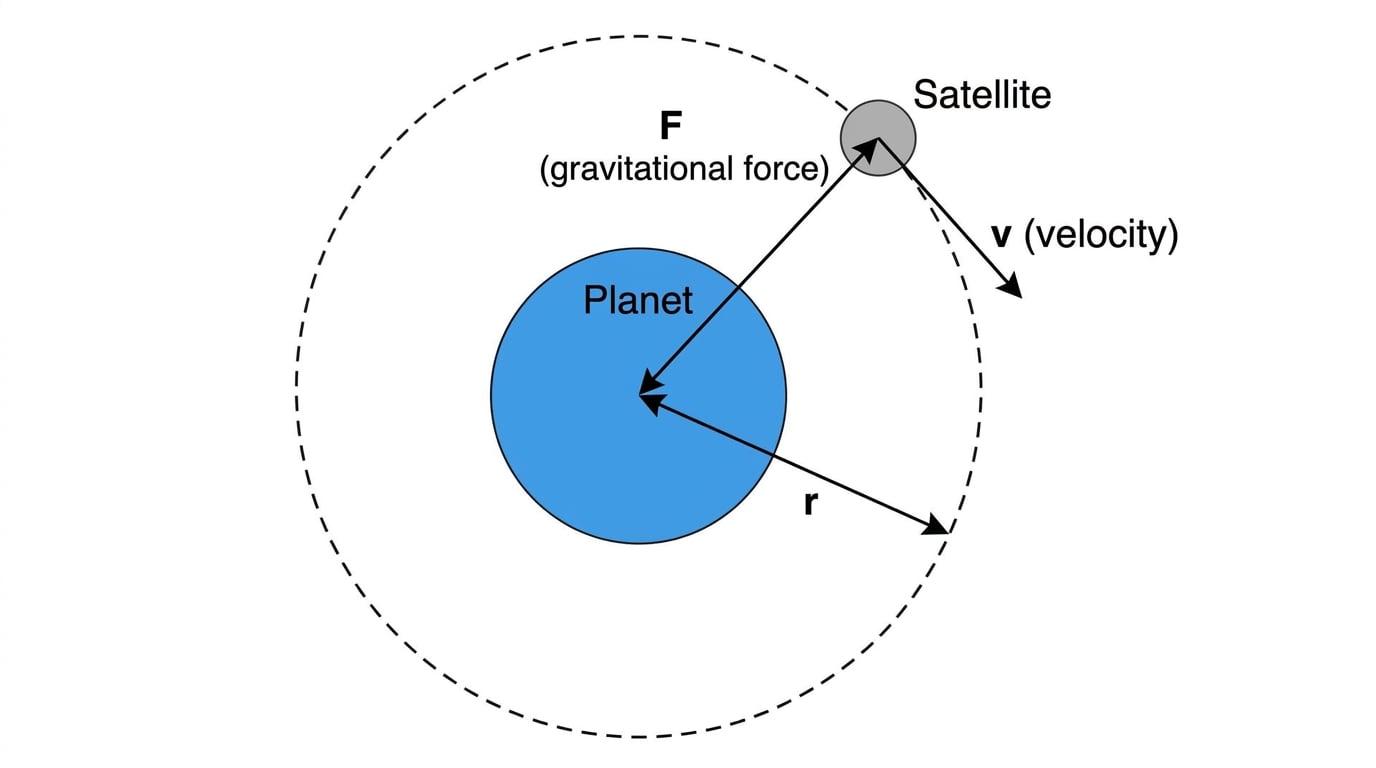
Let's say a satellite of mass mmm is orbiting a planet of mass MMM at a distance rrr from the planet's centre, moving at a constant speed vvv.
The gravitational force between them is given by Newton's law of gravitation:
F=GMmr2 F = \frac{GMm}{r^2} F=r2GMmThe centripetal force required to maintain this circular orbit is:
F=mv2r F = \frac{mv^2}{r} F=rmv2Because gravity provides this centripetal force, we equate the two:
GMmr2=mv2r \frac{GMm}{r^2} = \frac{mv^2}{r} r2GMm=rmv2By cancelling mmm and one factor of rrr, we can rearrange this to find the orbital speed vvv:
v2=GMr ⟹ v=GMr v^2 = \frac{GM}{r} \implies v = \sqrt{\frac{GM}{r}} v2=rGM⟹v=rGMOrbital speed is independent of mass
Notice that the mass of the satellite (mmm) cancelled out. This means that at a given radius, a massive space station and a tiny bolt must travel at exactly the same speed to maintain their orbit! The orbital speed only depends on the mass of the central object (MMM) and the orbital radius (rrr).
Deriving Kepler's Third Law (T2∝r3T^2 \propto r^3T2∝r3)
The orbital period TTT is the time taken for one complete orbit. Since the satellite travels the circumference of the orbit (2πr2\pi r2πr) at speed vvv, we know:
v=2πrT v = \frac{2\pi r}{T} v=T2πrSubstitute this expression for vvv into our earlier equation GMmr2=mv2r\frac{GMm}{r^2} = \frac{mv^2}{r}r2GMm=rmv2:
GMr=(2πrT)2 \frac{GM}{r} = \left(\frac{2\pi r}{T}\right)^2 rGM=(T2πr)2 GMr=4π2r2T2 \frac{GM}{r} = \frac{4\pi^2 r^2}{T^2} rGM=T24π2r2Rearranging to make T2T^2T2 the subject gives the relationship:
T2=(4π2GM)r3 T^2 = \left( \frac{4\pi^2}{GM} \right) r^3 T2=(GM4π2)r3Because 444, π\piπ, GGG, and MMM are all constants for a given central mass, the entire bracket is a constant. Therefore:
T2∝r3 T^2 \propto r^3 T2∝r3This is a mathematical statement of Kepler's Third Law.
Calculating orbital radius
A satellite is in orbit around the Earth with a period of 90 minutes. Calculate the radius of its orbit. Data: Mass of Earth M=5.97×1024M = 5.97 \times 10^{24}M=5.97×1024 kg, G=6.67×10⁻¹¹ N m2 kg−2G = 6.67 \times 10^{-11} \text{ N m}^2 \text{ kg}^{-2}G=6.67×10⁻¹¹ N m2 kg−2.
- First, convert the period TTT into standard SI units (seconds). T=90×60=5400T = 90 \times 60 = 5400T=90×60=5400 s
- State the formula linking TTT and rrr. T2=4π2r3GMT^2 = \frac{4\pi^2 r^3}{GM}T2=GM4π2r3
- Rearrange the formula to make r3r^3r3 the subject. r3=GMT24π2r^3 = \frac{GM T^2}{4\pi^2}r3=4π2GMT2
- Substitute the values into the equation. r3=(6.67×10−11)×(5.97×1024)×540024π2r^3 = \frac{(6.67 \times 10^{-11}) \times (5.97 \times 10^{24}) \times 5400^2}{4\pi^2}r3=4π2(6.67×10−11)×(5.97×1024)×54002 r3=2.94×10²⁰ m3r^3 = 2.94 \times 10^{20} \text{ m}^3r3=2.94×10²⁰ m3
- Take the cube root to find rrr. r=2.94×10203=6.65×10⁶ mr = \sqrt[3]{2.94 \times 10^{20}} = 6.65 \times 10^6 \text{ m}r=32.94×1020=6.65×10⁶ m
Analysing orbits with logarithmic graphs
In exams, you may be asked to verify T2∝r3T^2 \propto r^3T2∝r3 using data from several planets. Plotting T2T^2T2 against r3r^3r3 gives a straight line through the origin, but the numbers involved are astronomically huge. Instead, we often plot a logarithmic graph.
Starting with:
T2=(4π2GM)r3 T^2 = \left( \frac{4\pi^2}{GM} \right) r^3 T2=(GM4π2)r3Take the natural logarithm (ln\lnln) of both sides:
ln(T2)=ln(4π2r3GM) \ln(T^2) = \ln\left( \frac{4\pi^2 r^3}{GM} \right) ln(T2)=ln(GM4π2r3)Using the laws of logarithms (ln(ab)=ln(a)+ln(b)\ln(ab) = \ln(a) + \ln(b)ln(ab)=ln(a)+ln(b) and ln(an)=nln(a)\ln(a^n) = n \ln(a)ln(an)=nln(a)), we can expand this:
2ln(T)=3ln(r)+ln(4π2GM) 2 \ln(T) = 3 \ln(r) + \ln\left( \frac{4\pi^2}{GM} \right) 2ln(T)=3ln(r)+ln(GM4π2)Divide by 2 to get it into the form y=mx+cy = mx + cy=mx+c:
ln(T)=32ln(r)+12ln(4π2GM) \ln(T) = \frac{3}{2} \ln(r) + \frac{1}{2} \ln\left( \frac{4\pi^2}{GM} \right) ln(T)=23ln(r)+21ln(GM4π2)If you plot ln(T)\ln(T)ln(T) on the y-axis against ln(r)\ln(r)ln(r) on the x-axis, you will get a straight line with a gradient of 1.51.51.5 (32\frac{3}{2}23). The y-intercept allows you to calculate the mass of the central object MMM.
Forgetting the units of your intercept
When taking the y-intercept 12ln(4π2GM)\frac{1}{2} \ln\left( \frac{4\pi^2}{GM} \right)21ln(GM4π2) to find MMM, ensure you remember that TTT must have been in seconds and rrr in metres for GGG to work correctly. If the data table gave TTT in days or rrr in km, you must convert them before calculating MMM, or your mass will be completely wrong!
Energy in an orbit
A satellite in orbit possesses both kinetic energy (EkE_kEk) due to its speed, and gravitational potential energy (EpE_pEp) due to its position in a gravitational field.
Let's find expressions for both. We already know that v2=GMrv^2 = \frac{GM}{r}v2=rGM. Therefore, the kinetic energy is:
Ek=12mv2=12m(GMr)=GMm2r E_k = \frac{1}{2}mv^2 = \frac{1}{2}m \left( \frac{GM}{r} \right) = \frac{GMm}{2r} Ek=21mv2=21m(rGM)=2rGMmThe gravitational potential energy is defined as being zero at infinity. Because gravity is attractive, work must be done to move a mass to infinity, meaning EpE_pEp everywhere else is negative:
Ep=−GMmr E_p = -\frac{GMm}{r} Ep=−rGMmThe total energy (EEE) of the satellite is the sum of its kinetic and potential energies:
E=Ek+Ep E = E_k + E_p E=Ek+Ep E=GMm2r−GMmr E = \frac{GMm}{2r} - \frac{GMm}{r} E=2rGMm−rGMm E=−GMm2r E = -\frac{GMm}{2r} E=−2rGMmThe energy shortcut
Look closely at those three formulas! The magnitude of the kinetic energy is exactly half the magnitude of the potential energy. Ek=−12EpE_k = -\frac{1}{2}E_pEk=−21Ep Total Energy E=−EkE = -E_kE=−Ek
If an orbiting satellite experiences atmospheric drag (air resistance in very low orbits), its total energy decreases (becomes more negative). This means its radius rrr must decrease. As it falls to a lower radius, its EpE_pEp decreases (becomes more negative), but its EkE_kEk actually increases. Counter-intuitively, air resistance causes the satellite to speed up as it spirals inwards!
Escape velocity
Escape velocity
Escape velocity is the minimum speed an unpowered object needs at the surface of a planet to escape its gravitational field and reach infinity.
At the surface of a planet of radius rrr, the object has potential energy Ep=−GMmrE_p = -\frac{GMm}{r}Ep=−rGMm. To just escape, it must reach infinity where its potential energy is zero, and it will arrive there with zero kinetic energy. Therefore, its total energy at the surface must be exactly zero.
Total Energy=Ek+Ep=0 \text{Total Energy} = E_k + E_p = 0 Total Energy=Ek+Ep=0 12mv2−GMmr=0 \frac{1}{2}mv^2 - \frac{GMm}{r} = 0 21mv2−rGMm=0 12mv2=GMmr \frac{1}{2}mv^2 = \frac{GMm}{r} 21mv2=rGMmThe mass of the object mmm cancels out (meaning the escape velocity is the same for a rocket or a molecule of gas):
v2=2GMr ⟹ v=2GMr v^2 = \frac{2GM}{r} \implies v = \sqrt{\frac{2GM}{r}} v2=r2GM⟹v=r2GMSynchronous and geostationary orbits
Satellites are launched into different orbits depending on their purpose.
Synchronous orbit
A synchronous orbit is an orbit where the satellite's orbital period TTT is exactly equal to the rotational period of the object it is orbiting.
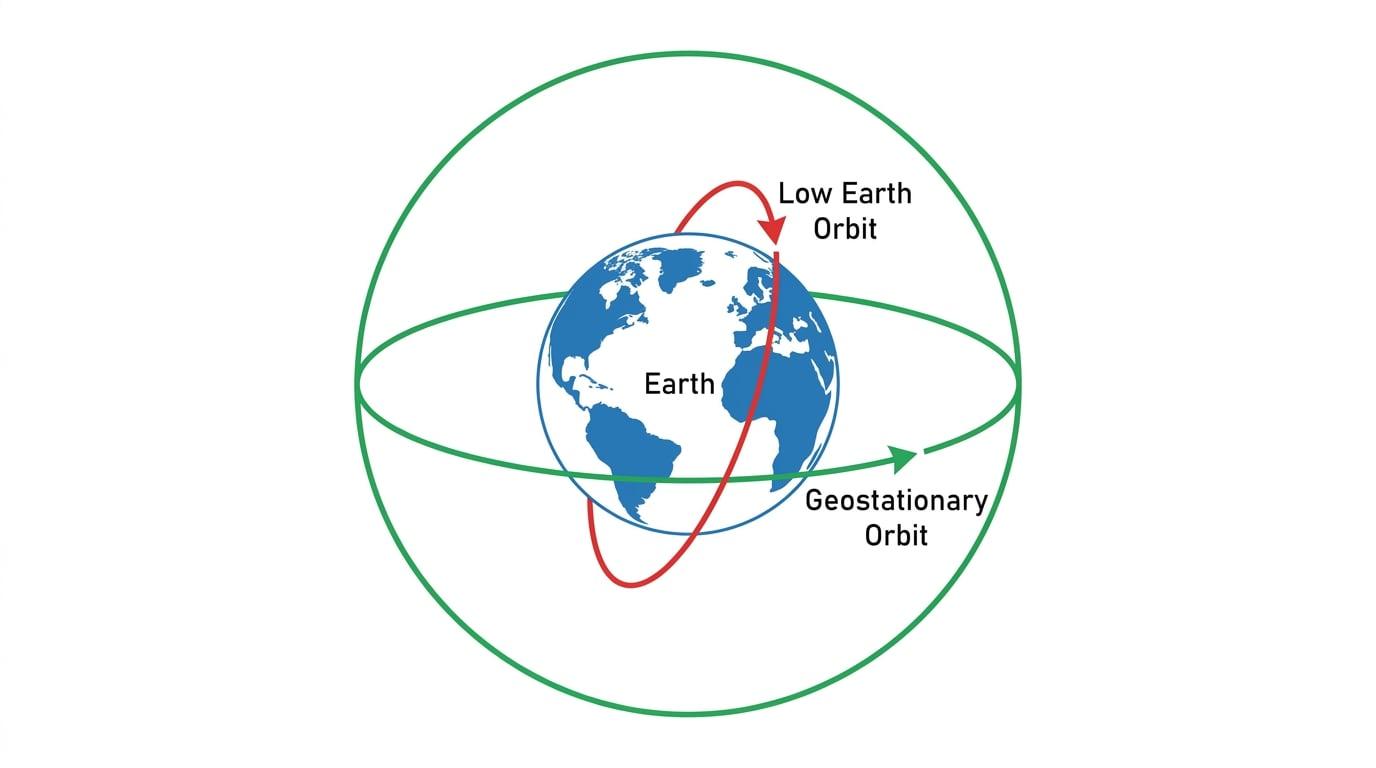
For Earth, a synchronous orbit has a period of 24 hours. A geostationary orbit is a very specific type of Earth-synchronous orbit with three strict rules:
- It must have a period of exactly 24 hours.
- It must orbit in the exact same direction as the Earth's rotation.
- It must be perfectly aligned with the equatorial plane (it orbits directly above the equator).
Because of these rules, a geostationary satellite stays exactly above the same point on Earth's surface at all times. This makes them ideal for telecommunications and satellite TV broadcasts, because receivers on Earth (like satellite dishes on houses) can be pointed at a fixed spot in the sky and never need to move.
Using T2∝r3T^2 \propto r^3T2∝r3, a geostationary orbit always has a radius of roughly 42 00042\,00042000 km from the centre of the Earth (or about 36 00036\,00036000 km above the surface).
Low Earth Orbits (LEO)
Low Earth Orbits are much closer to the surface (typically 160160160 km to 200020002000 km altitude). Because rrr is small, TTT is also small. A typical LEO satellite completes an orbit in about 90 to 120 minutes.
LEOs are often polar orbits (passing over the North and South poles). Because the Earth rotates beneath the satellite, a polar LEO satellite will eventually scan the entire surface of the Earth over multiple orbits.
LEO satellites are cheaper to launch (requiring less energy) and closer to the surface, making them ideal for high-resolution military surveillance, Earth mapping, and weather monitoring.
In the exam
- Watch out for altitude vs. radius: Questions love to give you the height above the surface (altitude) instead of the orbital radius rrr. Always add the planet's radius to the altitude to find rrr before using any formulas.
- Remember the time conversions: If you are using T2∝r3T^2 \propto r^3T2∝r3 to calculate MMM, TTT must be converted into seconds. 24 hours=24×60×60=86400 s24 \text{ hours} = 24 \times 60 \times 60 = 86400 \text{ s}24 hours=24×60×60=86400 s.
- Check the signs on energy: If a question asks for the change in potential energy, do "final minus initial" carefully. Since EpE_pEp values are negative, ΔEp=(−small number)−(−large number)\Delta E_p = (- \text{small number}) - (- \text{large number})ΔEp=(−small number)−(−large number), which yields a positive increase if moving outwards.
Check yourself
- Can you derive v=GMrv = \sqrt{\frac{GM}{r}}v=rGM by equating gravitational and centripetal forces?
- How do you prove that plotting ln(T)\ln(T)ln(T) against ln(r)\ln(r)ln(r) gives a gradient of 1.51.51.5?
- If a satellite's orbital radius increases, what happens to its kinetic energy, potential energy, and total energy?
- What three conditions must be met for an orbit to be geostationary?
