What is the permittivity of free space (ε0\varepsilon_0ε0)?
Notice the constant term 14πε0\frac{1}{4\pi\varepsilon_0}4πε01 at the front of the equation.
The symbol ε0\varepsilon_0ε0 represents the permittivity of free space (a vacuum). It is a measure of how easily an electric field can pass through a vacuum. Its value is universally constant: ε0≈8.85×10⁻¹² F m−1\varepsilon_0 \approx 8.85 \times 10^{-12} \text{ F m}^{-1}ε0≈8.85×10⁻¹² F m−1 (farads per metre). You do not need to memorise this; it is provided on your AQA data sheet.
Vacuums vs Air
Strictly speaking, Coulomb's law with ε0\varepsilon_0ε0 only applies in a perfect vacuum. If you put charges in water or oil, the force changes because the material's permittivity is different. However, the permittivity of air is so incredibly close to that of a vacuum that we treat air as a vacuum for all A-level calculations.
Treating spheres as point charges
Real objects are rarely perfect mathematical points. Fortunately, if you have a charged conducting sphere (like the metal dome of a Van de Graaff generator), the charge spreads out evenly over its surface.
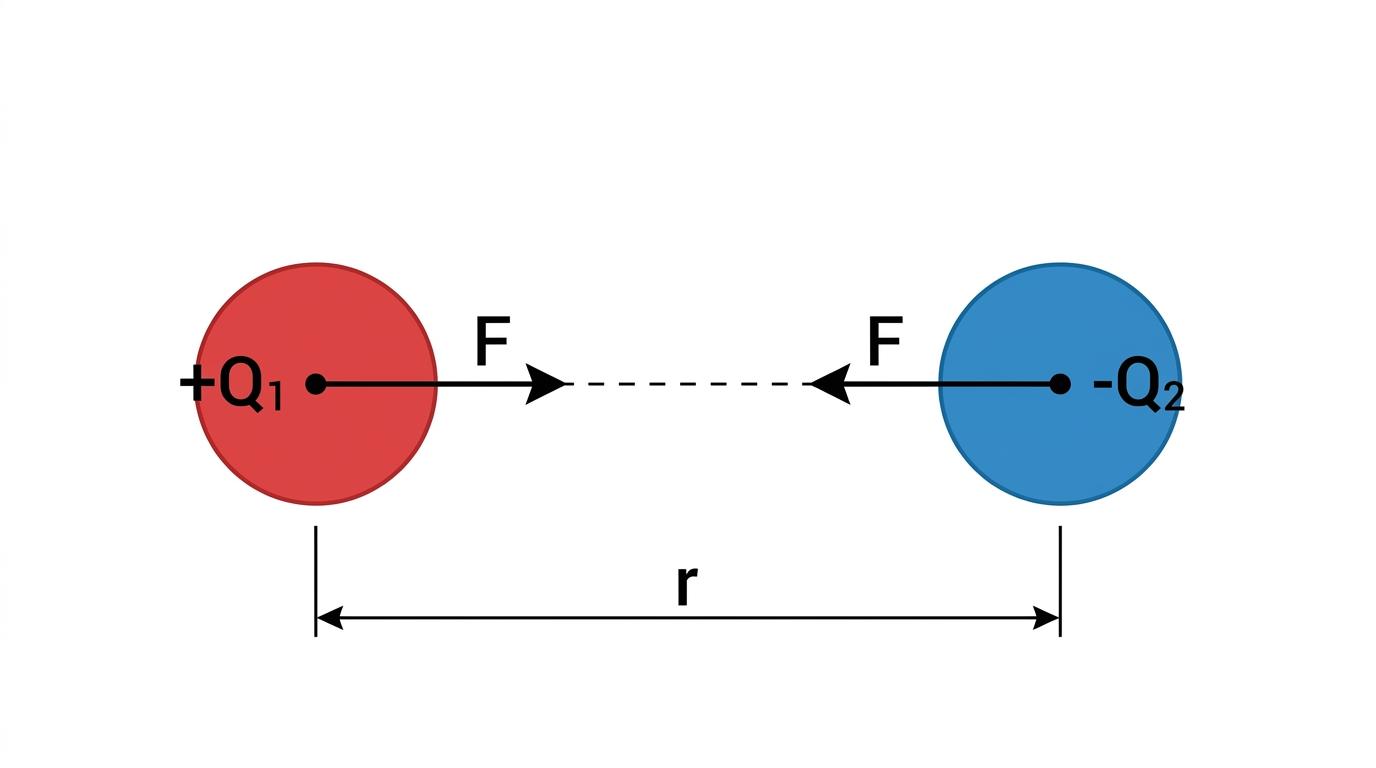
For the mathematics of Coulomb's law, a uniform spherical charge behaves exactly as if all of its charge were concentrated at a single point in its dead centre. This is why rrr is always measured from the centre of one sphere to the centre of the other, not from their surfaces.
The Inverse Square Law
Coulomb's law is an inverse square law. This means if you double the distance (2r2r2r) between two charges, the force doesn't halve—it drops to a quarter (1/41/41/4) of its original value because of the r2r^2r2 term. If you triple the distance, the force drops to a ninth (1/91/91/9).
Working with the formula
Let's look at how to apply this to an AQA-style calculation.
Calculating electrostatic force
Calculate the electrostatic force between two alpha particles separated by a distance of 5.0×10⁻¹⁵ m5.0 \times 10^{-15} \text{ m}5.0×10⁻¹⁵ m in a vacuum. (Charge of a proton =1.60×10⁻¹⁹ C= 1.60 \times 10^{-19} \text{ C}=1.60×10⁻¹⁹ C).
- Identify the charge of an alpha particle. An alpha particle is a helium nucleus (2 protons, 2 neutrons), so its charge is +2e+2e+2e: Q1=Q2=2×1.60×10−19 C=3.20×10⁻¹⁹ CQ_1 = Q_2 = 2 \times 1.60 \times 10^{-19} \text{ C} = 3.20 \times 10^{-19} \text{ C}Q1=Q2=2×1.60×10−19 C=3.20×10⁻¹⁹ C
- Write down Coulomb's law: F=14πε0Q1Q2r2F = \frac{1}{4\pi\varepsilon_0} \frac{Q_1 Q_2}{r^2}F=4πε01r2Q1Q2
- Substitute the values from the question and the data sheet (ε0=8.85×10⁻¹² F m−1\varepsilon_0 = 8.85 \times 10^{-12} \text{ F m}^{-1}ε0=8.85×10⁻¹² F m−1): F=14π(8.85×10−12)×(3.20×10−19)×(3.20×10−19)(5.0×10⁻¹⁵)2F = \frac{1}{4\pi(8.85 \times 10^{-12})} \times \frac{(3.20 \times 10^{-19}) \times (3.20 \times 10^{-19})}{(5.0 \times 10^{-15})^2}F=4π(8.85×10⁻¹²)1×(5.0×10−15)2(3.20×10−19)×(3.20×10−19)
- Calculate the result carefully on your calculator: F=(8.99×109)×1.024×10−372.5×10⁻²⁹F≈36.8 N\begin{aligned} F &= (8.99 \times 10^9) \times \frac{1.024 \times 10^{-37}}{2.5 \times 10^{-29}} \\ F &\approx 36.8 \text{ N} \end{aligned}FF=(8.99×109)×2.5×10−291.024×10−37≈36.8 N
- State the direction of the force. Since both alpha particles are positive, they repel. The force is 36.8 N36.8 \text{ N}36.8 N (repulsion).
Forgetting to square the distance
The most frequent error in Coulomb's law calculations is forgetting to square the rrr term on the bottom of the fraction. Always double-check your calculator input to ensure the distance is squared!
Handling the signs
If you put negative charges into Coulomb's law, you get a negative force. A negative force means attraction, and a positive force means repulsion. However, it is usually much safer and less confusing to ignore the positive/negative signs when putting charges into the formula. Just calculate the magnitude of the force, and then use your common sense (like charges repel, opposites attract) to state the direction at the end.
Comparing Electrostatic and Gravitational Forces
Have you noticed how similar Coulomb's law looks to Newton's law of gravitation from your earlier studies?
- Gravitation: F=Gm1m2r2F = \frac{G m_1 m_2}{r^2}F=r2Gm1m2 (Depends on mass, universally attractive).
- Electrostatics: F=14πε0Q1Q2r2F = \frac{1}{4\pi\varepsilon_0} \frac{Q_1 Q_2}{r^2}F=4πε01r2Q1Q2 (Depends on charge, can be attractive or repulsive).
Both are inverse square laws. Both act over infinite distances. But how do their strengths compare?
At the human and planetary scale, gravity rules the universe because large objects (like stars and planets) have massive amounts of mass but are generally electrically neutral.
However, at the subatomic scale, the story is completely different. Subatomic particles like protons and electrons have a tiny mass but a comparatively huge charge.
Comparing forces in a hydrogen atom
A hydrogen atom consists of a single proton and a single electron separated by an average distance of 5.3×10⁻¹¹ m5.3 \times 10^{-11} \text{ m}5.3×10⁻¹¹ m. Calculate the ratio of the electrostatic force to the gravitational force between them.
- Write out the expressions for both forces. FE=14πε0Q1Q2r2andFG=Gm1m2r2F_E = \frac{1}{4\pi\varepsilon_0} \frac{Q_1 Q_2}{r^2} \quad \text{and} \quad F_G = \frac{G m_1 m_2}{r^2}FE=4πε01r2Q1Q2andFG=r2Gm1m2
- Set up the ratio. Notice that because both forces share the same inverse square law, the r2r^2r2 terms will cancel out! This saves time. FEFG=14πε0QpQeGmpme\frac{F_E}{F_G} = \frac{\frac{1}{4\pi\varepsilon_0} Q_p Q_e}{G m_p m_e}FGFE=Gmpme4πε01QpQe
- Find the constants from your data sheet:
- Proton charge QpQ_pQp and electron charge Qe=1.60×10⁻¹⁹ CQ_e = 1.60 \times 10^{-19} \text{ C}Qe=1.60×10⁻¹⁹ C
- Proton mass mp=1.67×10⁻²⁷ kgm_p = 1.67 \times 10^{-27} \text{ kg}mp=1.67×10⁻²⁷ kg
- Electron mass me=9.11×10⁻³¹ kgm_e = 9.11 \times 10^{-31} \text{ kg}me=9.11×10⁻³¹ kg
- G=6.67×10⁻¹¹ N m2 kg−2G = 6.67 \times 10^{-11} \text{ N m}^2 \text{ kg}^{-2}G=6.67×10⁻¹¹ N m2 kg−2
- ε0=8.85×10⁻¹² F m−1\varepsilon_0 = 8.85 \times 10^{-12} \text{ F m}^{-1}ε0=8.85×10⁻¹² F m−1
- Substitute the values into the simplified ratio: FEFG=14π(8.85×10⁻¹²)(1.60×10⁻¹⁹)2(6.67×10⁻¹¹)(1.67×10⁻²⁷)(9.11×10⁻³¹)FEFG=2.3×10−81.0×10−47FEFG≈2.3×1039\begin{aligned} \frac{F_E}{F_G} &= \frac{\frac{1}{4\pi(8.85 \times 10^{-12})} (1.60 \times 10^{-19})^2}{(6.67 \times 10^{-11}) (1.67 \times 10^{-27}) (9.11 \times 10^{-31})} \\ \frac{F_E}{F_G} &= \frac{2.3 \times 10^{-8}}{1.0 \times 10^{-47}} \\ \frac{F_E}{F_G} &\approx 2.3 \times 10^{39} \end{aligned}FGFEFGFEFGFE=(6.67×10⁻¹¹)(1.67×10⁻²⁷)(9.11×10⁻³¹)4π(8.85×10⁻¹²)1(1.60×10⁻¹⁹)2=1.0×10−472.3×10⁻⁸≈2.3×1039
The result of that example is staggering. The electrostatic attraction holding the electron in orbit around the proton is approximately 103910^{39}1039 times stronger than the gravitational attraction.
Gravity is negligible for subatomic particles
Because the electrostatic force is roughly 39 orders of magnitude stronger than gravity at the subatomic scale, we completely ignore gravitational forces when dealing with particle physics and atomic structures.
In the exam
- Watch out for prefixes: Exam questions rarely give charges in standard coulombs. Look out for microcoulombs (μC\mu\text{C}μC, ×10−6\times 10^{-6}×10−6), nanocoulombs (nC\text{nC}nC, ×10−9\times 10^{-9}×10−9), and picocoulombs (pC\text{pC}pC, ×10−12\times 10^{-12}×10−12).
- Remember where rrr is measured from: The distance rrr is strictly centre-to-centre. If an exam gives you the distance between the surfaces of two spherical charges, you must add the radii of both spheres to find the true rrr.
- Drop the negative signs: Input only positive values for QQQ into your calculator. Determine whether the final force is attractive or repulsive based on the charges (like repels, opposite attracts) and write this next to your numerical answer.
- Use algebraic cancellation: When asked to compare Coulomb's force to gravitational force for two particles, write out the algebra first. The r2r^2r2 terms will cancel out, saving you from doing complex fraction calculations and reducing the chance of calculator errors.
Check yourself
- If the distance between two identically charged spheres is tripled, by what factor does the repulsive force change?
- Why are we allowed to use Coulomb's law in the physics laboratory if it technically only applies in a vacuum?
- Explain why gravitational forces are ignored when calculating the force between an alpha particle and a gold nucleus in a scattering experiment.