Non-flow processes (A-level only)
What you'll learn in this topic:
- What a "non-flow" process is and how to apply the First Law of Thermodynamics to it.
- The physical meanings and mathematical equations for four specific changes: constant volume, constant pressure, isothermal, and adiabatic.
- How to sketch and interpret these processes on a pressure-volume (p−Vp-Vp−V) diagram.
A non-flow process simply means we are looking at a fixed mass of gas trapped within a closed boundary—like gas sealed inside a cylinder with a piston. No gas flows in, and no gas flows out.
To understand how the gas behaves when we heat it, cool it, squash it, or let it expand, we rely heavily on the First Law of Thermodynamics.
The First Law of Thermodynamics
The First Law is essentially the principle of conservation of energy applied to a gas. For the AQA specification, the equation is written as:
Q=ΔU+W Q = \Delta U + W Q=ΔU+W- QQQ is the heat energy supplied to the gas.
- ΔU\Delta UΔU is the increase in the internal energy of the gas (which corresponds to an increase in temperature).
- WWW is the work done by the gas when it expands.
If heat is removed from the gas, QQQ is negative. If the gas is compressed, work is done on the gas, so WWW is negative. If the gas cools down, ΔU\Delta UΔU is negative.
Let's look at the four distinct ways we can change the state of this trapped gas.
1. Constant volume change (Isochoric)
Imagine heating a gas trapped in a rigid, thick-walled metal box. The walls cannot move, so the volume of the gas remains completely constant.
Because the volume cannot change (ΔV=0\Delta V = 0ΔV=0), the gas cannot expand. If it cannot expand, it cannot do any work against its surroundings. Therefore, W=0W = 0W=0.
Applying the First Law (Q=ΔU+WQ = \Delta U + WQ=ΔU+W), we get:
Q=ΔU Q = \Delta U Q=ΔUAll the heat energy you supply to the gas goes directly into increasing its internal energy. The molecules move faster, and the temperature and pressure of the gas rise.
2. Constant pressure change (Isobaric)
Now imagine the gas is in a cylinder with a free-moving, frictionless piston. As you heat the gas, it tries to increase in pressure. However, because the piston is free to slide outwards, the gas expands just enough to keep the pressure inside balanced with the constant pressure outside.
Because the gas expands, it is pushing a force over a distance. It is doing work. We can calculate this work using the constant pressure ppp and the change in volume ΔV\Delta VΔV:
W=pΔV W = p\Delta V W=pΔVApplying the First Law, the heat supplied goes into doing two things at once: raising the internal energy (making it hotter) and doing work to push the piston out:
Q=ΔU+pΔV Q = \Delta U + p\Delta V Q=ΔU+pΔVHeating a gas at constant pressure
A fixed mass of gas is heated at a constant pressure of 1.0×10⁵ Pa1.0 \times 10^5 \text{ Pa}1.0×10⁵ Pa. Its volume expands from 0.020 m30.020 \text{ m}^30.020 m3 to 0.035 m30.035 \text{ m}^30.035 m3. The total heat energy supplied to the gas is 2500 J2500 \text{ J}2500 J. Calculate the change in internal energy of the gas.
- Calculate the work done by the gas: Use the formula for work done at constant pressure. W=pΔVW=1.0×105×(0.035−0.020)W=1.0×105×0.015=1500 J\begin{aligned} W &= p\Delta V \\ W &= 1.0 \times 10^5 \times (0.035 - 0.020) \\ W &= 1.0 \times 10^5 \times 0.015 = 1500 \text{ J} \end{aligned}WWW=pΔV=1.0×105×(0.035−0.020)=1.0×105×0.015=1500 J
- Apply the First Law of Thermodynamics: Substitute your values into Q=ΔU+WQ = \Delta U + WQ=ΔU+W and rearrange to find ΔU\Delta UΔU. 2500=ΔU+1500ΔU=2500−1500=1000 J\begin{aligned} 2500 &= \Delta U + 1500 \\ \Delta U &= 2500 - 1500 = 1000 \text{ J} \end{aligned}2500ΔU=ΔU+1500=2500−1500=1000 J
3. Isothermal change
An isothermal change is one where the temperature of the gas remains perfectly constant throughout.
For an ideal gas, the internal energy depends only on its absolute temperature. If the temperature doesn't change, the internal energy doesn't change. Therefore, ΔU=0\Delta U = 0ΔU=0.
Applying the First Law (Q=ΔU+WQ = \Delta U + WQ=ΔU+W), we get:
Q=W Q = W Q=WIf the gas expands and does work (WWW is positive), it must be absorbing an equal amount of heat from its surroundings (QQQ is positive) to prevent itself from cooling down. This is usually achieved by letting the gas expand very slowly in a cylinder with thin, highly conductive walls, so heat has plenty of time to transfer in.
Because temperature is constant, we can look at the ideal gas equation (pV=nRTpV = nRTpV=nRT). Since nnn, RRR, and TTT are all constants, we get Boyle's Law:
pV=constant pV = \text{constant} pV=constant4. Adiabatic change
An adiabatic change is the exact opposite of an isothermal one in terms of heat flow. In an adiabatic process, no heat enters or leaves the system. Therefore, Q=0Q = 0Q=0.
This usually happens if the cylinder is heavily insulated, or if the change happens so fast that there is simply no time for heat to transfer (like the rapid compression in a car engine cylinder).
Applying the First Law (Q=ΔU+WQ = \Delta U + WQ=ΔU+W) with Q=0Q = 0Q=0:
0=ΔU+W⇒ΔU=−W 0 = \Delta U + W \quad \Rightarrow \quad \Delta U = -W 0=ΔU+W⇒ΔU=−WIf the gas expands rapidly, it does work (WWW is positive). Because no heat can enter to replace the lost energy, the internal energy drops (ΔU\Delta UΔU is negative), meaning the gas cools down. Conversely, rapid compression causes the gas to heat up dramatically.
The relationship between pressure and volume for an adiabatic change is given by:
pVγ=constant pV^\gamma = \text{constant} pVγ=constantThe adiabatic constant
The symbol γ\gammaγ (gamma) is the ratio of the specific heat capacities of the gas. You don't need to calculate it from scratch; the exam board will provide its value in the question if you need it (for air, γ\gammaγ is usually around 1.4).
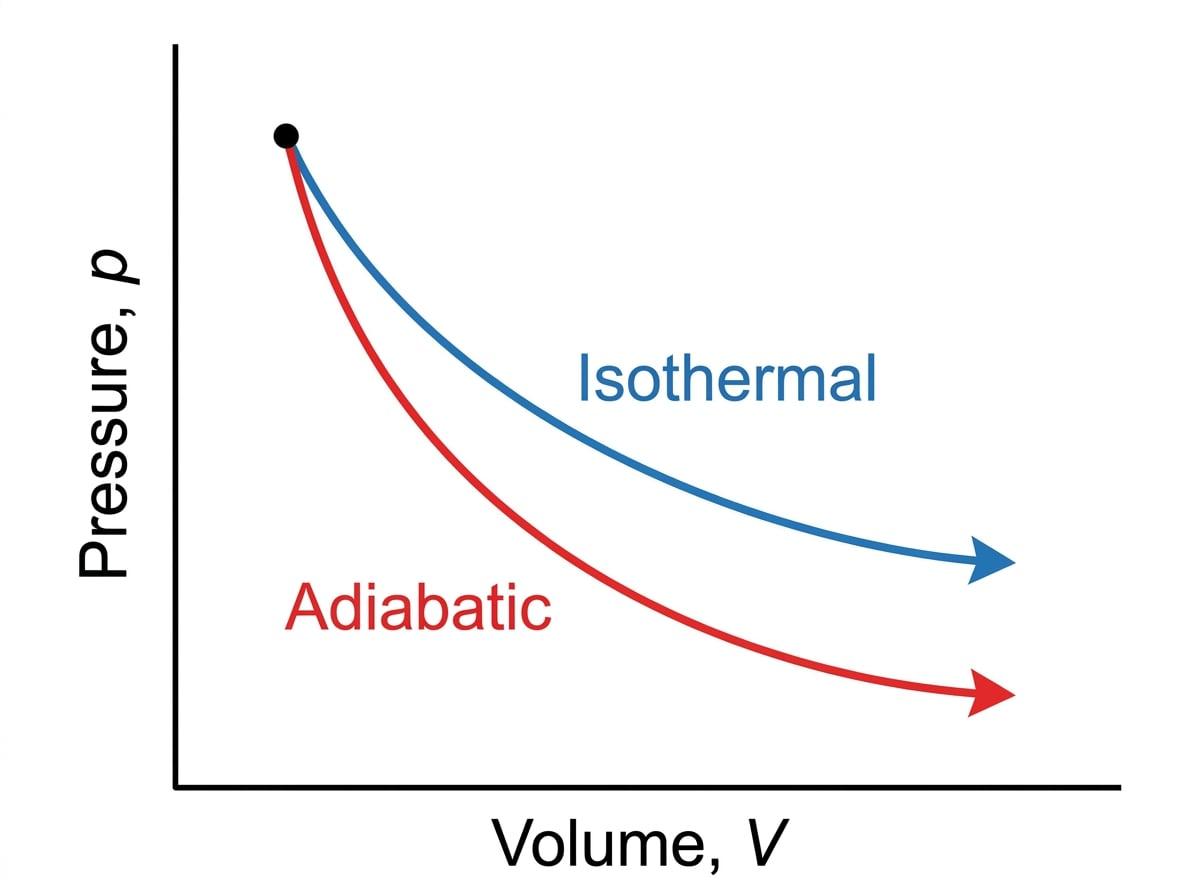
Isothermal vs. Adiabatic on a p-V diagram
Both isothermal and adiabatic expansions cause the pressure to drop as volume increases, but they look different on a p−Vp-Vp−V graph.
- The isothermal curve follows p∝1Vp \propto \frac{1}{V}p∝V1.
- The adiabatic curve follows p∝1Vγp \propto \frac{1}{V^\gamma}p∝Vγ1. Since γ\gammaγ is greater than 1, the adiabatic curve is noticeably steeper.
Adiabatic compression in an engine
Air in a diesel engine cylinder is compressed adiabatically. Its initial pressure is 1.0×10⁵ Pa1.0 \times 10^5 \text{ Pa}1.0×10⁵ Pa and its initial volume is 5.0×10⁻⁴ m35.0 \times 10^{-4} \text{ m}^35.0×10⁻⁴ m3. It is rapidly compressed to a volume of 2.5×10⁻⁵ m32.5 \times 10^{-5} \text{ m}^32.5×10⁻⁵ m3.
Calculate the final pressure of the air. (Assume γ=1.4\gamma = 1.4γ=1.4)
- State the relationship for an adiabatic change: Because pVγ=constantpV^\gamma = \text{constant}pVγ=constant, we can equate the initial and final states:
- Rearrange to solve for the final pressure (p2p_2p2):
- Substitute the values: p2=1.0×105×(5.0×10−42.5×10−5)1.4p2=1.0×105×(20)1.4p2=1.0×105×66.29=6.6×10⁶ Pa\begin{aligned} p_2 &= 1.0 \times 10^5 \times \left( \frac{5.0 \times 10^{-4}}{2.5 \times 10^{-5}} \right)^{1.4} \\ p_2 &= 1.0 \times 10^5 \times (20)^{1.4} \\ p_2 &= 1.0 \times 10^5 \times 66.29 = 6.6 \times 10^6 \text{ Pa} \end{aligned}p2p2p2=1.0×105×(2.5×10−55.0×10−4)1.4=1.0×105×(20)1.4=1.0×105×66.29=6.6×10⁶ Pa
Forgetting the power of gamma
When typing p1V1γ=p2V2γp_1 V_1^\gamma = p_2 V_2^\gammap1V1γ=p2V2γ into your calculator, it is very easy to accidentally calculate (pV)γ(pV)^\gamma(pV)γ instead. Remember that the exponent γ\gammaγ applies only to the volume VVV, not the pressure! Grouping the volumes into a fraction (V1V2)γ\left(\frac{V_1}{V_2}\right)^\gamma(V2V1)γ as shown in the example above is the safest way to avoid this calculator error.
In the exam
- Watch out for keywords: If a question says the process happens "slowly", assume it is isothermal. If it says it happens "rapidly", assume it is adiabatic.
- Check your signs: When applying Q=ΔU+WQ = \Delta U + WQ=ΔU+W, double-check whether the gas is expanding (+W+W+W) or being compressed (−W-W−W), and whether it's gaining heat (+Q+Q+Q) or losing heat (−Q-Q−Q).
- Use the formula booklet: You don't need to memorise pVγ=constantpV^\gamma = \text{constant}pVγ=constant or W=pΔVW = p\Delta VW=pΔV, as they are provided in your data sheet. But you do need to know which physical situation each formula applies to.
Check yourself
- Can you state why the work done during a constant volume process is zero?
- If a gas is compressed adiabatically, does its temperature increase, decrease, or stay the same?
- Which curve on a p−Vp-Vp−V diagram is steeper: an isothermal expansion or an adiabatic expansion?