

What you'll learn
- How to calculate the magnetic force on a single moving charge.
- Why charged particles move in circular paths when they enter a magnetic field.
- How to derive the radius of that circular path.
- The structure of a cyclotron and why its alternating voltage doesn't need to change frequency as the particle speeds up.
The force on a single moving charge
You already know that a wire carrying an electric current experiences a force when placed in a magnetic field (F=BIlF = BIlF=BIl). But what is an electric current? It is simply a flow of charged particles! If a whole stream of charges experiences a force, it stands to reason that a single moving charge will experience a force too.
If a particle with charge QQQ moves at velocity vvv perpendicular to a uniform magnetic field of flux density BBB, the magnetic force FFF acting on it is:
Magnetic force on a moving charge
Where:
- FFF is the magnetic force in newtons (N\text{N}N)
- BBB is the magnetic flux density in teslas (T\text{T}T)
- QQQ is the charge of the particle in coulombs (C\text{C}C)
- vvv is the velocity of the particle in metres per second (m s−1\text{m s}^{-1}m s−1)
Note: This formula only applies when the velocity is entirely perpendicular to the magnetic field. If the particle moves parallel to the field, it experiences zero magnetic force.
Determining the direction
Because this force is exactly the same underlying phenomenon as the motor effect, we still use Fleming’s Left-Hand Rule to find the direction of the force:
- First finger: Magnetic Field (from North to South)
- seCond finger: Conventional Current
- Thumb: Thrust or Force
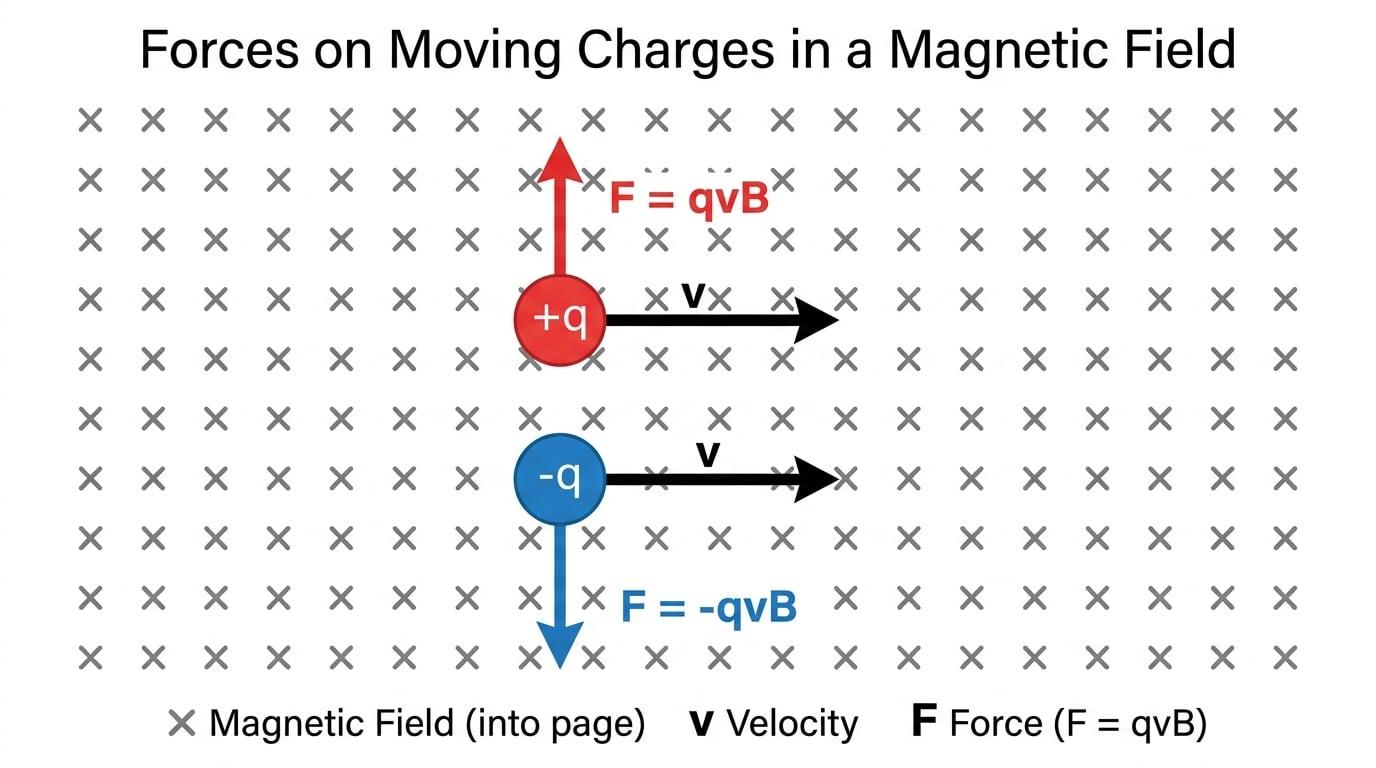
The 'Current' finger for electrons
A huge trap in AQA exams is asking for the direction of force on an electron.
Remember that conventional current is defined as the flow of positive charge. If an electron (negative charge) is moving to the right, that is equivalent to a conventional current to the left. You must point your second finger in the opposite direction to the electron's velocity!
Calculating force on an alpha particle
An alpha particle travels at 1.5×10⁶ m s−11.5 \times 10^6 \text{ m s}^{-1}1.5×10⁶ m s−1 perpendicularly into a uniform magnetic field of flux density 0.40 T0.40 \text{ T}0.40 T. Calculate the magnetic force exerted on the alpha particle. (The elementary charge is e=1.60×10⁻¹⁹ Ce = 1.60 \times 10^{-19} \text{ C}e=1.60×10⁻¹⁹ C)
- Identify the charge of the particle: An alpha particle consists of two protons and two neutrons, so its charge is +2e+2e+2e. Q=2×1.60×10−19=3.20×10⁻¹⁹ CQ = 2 \times 1.60 \times 10^{-19} = 3.20 \times 10^{-19} \text{ C}Q=2×1.60×10−19=3.20×10⁻¹⁹ C
- Substitute into the magnetic force equation: F=BQvF=0.40×(3.20×10−19)×(1.5×106)\begin{aligned} F &= BQv \\ F &= 0.40 \times \left(3.20 \times 10^{-19}\right) \times \left(1.5 \times 10^6\right) \end{aligned}FF=BQv=0.40×(3.20×10−19)×(1.5×106)
- Calculate the final answer: F=1.92×10⁻¹³ NF = 1.92 \times 10^{-13} \text{ N}F=1.92×10⁻¹³ N
Circular paths
When a charged particle moves perpendicularly into a uniform magnetic field, Fleming's Left-Hand Rule tells us that the force is always at exactly 90∘90^\circ90∘ to the velocity.
Because the force is perpendicular to the motion:
- It does no work on the particle (since work done requires moving a distance in the direction of the force).
- The particle's speed remains constant.
- Only the direction of the velocity changes.
A force of constant magnitude that is always perpendicular to velocity provides a centripetal force. This means the particle will travel in a circular path!
Deriving the radius
To find the radius rrr of this circular path, we equate the magnetic force to the centripetal force:
Fmagnetic=FcentripetalBQv=mv2r\begin{aligned} F_{\text{magnetic}} &= F_{\text{centripetal}} \\ BQv &= \frac{mv^2}{r} \end{aligned}FmagneticBQv=Fcentripetal=rmv2By cancelling one vvv from each side and rearranging for rrr, we get a very important equation:
Radius of a charged particle's path
This equation tells us that:
- A faster or heavier particle (mmm or vvv increases) has more momentum and will turn less sharply, meaning a larger radius.
- A stronger magnetic field or higher charge (BBB or QQQ increases) creates a stronger pulling force, resulting in a tighter turn and a smaller radius.
Radius of an electron's path
An electron enters a uniform magnetic field of 1.5×10⁻³ T1.5 \times 10^{-3} \text{ T}1.5×10⁻³ T at a speed of 4.0×10⁶ m s−14.0 \times 10^6 \text{ m s}^{-1}4.0×10⁶ m s−1 perpendicular to the field lines. Calculate the radius of its circular path. (Mass of an electron me=9.11×10⁻³¹ kgm_e = 9.11 \times 10^{-31} \text{ kg}me=9.11×10⁻³¹ kg; elementary charge e=1.60×10⁻¹⁹ Ce = 1.60 \times 10^{-19} \text{ C}e=1.60×10⁻¹⁹ C)
- State the known values: m=9.11×10⁻³¹ kgv=4.0×10⁶ m s−1B=1.5×10⁻³ TQ=1.60×10⁻¹⁹ C(magnitude of charge)\begin{aligned} m &= 9.11 \times 10^{-31} \text{ kg} \\ v &= 4.0 \times 10^6 \text{ m s}^{-1} \\ B &= 1.5 \times 10^{-3} \text{ T} \\ Q &= 1.60 \times 10^{-19} \text{ C} \quad \text{(magnitude of charge)} \end{aligned}mvBQ=9.11×10⁻³¹ kg=4.0×10⁶ m s−1=1.5×10⁻³ T=1.60×10⁻¹⁹ C(magnitude of charge)
- Substitute into the radius equation: r=mvBQr=(9.11×10−31)×(4.0×106)(1.5×10−3)×(1.60×10−19)\begin{aligned} r &= \frac{mv}{BQ} \\ r &= \frac{\left(9.11 \times 10^{-31}\right) \times \left(4.0 \times 10^6\right)}{\left(1.5 \times 10^{-3}\right) \times \left(1.60 \times 10^{-19}\right)} \end{aligned}rr=BQmv=(1.5×10−3)×(1.60×10−19)(9.11×10−31)×(4.0×106)
- Calculate the result: r=0.0152 m=1.52 cmr = 0.0152 \text{ m} = 1.52 \text{ cm}r=0.0152 m=1.52 cm
Application: The Cyclotron
A cyclotron is a type of particle accelerator that uses both electric and magnetic fields to accelerate charged particles to very high speeds. They are often used in hospitals to produce radioactive isotopes for medical imaging.
How it works
A cyclotron consists of two hollow, D-shaped metal electrodes (imaginatively called "Dees") placed in a vacuum chamber. A uniform magnetic field passes vertically through the Dees.
Between the straight edges of the Dees is a small gap, across which a high-frequency alternating voltage is applied.
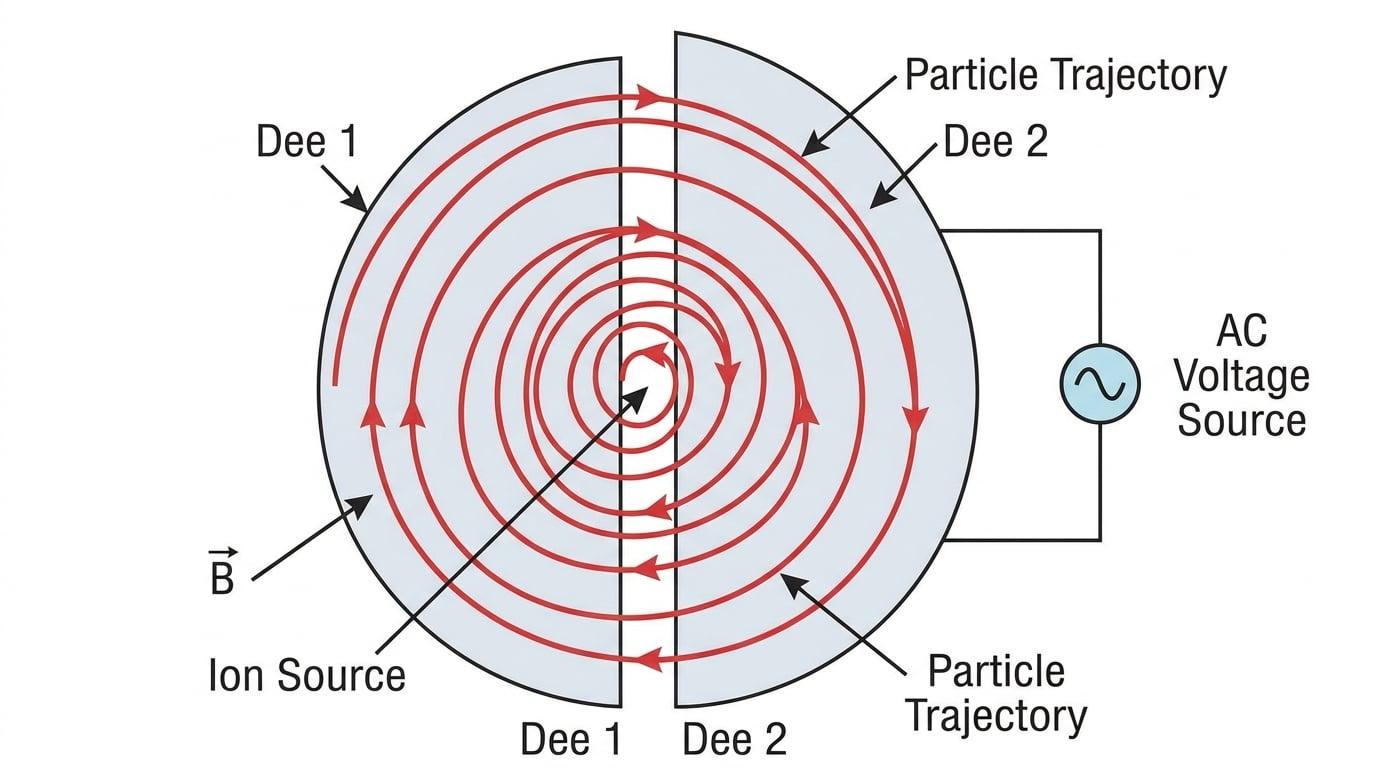
- A charged particle (e.g., a proton) is injected into the center.
- The electric field in the gap accelerates the proton across to one of the Dees.
- Once inside the hollow Dee, there is no electric field. However, the vertical magnetic field forces the proton into a semicircular path.
- Just as the proton completes its semicircle and reaches the gap again, the alternating voltage reverses direction.
- The proton is accelerated across the gap again, gaining kinetic energy.
- Because it is now moving faster, it travels in a semicircular path with a larger radius (r=mvBQr = \frac{mv}{BQ}r=BQmv).
- This process repeats, with the proton spiralling outwards until it exits the cyclotron at a very high speed.
The "magic" of the Cyclotron
You might wonder: as the particle speeds up and travels a wider path, doesn't it take longer to complete a semicircle? If it takes longer, wouldn't we need to constantly adjust the frequency of the alternating voltage so it always switches at exactly the right time?
Brilliantly, no. The time taken to complete one semicircle is completely independent of the particle's speed! Let's prove this mathematically.
The time ttt taken to travel a semicircular path is the distance (half a circumference, πr\pi rπr) divided by the speed vvv:
t=πrvt = \frac{\pi r}{v}t=vπrSubstitute our expression for radius, r=mvBQr = \frac{mv}{BQ}r=BQmv:
t=π(mvBQ)vt = \frac{\pi \left( \frac{mv}{BQ} \right)}{v}t=vπ(BQmv)The vvv on the top and the vvv on the bottom cancel out!
t=πmBQt = \frac{\pi m}{BQ}t=BQπmBecause mass (mmm), magnetic flux density (BBB), and charge (QQQ) are all constant, the time spent in the Dee is constant. As the particle gets faster, it covers a longer path, but these two effects cancel each other out perfectly.
Time period and Frequency
Because the time for one semicircle is t=πmBQt = \frac{\pi m}{BQ}t=BQπm, the time for a full cycle (the time period, TTT) is double that:
T=2πmBQT = \frac{2\pi m}{BQ}T=BQ2πmThe alternating voltage must complete one full cycle in this time. Therefore, the required frequency fff of the AC supply is:
f=1T=BQ2πmf = \frac{1}{T} = \frac{BQ}{2\pi m}f=T1=2πmBQIn the exam
- Watch out for standard form: Particle masses and charges are very small (e.g., 10−3110^{-31}10−31, 10−1910^{-19}10−19), while speeds are often very high (10610^6106). Use the fractions button and standard form
[x10^x]button on your calculator carefully to avoid syntax errors. - Left hand for force, right hand for coils: Do not mix up Fleming's Left-Hand Rule (for forces on moving charges) with the Right-Hand Grip Rule (for finding the magnetic field around a wire).
- Specific charge: AQA sometimes gives you the "specific charge" of a particle (charge per unit mass, Q/mQ/mQ/m) instead of QQQ and mmm separately. You can substitute this directly into the radius equation: r=vB(Qm)r = \frac{v}{B \left(\frac{Q}{m}\right)}r=B(mQ)v.
Check yourself
- If an electron and a proton are fired into a magnetic field at the same speed, which one will have a larger radius of curvature, and why?
- What happens to the kinetic energy of a charged particle while it is moving inside the "Dee" of a cyclotron?
- Why is an alternating voltage required in a cyclotron rather than a direct current (DC) voltage?
