Magnetic flux density (A-level only)
What you'll learn
- How a current-carrying wire interacts with a magnetic field to produce a force (the motor effect).
- How to predict the direction of this force using Fleming's left-hand rule.
- The formal definition of magnetic flux density and its unit, the tesla.
- How to calculate the magnitude of the force using F=BIlF = BIlF=BIl.
- How to measure magnetic flux density experimentally using a top-pan balance (Required Practical 10).
The Motor Effect and Fleming's Left-Hand Rule
You will already know from GCSE that when you place a wire carrying an electric current into a magnetic field, the wire experiences a force. This happens because the magnetic field created by the current interacts with the external magnetic field. We call this the motor effect.
Because force, magnetic field, and current are all vectors (they have a direction), their directions are strictly linked. They are always mutually perpendicular (at right angles to each other). To figure out the direction of the force, we use Fleming's left-hand rule.
Hold your left hand out and point your first three fingers so they are all at right angles to one another.
- First finger = Magnetic Field (pointing from North to South)
- seCond finger = Conventional Current (pointing from positive to negative)
- Thumb = Thrust or Force (the direction the wire will be pushed)
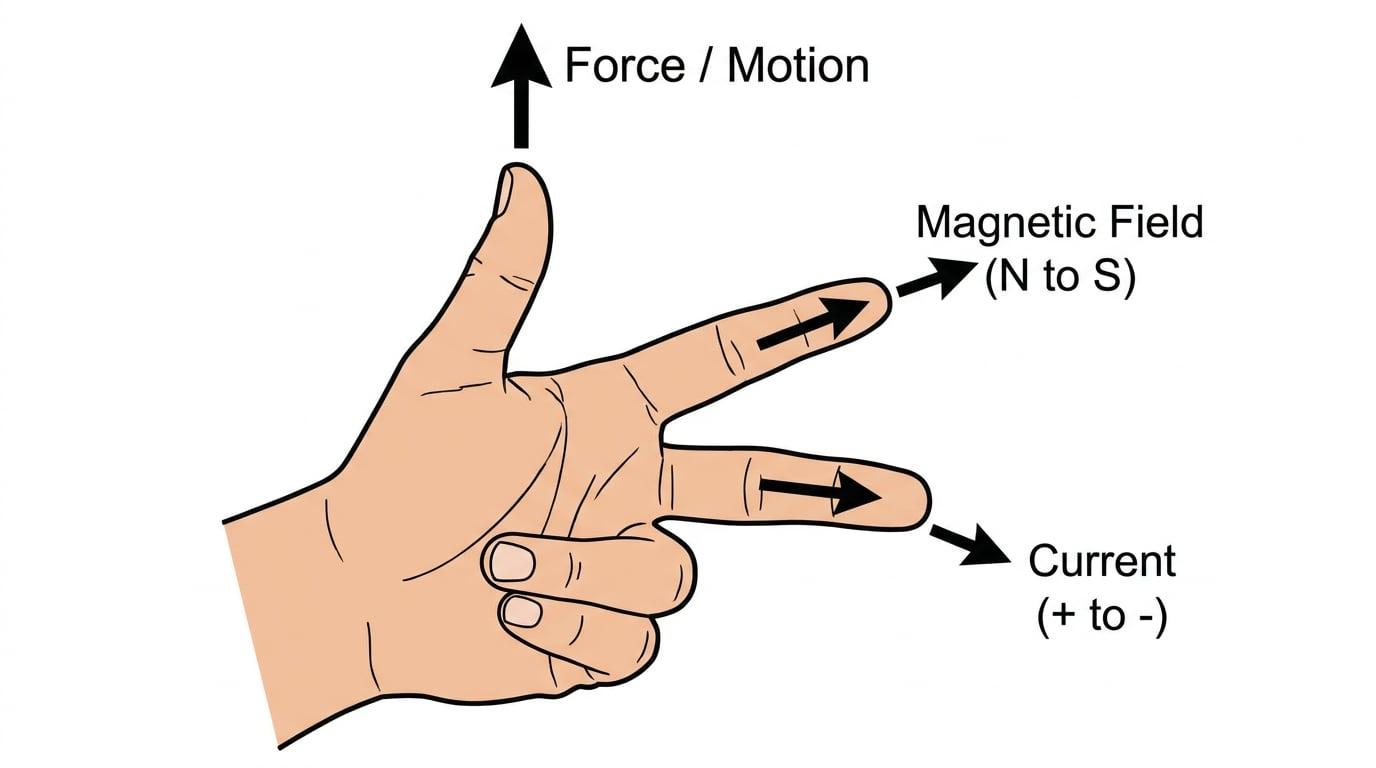
Using the wrong hand or current
It is surprisingly common to accidentally use your right hand in an exam, especially if you are holding your pen in your right hand. Always put your pen down and physically hold up your left hand! Also, remember that the second finger must point in the direction of conventional current (positive to negative), not electron flow.
Finding the direction of force
A wire carrying a DC current is placed horizontally between two strong magnets. The North pole is directly above the wire, and the South pole is directly below it. The current flows from left to right. What is the direction of the force on the wire?
- Align your First finger (Field) pointing straight down, from North to South.
- Keep your first finger pointing down, and rotate your wrist so your seCond finger (Current) points from left to right.
- Look at your Thumb (Force). It should be pointing away from you, directly into the page/screen. The force pushes the wire inwards.
Magnetic Flux Density and the Tesla
To calculate the exact force on our wire, we need a way to measure the "strength" of the magnetic field. In Physics, we call this the magnetic flux density. Its symbol is BBB.
Magnetic flux density
Magnetic flux density (BBB) is the force acting per unit current per unit length on a wire placed at right angles to the magnetic field.
Because we define magnetic flux density based on the force it produces, we can also define its unit, the tesla (symbol T\text{T}T).
The tesla
The tesla (T\text{T}T) is the unit of magnetic flux density. A field has a magnetic flux density of 1 T1\text{ T}1 T if a 1 m1\text{ m}1 m length of wire carrying a current of 1 A1\text{ A}1 A placed perpendicular to the field experiences a force of 1 N1\text{ N}1 N.
The tesla is a very large unit. The Earth's magnetic field is roughly 0.00005 T0.00005\text{ T}0.00005 T, and a strong fridge magnet is about 0.01 T0.01\text{ T}0.01 T. You will frequently see magnetic flux densities given in millitesla (mT\text{mT}mT) in exam questions.
Calculating the Force
The definitions above lead us directly to the mathematical formula for the force on a current-carrying wire.
When the wire is placed perpendicular to the magnetic field lines, the force FFF is given by:
F=BIl F = B I l F=BIlWhere:
- FFF is the force in newtons (N\text{N}N)
- BBB is the magnetic flux density in teslas (T\text{T}T)
- III is the current in amps (A\text{A}A)
- lll is the length of the wire that is inside the magnetic field, in metres (m\text{m}m)
The perpendicular condition
The equation F=BIlF = BIlF=BIl only works when the current is exactly 90∘90^{\circ}90∘ to the magnetic field lines. If the wire is parallel to the field lines, it experiences zero force!
Calculating force on a wire
A straight piece of copper wire is placed perpendicular to a uniform magnetic field of 45 mT45 \text{ mT}45 mT. The length of wire completely within the uniform field is 8.0 cm8.0 \text{ cm}8.0 cm. A current of 2.5 A2.5 \text{ A}2.5 A flows through the wire. Calculate the magnetic force acting on the wire.
- Identify the given values and convert them to standard SI units:
- State the formula. The wire is perpendicular to the field, so we can use:
- Substitute the values into the formula and calculate the result:
Required Practical 10: The Top-Pan Balance
You need to know how to measure magnetic flux density experimentally. We can't easily measure the upward force on a floating piece of wire, but we can cleverly use Newton's Third Law of Motion.
If the magnetic field pushes the wire upwards, the wire must push the magnets downwards with an equal and opposite force. If we place the magnets on a digital top-pan balance, this downward push will register as an increase in the mass reading.
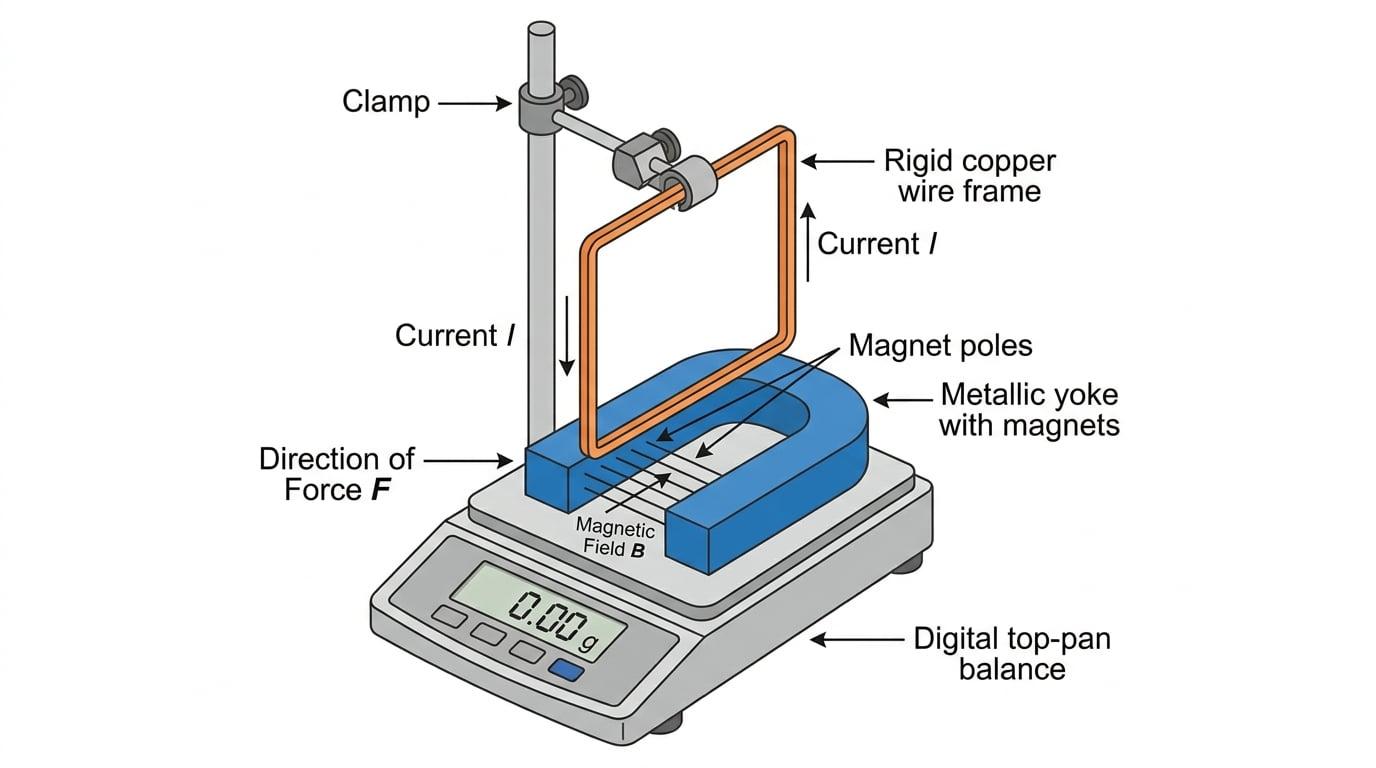
The Procedure
A stiff square frame of wire is clamped rigidly in place. Its bottom edge (length lll) sits horizontally between the opposite poles of a magnet assembly. The magnet assembly is placed on a digital top-pan balance, which is zeroed (tared).
When a current III is turned on, a magnetic force acts on the wire. By Fleming's left-hand rule, if we arrange the current and field correctly, the force on the wire is upwards. Therefore, the force on the magnets is downwards. The top-pan balance shows an apparent increase in mass, Δm\Delta mΔm.
The Analysis
The extra downward force measured by the balance is simply the "extra weight", calculated using F=mgF = m gF=mg. So, the magnetic force is:
F=Δm⋅g F = \Delta m \cdot g F=Δm⋅gWe can equate this to the magnetic force equation:
Δm⋅g=BIl \Delta m \cdot g = B I l Δm⋅g=BIlTo find BBB accurately, we do not just rely on one reading. We vary the current III and record the corresponding apparent change in mass Δm\Delta mΔm.
Graphical analysis
If you plot a graph of the force FFF on the y-axis against the current III on the x-axis, you will get a straight line through the origin. Because F=(Bl)⋅IF = (Bl) \cdot IF=(Bl)⋅I, the gradient of this graph is equal to BlBlBl. To find the magnetic flux density BBB, you simply divide the gradient by the length of the wire lll.
Finding B from experimental data
In a top-pan balance experiment, a wire of length 5.0 cm5.0 \text{ cm}5.0 cm is placed between two magnets. When a current of 3.0 A3.0 \text{ A}3.0 A is passed through the wire, the balance reading increases by 0.42 g0.42 \text{ g}0.42 g. Calculate the magnetic flux density between the magnets. (Assume g=9.81 m s−2g = 9.81 \text{ m s}^{-2}g=9.81 m s−2)
- Convert the apparent change in mass into kilograms:
- Calculate the magnetic force using F=Δm⋅gF = \Delta m \cdot gF=Δm⋅g:
- Rearrange the magnetic force equation to make BBB the subject:
- Substitute the known values (l=0.050 ml = 0.050 \text{ m}l=0.050 m) into the rearranged equation:
(or 27 mT27 \text{ mT}27 mT)
In the exam
- Check your units: Length must be in metres (m\text{m}m), and flux density is often given in millitesla (mT\text{mT}mT). Always convert to standard SI units before applying F=BIlF = BIlF=BIl.
- Identify the correct length: lll is strictly the length of the wire that is inside the magnetic field. If a 50 cm50 \text{ cm}50 cm wire passes through a 5 cm5 \text{ cm}5 cm wide magnetic field, use l=0.05 ml = 0.05 \text{ m}l=0.05 m.
- Use the Third Law explicitly: If a 6-mark question asks you to explain the top-pan balance practical, you must explicitly state Newton's Third Law. The mark scheme always requires you to explain why the balance reading changes (downward force on magnets is equal and opposite to the upward magnetic force on the wire).
Check yourself
- Can you state the definition of the tesla without looking at the notes?
- Which finger represents the magnetic field in Fleming's left-hand rule, and which way does the field point?
- If a wire is placed parallel to the magnetic field lines, what is the magnitude of the force acting on it?
- In the top-pan balance experiment, what does the gradient of a graph of Force against Current represent?