Magnetic flux and flux linkage (A-level only)
Welcome to the start of electromagnetic induction! Before we can understand how moving magnets generate electricity (Faraday's Law), we need a way to measure exactly "how much" magnetic field is passing through a specific area.
What you'll learn in this topic:
- The definition of magnetic flux and how it differs from magnetic flux density.
- How to calculate magnetic flux linkage for a coil with multiple turns.
- How to adapt your calculations when a coil is rotated at an angle to the magnetic field.
What is Magnetic Flux?
In the previous topic, you learned about magnetic flux density (BBB), which is measured in Tesla (T\text{T}T). You can think of flux density as the strength or concentration of the magnetic field.
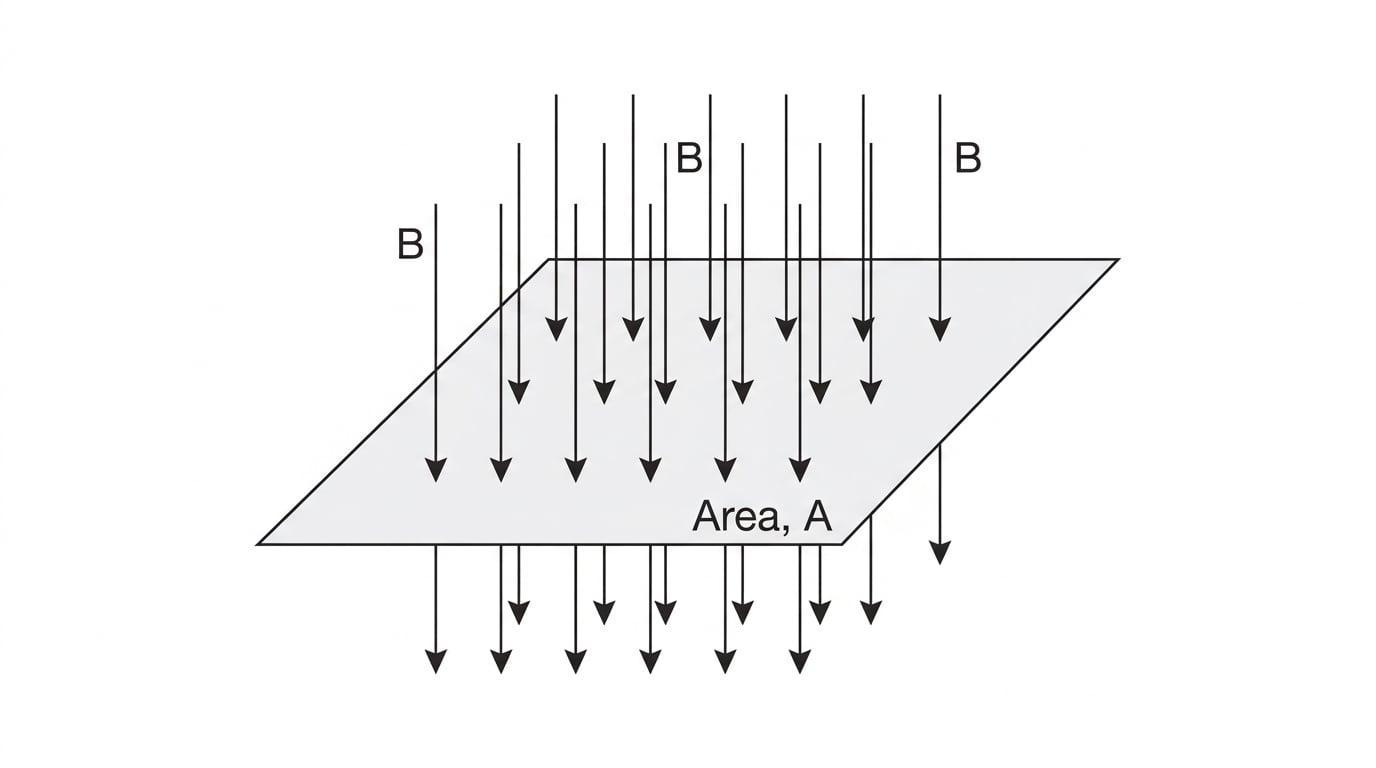
If we want to know the total amount of magnetic field passing through a particular surface (like a loop of wire), we need to combine the strength of the field with the area it covers. This total amount is called magnetic flux.
Catching the rain
Imagine a rainstorm. The magnetic flux density (BBB) is how heavily it's raining (the number of raindrops falling per square metre). The area (AAA) is the size of a bucket you've placed on the ground. The magnetic flux (Φ\PhiΦ) is the total amount of rain you actually catch in your bucket. A bigger bucket or heavier rain means you catch more water.
If the magnetic field is perfectly perpendicular (normal) to the area, we calculate the flux by simply multiplying the flux density by the area.
Magnetic Flux
Magnetic flux (Φ\PhiΦ) is defined by the equation:
Φ=BA \Phi = BA Φ=BAwhere:
- Φ\PhiΦ is the magnetic flux, measured in Webers (Wb\text{Wb}Wb).
- BBB is the magnetic flux density, measured in Tesla (T\text{T}T).
- AAA is the area perpendicular to the magnetic field, measured in square metres (m2\text{m}^2m2).
From this equation, we can see that 1 Wb1 \text{ Wb}1 Wb is exactly equivalent to 1 T m21 \text{ T m}^21 T m2.
Calculating Magnetic Flux
A flat rectangular loop of wire with dimensions 5.0 cm5.0 \text{ cm}5.0 cm by 8.0 cm8.0 \text{ cm}8.0 cm is placed in a uniform magnetic field of flux density 0.40 T0.40 \text{ T}0.40 T. The plane of the loop is perpendicular to the magnetic field lines. Calculate the magnetic flux passing through the loop.
- First, convert the dimensions of the loop into standard SI units (metres) and calculate the area AAA.
- State the formula for magnetic flux. Since the field is perpendicular to the loop, we can use the standard equation.
- Substitute the values into the equation to find the final answer.
Magnetic Flux Linkage
In real-world applications like motors and transformers, we rarely use a single loop of wire. Instead, we use coils made of many turns of wire wrapped together.
When a magnetic field passes through a coil, it passes through every single turn of that coil. To find the total flux interacting with the entire coil, we simply multiply the flux through one turn by the total number of turns.
Magnetic Flux Linkage
Magnetic flux linkage is the product of the magnetic flux and the number of turns in the coil.
Flux linkage=NΦ=BAN \text{Flux linkage} = N\Phi = BAN Flux linkage=NΦ=BANwhere:
- NNN is the number of turns in the coil.
- Φ\PhiΦ is the magnetic flux through a single turn (Wb\text{Wb}Wb).
- The unit for flux linkage is the Weber-turn (often written as Wb turns\text{Wb turns}Wb turns), though technically the base unit is still just the Weber (Wb\text{Wb}Wb) because NNN is a dimensionless number.
Flux vs Flux Linkage
- Flux (Φ\PhiΦ) is for a single area or one loop of wire.
- Flux Linkage (NΦN\PhiNΦ) is the total flux scaled up for a coil with NNN loops.
In AQA exams, always check whether the question asks for "flux" or "flux linkage".
Calculating Flux Linkage
A circular search coil has 500500500 turns and a radius of 1.5 cm1.5 \text{ cm}1.5 cm. It is placed in a uniform magnetic field of 45 mT45 \text{ mT}45 mT such that the field is perpendicular to the plane of the coil. Calculate the magnetic flux linkage.
- Convert the radius to standard units and calculate the area of the circular coil using A=πr2A = \pi r^2A=πr2.
- Convert the magnetic flux density from milliTesla (mT\text{mT}mT) to Tesla (T\text{T}T).
- Substitute the values into the flux linkage formula NΦ=BANN\Phi = BANNΦ=BAN.
- Round the final answer to an appropriate number of significant figures (two, matching the given values).
Coils at an Angle
So far, we have only looked at situations where the magnetic field hits the coil perfectly straight-on (perpendicular to the surface). But what happens if the coil is tilted?
Going back to our rain bucket analogy: if you tilt the bucket sideways, it catches less rain. If you turn it completely on its side, it catches no rain at all.
When a coil is tilted, we only care about the perpendicular component of the magnetic field. To calculate this mathematically, we use an angle θ\thetaθ.
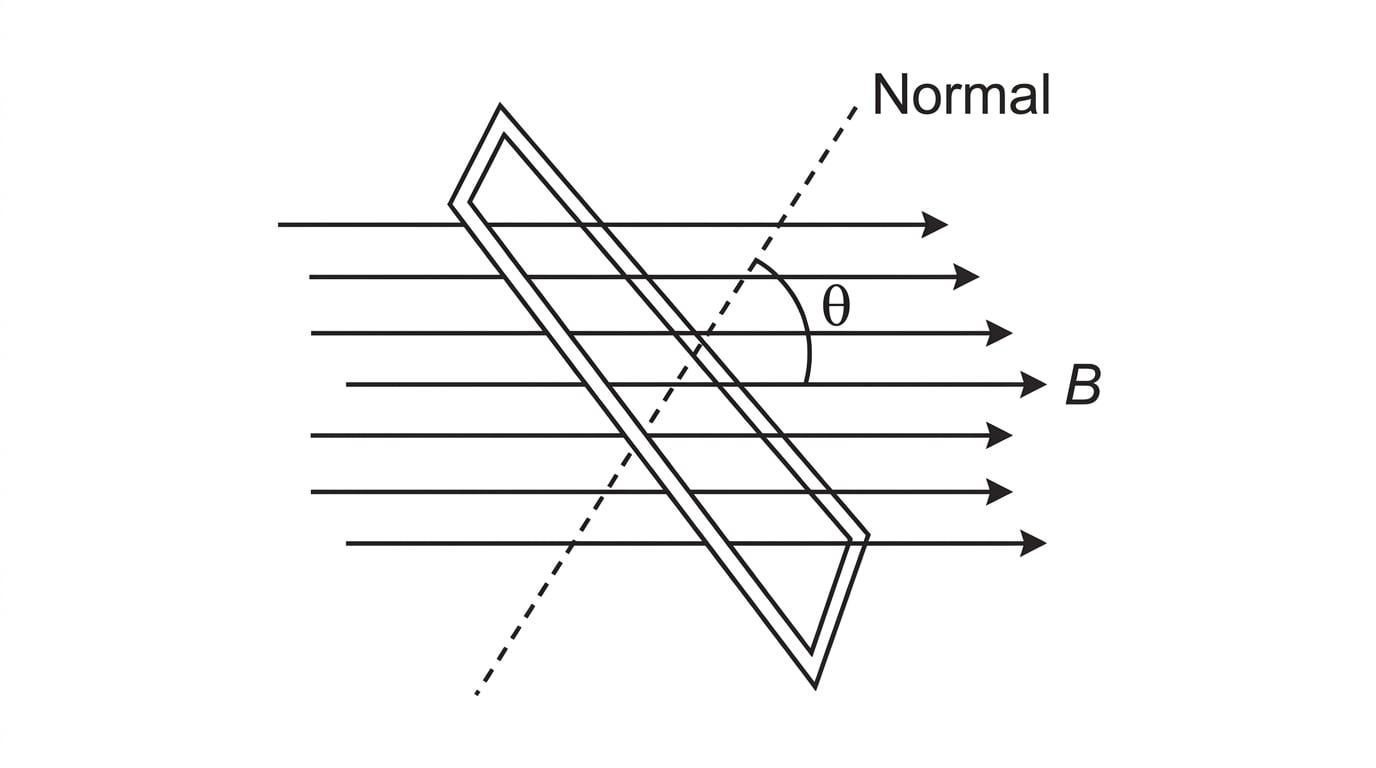
In physics, we usually measure angles relative to the normal. The normal is an imaginary line sticking straight out of the coil's surface at exactly 90∘90^\circ90∘.
- When the coil is directly facing the field, the normal is parallel to the field lines (θ=0∘\theta = 0^\circθ=0∘), giving maximum flux.
- When the coil is parallel to the field, the normal is at 90∘90^\circ90∘ to the field (θ=90∘\theta = 90^\circθ=90∘), giving zero flux.
This relationship is described by the cosine function:
NΦ=BANcosθ N\Phi = BAN \cos\theta NΦ=BANcosθUsing the wrong angle
AQA examiners love to try and trick you by giving the angle between the magnetic field and the plane of the coil rather than the normal to the coil.
If the question says "the plane of the coil is at 30∘30^\circ30∘ to the magnetic field", you must subtract this from 90∘90^\circ90∘ to find the correct θ\thetaθ.
θ=90∘−30∘=60∘ \theta = 90^\circ - 30^\circ = 60^\circ θ=90∘−30∘=60∘Always draw a quick sketch to check which angle you've been given!
Rotating a Coil in a Magnetic Field
A rectangular coil with 200200200 turns, measuring 10 cm10 \text{ cm}10 cm by 15 cm15 \text{ cm}15 cm, is placed in a uniform magnetic field of 0.25 T0.25 \text{ T}0.25 T. The plane of the coil is at an angle of 40∘40^\circ40∘ to the magnetic field lines. Calculate the flux linkage.
- Calculate the area of the coil in m2\text{m}^2m2.
- Identify the correct angle θ\thetaθ. The question gives the angle to the plane of the coil, so we must find the angle to the normal.
- Use the angled flux linkage formula NΦ=BANcosθN\Phi = BAN \cos\thetaNΦ=BANcosθ.
Required Practical 11 Link
You will likely investigate this exact principle in the lab. By taking a small "search coil" connected to an oscilloscope and rotating it in a steady magnetic field, you can measure how the induced emf changes. Because the changing flux linkage depends on cosθ\cos\thetacosθ, the output you see on the oscilloscope as you continuously rotate the coil will be a smooth sinusoidal alternating voltage.
In the exam
- Check your units carefully: Areas are often given in cm2\text{cm}^2cm2 or mm2\text{mm}^2mm2. Remember that 1 cm2=10−4 m21 \text{ cm}^2 = 10^{-4} \text{ m}^21 cm2=10−4 m2 and 1 mm2=10−6 m21 \text{ mm}^2 = 10^{-6} \text{ m}^21 mm2=10−6 m2.
- Read the question twice for 'flux' vs 'flux linkage': If they ask for flux (Φ\PhiΦ), do not multiply by NNN. If they ask for flux linkage (NΦN\PhiNΦ), you must multiply by NNN.
- Hunt for the correct angle: Always ask yourself, "Is this angle to the normal, or to the plane of the coil?". If it's to the plane, use 90∘−angle90^\circ - \text{angle}90∘−angle to find θ\thetaθ.
- State units for your final answer: Use Wb\text{Wb}Wb for flux, and either Wb\text{Wb}Wb or Wb turns\text{Wb turns}Wb turns for flux linkage (both are accepted, but Wb turns\text{Wb turns}Wb turns shows the examiner you understand the difference).
Check yourself
- What is the definition of magnetic flux and what is its standard SI unit?
- If a coil is positioned so that its plane is completely parallel to the magnetic field lines, what is the magnetic flux linkage?
- How many Webers are equivalent to one Tesla square-metre (1 T m21 \text{ T m}^21 T m2)?
- If you are given the angle between the coil's flat surface and the magnetic field, how do you find the angle θ\thetaθ required for the formula NΦ=BANcosθN\Phi = BAN \cos\thetaNΦ=BANcosθ?