An experimental aircraft testing platform uses a horizontal conducting beam of length 3.2 m3.2\text{ m}3.2 m aligned in the east–west direction.
The localized uniform magnetic field in the test chamber has a flux density of 8.4×10⁻⁵ T8.4 \times 10^{-5}\text{ T}8.4×10⁻⁵ T and is directed at an angle of 55∘55^\circ55∘ to the horizontal floor, pointing downwards and in the northerly direction.
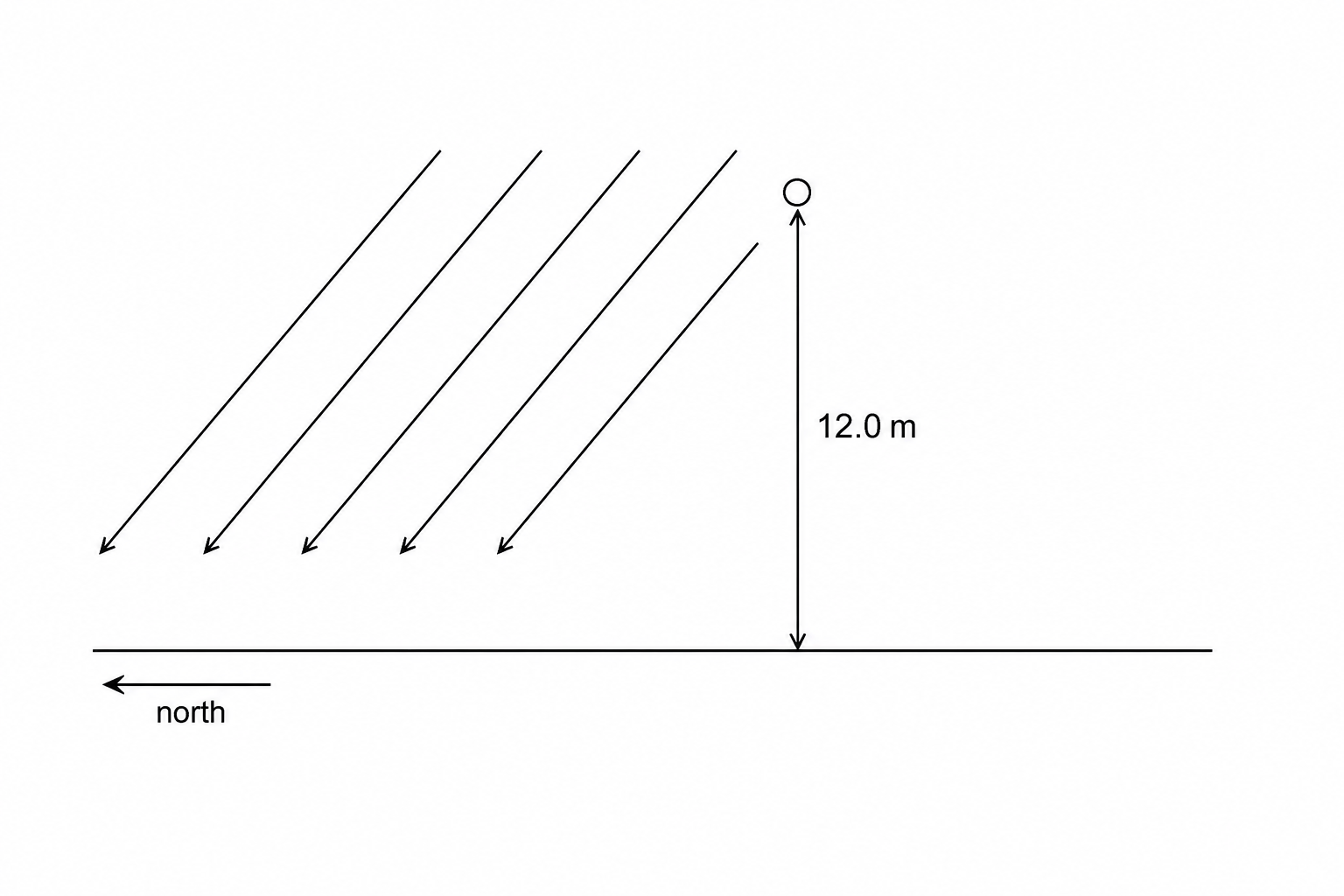
The beam is released from rest and falls vertically 12.0 m12.0\text{ m}12.0 m to the floor, maintaining its horizontal east–west orientation as it falls. Determine the average electromotive force (emf) induced across the beam during its fall. Assume that air resistance is negligible. Let g=9.81 m s−2g = 9.81\text{ m s}^{-2}g=9.81 m s−2.
The beam is returned to its original position at height 12.0 m12.0\text{ m}12.0 m. It is now supported by a light, non-conducting pole of length 12.0 m12.0\text{ m}12.0 m that is hinged on the floor. The pole is initially vertical and is then released.
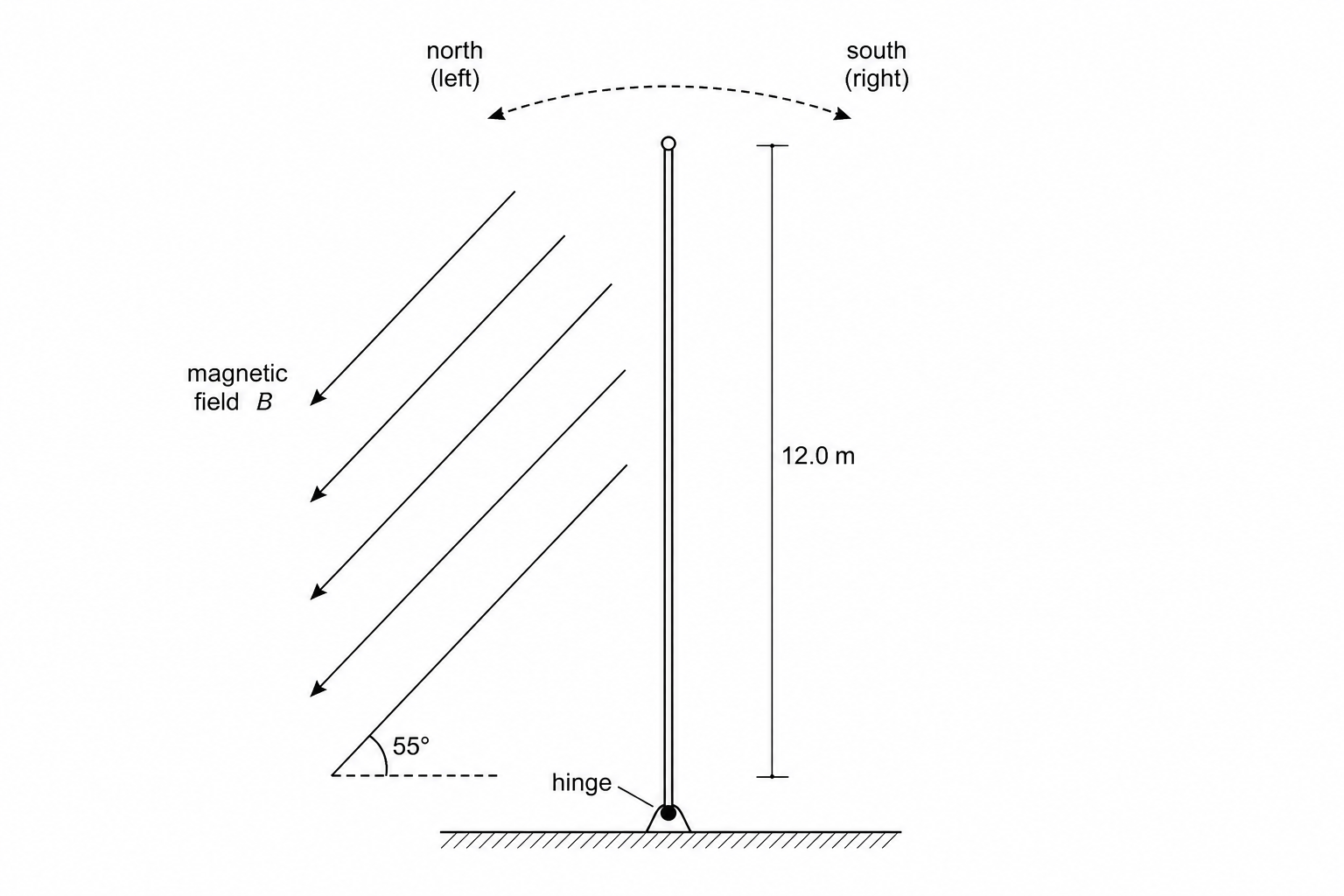
The beam and pole can fall to the floor either to the left (northward) or to the right (southward).
During each fall, there are changes in the magnitude and direction of the induced emf. Explain how and why these changes differ depending on whether the beam falls northward (to the left) or southward (to the right).