Half-life (A-level only)
What you'll learn
- The difference between physical, biological, and effective half-lives.
- Why medical tracers disappear from the body faster than their physical decay rate suggests.
- How to use the equation 1TE=1TB+1TP\frac{1}{T_E} = \frac{1}{T_B} + \frac{1}{T_P}TE1=TB1+TP1 to calculate clearance times.
When a patient is injected with a radioactive tracer for a medical scan (like a PET or gamma camera scan), the hospital needs to know exactly how long the patient will remain radioactive. We want the tracer to stick around long enough to get a clear image, but vanish quickly afterwards so the patient doesn't receive an unnecessary dose of ionising radiation.
The trick is that the tracer disappears from the body via two completely independent processes happening at the same time.
The Three Half-lives
First, the tracer is radioactive, so the unstable nuclei are constantly decaying into stable ones. Second, the tracer is a chemical substance, meaning the patient's body is actively trying to filter it out and excrete it (usually through urine, faeces, or sweat).
We define a specific half-life for each of these processes, and a final one for the overall effect.
Physical half-life ()
The time taken for the number of radioactive nuclei of the isotope to halve due to spontaneous radioactive decay. This is a fixed property of the specific isotope (e.g., Technetium-99m always has a physical half-life of 6.0 hours) and cannot be changed by temperature, pressure, or chemical reactions.
Biological half-life ()
The time taken for the body's natural physiological processes to excrete or eliminate half of the administered substance. This depends entirely on the chemical form of the tracer, which organ it targets, and the patient's biological metabolism.
Effective half-life ()
The time taken for the total radioactive activity inside the patient's body to halve. This is the observable result of both physical decay and biological excretion working together.
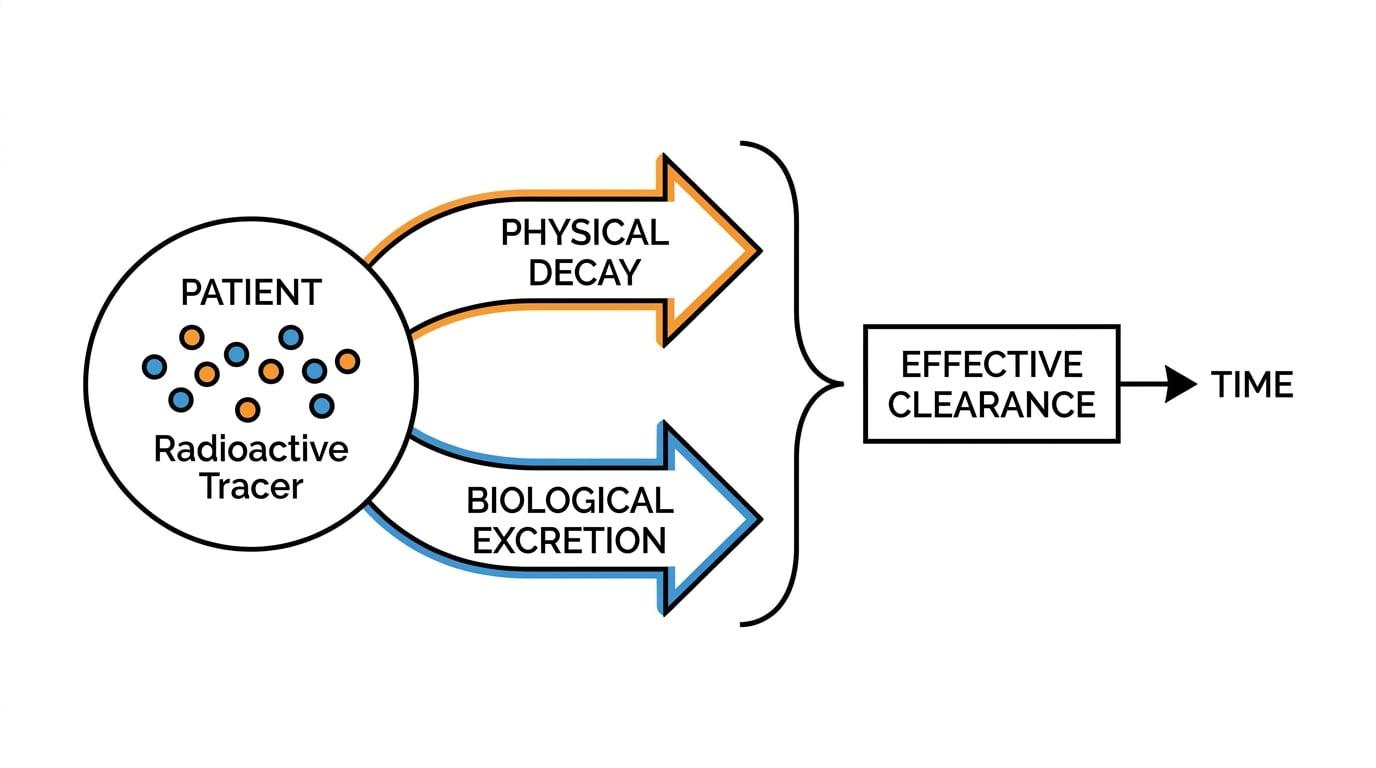
The Effective Half-life Equation
Because both processes are removing active tracer from the body at the same time, the overall rate of removal is simply the sum of the two individual rates.
In nuclear physics, the rate of decay is determined by the decay constant, λ\lambdaλ. So, the effective decay constant is the sum of the biological and physical decay constants:
λE=λB+λP\lambda_E = \lambda_B + \lambda_PλE=λB+λPYou already know from your earlier radioactivity studies that the decay constant is related to half-life by the equation λ=ln(2)T\lambda = \frac{\ln(2)}{T}λ=Tln(2). If we substitute this into our rate equation, we get:
ln(2)TE=ln(2)TB+ln(2)TP\frac{\ln(2)}{T_E} = \frac{\ln(2)}{T_B} + \frac{\ln(2)}{T_P}TEln(2)=TBln(2)+TPln(2)Dividing the entire equation by ln(2)\ln(2)ln(2) leaves us with the formula you need to use in the exam:
1TE=1TB+1TP\frac{1}{T_E} = \frac{1}{T_B} + \frac{1}{T_P}TE1=TB1+TP1Two processes, one result
Because physical decay and biological excretion happen simultaneously, the active tracer is being cleared "from both ends". As a result, the effective half-life (TET_ETE) will always be shorter than both the physical half-life (TPT_PTP) and the biological half-life (TBT_BTB).
The 'Parallel Resistors' Rule
Notice how the formula 1TE=1TB+1TP\frac{1}{T_E} = \frac{1}{T_B} + \frac{1}{T_P}TE1=TB1+TP1 looks exactly like the formula for total resistance of two resistors in parallel? The maths behaves exactly the same way. If you calculate an effective half-life that is larger than either of your starting numbers, you know immediately that you've made a mistake!
Working with the Formula
Let's look at how AQA tests this equation. The most common question simply asks you to find the effective half-life given the other two.
Calculating effective half-life
Technetium-99m (Tc-99m) is widely used as a medical tracer. It has a physical half-life of 6.0 hours. When bound to a certain pharmaceutical and injected into a patient, it has a biological half-life of 12.0 hours. Calculate the effective half-life of the tracer in the patient.
-
State the known values and ensure they are in the same units. TP=6.0 hoursT_P = 6.0 \text{ hours}TP=6.0 hours TB=12.0 hoursT_B = 12.0 \text{ hours}TB=12.0 hours
-
Write out the effective half-life formula.
- Substitute the values into the equation.
- Calculate the sum of the fractions (find a common denominator or use your calculator).
- Crucial step: Invert the fraction to find TET_ETE, not 1TE\frac{1}{T_E}TE1.
Units matter
You do not always need to convert your times into seconds! As long as TBT_BTB and TPT_PTP are in the exact same units (e.g., both in days, or both in hours), you can put them straight into the formula. Your calculated TET_ETE will simply come out in those same units. However, if a question gives you TPT_PTP in days and TBT_BTB in hours, you must convert one to match the other before adding the fractions.
Working Backwards
Sometimes, the hospital can measure the effective half-life directly by putting a radiation detector over the patient and monitoring how fast the activity drops. If they already know the physical half-life of the isotope, they can calculate how fast the patient's body is processing the drug.
Finding the biological half-life
A patient is given an Iodine-131 tracer, which has a physical half-life of 8.0 days. Over the next few days, doctors measure the radiation emitted by the patient and determine that the effective half-life is 5.0 days. Calculate the biological half-life of the tracer.
-
State the known values. TP=8.0 daysT_P = 8.0 \text{ days}TP=8.0 days TE=5.0 daysT_E = 5.0 \text{ days}TE=5.0 days
-
Write out the formula.
- Rearrange the formula to make 1TB\frac{1}{T_B}TB1 the subject.
- Substitute the known values.
- Calculate the right-hand side.
- Invert the answer to find TBT_BTB.
Extreme Cases
Sometimes, the biological half-life is vastly different from the physical half-life. Understanding what happens to the formula in these extreme cases is a great way to deepen your understanding:
- When TBT_BTB is effectively infinite: If a tracer gets permanently locked into the body's structure (like Strontium-90 mimicking calcium and binding completely to bone), the body essentially never excretes it. Here, TB≈∞T_B \approx \inftyTB≈∞. Because 1∞=0\frac{1}{\infty} = 0∞1=0, the equation becomes 1TE=0+1TP\frac{1}{T_E} = 0 + \frac{1}{T_P}TE1=0+TP1. In this case, the effective half-life is entirely determined by the physical half-life: TE=TPT_E = T_PTE=TP.
- When TPT_PTP is incredibly long: If we use an isotope with a physical half-life of thousands of years, 1TP\frac{1}{T_P}TP1 approaches zero. The tracer hardly decays at all while in the body, so it only disappears because the patient urinates or exhales it out. In this case, TE≈TBT_E \approx T_BTE≈TB.
In the exam
- Check your units first: Before touching your calculator, verify that TBT_BTB and TPT_PTP share the same unit of time. If they don't, convert one.
- Don't forget to flip: The most common mistake in AQA exams is calculating 1TE\frac{1}{T_E}TE1 and writing that down as the final answer. Always take the reciprocal at the very end (x−1x^{-1}x−1 on your calculator).
- Use the sanity check: Look at your final answer for TET_ETE. It must be a smaller number than both TPT_PTP and TBT_BTB. If it isn't, go back and check your algebra.
- Be precise with definitions: If asked to define these terms, make sure you explicitly mention that physical half-life is due to "radioactive decay" and biological is due to "excretion" or "clearance by physiological processes".
Check yourself
- Can you define physical, biological, and effective half-life without looking at the notes?
- If a patient is given a tracer with TP=2.0 hoursT_P = 2.0 \text{ hours}TP=2.0 hours and TB=2.0 hoursT_B = 2.0 \text{ hours}TB=2.0 hours, what is the effective half-life without using a calculator?
- Why is it physically impossible for the effective half-life of a medical tracer to be longer than its physical half-life?