Estimation of physical quantities
What you'll learn
- What an order of magnitude means, and why powers of ten are so useful.
- How to round approximate values to the nearest order of magnitude.
- How to combine rough estimates with physics equations to get derived estimates.
- How to avoid common estimation mistakes in A-Level questions.
Why estimate in physics?
In real physics, you often do not know every detail. You might not know the exact mass of a car, the exact area of a shoe, or the exact speed of a falling object.
But you can still make a useful estimate.
An estimate is a reasonable approximate value based on physical knowledge, simple assumptions, and sensible units. Estimation is not random guessing: it is controlled simplification.
Estimation is controlled guessing
A good estimate uses SI units, simple models, and powers of ten. It should be good enough to tell whether a detailed numerical answer is physically sensible.
Prerequisite: SI units and scientific notation
A physical quantity is something that can be measured, such as length, mass, time, current, energy, or force. A physical quantity must include both a number and a unit.
For this topic, you should normally convert quantities into SI units before calculating. For example:
- length in metres, m
- mass in kilograms, kg
- time in seconds, s
- speed in metres per second, m s−1\text{m s}^{-1}m s−1
- force in newtons, N
- energy in joules, J
Scientific notation
A number is in scientific notation when it is written as a number between 1 and 10 multiplied by a power of ten. For example, 4500 m4500\ \text{m}4500 m is written as 4.5×10³ m4.5 \times 10^3\ \text{m}4.5×10³ m.
The power of ten tells you the scale of the quantity. For instance, 10310^3103 means thousands, while 10−310^{-3}10−3 means thousandths.
Estimating in the wrong unit
If a formula uses SI units, convert first. For example, 5 cm should be converted to 5×10⁻² m5 \times 10^{-2}\ \text{m}5×10⁻² m before using it in an equation involving metres.
Orders of magnitude
An order of magnitude is a power of ten. It tells you the rough scale of a quantity, ignoring fine detail.
For example, a quantity of 3×10⁶ J3 \times 10^6\ \text{J}3×10⁶ J is on the million-joule scale, so its order of magnitude is about 106 J10^6\ \text{J}106 J.
Order of magnitude
The order of magnitude of a quantity is the power of ten that represents its approximate scale. Two quantities differ by one order of magnitude if one is about ten times larger than the other.
A difference of:
- one order of magnitude means a factor of 101010
- two orders of magnitude means a factor of 10210^2102, or 100
- three orders of magnitude means a factor of 10310^3103, or 1000
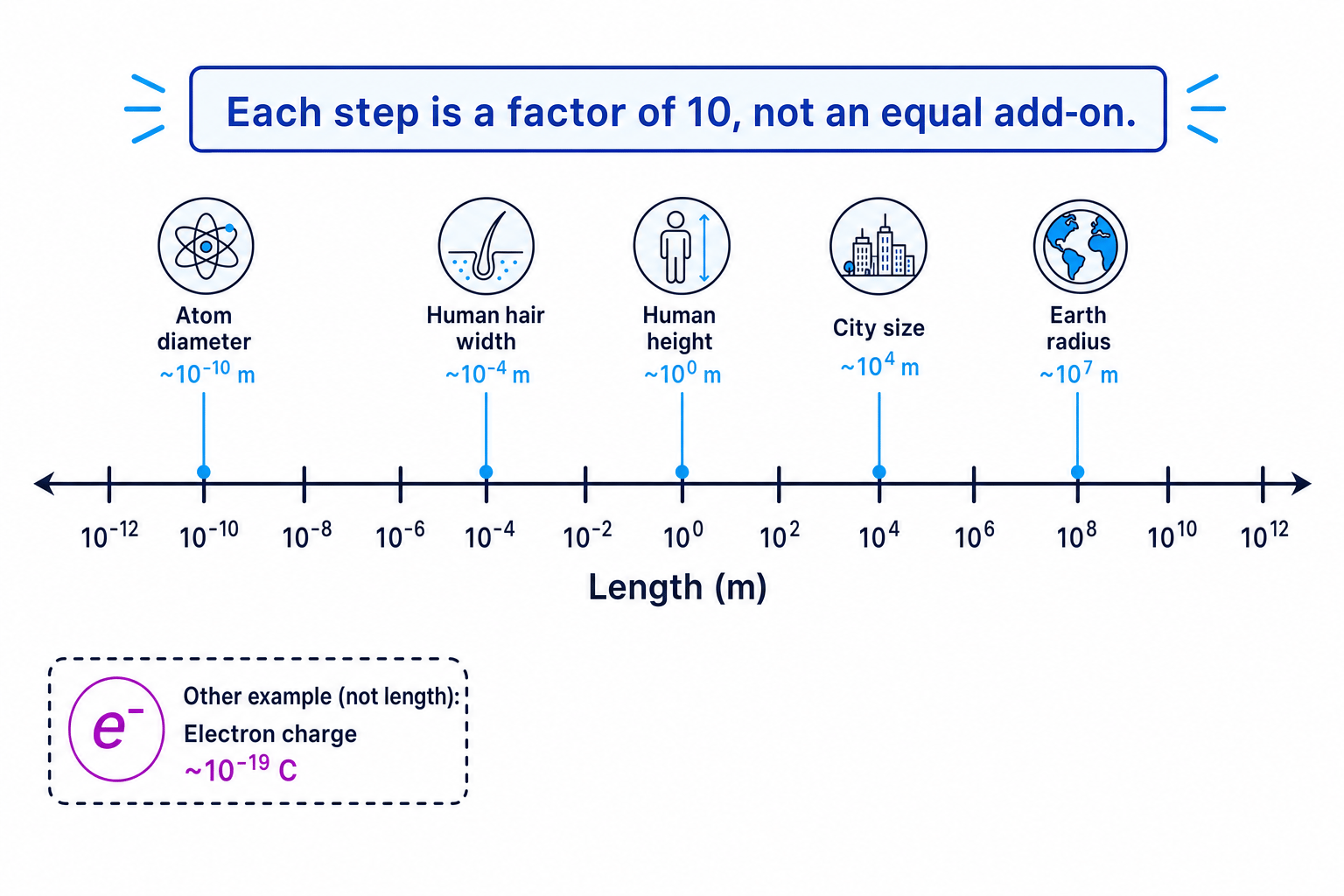
The diagram shows why this is best thought of as a logarithmic scale: each step is multiplication by 10, not adding the same amount each time.
Comparing two sizes
A human hair has a width of about 10−4 m10^{-4}\ \text{m}10−4 m. An atom has a diameter of about 10−10 m10^{-10}\ \text{m}10−10 m. Estimate how many orders of magnitude larger the hair is than the atom.
- Form the ratio of the two lengths:
- Use the rule for dividing powers of ten: subtract the indices.
- Interpret the result: the hair is about 10610^6106 times wider, so it is about six orders of magnitude larger than the atom.
Rounding to the nearest order of magnitude
Sometimes a question asks for an answer “to the nearest order of magnitude”. That means your final answer should be a single power of ten, such as 10−3 m10^{-3}\ \text{m}10−3 m, 102 N10^2\ \text{N}102 N, or 106 J10^6\ \text{J}106 J.
If a quantity is written as:
x=c×10n x = c \times 10^n x=c×10nwhere ccc is between 1 and 10, then:
- if ccc is less than about 10\sqrt{10}10, use 10n10^n10n
- if ccc is greater than about 10\sqrt{10}10, use 10n+110^{n+1}10n+1
Since 10≈3.16\sqrt{10} \approx 3.1610≈3.16, a quick rule is: coefficients 1, 2, and 3 usually round down; coefficients 4 to 9 usually round up.
Rounding a length to an order of magnitude
A small object has length 0.0048 m. Estimate its length to the nearest order of magnitude.
- Write the value in scientific notation:
-
Compare the coefficient 4.8 with 10≈3.16\sqrt{10} \approx 3.1610≈3.16. Since 4.8 is larger, the value is closer to the next power of ten.
-
Round 4.8×10⁻³ m4.8 \times 10^{-3}\ \text{m}4.8×10⁻³ m to the nearest order of magnitude:
- Interpret the answer: the object is on the centimetre scale, since 10−2 m10^{-2}\ \text{m}10−2 m is 1 cm.
Estimate first, refine second
If you are doing a longer calculation, keep one significant figure during the working. Only reduce to a single power of ten if the question specifically asks for the nearest order of magnitude.
Useful benchmark quantities
You are not expected to memorise a huge list, but it helps to know a few everyday scales.
Useful rough values include:
- human height: about 1 m
- human mass: about 102 kg10^2\ \text{kg}102 kg
- walking speed: about 1 m s−11\ \text{m s}^{-1}1 m s−1
- car mass: about 103 kg10^3\ \text{kg}103 kg
- gravitational field strength near Earth: g≈10 N kg−1g \approx 10\ \text{N kg}^{-1}g≈10 N kg−1
- density of water: about 103 kg m−310^3\ \text{kg m}^{-3}103 kg m−3
- atmospheric pressure: about 105 Pa10^5\ \text{Pa}105 Pa
- speed of light in vacuum: about 3×10⁸ m s−13 \times 10^8\ \text{m s}^{-1}3×10⁸ m s−1
These are “anchor points” you can build from.
The full technique: building an estimate
Many estimation questions are derived estimates. That means you estimate some simpler quantities first, then combine them using a physics relationship.
For example, you might estimate kinetic energy using:
Ek=12mv2 E_k = \frac{1}{2}mv^2 Ek=21mv2or pressure using:
p=FA p = \frac{F}{A} p=AFThe usual method is:
- Identify the quantity you want and its SI unit.
- Choose a simple physical model.
- Estimate the input quantities.
- Substitute into a physics equation.
- Round the final answer sensibly.
- Check that the size and units are reasonable.
Break the problem down
Hard estimates become easier when you split them into quantities you can estimate: masses, lengths, times, speeds, areas, and forces.
Estimating the kinetic energy of a car
Estimate the kinetic energy of a car travelling at motorway speed.
-
Model the car using a typical mass and speed. A reasonable car mass is m≈103 kgm \approx 10^3\ \text{kg}m≈103 kg, and a motorway speed is about v≈30 m s−1v \approx 30\ \text{m s}^{-1}v≈30 m s−1, which is 3×101 m s−13 \times 10^1\ \text{m s}^{-1}3×101 m s−1.
-
Choose the relevant physics equation for kinetic energy:
- Substitute the estimates, remembering that the speed is squared:
-
Round to the nearest order of magnitude. Since 4.5 is greater than 10\sqrt{10}10, this is closest to 106 J10^6\ \text{J}106 J.
-
Interpret the result: a moving car has kinetic energy of order 106 J10^6\ \text{J}106 J, or about a megajoule.
Forgetting powers in the formula
If a quantity is squared or cubed, small changes in your estimate become much bigger. In Ek=12mv2E_k = \frac{1}{2}mv^2Ek=21mv2, doubling the speed makes the kinetic energy four times larger.
Combining powers of ten
When estimating, you often calculate mostly with powers of ten.
The key rules are:
- multiplying powers of ten: add the indices
- dividing powers of ten: subtract the indices
- raising a power of ten to a power: multiply the indices
For example:
10310−2=103−(−2)=105 \frac{10^3}{10^{-2}} = 10^{3 - (-2)} = 10^5 10−2103=103−(−2)=105That is why order-of-magnitude calculations can often be done mentally.
Estimating pressure beneath a standing person
Estimate the pressure exerted on the floor by a standing person.
- Estimate the person’s weight using F=mgF = mgF=mg. For a mass of about 70 kg70\ \text{kg}70 kg and g≈10 N kg−1g \approx 10\ \text{N kg}^{-1}g≈10 N kg−1:
This is of order 103 N10^3\ \text{N}103 N.
- Estimate the contact area of two shoe soles. If each sole is roughly 0.25 m long and 0.08 m wide, then:
- Use the pressure equation:
- Round the result: the pressure is of order 104 Pa10^4\ \text{Pa}104 Pa.
How accurate should an estimate be?
For this topic, the goal is usually the nearest order of magnitude, not a highly precise number.
That means being within a factor of 10 is often the main expectation. However, your estimate should still be physically sensible. An answer of 109 kg10^9\ \text{kg}109 kg for a car’s mass would not be acceptable, because it is many orders of magnitude too large.
Near a rounding boundary
If your coefficient is close to 10\sqrt{10}10, a small change in assumptions may change the nearest order of magnitude. In that situation, state your assumptions clearly and avoid pretending the estimate is more precise than it is.
Order of magnitude versus significant figures
These are related, but not identical.
An answer to one significant figure keeps a coefficient, such as 5×10⁵ J5 \times 10^5\ \text{J}5×10⁵ J.
An answer to the nearest order of magnitude is just a power of ten, such as 106 J10^6\ \text{J}106 J.
So always read the wording carefully. If the question says “estimate”, a one-significant-figure answer with units may be appropriate. If it says “nearest order of magnitude”, give a power of ten.
In the exam
- Convert to SI units before using equations, especially for areas and volumes.
- State simple assumptions, such as “mass of car ≈103 kg\approx 10^3\ \text{kg}≈103 kg” or “human height ≈1 m\approx 1\ \text{m}≈1 m”.
- Keep calculations rough: one significant figure is usually enough until the final order-of-magnitude answer.
- Check whether your final answer is asking for an approximate value or a single power of ten.
- Do a sanity check: compare your answer with a familiar benchmark quantity.
Check yourself
- What does it mean for two quantities to differ by three orders of magnitude?
- Estimate the order of magnitude of the weight of a typical adult.
- Why is it important to convert centimetres to metres before using a formula involving area?