Electromotive force and internal resistance
What you'll learn:
- The true definition of electromotive force (emf) and how it differs from potential difference (pd).
- Why batteries get warm and seem to "lose" voltage when connected to a circuit.
- How to calculate internal resistance and terminal pd using the equation ε=I(R+r)\varepsilon = I(R + r)ε=I(R+r).
- The theory behind Required Practical 6: determining emf and internal resistance from a graph.
What is Electromotive Force?
If you pick up a standard AA battery, the label will tell you it provides 1.5 volts. You might think of this as the "push" the battery gives to the electrons. In Physics, we call this theoretical maximum voltage the electromotive force, or emf for short.
However, the name is slightly misleading! Emf is not actually a force measured in newtons. It is a measure of energy transferred per unit of charge.
Electromotive force (emf, )
Electromotive force is the electrical energy transferred by a power supply to each coulomb of charge passing through it.
ε=EQ \varepsilon = \frac{E}{Q} ε=QEWhere:
- ε\varepsilonε is the electromotive force in volts (V\text{V}V)
- EEE is the energy transferred to the charge in joules (J\text{J}J)
- QQQ is the charge in coulombs (C\text{C}C)
You already know the formula for potential difference (V=WQV = \frac{W}{Q}V=QW). Notice how similar the equation for emf is? The difference lies in energy transfer:
- Emf (ε\varepsilonε) is the energy gained by charges as they pass through the power supply (chemical energy converting to electrical energy).
- Potential difference (VVV) is the energy lost or transferred by charges as they pass through components like resistors or bulbs (electrical energy converting to heat or light).
Calculating emf
A battery transfers 45 joules of chemical energy to electrical energy when a charge of 3.0 coulombs passes through it. Calculate the electromotive force of the battery.
- State the known values: E=45 JE = 45\text{ J}E=45 J and Q=3.0 CQ = 3.0\text{ C}Q=3.0 C.
- State the formula for electromotive force:
- Substitute the values and calculate the result:
- The electromotive force is 15 volts.
Internal Resistance and "Lost Volts"
Here is a strange but true fact: if you connect a voltmeter across an unconnected 9 volt battery, it reads 9 volts. But the moment you connect that same battery to a circuit and allow current to flow, the voltage across the battery drops. It might read 8.5 volts instead.
Where did the missing 0.5 volts go? The answer is internal resistance.
Real batteries are not perfect. They are filled with chemicals, pastes, and metal electrodes. When charge flows through the battery itself, these materials resist the flow.
Internal resistance ()
The opposition to the flow of electrical current inside a power source itself, causing a loss of energy (as heat) before the current even leaves the source. It is measured in ohms (Ω\OmegaΩ).
Because the battery has its own resistance, some of the electrical energy it generates is used up just pushing the charge through the battery itself. This is why batteries get warm when you use them!
We can picture a real battery as a perfect, ideal power source (providing the emf, ε\varepsilonε) in series with a tiny internal resistor (rrr).
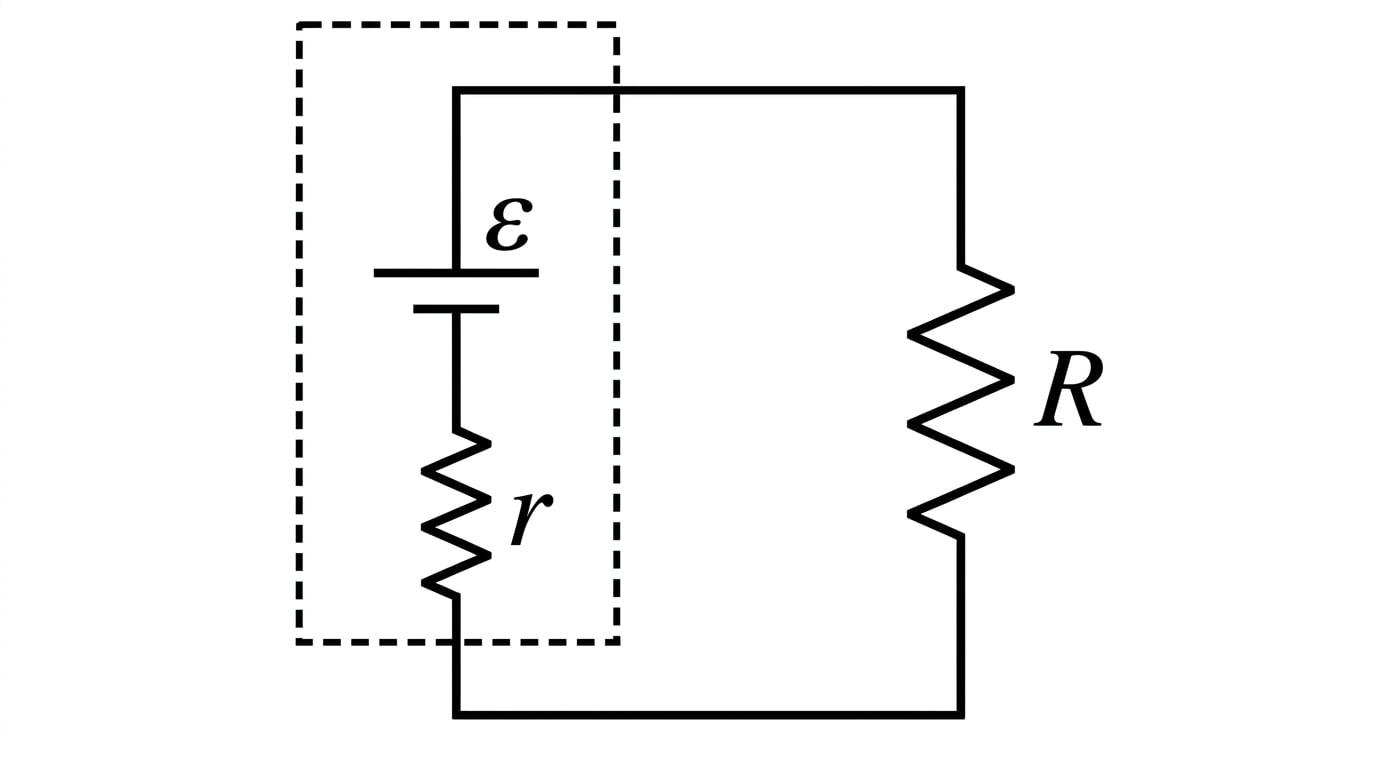
The dashed box represents the physical battery. RRR is the external load resistance. Notice how the internal resistor rrr is inescapably in series with the ideal emf source ε\varepsilonε.
Terminal potential difference
Because some energy is wasted inside the battery, the voltage available to the rest of the circuit is always less than the emf. We call this available voltage the terminal potential difference (or terminal pd, VVV).
The "missing" voltage is called the lost volts. By Ohm's law, the voltage lost across the internal resistance rrr when a current III flows is IrIrIr.
This gives us a crucial relationship:
Terminal pd=Emf−Lost volts \text{Terminal pd} = \text{Emf} - \text{Lost volts} Terminal pd=Emf−Lost volts V=ε−Ir V = \varepsilon - Ir V=ε−IrWhen does terminal pd equal emf?
The terminal pd VVV is only exactly equal to the emf ε\varepsilonε when there is absolutely no current flowing (I=0I = 0I=0), because then the lost volts (IrIrIr) will be zero. This is called an "open circuit".
The Main Circuit Equation
If we look at the whole circuit, the terminal pd (VVV) is simply the voltage across the external load resistor (RRR). So, we can replace VVV with IRIRIR.
If we substitute IRIRIR into our equation:
IR=ε−Ir IR = \varepsilon - Ir IR=ε−IrRearranging this to make ε\varepsilonε the subject gives us the main equation you will use in the AQA exam:
The Emf Circuit Equation
Where:
- ε\varepsilonε = electromotive force in volts (V\text{V}V)
- III = current in the circuit in amps (A\text{A}A)
- RRR = total external resistance in ohms (Ω\OmegaΩ)
- rrr = internal resistance of the supply in ohms (Ω\OmegaΩ)
This is fundamentally a statement of the Conservation of Energy. The total energy supplied per coulomb (ε\varepsilonε) equals the energy used per coulomb in the external circuit (IRIRIR) plus the energy wasted per coulomb inside the battery (IrIrIr).
Finding the internal resistance
A cell of electromotive force 1.5 volts is connected to an external resistor of 4.5 ohms. A current of 0.30 amps flows through the circuit. Calculate the internal resistance of the cell.
- State the known variables: ε=1.5 V\varepsilon = 1.5\text{ V}ε=1.5 V, R=4.5 ΩR = 4.5\text{ }\OmegaR=4.5 Ω, I=0.30 AI = 0.30\text{ A}I=0.30 A.
- Write down the equation linking these variables:
- Substitute the known values into the equation:
- Expand the bracket (or divide both sides by the current):
- Rearrange to find the lost volts:
- Solve for the internal resistance, rrr:
Required Practical 6: The V-I Graph
You are required to know how to investigate the emf and internal resistance of a cell practically. The standard method involves connecting a cell to a variable resistor, measuring the terminal pd (VVV) and the current (III) for various resistance settings.
When you plot the terminal pd (VVV) on the y-axis against the current (III) on the x-axis, you get a straight line with a negative gradient. Let's see why mathematically.
Take our terminal pd equation:
V=ε−Ir V = \varepsilon - Ir V=ε−IrRearrange it slightly to match the equation of a straight line, y=mx+cy = mx + cy=mx+c:
V=−rI+ε V = -rI + \varepsilon V=−rI+εLooking at this matching pattern:
- yyy is the terminal pd (VVV).
- xxx is the current (III).
- mmm (the gradient) is −r-r−r.
- ccc (the y-intercept) is ε\varepsilonε.
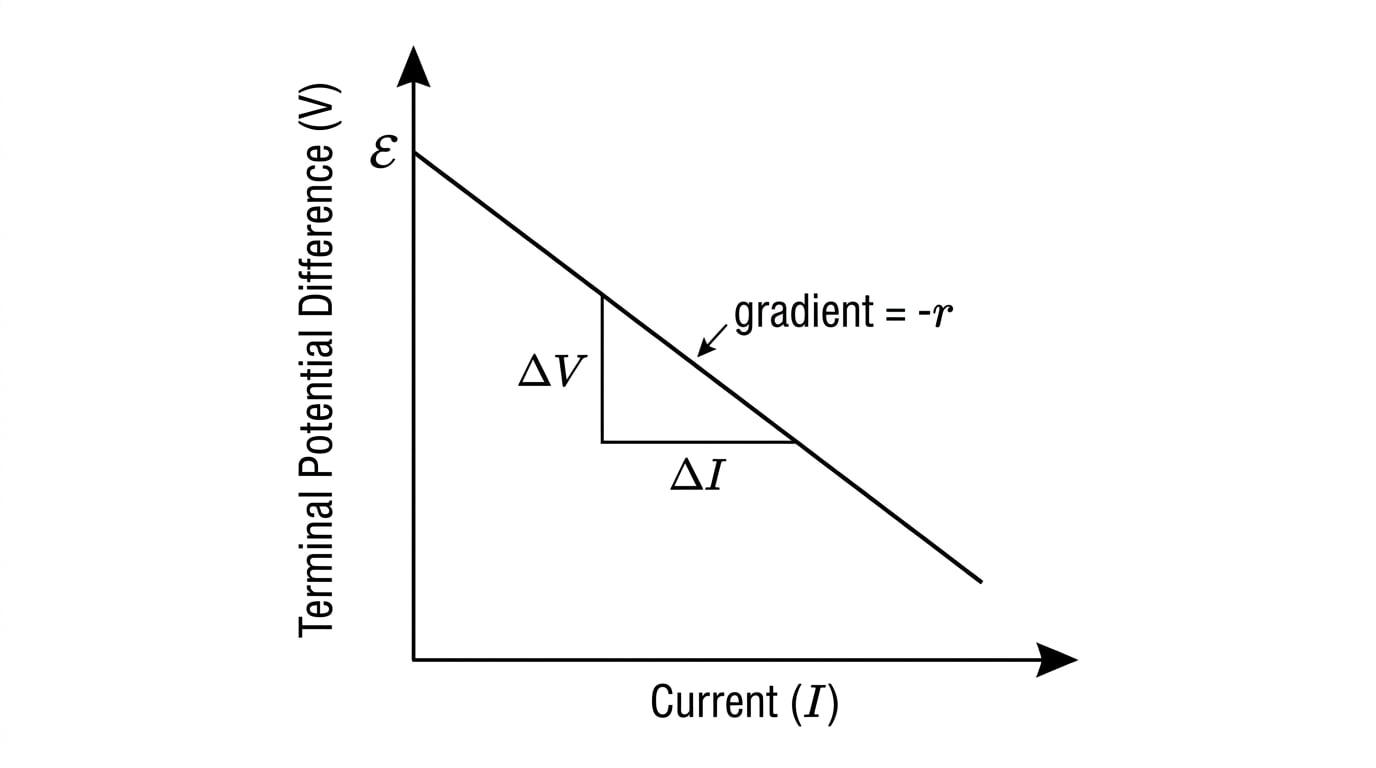
The y-intercept gives the electromotive force, and the negative of the gradient gives the internal resistance.
Analysing the graph quickly
If an exam question gives you a VVV-III graph:
- To find the emf, just read the value where the line crosses the vertical VVV axis.
- To find the internal resistance, calculate the gradient (change in Vchange in I\frac{\text{change in } V}{\text{change in } I}change in Ichange in V) and ignore the negative sign.
Calculating constants from a V-I graph
A student plots a graph of terminal pd against current for a particular cell. The line crosses the y-axis at 6.0 volts. At a current of 2.0 amps, the terminal pd is 4.5 volts. Calculate the internal resistance of the cell.
- Identify the emf from the y-intercept:
- Identify two points on the line to find the gradient. We have (0,6.0)(0, 6.0)(0,6.0) and (2.0,4.5)(2.0, 4.5)(2.0,4.5).
- Calculate the gradient (m=ΔyΔxm = \frac{\Delta y}{\Delta x}m=ΔxΔy):
- Equate the gradient to −r-r−r:
- State the final internal resistance:
Forgetting the variable resistor
When drawing the circuit diagram for this required practical from memory, students often forget how to vary the current. You must include a variable resistor in series with the cell and ammeter, otherwise you will only get one reading for VVV and III and won't be able to plot a line!
In the exam
- Be careful with definitions: If asked to define emf, explicitly state "energy transferred per unit charge". Saying "voltage of the battery" will score zero marks.
- Watch out for power: The exam often ties this topic to electrical power. If you multiply the entire equation V=ε−IrV = \varepsilon - IrV=ε−Ir by current III, you get VI=εI−I2rVI = \varepsilon I - I^2 rVI=εI−I2r. This translates to: Power output to circuit = Total power generated - Power wasted as heat inside the battery.
- Multiple cells: If a question puts two identical cells in series, their emfs add up (2ε2\varepsilon2ε) and their internal resistances add up (2r2r2r). If they are in parallel, the total emf is just ε\varepsilonε, but the total internal resistance halves (r2\frac{r}{2}2r).
Check yourself
- Can you explain why the terminal pd of a battery is usually lower than its printed emf?
- What physical property of the battery does the gradient represent on a VVV-III graph?
- If a battery is short-circuited (the external resistance RRR is zero), what happens to the terminal pd?
- Can you write down the equation linking emf, terminal pd, current, and internal resistance without looking at the notes above?