

What you'll learn
- The definition of absolute electric potential and why it is zero at infinity.
- How to calculate the work done when a charge moves through a potential difference.
- What equipotential surfaces are and why moving along them requires zero work.
- How to link electric field strength and electric potential using graphs and gradients.
Absolute Electric Potential
When you push two positively charged particles together, they repel. To force them closer, you have to do work (transfer energy) against this repulsive electrostatic force. This stored energy is electric potential energy. To make comparisons easier, we define the electric potential at a point in space, which is the potential energy per unit charge.
Absolute electric potential (V)
The absolute electric potential at a point is the work done per unit positive charge in moving a small test charge from infinity to that point in the field. It is measured in volts (V\text{V}V) or joules per coulomb (J C−1\text{J C}^{-1}J C−1).
Why measure from infinity? At an infinite distance from a charge, the electric force is perfectly zero. Therefore, we define the electric potential at infinity to be exactly 0 V0\text{ V}0 V.
When a positive test charge moves from infinity towards another positive charge, work must be done on the test charge to overcome the repulsion, so the potential becomes positive. If it moves towards a negative charge, the attractive force does work, and the potential becomes negative.
Potential in a radial field
For a single point charge QQQ, the electric field is radial. The electric potential VVV at a distance rrr from the centre of the charge is given by:
V=14πε0Qr V = \frac{1}{4\pi\varepsilon_0} \frac{Q}{r} V=4πε01rQWhere:
- VVV is the electric potential in volts (V\text{V}V)
- ε0\varepsilon_0ε0 is the permittivity of free space (F m−1\text{F m}^{-1}F m−1)
- QQQ is the point charge creating the field in coulombs (C\text{C}C)
- rrr is the distance from the centre of the charge in metres (m\text{m}m)
Forgetting the sign of the charge
Electric potential is a scalar quantity, not a vector. It does not have a direction, but it does have a sign. Always include the sign of QQQ in your calculation. A positive charge creates a positive potential, and a negative charge creates a negative potential. When finding the total potential from multiple charges, you simply add the potentials together algebraically (e.g. +5 V+5\text{ V}+5 V and −2 V-2\text{ V}−2 V makes +3 V+3\text{ V}+3 V).
Calculating potential in a radial field
Calculate the electric potential at a distance of 5.0×10⁻¹⁰ m5.0 \times 10^{-10}\text{ m}5.0×10⁻¹⁰ m from the nucleus of a gold atom (atomic number 79).
- Determine the charge QQQ of the gold nucleus. The atomic number is 79, meaning it has 79 protons.
- State the formula for the electric potential in a radial field.
- Substitute the values into the formula, using ε0=8.85×10⁻¹² F m−1\varepsilon_0 = 8.85 \times 10^{-12}\text{ F m}^{-1}ε0=8.85×10⁻¹² F m−1.
- State the final answer with the correct sign. Because the nucleus is positively charged, the potential is +227 V+227\text{ V}+227 V.
Electric Potential Difference and Work Done
If you move a charge QQQ from one point in an electric field to another, its electric potential energy changes. The difference in electric potential between the two points is the electric potential difference (ΔV\Delta VΔV).
The work done (ΔW\Delta WΔW) in moving a charge through a potential difference is given by:
ΔW=QΔV \Delta W = Q \Delta V ΔW=QΔVCalculating work done moving a charge
An alpha particle is moved from a point where the electric potential is +3000 V+3000\text{ V}+3000 V to a point where the potential is +8000 V+8000\text{ V}+8000 V. Calculate the work done on the alpha particle.
- Identify the charge QQQ of an alpha particle. An alpha particle consists of two protons and two neutrons.
- Calculate the potential difference ΔV\Delta VΔV between the two points.
- Use the work done equation to find the final energy transferred.
Equipotential Surfaces
Just like contour lines on a map show regions of equal height, equipotential surfaces show regions of equal electric potential.
If you move a charge along an equipotential surface, the potential difference ΔV\Delta VΔV is zero. Looking back at our equation ΔW=QΔV\Delta W = Q \Delta VΔW=QΔV, if ΔV=0\Delta V = 0ΔV=0, then the work done ΔW\Delta WΔW must also be zero!
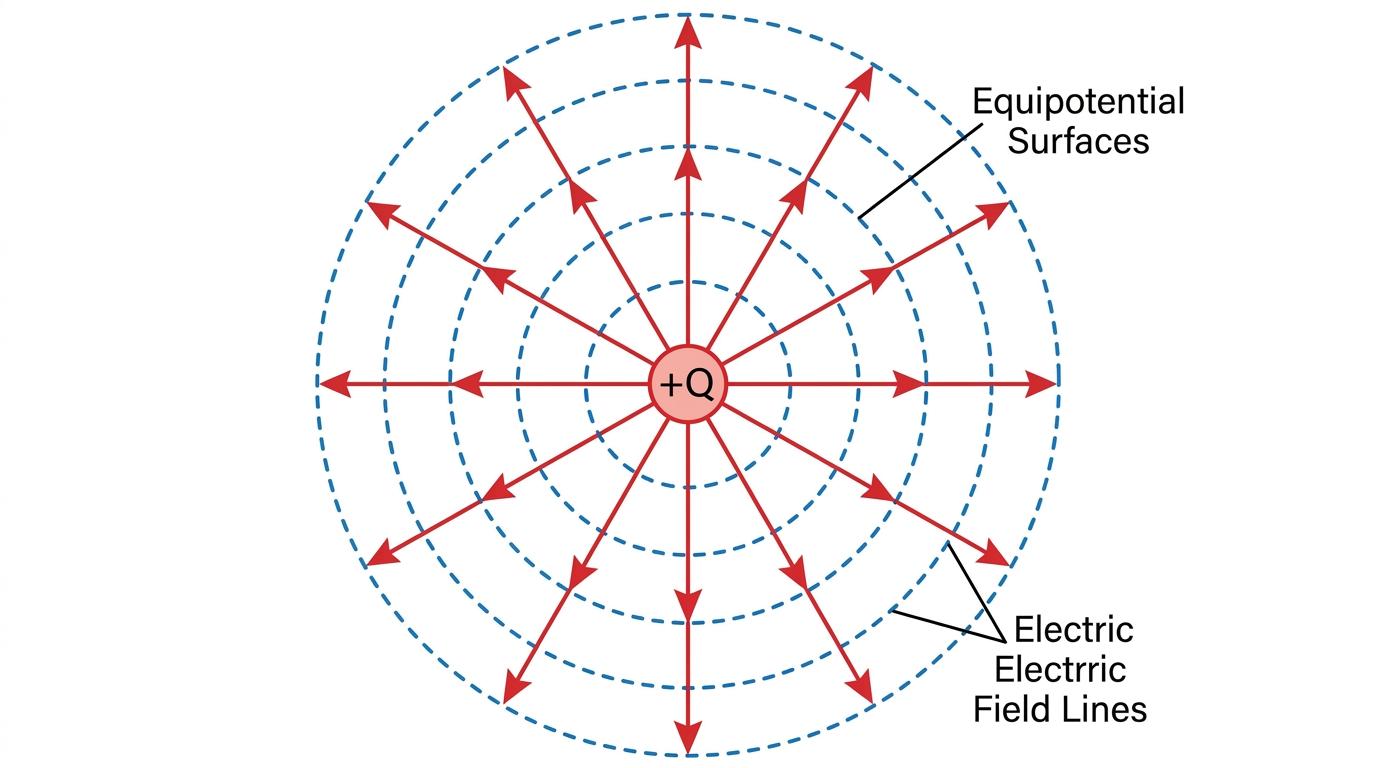
Equipotentials and Field Lines
Equipotential lines and electric field lines always cross at exactly 90∘90^\circ90∘ (they are orthogonal). If they didn't, there would be a component of the electric force acting along the equipotential surface, meaning work would be done moving along it—which contradicts the definition of an equipotential!
Linking E and V Graphically
Electric field strength (EEE) and electric potential (VVV) are intimately linked. For a radial field around a point charge, they both decrease as distance rrr increases, but they do so at different rates:
- Electric potential follows an inverse law: V∝1rV \propto \frac{1}{r}V∝r1
- Electric field strength follows an inverse-square law: E∝1r2E \propto \frac{1}{r^2}E∝r21
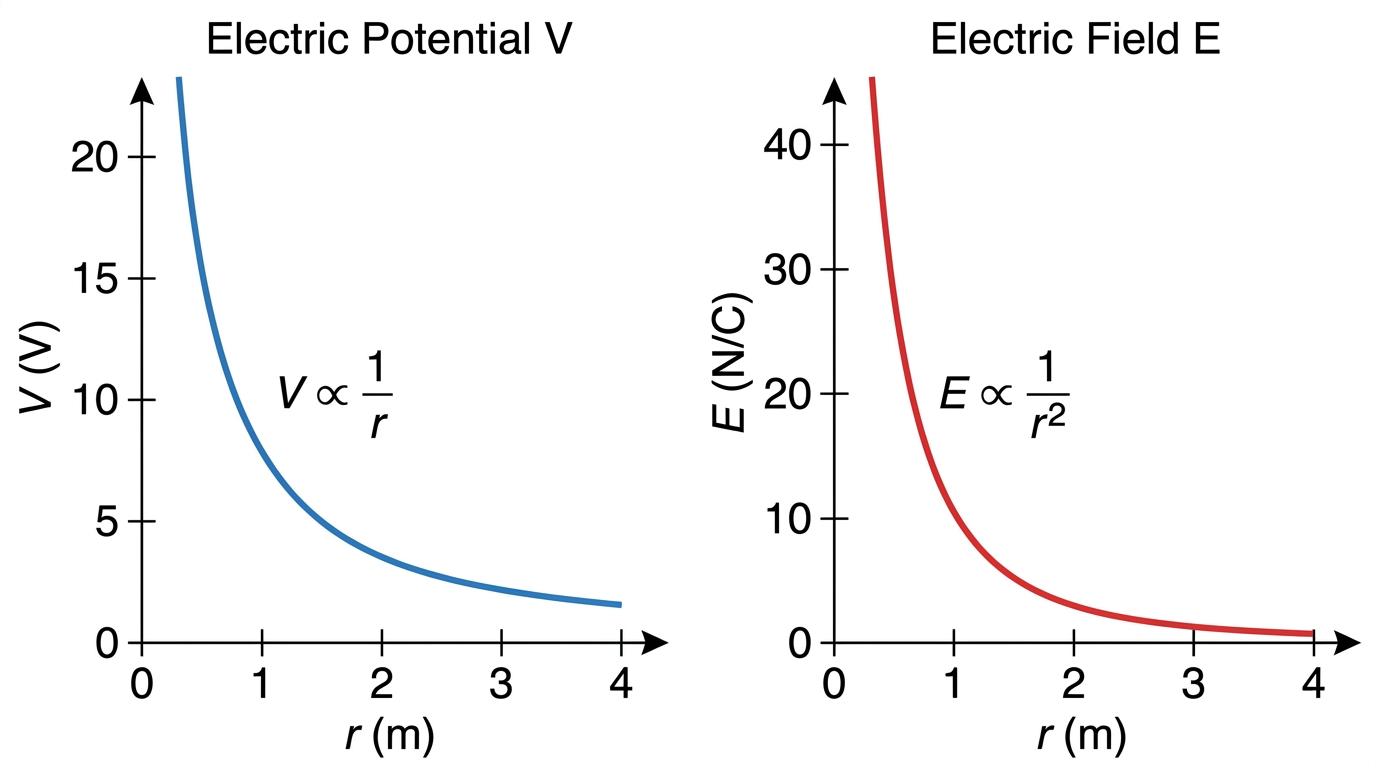
Because EEE follows an inverse-square law, its graph drops off much more steeply than the graph for VVV.
The Mathematical Link
The electric field strength tells us how rapidly the potential is changing with distance. The magnitude of the electric field strength EEE is equal to the potential gradient:
E=ΔVΔr E = \frac{\Delta V}{\Delta r} E=ΔrΔVThis relationship gives us two very important graphical rules:
- Gradient of a VVV against rrr graph: The magnitude of the gradient at any point on a potential-distance graph equals the electric field strength EEE at that point. (Strictly, E=−ΔVΔrE = -\frac{\Delta V}{\Delta r}E=−ΔrΔV, meaning the field points in the direction of decreasing potential).
- Area under an EEE against rrr graph: The area under an electric field-distance graph between two points gives the electric potential difference ΔV\Delta VΔV between those points.
Summary of Graph Rules
- To find ΔV\Delta VΔV from an E−rE-rE−r graph: Calculate the area under the curve.
- To find EEE from a V−rV-rV−r graph: Draw a tangent and calculate the gradient.
In the exam
- Check your units: Distances in AQA questions are often given in cm\text{cm}cm or mm\text{mm}mm. Always convert rrr to metres (m\text{m}m) before calculating VVV or EEE.
- Watch the signs: AQA loves to mix positive and negative charges in multi-charge questions. Remember that electric fields are vectors (they cancel out or add up depending on direction), but electric potentials are scalars (they just add algebraically: +5 V+−3 V=+2 V+5\text{ V} + -3\text{ V} = +2\text{ V}+5 V+−3 V=+2 V).
- Counting squares: When asked to find the potential difference from an E−rE-rE−r graph, the curve won't be a neat triangle or rectangle. You will need to estimate the area by counting the squares under the curve. Don't forget to calculate the area (in volts) of a single small square first!
Check yourself
- Why is the absolute electric potential at an infinite distance from a charge defined as exactly 0 V0\text{ V}0 V?
- What is the difference between the rate of decay of an electric field EEE and an electric potential VVV as you move away from a point charge?
- If a proton moves along an equipotential surface of +500 V+500\text{ V}+500 V, how much work is done by the electric field?
- How would you determine the electric potential difference between two points using a graph of electric field strength against distance?
