

What you'll learn in this topic:
- How to visualise electric fields using field lines.
- The formal definition of electric field strength (EEE).
- How to calculate EEE for uniform fields (between parallel plates) and radial fields (around point charges).
- How to predict the parabolic trajectory of a charged particle moving through a uniform electric field.
Visualising Electric Fields
An electric field is a region of space where a charged particle experiences a non-contact force. Just like we use field lines to visualise magnetic and gravitational fields, we use electric field lines to show the shape and direction of an electric field.
There are three key rules for electric field lines:
- They always point in the direction of the force that a positive test charge would experience.
- They never cross each other.
- The closer together the lines are, the stronger the electric field.
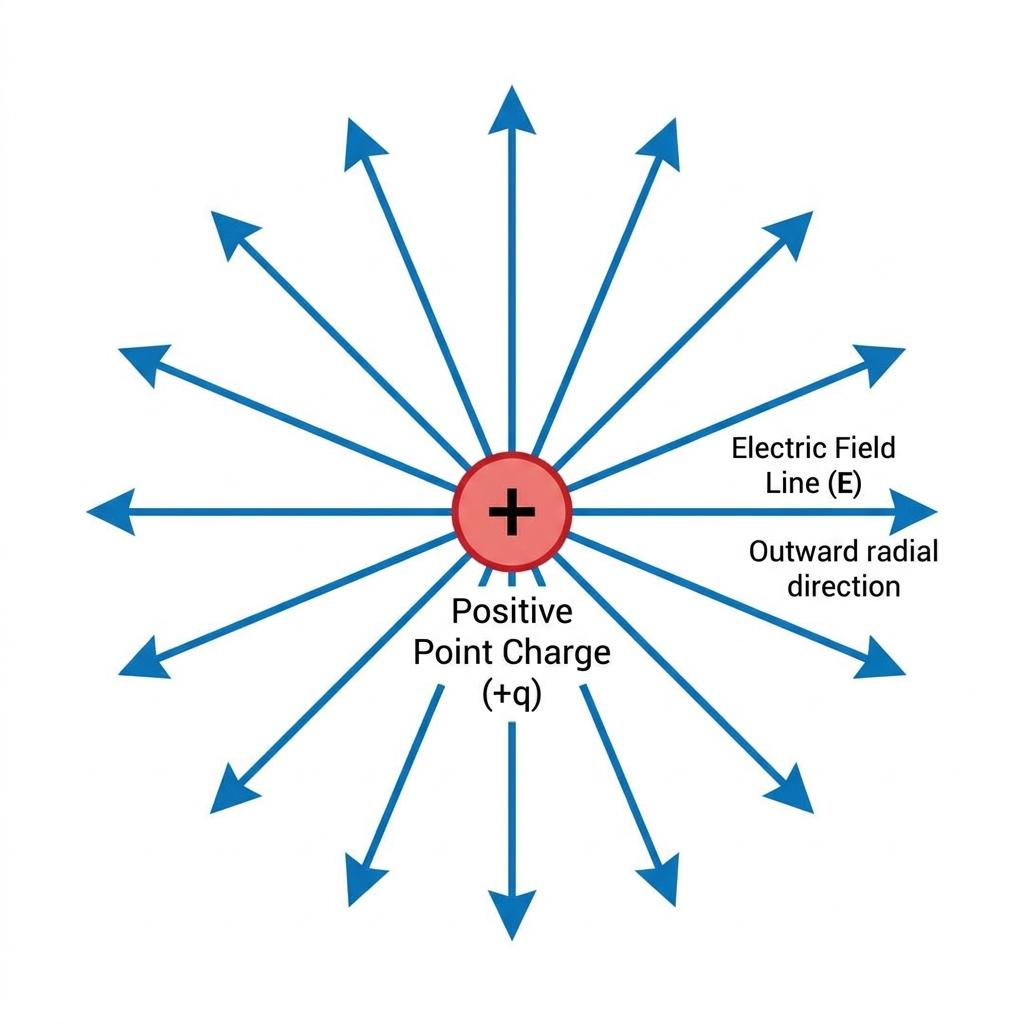
For a positive point charge, the lines point radially outwards (because another positive charge would be repelled). For a negative point charge, the lines point radially inwards.
Defining Electric Field Strength
To do any physics with electric fields, we need a way to measure how "strong" the field is at a specific point.
Electric Field Strength
Electric field strength (EEE) at a point in space is defined as the force experienced per unit positive charge at that point.
This definition gives us our first crucial equation:
E=FQ E = \frac{F}{Q} E=QFWhere:
- EEE is the electric field strength in newtons per coulomb (N C−1\text{N C}^{-1}N C−1).
- FFF is the electrostatic force on the charge in newtons (N\text{N}N).
- QQQ is the charge in coulombs (C\text{C}C).
Vector Quantity
Electric field strength is a vector. It has both magnitude and direction. If you are asked for the electric field strength, you must state its direction (e.g., "towards the negative plate" or "radially outwards").
Calculating basic field strength
A small sphere carrying a charge of +3.2×10⁻¹⁹ C+3.2 \times 10^{-19} \text{ C}+3.2×10⁻¹⁹ C experiences an electrostatic force of 1.6×10⁻¹⁵ N1.6 \times 10^{-15} \text{ N}1.6×10⁻¹⁵ N to the right when placed in an electric field. Calculate the electric field strength at this point.
- Identify the knowns: Q=+3.2×10⁻¹⁹ CQ = +3.2 \times 10^{-19} \text{ C}Q=+3.2×10⁻¹⁹ C, F=1.6×10⁻¹⁵ NF = 1.6 \times 10^{-15} \text{ N}F=1.6×10⁻¹⁵ N.
- State the formula: E=FQE = \frac{F}{Q}E=QF.
- Substitute the values:
- Calculate the magnitude: E=5000 N C−1E = 5000 \text{ N C}^{-1}E=5000 N C−1.
- State the direction: Because the test charge is positive, the field direction matches the force direction. The field is 5000 N C−15000 \text{ N C}^{-1}5000 N C−1 to the right.
Uniform Electric Fields
A uniform electric field is one where the electric field strength is exactly the same magnitude and direction everywhere. We can create a uniform field by applying a potential difference (voltage) across two parallel metal plates.
The field lines between parallel plates are straight, parallel, and evenly spaced, pointing from the positive plate to the negative plate.
To find the magnitude of the electric field strength in a uniform field, we use:
E=Vd E = \frac{V}{d} E=dVWhere:
- VVV is the potential difference between the plates in volts (V\text{V}V).
- ddd is the perpendicular distance between the plates in metres (m\text{m}m).
Notice that this equation gives EEE the units of volts per metre (V m−1\text{V m}^{-1}V m−1).
Equivalent Units
The units N C−1\text{N C}^{-1}N C−1 and V m−1\text{V m}^{-1}V m−1 are entirely equivalent. AQA loves to test this in multiple-choice questions! You can use either unit for electric field strength unless a specific one is asked for.
Deriving E=VdE = \frac{V}{d}E=dV
You need to know how to derive this formula using the concept of work done. Imagine moving a positive charge QQQ from the negative plate to the positive plate.
Derivation: Uniform Field Equation
- The work done (WWW) moving the charge against the electric force is the force multiplied by the distance: W=FdW = FdW=Fd.
- By the definition of potential difference, the work done moving a charge across a potential difference ΔV\Delta VΔV is: W=QΔVW = Q\Delta VW=QΔV.
- Equate the two expressions for work done: Fd=QΔVFd = Q\Delta VFd=QΔV.
- Rearrange for force per unit charge (FQ\frac{F}{Q}QF):
- Since E=FQE = \frac{F}{Q}E=QF, we can substitute EEE in:
Field between parallel plates
Two parallel conducting plates are separated by 5.0 mm5.0 \text{ mm}5.0 mm. A potential difference of 2.0 kV2.0 \text{ kV}2.0 kV is applied across them. Calculate the electric field strength between the plates and the force experienced by an electron in this field.
- Convert units to SI: d=5.0×10⁻³ md = 5.0 \times 10^{-3} \text{ m}d=5.0×10⁻³ m and V=2000 VV = 2000 \text{ V}V=2000 V.
- Calculate the field strength using E=VdE = \frac{V}{d}E=dV:
- Identify the charge of an electron from your data sheet: Q=1.60×10⁻¹⁹ CQ = 1.60 \times 10^{-19} \text{ C}Q=1.60×10⁻¹⁹ C. (We only need the magnitude for the force).
- Calculate the force using F=EQF = EQF=EQ:
Trajectories in a Uniform Field
When a charged particle enters a uniform electric field initially at right angles to the field lines, it undergoes parabolic motion.
This is mathematically identical to a mass being thrown horizontally in Earth's uniform gravitational field (projectile motion).
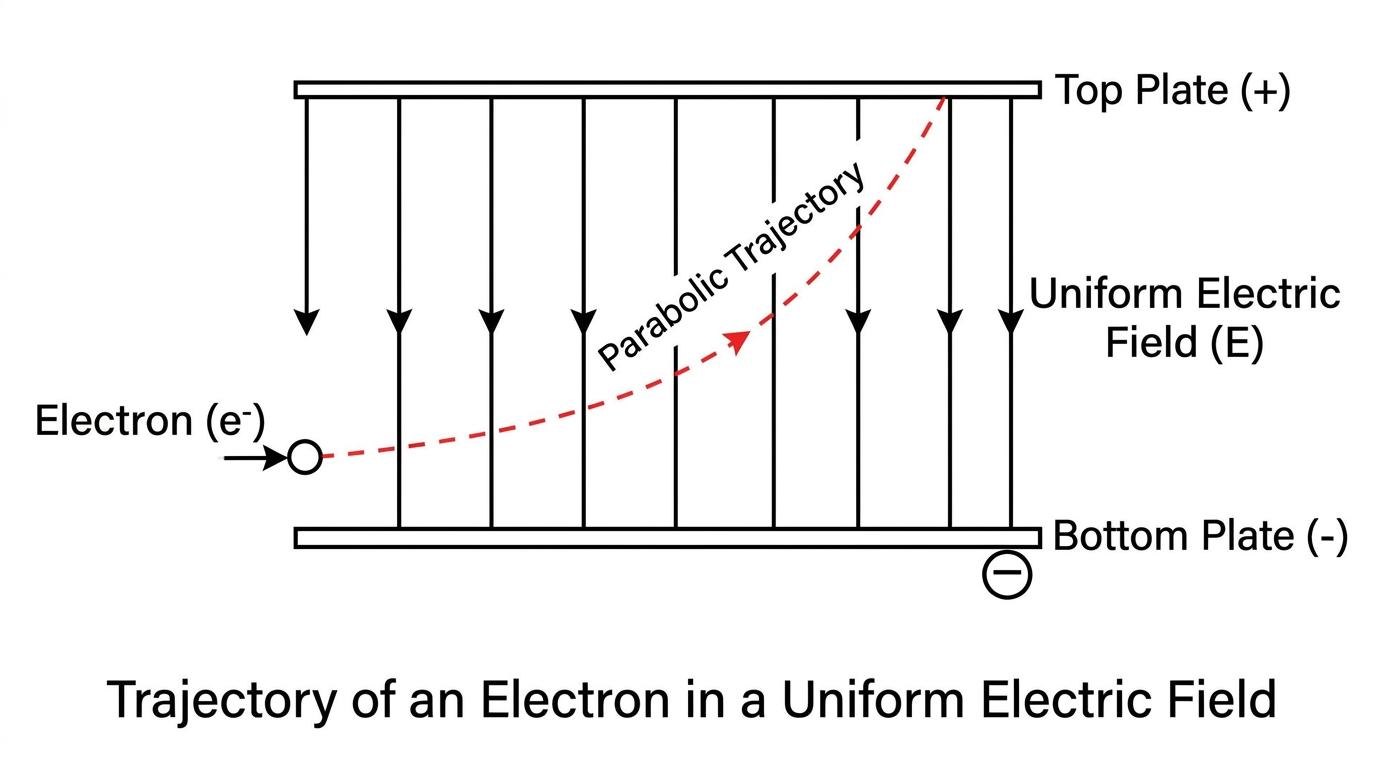
Why does it trace a parabola?
- Horizontally: There is no component of the electric force in the horizontal direction. Therefore, horizontal acceleration is zero, and the horizontal velocity remains constant.
- Vertically: The electric force acts straight down (or straight up, depending on the charge). Because the field is uniform, this force is constant. A constant force causes a constant vertical acceleration (a=Fma = \frac{F}{m}a=mF).
Confusing the direction of deflection
Electrons (and other negative charges) are deflected in the opposite direction to the electric field lines. Remember, field lines show the force on a positive charge. An electron will accelerate towards the positive plate.
Radial Electric Fields
Unlike the uniform field between parallel plates, the field around a spherical or point charge spreads out in all directions. This is a radial field.
As you get further from the point charge, the field lines spread further apart, indicating that the electric field strength is decreasing.
The magnitude of the electric field strength at a distance rrr from the centre of a point charge QQQ in a vacuum is given by:
E=14πε0Qr2 E = \frac{1}{4\pi\varepsilon_0} \frac{Q}{r^2} E=4πε01r2QWhere:
- ε0\varepsilon_0ε0 is the permittivity of free space (8.85×10⁻¹² F m−18.85 \times 10^{-12} \text{ F m}^{-1}8.85×10⁻¹² F m−1, given on your data sheet).
- QQQ is the point charge creating the field in coulombs (C\text{C}C).
- rrr is the distance from the centre of the charge in metres (m\text{m}m).
This is an inverse square law. If you double the distance from the charge, the electric field strength drops to one-quarter of its previous value.
The Campfire
Think of a point charge like a campfire in a vast open field. The heat (field strength) you feel radiates outwards in all directions. If you take two steps back instead of one, you don't just feel half as warm; you feel a quarter as warm, because the same total amount of heat is now spread over a much larger spherical area.
Radial field of a nucleus
Calculate the electric field strength at a distance of 2.0×10⁻¹⁰ m2.0 \times 10^{-10} \text{ m}2.0×10⁻¹⁰ m from a helium nucleus. A helium nucleus contains 2 protons.
- Calculate the total charge QQQ of the helium nucleus. Each proton has a charge of +e+e+e (1.60×10⁻¹⁹ C1.60 \times 10^{-19} \text{ C}1.60×10⁻¹⁹ C):
- State the radial field formula:
- Substitute the values (using ε0=8.85×10⁻¹² F m−1\varepsilon_0 = 8.85 \times 10^{-12} \text{ F m}^{-1}ε0=8.85×10⁻¹² F m−1):
- Calculate the result:
- State the direction: Radially outwards, because the nucleus is positive.
In the exam
- Check your particle: Is the question asking about an electron, proton, or alpha particle? Look up their exact charges and masses on the data sheet immediately so you don't make a silly slip.
- Identify the field type: If the question mentions "parallel plates", write down E=VdE = \frac{V}{d}E=dV. If it mentions a "point charge" or "nucleus", write down E=14πε0Qr2E = \frac{1}{4\pi\varepsilon_0}\frac{Q}{r^2}E=4πε01r2Q.
- Resolve 2D trajectories: If you are asked to calculate how far an electron deflects between plates, split the motion into horizontal and vertical components exactly as you would for A-level Mechanics projectiles. Use t=dvt = \frac{d}{v}t=vd horizontally to find the time spent in the field.
Check yourself
- Can you draw the electric field lines for a uniform field and a radial field, ensuring the arrows point in the correct direction?
- What are the two equivalent SI units for electric field strength?
- From memory, can you derive E=VdE = \frac{V}{d}E=dV using work done?
- Why does an electron follow a parabolic path when it enters a uniform electric field at right angles?
