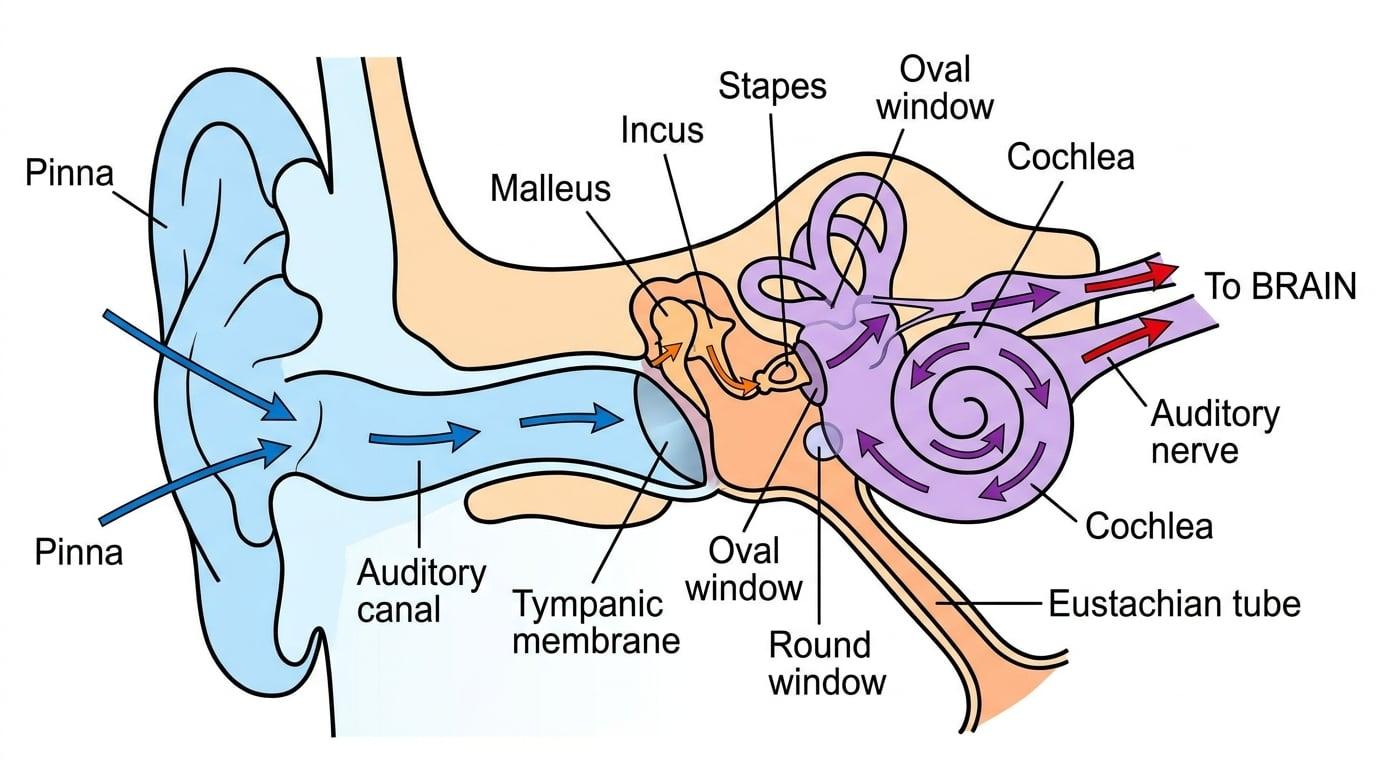
Welcome to the physics of the ear! While this might sound like a biology topic at first, human hearing is actually a masterclass in waves, resonance, and pressure mechanics.
What you'll learn:
- How the ear is structured into three main sections (Outer, Middle, Inner).
- Why the middle ear acts as an essential mechanical amplifier.
- How the "impedance matching" process transfers sound from air to fluid.
- How the inner ear distinguishes between different frequencies of sound.
1. Structure of the Ear
To understand how we hear, we first need to look at the "machinery" of the ear. The human ear is divided into three distinct zones, each with a specific physical role in transmitting sound.
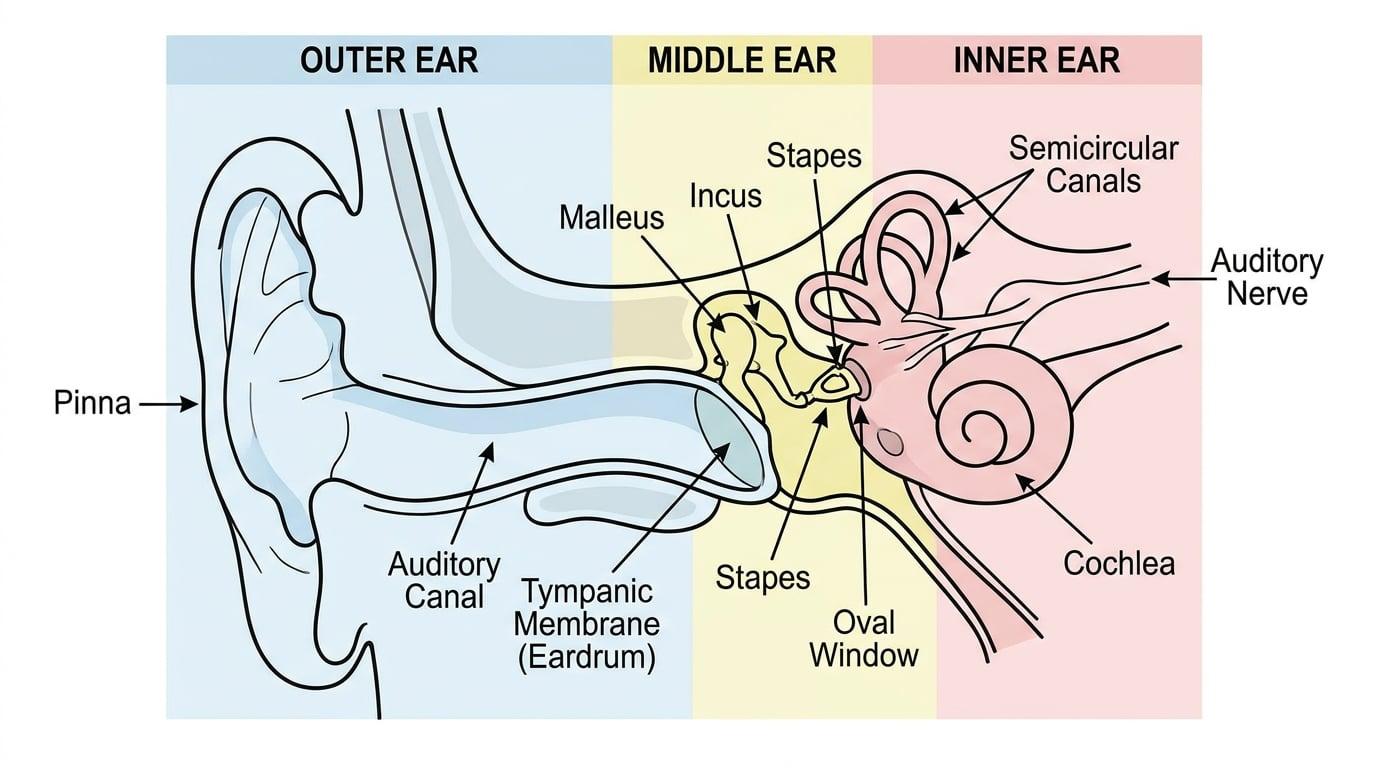
The Outer Ear
- Pinna: The visible, fleshy part on the side of the head. It acts as a funnel, capturing sound waves and directing them inward.
- Auditory Canal: A tube roughly 2.5 cm2.5 \text{ cm}2.5 cm long that channels sound down to the eardrum.
The Middle Ear (Air-filled)
- Tympanic Membrane (Eardrum): A thin, flexible cone that vibrates when sound waves hit it.
- Ossicles: A chain of three tiny bones—the malleus (hammer), incus (anvil), and stapes (stirrup). They connect the eardrum to the inner ear.
- Eustachian Tube: A tube connecting the middle ear to the throat, ensuring the air pressure is equalised on both sides of the eardrum.
The Inner Ear (Fluid-filled)
- Oval Window: A small membrane where the stapes connects, acting as the "front door" to the inner ear.
- Cochlea: A coiled, fluid-filled tube that looks like a snail shell. This is where mechanical vibrations are converted into electrical signals.
- Round Window: Another membrane on the cochlea that bulges outward when the oval window pushes inward, allowing the fluid to move (since fluids are incompressible).
2. Transmission Processes
Hearing is simply a series of energy transfers: from acoustic energy (sound waves) to mechanical energy (vibrating bones), to hydrodynamic energy (fluid waves), and finally to electrical energy (nerve impulses). Let's look at the physics happening in each section.
The Outer Ear: Funnelling and Resonance
Sound waves are gathered by the pinna and travel down the auditory canal. Because the canal is a tube that is open at one end (the pinna) and closed at the other (the eardrum), it acts as an acoustic resonator.
Just like a pipe in a church organ, the canal naturally amplifies frequencies whose quarter-wavelength matches the length of the tube. For a typical human ear, this resonance peak occurs at around 3000 Hz3000 \text{ Hz}3000 Hz, which happens to be the frequency range most important for understanding human speech!
The Middle Ear: Impedance Matching
This is the most heavily tested concept in this topic.
The problem of acoustic impedance
Sound waves in the air are travelling through a low-density gas. However, the inner ear (the cochlea) is filled with a dense, watery fluid. If sound waves travelling in air hit water directly, about 99.9%99.9\%99.9% of the energy simply reflects off the surface. To solve this, the middle ear must act as a transformer to boost the pressure.
Impedance Matching
The process of modifying the transmission of waves from one medium to another (e.g., from air to fluid) to minimise reflection and maximise the transfer of energy.
The middle ear achieves this massive pressure boost via two separate mechanisms:
-
The Area Effect (The main factor): The area of the tympanic membrane (eardrum) is roughly 202020 times larger than the area of the oval window. All the force captured over the large eardrum is focused onto the tiny oval window. Since pressure PPP is force FFF divided by area AAA (P=FAP = \frac{F}{A}P=AF), decreasing the area drastically increases the pressure.
-
The Lever Effect (The minor factor): The ossicles do not just transfer force; they act as a system of levers. Their arrangement provides a slight mechanical advantage, multiplying the force exerted on the eardrum by a factor of about 1.51.51.5 by the time it reaches the oval window.
Combined, these two effects amplify the pressure of the sound wave by a factor of roughly 303030 (20×1.520 \times 1.520×1.5), ensuring the wave successfully pushes into the cochlear fluid.
Calculating Pressure Amplification
A patient's eardrum has an effective area of 55 mm255 \text{ mm}^255 mm2 and the oval window has an area of 3.2 mm23.2 \text{ mm}^23.2 mm2. The ossicles act as a lever, multiplying the force on the eardrum by 1.51.51.5. A sound wave creates a pressure P1P_1P1 on the eardrum.
Calculate the ratio of the pressure on the oval window, P2P_2P2, to the pressure on the eardrum, P1P_1P1.
- State the relationship between pressure, force, and area for the eardrum. Let the force on the eardrum be F1F_1F1 and its area be A1A_1A1.
- Express the force and area at the oval window in terms of the eardrum. Let the force at the oval window be F2F_2F2 and the area be A2A_2A2.
- Write the equation for the pressure at the oval window, P2P_2P2.
(Wait, it is easier to use the raw numbers!). Let's use the actual area values instead of fractions of A1A_1A1. 4. Re-calculate step 3 using the raw areas to find P2P_2P2.
P2=1.5⋅F13.2⋅10−6 P_2 = \frac{1.5 \cdot F_1}{3.2 \cdot 10^{-6}} P2=3.2⋅10−61.5⋅F1 P1=F155⋅10−6 P_1 = \frac{F_1}{55 \cdot 10^{-6}} P1=55⋅10−6F1- Divide P2P_2P2 by P1P_1P1 to find the ratio. The F1F_1F1 and 10−610^{-6}10−6 terms will cancel out.
- The pressure at the oval window is approximately 262626 times greater than at the eardrum.
Area units in ratios
When calculating a ratio like A1A2\frac{A_1}{A_2}A2A1, you don't necessarily need to convert mm2\text{mm}^2mm2 to m2\text{m}^2m2 if both are in the same units—the conversion factor of 10−610^{-6}10−6 will cancel out anyway! Just be careful if the question asks for a final force or pressure value in standard SI units; then you must convert.
The Inner Ear: Frequency Detection
Once the pressure wave enters the fluid of the cochlea via the oval window, it travels along a delicate structure called the basilar membrane.
This membrane is lined with tiny sensory hair cells. When the membrane vibrates, the hair cells bend, triggering an electrical action potential that travels down the auditory nerve to the brain.
But how do we tell the difference between a high-pitched squeak and a low-pitched rumble?
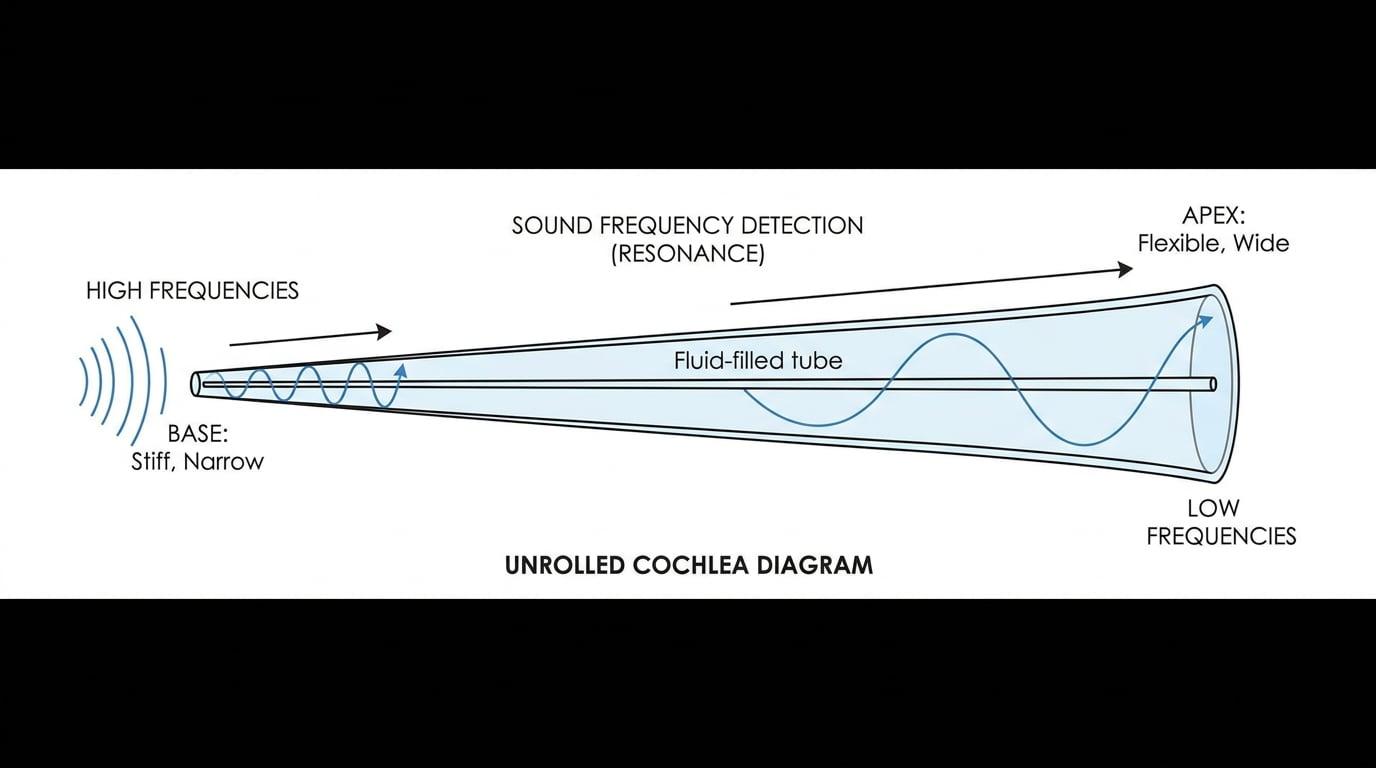
The basilar membrane acts as a frequency analyzer due to its physical properties varying along its length:
- At the base (near the oval window): The membrane is narrow and stiff. Like a short, tight guitar string, it has a high natural resonant frequency. High-frequency sounds cause maximum vibration here.
- At the apex (the far end of the cochlear spiral): The membrane is wide and flexible. Like a thick, loose guitar string, it has a low natural resonant frequency. Low-frequency sounds cause maximum vibration here.
Reversing the properties
A very common exam error is thinking the widest part of the membrane vibrates at the highest frequency. Think of string instruments: the thickest, floppiest strings produce the lowest bass notes. Therefore, the wide, flexible apex detects low frequencies.
Playing the piano
Think of the basilar membrane like the keys on a piano. The brain knows what pitch it is hearing simply by checking which specific hair cell on the "keyboard" just fired an electrical signal.
In the exam
When answering structured questions on the transmission of sound in the ear:
- Always mention impedance matching if asked about the function of the middle ear.
- Clearly distinguish between the two mechanisms of amplification: the lever action of the ossicles (amplifies force) and the ratio of areas between the eardrum and oval window (amplifies pressure).
- If asked about frequency detection, state that the basilar membrane varies in thickness and tension. Be specific: "Base is stiff/narrow for high frequencies; apex is flexible/wide for low frequencies."
- Remember that the final output is an electrical signal (action potential) sent via the auditory nerve.
Check yourself
- What would happen to the energy of sound waves if they hit the oval window directly, without the middle ear?
- What are the three bones in the ossicle chain, and what are their dual purposes?
- How does the equation P=FAP = \frac{F}{A}P=AF explain the primary mechanism of impedance matching?
- Which end of the basilar membrane resonates in response to a 150 Hz150 \text{ Hz}150 Hz sound, and what are its physical properties?