Defects of vision and their correction using lenses (A-level only)
What you'll learn:
- How converging and diverging lenses behave, and how to calculate their power.
- The "real is positive" sign convention and how to use the thin lens equation.
- The causes of short-sightedness (myopia) and long-sightedness (hypermetropia), and how to draw ray diagrams for their correction.
- How to calculate the exact power of the lenses required to correct specific visual defects.
- How to read a lens prescription for astigmatism.
1. Lens Basics and the Sign Convention
Before we look at the eye, we need to understand the lenses used to correct it. There are two main types of thin lens:
- Converging (convex) lenses: Thicker in the middle. They cause parallel light rays to meet at a point.
- Diverging (concave) lenses: Thinner in the middle. They cause parallel light rays to spread out.
Principal Focus and Focal Length
The principal focus (or focal point) of a converging lens is the point where parallel rays incident on the lens converge. For a diverging lens, it is the point from which parallel rays appear to diverge.
The focal length, fff, is the distance from the centre of the lens to the principal focus.
The power of a lens tells you how strongly it bends light. A shorter focal length means a stronger lens, which means a higher power. Power is calculated as:
P=1fP = \frac{1}{f}P=f1Where PPP is power in dioptres (D) and fff is focal length in metres (m).
The "Real is Positive" Sign Convention
AQA uses the real is positive, virtual is negative sign convention. You must memorise these rules:
- Real images and real focal points are positive.
- Virtual images and virtual focal points are negative.
Therefore:
- A converging lens has a positive focal length and a positive power.
- A diverging lens has a negative focal length and a negative power.
The Lens Equation and Magnification
To find out where an image will form, we use the thin lens equation:
1u+1v=1f\frac{1}{u} + \frac{1}{v} = \frac{1}{f}u1+v1=f1Where:
- uuu is the distance from the object to the lens (always positive, as the object is real).
- vvv is the distance from the image to the lens (positive if real, negative if virtual).
- fff is the focal length.
Lenses also change the apparent size of an object. The magnification mmm is the ratio of the image size to the object size, which is equal to the ratio of their distances from the lens:
m=vum = \frac{v}{u}m=uv2. The Un-defective (Normal) Eye
A normal human eye can change the shape of its biological lens to focus on objects at different distances.
- The near point is the closest distance the eye can focus on comfortably. For a normal adult eye, we take this standard value to be 25 cm (0.25 m).
- The far point is the furthest distance the eye can focus on. For a normal eye, this is infinity (∞\infty∞).
Visual defects occur when the eye's physical dimensions or lens strength prevent it from focusing light on the retina at these standard distances.
3. Myopia (Short-sightedness)
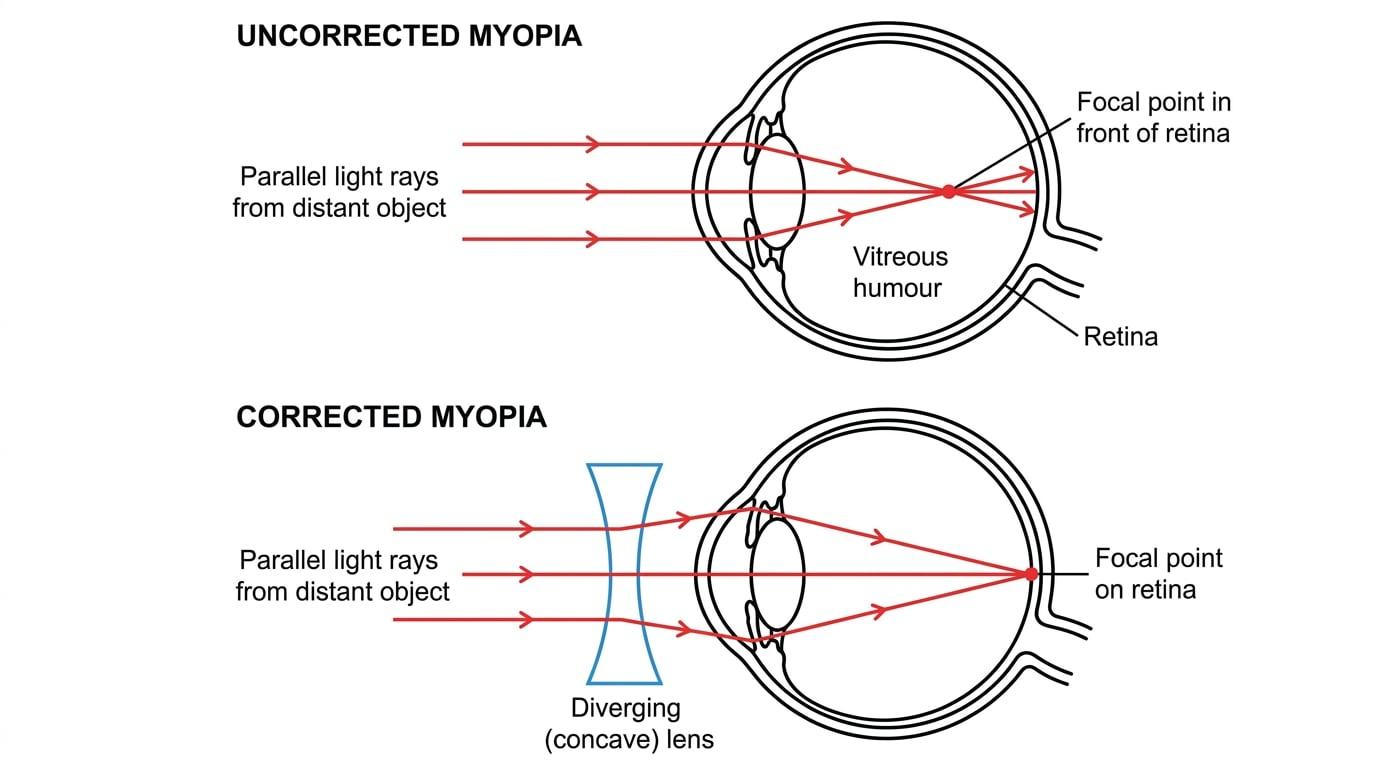
A person with myopia can see near objects clearly but distant objects appear blurry. Their far point is less than infinity.
The Cause: The eyeball is too long, or the cornea/lens system is too powerful. As a result, parallel rays of light from a distant object converge too quickly and focus in front of the retina.
The Correction: We place a diverging (concave) lens in front of the eye. This spreads the light rays out slightly before they enter the eye, pushing the focal point back onto the retina.
Calculating the Correcting Lens for Myopia
When correcting vision, the corrective lens takes an object at a "normal" distance and creates a virtual image at a distance the defective eye can actually see.
For myopia, we want the person to see objects at infinity (u=∞u = \inftyu=∞). The lens must create an image of this object at the person's actual, uncorrected far point. Because the image is on the same side of the lens as the object, it is a virtual image, so vvv is negative.
Correcting Myopia
A student has myopia and their uncorrected far point is 2.5 m. Calculate the power of the lens required to correct their vision.
- Identify the object distance (uuu). We want to correct their far point to normal, which is infinity. So, u=∞u = \inftyu=∞.
- Identify the image distance (vvv). The lens must place a virtual image at the student's actual far point. Since the image is virtual, vvv is negative. So, v=−2.5 mv = -2.5 \text{ m}v=−2.5 m.
- Substitute into the lens equation to find the focal length fff: 1f=1u+1v1f=1∞+1−2.5\begin{aligned} \frac{1}{f} &= \frac{1}{u} + \frac{1}{v} \\ \frac{1}{f} &= \frac{1}{\infty} + \frac{1}{-2.5} \end{aligned}f1f1=u1+v1=∞1+−2.51
- Recall that 111 divided by infinity is 000. Therefore: 1f=0−0.40=−0.40 m−1\frac{1}{f} = 0 - 0.40 = -0.40 \text{ m}^{-1}f1=0−0.40=−0.40 m−1
- Because Power P=1fP = \frac{1}{f}P=f1, the power of the lens is simply the value we just calculated. P=−0.40 DP = -0.40 \text{ D}P=−0.40 D (Note: The negative sign confirms we need a diverging lens, which makes sense for myopia).
Forgetting the negative sign on virtual images
In all eye correction calculations, the image formed by the glasses is virtual (the light doesn't actually converge there, it just appears to come from there). If you forget to make vvv a negative number, your final power will be completely wrong!
4. Hypermetropia (Long-sightedness)
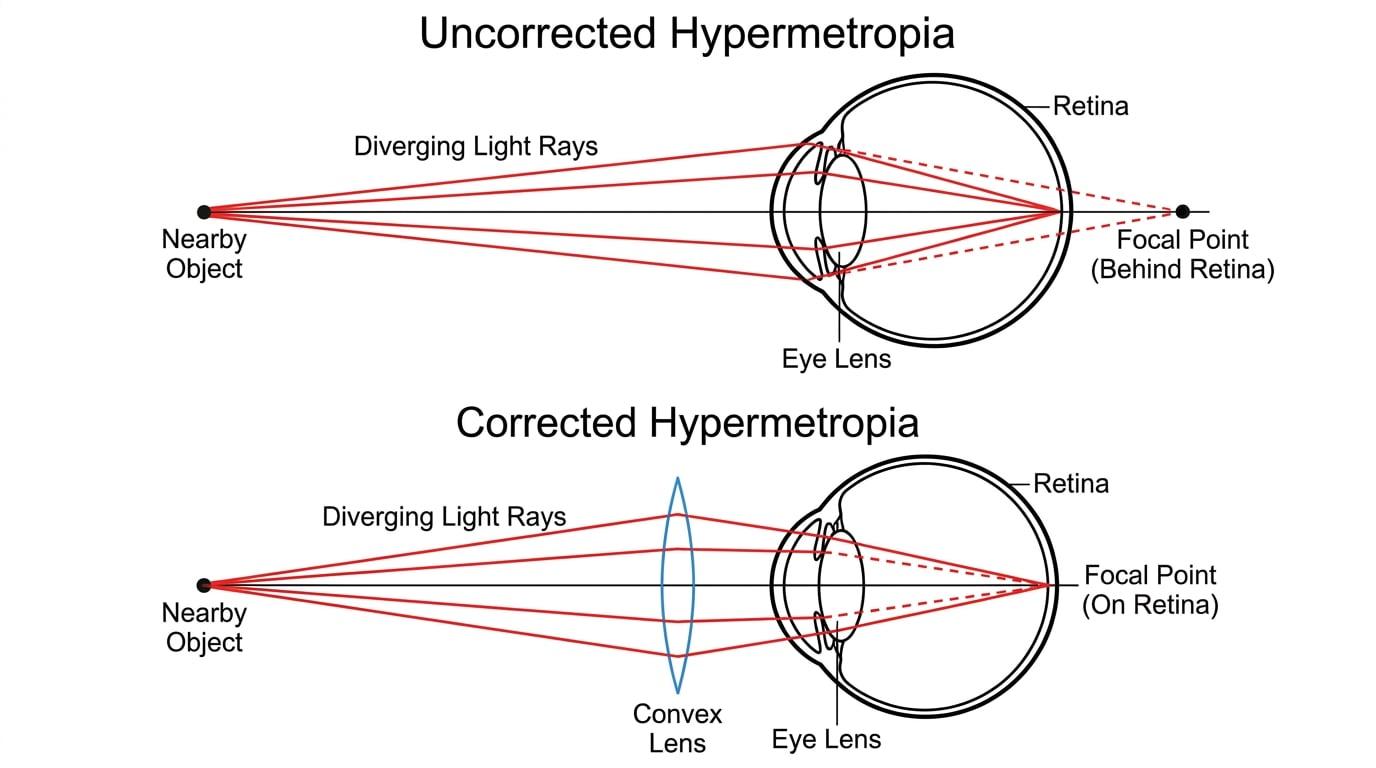
A person with hypermetropia can see distant objects clearly, but close objects appear blurry. Their near point is further away than the normal 0.25 m.
The Cause: The eyeball is too short, or the cornea/lens system is too weak. As a result, diverging rays from a close object do not converge fast enough and focus behind the retina.
The Correction: We place a converging (convex) lens in front of the eye. This bends the light rays inwards slightly before they enter the eye, pulling the focal point forward onto the retina.
Calculating the Correcting Lens for Hypermetropia
For hypermetropia, we want the person to read a book at the standard near point of 0.25 m (u=0.25 mu = 0.25 \text{ m}u=0.25 m). The lens must create a virtual image of this book at the person's actual, uncorrected near point. Again, because the image is virtual, vvv is negative.
Correcting Hypermetropia
An older adult has hypermetropia with an uncorrected near point of 0.80 m. Calculate the power of the lens needed to allow them to read a newspaper at 0.25 m.
- Identify the object distance (uuu). We want the object to be at the normal near point. So, u=0.25 mu = 0.25 \text{ m}u=0.25 m.
- Identify the image distance (vvv). The lens must put a virtual image at their defective near point. So, v=−0.80 mv = -0.80 \text{ m}v=−0.80 m.
- Substitute these values into the lens equation: P=1fP=1u+1vP=10.25+1−0.80\begin{aligned} P &= \frac{1}{f} \\ P &= \frac{1}{u} + \frac{1}{v} \\ P &= \frac{1}{0.25} + \frac{1}{-0.80} \end{aligned}PPP=f1=u1+v1=0.251+−0.801
- Calculate the power: P=4.0−1.25P=+2.75 D\begin{aligned} P &= 4.0 - 1.25 \\ P &= +2.75 \text{ D} \end{aligned}PP=4.0−1.25=+2.75 D (The positive sign confirms a converging lens is required).
Summary of Corrections
- Myopia: Far point is too close. Needs a diverging lens (negative power). Set u=∞u = \inftyu=∞ and v=−defective far pointv = -\text{defective far point}v=−defective far point.
- Hypermetropia: Near point is too far. Needs a converging lens (positive power). Set u=0.25 mu = 0.25 \text{ m}u=0.25 m and v=−defective near pointv = -\text{defective near point}v=−defective near point.
5. Astigmatism and Prescriptions
Myopia and hypermetropia occur when the eye is too long or short. Astigmatism occurs when the cornea has an irregular shape. Instead of being perfectly spherical like a football, an astigmatic cornea is shaped more like a rugby ball—curving more steeply in one plane than in the perpendicular plane.
This means that vertical lines might be in focus while horizontal lines are blurry, or vice versa.
To correct astigmatism, opticians use a cylindrical lens. This lens adds optical power in one specific plane but not in the plane perpendicular to it.
Reading a Prescription
Opticians write lens prescriptions in a standard format, which you need to be able to interpret. It contains three main components:
- SPH (Sphere): The spherical power required to correct basic myopia or hypermetropia. It is the same in all directions. A negative SPH means myopia; a positive SPH means hypermetropia.
- CYL (Cylinder): The extra cylindrical power added to correct astigmatism.
- AXIS: The angle (from 0∘0^\circ0∘ to 180∘180^\circ180∘) at which the cylindrical lens must be aligned to fix the astigmatism.
Interpreting a Prescription
A patient receives the following prescription for their right eye: SPH: -1.50 CYL: +0.75 AXIS: 90
- SPH -1.50: The patient has myopia (short-sightedness) because the spherical power is negative. A diverging lens of power -1.50 D is required generally.
- CYL +0.75: The patient has astigmatism. An extra cylindrical power of +0.75 D must be added.
- AXIS 90: This cylindrical correction must be applied at an angle of 90 degrees (vertically across the eye).
In the exam
- Check your units: Uncorrected near and far points are often given in cm in the question text. You must convert them to metres (m) before calculating power in dioptres (D).
- Watch your signs: The image distance vvv will always be negative when calculating corrective spectacles because the glasses form a virtual image. If you add instead of subtract in the lens equation, your power will be completely wrong.
- State the obvious: If a question asks you to explain how a lens corrects myopia, explicitly state: "Myopia means the image forms in front of the retina. A diverging lens is used. This spreads the rays out before they enter the eye, moving the focal point further back onto the retina."
Check yourself
- What is the AQA sign convention for a virtual image?
- In a calculation to correct hypermetropia, what value should you use for uuu?
- If a person's far point is 5.0 m, what type of lens do they need, and is its power positive or negative?
- What does the AXIS number on an optical prescription indicate?