Conservation of energy
Welcome to one of the most powerful and universal concepts in all of physics: the conservation of energy. You'll find that many complex mechanics problems involving forces and acceleration can be solved much more easily using an energy approach.
What you'll learn:
- The Principle of Conservation of Energy and what a "closed system" is.
- How to calculate energy transfers between gravitational potential energy (GPE) and kinetic energy (KE) in ideal, frictionless scenarios.
- How to solve real-world problems by accounting for the work done against resistive forces like friction and air resistance.
The Principle of Conservation of Energy
Before we start calculating, we need to state the golden rule of energy.
Principle of Conservation of Energy
Energy cannot be created or destroyed, it can only be transferred from one store to another. The total energy of a closed system remains constant.
In mechanics, the "stores" we care about most are:
- Gravitational Potential Energy (GPE): The energy an object has due to its height in a gravitational field. Calculated using ΔEp=mgΔh\Delta E_p = mg\Delta hΔEp=mgΔh.
- Kinetic Energy (KE): The energy an object has due to its motion. Calculated using Ek=12mv2E_k = \frac{1}{2}mv^2Ek=21mv2.
- Thermal Energy: The energy spread into the surroundings, usually because work has been done against resistive forces.
Ideal Scenarios: No Resistive Forces
Let's start with a perfect, physics-land scenario where there is no air resistance and no friction. In these ideal cases, any gravitational potential energy lost is converted entirely into kinetic energy (or vice versa).
Loss of GPE=Gain in KE \text{Loss of GPE} = \text{Gain in KE} Loss of GPE=Gain in KE mgΔh=12mv2 mg\Delta h = \frac{1}{2}mv^2 mgΔh=21mv2Notice something brilliant about this equation? If we divide both sides by mass (mmm), it cancels out! This proves Galileo's famous thought experiment: in the absence of air resistance, all objects fall at the same rate regardless of their mass.
Example 1: Dropping a ball (Ideal)
A steel ball of mass 0.50 kg is dropped from a bridge that is 15.0 m above a river. Assuming air resistance is negligible, calculate the speed of the ball just before it hits the water. Use g=9.81 m s−2g = 9.81 \text{ m s}^{-2}g=9.81 m s−2.
- Calculate the GPE lost as the ball falls:
- Equate the lost GPE to the gained KE: Because there are no resistive forces, all the GPE transfers into KE.
- Rearrange the kinetic energy equation to find speed:
- Square root to find the final speed:
Rounding to 3 significant figures gives a final answer of 17.2 m s⁻¹.
The mass shortcut
In the example above, we calculated the actual energy in Joules because we were given the mass. If the question didn't give you the mass, don't panic! Because mmm cancels out in mgΔh=12mv2mg\Delta h = \frac{1}{2}mv^2mgΔh=21mv2, you can just write gΔh=12v2g\Delta h = \frac{1}{2}v^2gΔh=21v2 and solve directly for vvv.
Real Scenarios: Work Done Against Resistive Forces
In the real world, things drag, scrape, and rub. Air resistance and friction act against the direction of motion. When an object pushes through these forces, it does work.
This work transfers energy out of the mechanical stores (KE and GPE) and into the thermal store of the surroundings. This energy isn't destroyed (conservation of energy still holds!), but it is "lost" from the point of view of the moving object.
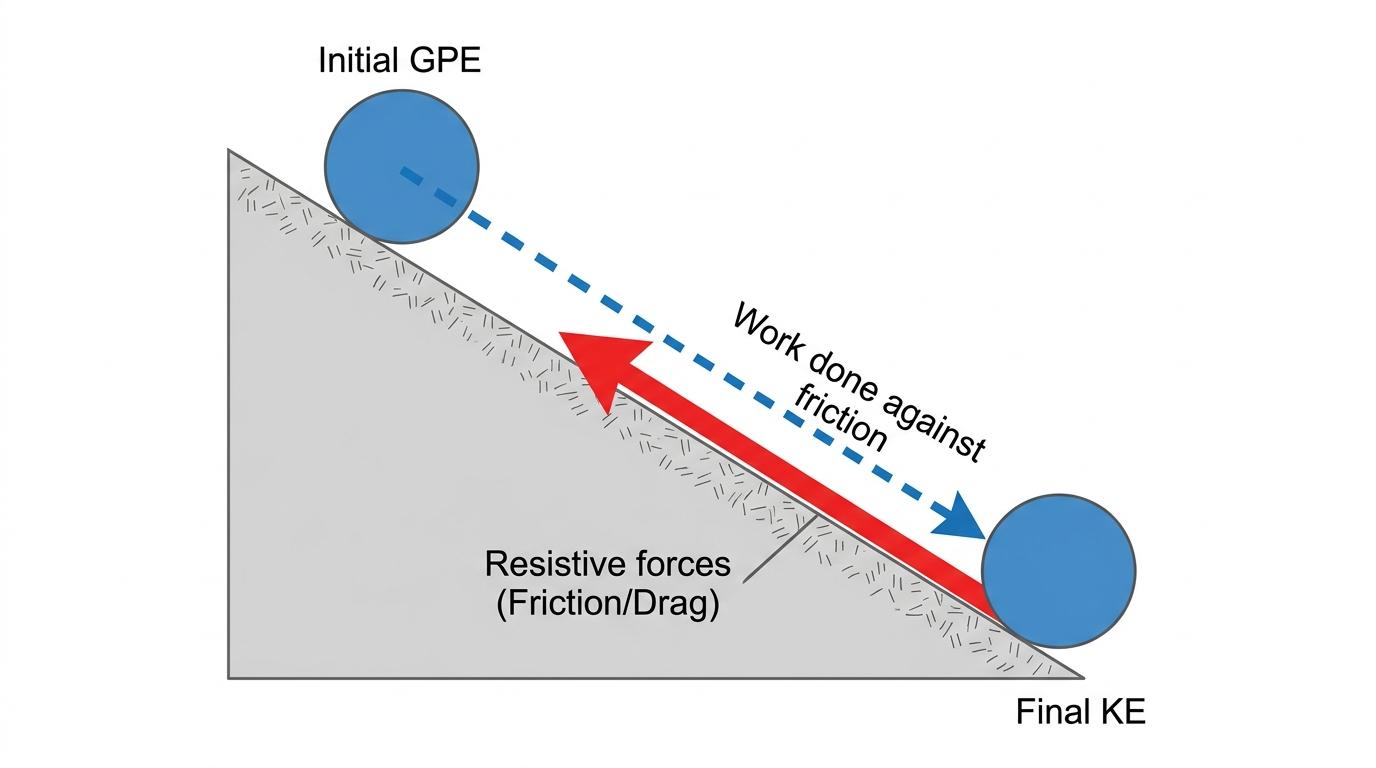
We can express this as a simple word equation:
Initial Energy=Final Energy+Work done against resistance \text{Initial Energy} = \text{Final Energy} + \text{Work done against resistance} Initial Energy=Final Energy+Work done against resistanceOr, if an object is falling or rolling down a hill:
Loss of GPE=Gain in KE+Work done against friction \text{Loss of GPE} = \text{Gain in KE} + \text{Work done against friction} Loss of GPE=Gain in KE+Work done against frictionRemember that work done is calculated as Force ×\times× distance (W=FsW = FsW=Fs). The distance (sss) must be the actual distance moved along the rough surface, not the vertical height!
Distance vs. Height
When calculating the work done against friction on a slope (W=FsW = FsW=Fs), students often accidentally use the vertical height hhh instead of the slope length sss. Resistive forces act along the path of motion, so always use the length of the path for work done.
Example 2: Cyclist descending a hill (Real)
A cyclist and her bike have a combined mass of 80.0 kg. She freewheels (without pedalling) down a rough hill. The hill has a vertical drop of 25.0 m and the length of the road down the slope is 200 m. She starts from rest and reaches a speed of 18.0 m s⁻¹ at the bottom. Calculate the average resistive force acting on the cyclist. Use g=9.81 m s−2g = 9.81 \text{ m s}^{-2}g=9.81 m s−2.
- Calculate the initial energy (GPE at the top):
Since she starts from rest, initial KE is zero. Total initial energy = 19620 J.
- Calculate the final energy (KE at the bottom):
- Find the work done against resistive forces: If this were a perfect world, she would have 19620 J of kinetic energy at the bottom. She only has 12960 J. The "missing" energy is the work done against friction and drag.
- Calculate the average resistive force: Work done is Force ×\times× distance along the slope.
The Balance Sheet
Think of energy like a bank account. You start with a certain balance (Initial GPE + Initial KE). You spend some on fees (Work done against resistance). Whatever is left over is your final balance (Final GPE + Final KE). If you set up this equation carefully, you can solve almost any mechanics problem!
A Note on Chemical Energy and Food
The AQA specification suggests estimating the energy derived from food consumption. Energy conservation applies to humans too! When you climb a mountain, your body is doing work to increase your GPE. This energy comes from the chemical store in your food.
If a chocolate bar contains 1000 kJ1000 \text{ kJ}1000 kJ (1,000,000 J1,000,000 \text{ J}1,000,000 J) of chemical energy, and your body is about 20% efficient at converting this to useful mechanical work, you could estimate how high it would allow a 70 kg person to climb by setting 0.2×1,000,000=mgΔh0.2 \times 1,000,000 = mg\Delta h0.2×1,000,000=mgΔh. Energy conservation applies across all of physics and biology.
In the exam
- Read carefully for "resistive forces": If a question says "smooth", "frictionless", or "ignore air resistance", use the simple ΔEp=ΔEk\Delta E_p = \Delta E_kΔEp=ΔEk approach. If it mentions "rough" or gives you a resistive force, you must include the work done term.
- Track your signs: If an object is moving upwards, it is gaining GPE and losing KE. The work done against gravity is the GPE gained.
- Check your units: Energy is always in Joules (J). If a question gives you a force in kN or a distance in km, convert them to N and m before multiplying to find work done. Similarly, masses must be in kg.
- Don't use suvat blindly: If a slope is curved (like a roller coaster or a pendulum), the acceleration is not constant. Equations of constant acceleration (v2=u2+2asv^2 = u^2 + 2asv2=u2+2as) will give you the wrong answer. Energy conservation is the only way to find the final speed on a curved track!
Check yourself
- Can you state the Principle of Conservation of Energy exactly as it should be written in an exam?
- If a 2 kg block drops from a height of 5 m, why might its kinetic energy just before hitting the ground be less than 98.1 J? What happened to the "missing" energy?
- When calculating the work done against friction by a block sliding down a ramp, do you multiply the friction force by the vertical height of the ramp or the length of the sloping surface?