2.4 Probability Distributions
123456789101112131415161718192021222324252627282930313233343536373839404142434445464748495051525354555657585960616263646566676869707172737475767778798081828384858687888990919293949596979899100101102103104105106107108109110111112113114115116117118119120121122123124125126127128129130131132133134135136137138139140141142143144145146147148149150151152
Question 33
The random variable D D\,D represents the depth, in cm, of a hole created by an automated drill. It is known that D D\,D follows a normal distribution with mean 18 and standard deviation 5.
a.[2]
Determine the probability that a randomly selected hole has a depth greater than 22 cm.
b.[3]
Find the value of c c\,c such that
P(18−c<D<18+c)=0.90 P(18 - c < D < 18 + c) = 0.90 P(18−c<D<18+c)=0.90c.[4]
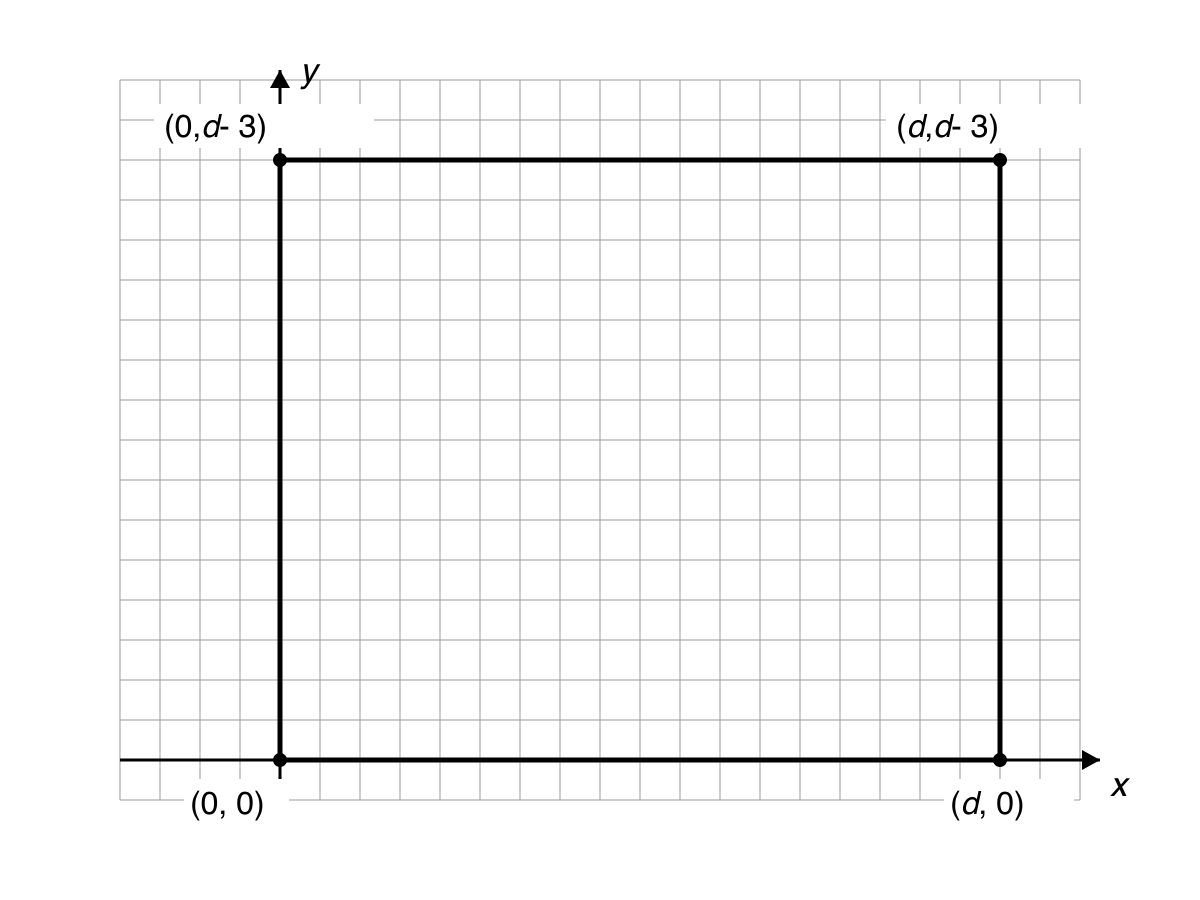
A single observation d d\,d of D D\,D is to be taken. A rectangle is constructed on a coordinate grid with vertices at the points (0,0)(0, 0)(0,0), (d,0)(d, 0)(d,0), (d,d−3)(d, d - 3)(d,d−3), and (0,d−3)(0, d - 3)(0,d−3).
Find the probability that the area of this rectangle is more than 180 cm2^22.
2.4 Probability Distributions Questions
390 exam-style questions on OCR (MEI) A Level Maths 2.4 Probability Distributions, covering 2.4.1 Recognise binomial situations, 2.4.2 Probability of success p, 2.4.3 Calculate binomial probabilities, 2.4.4 Mean of the binomial distribution, 2.4.5 Expected frequencies for binomial, 2.4.6 Probability functions and discrete random variables, 2.4.7 Numerical probabilities for a simple distribution, 2.4.8 Normal distribution as a model (A-level only), 2.4.9 Shape of the Normal curve (A-level only), 2.4.10 Linear transformation and standardising (A-level only), 2.4.11 Symmetry and inflection of Normal curve (A-level only), 2.4.12 Calculate probabilities from a Normal distribution (A-level only), 2.4.13 Model with probability distributions, and 2.4 Probability Distributions. Each one has a worked solution and a mark scheme showing where the marks go.