Question 41
The power output, P P\,P kW, of a solar array is monitored over a 12-hour period. The graph of P P\,P against time ttt (hours after 00:00) shows the system's performance between t=8t = 8t=8 and t=20t = 20t=20. Readings taken from the graph at regular 4-hour intervals are recorded in the table below.
t8121620P1.26.85.40.6 \begin{array}{|c|c|c|c|c|} \hline t & 8 & 12 & 16 & 20 \\ \hline P & 1.2 & 6.8 & 5.4 & 0.6 \\ \hline \end{array} tP81.2126.8165.4200.6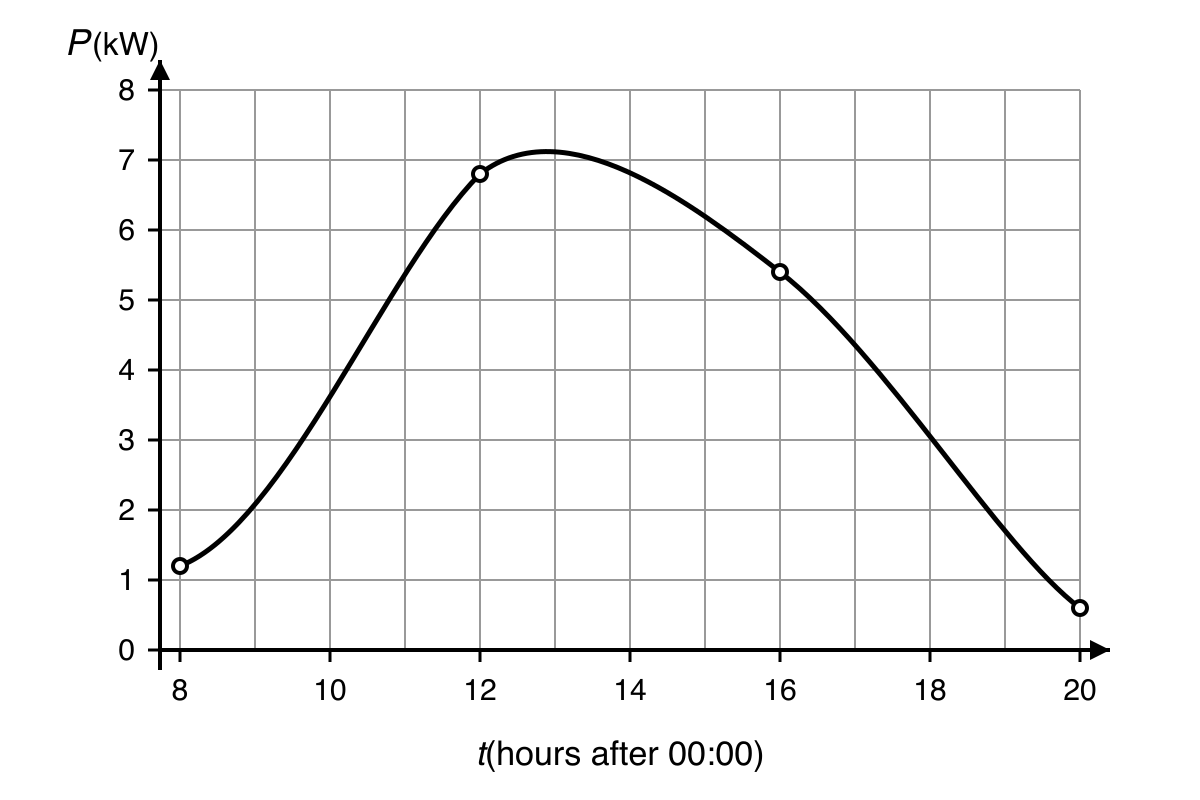
a.[4]
Use the trapezium rule with three strips of equal width to estimate the total energy produced, in kilowatt-hours (kWh), over the interval 8≤t≤208 \le t \le 208≤t≤20.
b.[1]
It is suggested that the power output P P\,P can be modelled by a quadratic function of t t\,t for 8≤t≤208 \le t \le 208≤t≤20. Explain how this model could be used to find an alternative estimate for the total energy produced during this time interval.
1.10 Numerical Methods (A-level only) Questions
133 exam-style questions on OCR (MEI) A Level Maths 1.10 Numerical Methods (A-level only), covering 1.10.1 Locate roots by change of sign (A-level only), 1.10.2 When change of sign methods fail (A-level only), 1.10.3 Fixed point iteration (A-level only), 1.10.4 Newton-Raphson method (A-level only), 1.10.5 Convergence of iterations (A-level only), 1.10.6 Trapezium rule (A-level only), 1.10.7 Upper and lower bounds using rectangles (A-level only), and 1.10.8 Numerical methods to solve problems (A-level only). Each one has a worked solution and a mark scheme showing where the marks go.