Question 59
In this question use g=9.8g = 9.8g=9.8 m s−2^{-2}−2.
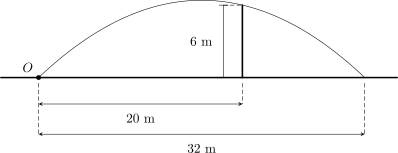
A ball, modelled as a particle, is projected from a point O O\,O on horizontal ground with speed U U\,U m s−1^{-1}−1 at an angle θ \theta\,θ above the horizontal. Air resistance is modelled as negligible.
A vertical wall of height 6 m stands on the same horizontal ground, 20 m from OOO, in the vertical plane of the ball's motion. The ball just passes over the top of the wall.
The ball lands on the ground 32 m from OOO.
a.[3]
Show that the trajectory can be written as y=Ax−Bx2y=Ax-Bx^2y=Ax−Bx2, where A=tanθA=\tan\thetaA=tanθ and B=4.9U2cos2θB=\dfrac{4.9}{U^2\cos^2\theta}B=U2cos2θ4.9.
b.[5]
Hence find the value of θ \theta\,θ and the value of UUU.
3.2 Kinematics Questions
260 exam-style questions on OCR A Level Maths 3.2 Kinematics, covering 3.2.1 Language of kinematics, 3.2.2 Graphs in kinematics, 3.2.3 Displacement-time and velocity-time graphs, 3.2.4 Constant acceleration formulae, 3.2.5 Constant acceleration in two dimensions (A-level only), 3.2.6 Non-uniform acceleration in one dimension (A-level only), 3.2.7 Non-uniform acceleration in two dimensions (A-level only), 3.2.8 Motion under gravity using vectors (A-level only), and 3.2.9 Projectiles (A-level only). Each one has a worked solution and a mark scheme showing where the marks go.