Question 33
In this question use g=9.8g = 9.8g=9.8 m s−2^{-2}−2.
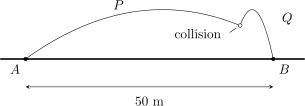
The points A A\,A and B B\,B lie 50 m apart on horizontal ground. At time t=0t = 0t=0 two balls, P P\,P and QQQ, are projected in the vertical plane containing A A\,A and BBB.
P P\,P is projected from A A\,A with speed 25 m s−1^{-1}−1 at an angle of 30° 30°\,30° above the horizontal, towards BBB.
Q Q\,Q is projected from B B\,B with speed U U\,U m s−1^{-1}−1 at an angle θ \theta\,θ above the horizontal, towards AAA.
At time t=2t = 2t=2 the two balls collide.
a.[3]
Find the velocity of P P\,P in the instant before it collides with QQQ.
b.[5]
Find the size of the angle θ \theta\,θ and the value of UUU.
c.[1]
State one limitation of the model that could affect the accuracy of your answers.
3.2 Kinematics Questions
260 exam-style questions on OCR A Level Maths 3.2 Kinematics, covering 3.2.1 Language of kinematics, 3.2.2 Graphs in kinematics, 3.2.3 Displacement-time and velocity-time graphs, 3.2.4 Constant acceleration formulae, 3.2.5 Constant acceleration in two dimensions (A-level only), 3.2.6 Non-uniform acceleration in one dimension (A-level only), 3.2.7 Non-uniform acceleration in two dimensions (A-level only), 3.2.8 Motion under gravity using vectors (A-level only), and 3.2.9 Projectiles (A-level only). Each one has a worked solution and a mark scheme showing where the marks go.