Question 46
Two balls A A\,A and B B\,B have mass of 3 kg and 2 kg respectively. The balls are connected by a string which passes over a fixed pulley. Ball A A\,A is held at rest with the string taut and the hanging parts of the string vertical. Ball A A\,A is released. The string is modelled as being light and inextensible, the balls are modelled as particles, the pulley is modelled as being smooth and air resistance is ignored.
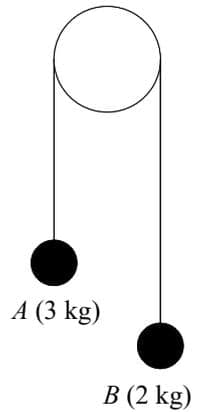
a.[2]
Show that the equations of motion for A A\,A and B B\,B are
3g−T=3aandT−2g=2a. 3g-T=3a \quad\text{and}\quad T-2g=2a. 3g−T=3aandT−2g=2a.b.[6]
Using the model, find, in terms of ggg, the magnitude of the force exerted on the pulley by the string while A A\,A is falling and before B B\,B hits the pulley.
c.[1]
State one limitation of the model, apart from ignoring air resistance, that will affect the accuracy of your answer to part (b).
Forces and Motion Questions
182 exam-style questions on Edexcel A Level Maths Forces and Motion, covering 10.1 Force Diagrams, 10.2 Forces as Vectors, 10.3 Forces and Acceleration, 10.4 Motion in 2 Dimensions, 10.5 Connected Particles, and 10.6 Pulleys. Each one has a worked solution and a mark scheme showing where the marks go.