Question 92
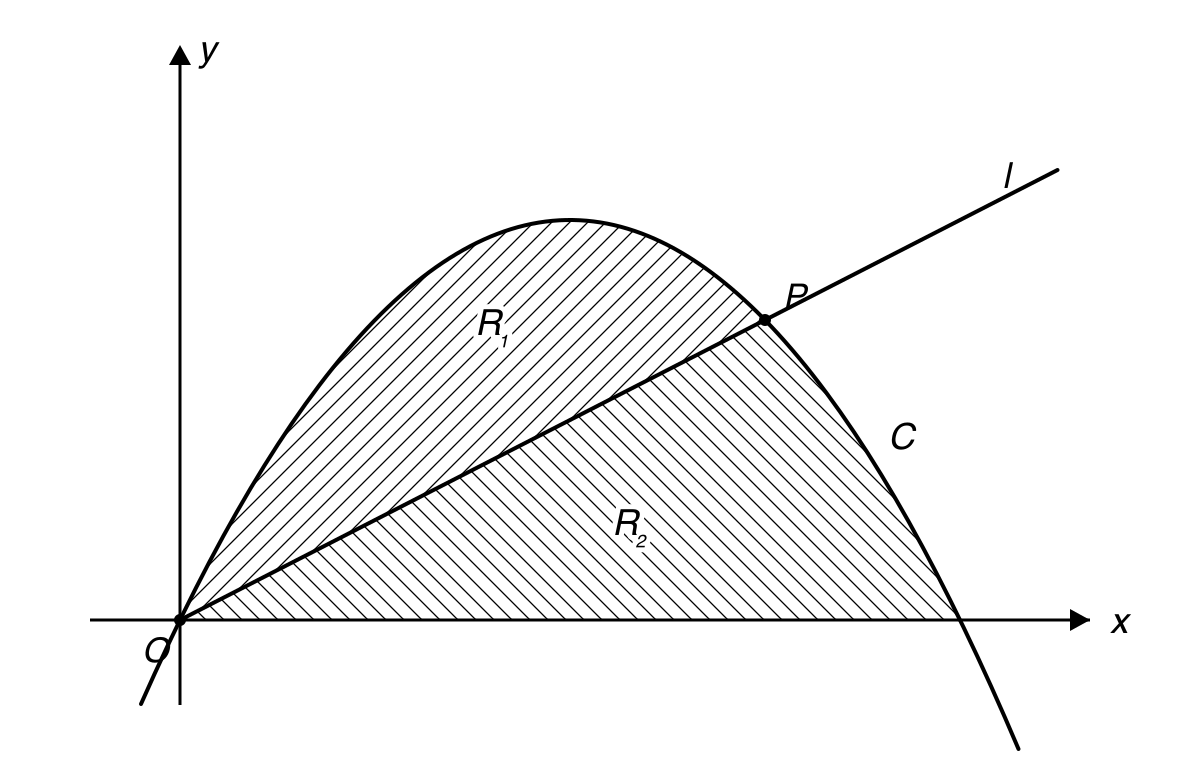
The figure shows
- the curve CCC with equation y=2x−x2y = 2x - x^2y=2x−x2
- the line lll with equation y=mxy = mxy=mx, where mmm is a constant and 0<m<20 < m < 20<m<2
The line and the curve intersect at the origin OOO and at the point PPP.
a.[2]
Find, in terms of mmm, the coordinates of PPP.
b.[3]
The region R1R_1R1, shown shaded in the figure, is bounded by CCC and lll.
Show that the area of R1R_1R1 is
(2−m)36 \frac{(2 - m)^3}{6} 6(2−m)3c.[3]
The region R2R_2R2, also shown shaded in the figure, is bounded by CCC, the xxx-axis and lll. Given that the area of R1R_1R1 is equal to the area of R2R_2R2,
find the exact value of mmm.
1.11 H: Integration Questions
480 exam-style questions on AQA A Level Maths 1.11 H: Integration, covering 1.11.1 Fundamental Theorem of Calculus, 1.11.2 Integrating standard functions, 1.11.3 Definite integrals and areas, 1.11.4 Integration as the limit of a sum (A-level only), 1.11.5 Integration by substitution and by parts (A-level only), 1.11.6 Integration using partial fractions (A-level only), 1.11.7 Differential equations with separable variables (A-level only), and 1.11.8 Interpreting solutions of differential equations (A-level only). Each one has a worked solution and a mark scheme showing where the marks go.