Question 14
Figure 1 below shows the curve y=xlnxy = x\ln xy=xlnx for x>0x > 0x>0. The region R R\,R is bounded by the curve, the line x=4x = 4x=4 and the xxx-axis.
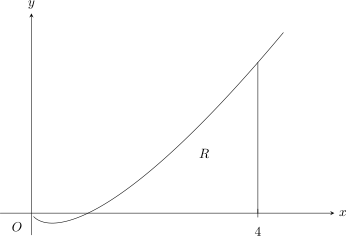
Show that the exact area of R R\,R is Aln2+BA\ln 2 + BAln2+B, where A A\,A and B B\,B are rational numbers to be found.
1.11 H: Integration Questions
480 exam-style questions on AQA A Level Maths 1.11 H: Integration, covering 1.11.1 Fundamental Theorem of Calculus, 1.11.2 Integrating standard functions, 1.11.3 Definite integrals and areas, 1.11.4 Integration as the limit of a sum (A-level only), 1.11.5 Integration by substitution and by parts (A-level only), 1.11.6 Integration using partial fractions (A-level only), 1.11.7 Differential equations with separable variables (A-level only), and 1.11.8 Interpreting solutions of differential equations (A-level only). Each one has a worked solution and a mark scheme showing where the marks go.